Tag Archives: merkel

Bavarian elections provides Merkel, CSU a dress rehearsal for federal German vote

seehofer Exactly one week before Germans go to the polls to choose between center-right chancellor Angela Merkel and her center-left challenger Peer Steinbrück, Bavarian voters will elect its local state government in a key test for Merkel’s regional allies.Germany Flag Iconbavarian_flag_icon

The outcome isn’t incredibly doubtful because since 1947, Bavaria’s staunchly Catholic, business-friendly, socially conservative Christlich-Soziale Union in Bayern (CSU, the Christian Social Union) has controlled the 187-seat Landtag, the state legislature of Germany’s second-most populous state.

Given that the state has one of Germany’s — and Europe’s — best economies, the CSU looks set to strengthen its hold on Bavarian government in what amounts to a test run of many of the arguments that Merkel hopes will power her Christlich Demokratische Union Deutschlands (CDU, Christian Democratic Party) to victory on September 22 alongside the CSU, which has been united with the CDU in federal politics for decades.  Merkel, who currently governs in an alliance with the liberal Freie Demokratische Partei (FDP, Free Democratic Party), hopes that voters will give her credit for steering Germany — and the entire eurozone — through the worst of a sovereign debt crisis that began in 2010 and an economic recession from which Europe may already be recovering.

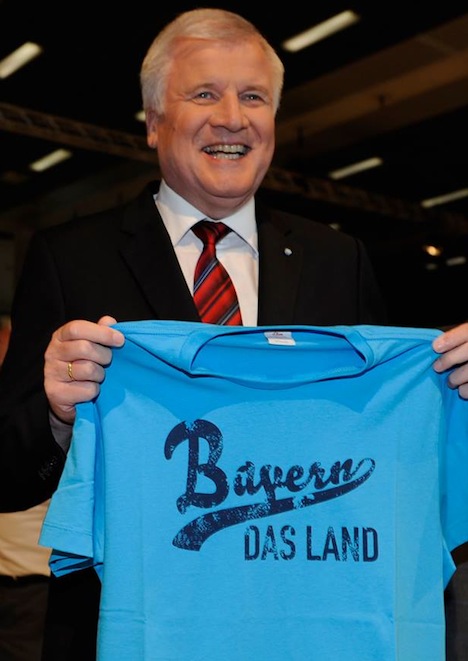
But the CSU and Bavaria’s minister president Horst Seehofer (pictured above) can make an even more sanguine case on the basis of the Bavarian economy, which showcases several star multinational corporations, such as BMW, Siemens, and adidas.  Whereas the European Union had an average unemployment rate of 10.4% in 2012 and Germany had an unemployment rate of 5.5%, Bavaria’s was just 3.2%.  To consider just how staggering that is, consider that United States last had an unemployment rate that low in October 1953. It’s an economy that, at around  €465 billion ($610 billion), is about as large as the economy of the US state of Pennsylvania and even larger than the entire economy of Saudi Arabia, and nearly 1.5 times the size of the economy of neighboring Austria.

If the CSU is successful on September 15, it will mark a rebound from the previous September 2008 election, the CSU’s worst performance since 1954.  Five years ago, Bavarian voters went to the polls in the middle of an uncertain future, with the collapse of US financial firm Lehman Brothers and a global financial panic topping world headlines.  It was also a period of uncertain leadership within the CSU, Bavarian minister-president Edmund Stoiber resigned after 14 years in office following the resignation of his chief of staff, Michael Höhenberger, which itself followed accusations that Höhenberger snooped on the private life of one of Stoiber’s critics.  Günther Beckstein, Stoiber’s longtime interior minister, succeeded Stoiber and led the CSU through the 2008 election, but stepped down following the CSU’s historic loss.

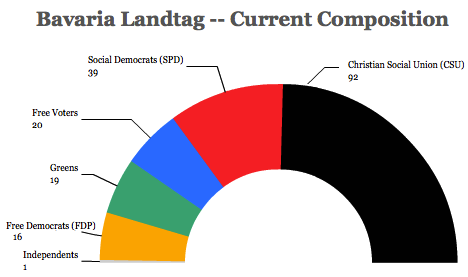
Even though the CSU won just 43.4% of the vote (a drop of over 17% from its prior performance) and lost its absolute majority in the Landtag, it remained the largest party in Bavaria by far, outpacing the second-place Sozialdemokratische Partei Deutschlands (SPD, Social Democratic Party) by nearly 25% of the vote and Seehofer, a former health and food minister, easily won election as Bavaria’s minister-president in October 2008.

As the CSU and the SPD both suffered historic losses, two additional groups on the Bavarian right made extraordinary gains.  The first is the Freie Wähler (FW, Free Voters), a bloc of independent, unaffiliated center-right deputies, which won 10% of the vote, largely from disappointed CSU supporters, and entered the Bavarian Landtag for the first time.  The second is the FDP, which won 8% and 16 seats, returning to the Bavarian legislature for the first time in 14 years and providing the CSU with a stable coalition partner in Munich.  Even the socialist Die Linke (The Left) competed for the first time and won 4.3%, impressive in a state as conservative as Bavariabavaria Five years later, although polling data isn’t as ubiquitous for Bavaria’s state election as for the wider federal German elections, the CSU is polling higher than in 2008, and it may win over 50% of the vote, restoring the absolute majority that it enjoyed in the Landtag without interruption from 1962 to 2008. That’s good news for Seehofer, because the FDP is faring as poorly in Bavaria as it is in federal polling — the Free Democrats are in danger of missing the 5% threshold required to win seats in the Bavarian Landtag (and in the federal Bundestag as well).  Meanwhile, the Social Democrats are in danger of setting a new postwar low in Bavaria on September 15 and in federal elections a week later — it’s polling at around 18% in Bavaria, which is even worse than its 2008 result (18.6%).  Continue reading Bavarian elections provides Merkel, CSU a dress rehearsal for federal German vote

Seventy years on, the politics of the Holocaust in Germany remain fraught with difficulty

merkeldachau

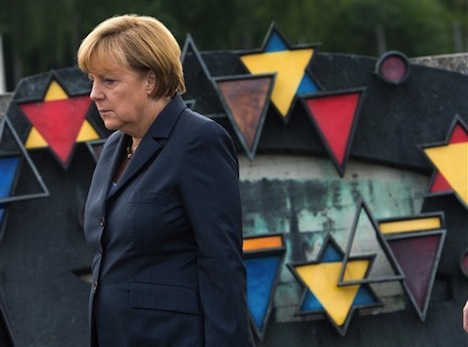
In what’s been perhaps the most boring campaign season in German politics since reunification, chancellor Angela Merkel made big headlines yesterday when she became the first acting chancellor to tour the grounds of the former Nazi concentration camp at Dachau.bavarian_flag_iconGermany Flag Icon

Merkel took a somber detour from her campaign to visit the site, where 41,000 mostly Jewish prisoners were slaughtered by the Nazi regime — the concentration camp’s location in the middle of Bavaria, in contrast to even more ghastly extermination camps at Auschwitz and Treblinka in what is today Poland, has always made it a particularly wrenching site in the postwar German memory.  Merkel laid a wreath in honor of the victims, and she met with several survivors, including 93-year-old Max Mannheimer, who was imprisoned at the camp at age 24 and today chairs the Dachau camp community association.  The visit won plaudits from German Jewish groups, who praised Merkel for pausing her campaign to reflect on the atrocities of what happened seven decades ago at Dachau, not just far to the east but in the southern heartland of Germany.

It is perhaps appropriate that Merkel, the first postwar East German chancellor, was the first active German leader to visit the site.  Merkel spent the first 35 years of her life behind the Iron Curtain, first as a physical chemist and increasingly, a pro-democracy activist when the Berlin Wall fell.  Though West Germany recovered rapidly after the end of  the Nazi era, East Germans suffered through four decades of authoritarian socialist rule under the heel of Soviet Russia.  In her brief remarks, Merkel noted that ‘the name Dachau is tragically famous as it serves as a model for the concentration camps,’ adding that ‘the memory of that fate fills me with deep sadness and shame.’

But the headlines are not entirely positive — and some are downright hostile — because Merkel scheduled the visit as an aside from a reelection whistle-stop tour.  After visiting Dachau, Merkel was off to visit a beer tent in the nearby town of Dachau and delivered a political speech alongside a Bavarian brass band in traditional costume.

A leader of the opposition Die Grünen (Green Party), Renate Künast, harshly attacked what she called a ‘tasteless and outrageous combination’:

“If you’re serious about commemoration at such a place of horrors, then you don’t pay such a visit during an election campaign,” she told the daily Leipziger Volkszeitung.

But Merkel’s main opponent, Peer Steinbrück, the chancellor candidate of the center-left Sozialdemokratische Partei Deutschlands (SPD, the Social Democratic Party), has not criticized her, and Jewish groups have universally cheered Merkel for her gesture, so it’s unlikely that the visit, or the controversy surrounding it, is likely to cause any lasting political damage.  Voters generally understand that incumbents running for reelection have two jobs — chancellor and candidate.

It’s a reminder that, despite Germany’s efforts to come to terms with the Holocaust, it’s not always an easy topic to navigate for German politicians, even 68 years after the end of World War II and even for a politician as skilled as Merkel. Continue reading Seventy years on, the politics of the Holocaust in Germany remain fraught with difficulty

Assessing the potential coalitions that might emerge after Germany’s federal elections

roslerFDP

With now less than 40 days to go until Germany’s federal elections, polls show that chancellor Angela Merkel is by far the most popular candidate to return as chancellor and her party, the Christlich Demokratische Union (CDU, Christian Democratic Union), will clearly be the largest bloc in Germany’s Bundestag after the election. Germany Flag Icon

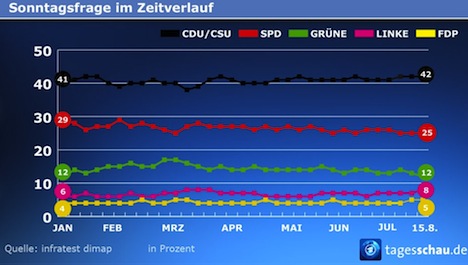
Polls have been remarkably consistent throughout much of the year leading up to the September 22 vote.  The center-right CDU, together with its Bavarian sister party, the Christlich-Soziale Union in Bayern (CSU, the Christian Social Union), overwhelmingly leads Germany’s largest center-left party, the Sozialdemokratische Partei Deutschlands (SPD, the Social Democratic Party), and voters overwhelmingly prefer Merkel to the SPD’s candidate for chancellor, Peer Steinbrück — by a nearly two-to-one margin.  Here’s the trendline from Infratest dimap, which released its latest poll this week:

chancellorgraph

This week’s news that Germany leads GDP growth in the eurozone, which itself pulled out of recession in the second quarter of 2013, will only buoy Merkel’s chances.  Barring a huge shift in public opinion that has only calcified over the past year, Steinbrück, a bland technocrat who comes from the right wing of the SPD and who served as finance minister in the ‘grand coalition’ government of 2005 to 2009, will lead the SPD to a loss of nearly historic proportions.  But while that means Merkel is very likely to return as chancellor, the composition of Merkel’s third government is less certain.

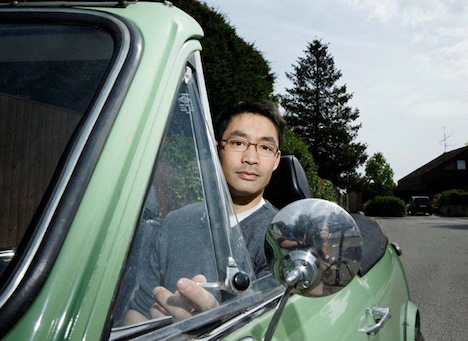
That’s because support for Merkel’s current coalition partners, the free-market liberal Freie Demokratische Partei (FDP, Free Democratic Party), has collapsed since the previous September 2009 election, when it won 14.6% of the vote and 93 seats in the Bundestag, a record-high electoral performance for the party.  But since 2009, the FDP has struggled to maintain a presence in local Germany elections, losing support in state after state.  Its decade-long leader Guido Westerwelle, the first openly gay party leader in German history, stepped down in April 2011 as party leader and vice chancellor (though he remains foreign minister) after the FDP won barely 5% in the state elections of Baden-Württemberg.  His successor as FDP leader is the Vietnamese-born Phillip Rösler (pictured above), who began his career in Lower Saxony (Niedersachsen) and who had served previously as health minister in the CDU/FDP coalition government from 2009 to 2011.

Although Rösler has not lifted the FDP back up to its 2009-level heights, he has managed to staunch the party’s decline.  In the May 2012 elections in North Rhine-Westphalia, Germany’s most populous state, the FDP managed to win 8.6% of the vote, an increase of nearly 2% from the previous election, though that’s largely due to the popularity of Christian Lindner, who led the FDP’s 2012 campaign.  More recently, though, in Lower Saxony’s state election in January 2013, the FDP won 9.9% of the vote, a gain of 1.7%.

It’s also because Germany’s electoral system is notoriously complex.  Germans will actually cast two votes in September — the first is for a candidate to represent one of 299 electoral districts in Germany, the second is for a German political party.  The second ‘party vote’ is meant to determine the party’s ultimate total share of seats in the Bundestag, and so a party will receive additional seats on the basis of the party vote sufficient to provide that its percentage of seats in the Bundestag is roughly equal to the percentage of votes it received pursuant to the party vote (so long as the party receives at least 5% of party vote support).  That means that the number of seats in the Bundestag changes from election to election — although it must have a minimum of 598 seats, it has had as few as 603 and as many as 672 since German reunification.

The FDP has struggled all year long to achieve merely 5% support in opinion polls and, while it’s doing better in polls than it was at the beginning of the year, there’s no guarantee that it will meet that threshold:

trendline2013germany

That means that, more than anything else, the composition of Germany’s next government turns on the FDP’s performance.  If it wins less than 5%, Merkel will not have the option of continuing a coalition with the FDP.  Moreover, even if the FDP wins more than 5%, it may still not win enough seats to cobble together a CDU/FDP majority in the 598-member Bundestag.

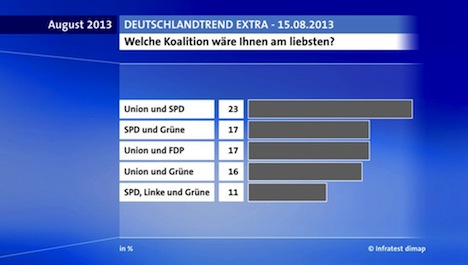
Furthermore, polls show that while German voters overwhelmingly prefer Merkel as chancellor, they actually favor a return to the CDU/SPD grand coalition, more than the current CDU-led government or a potential SPD-led government:

preferredcoalitions

Two additional coalitions — a CDU/Green government and a united left coalition among the SPD, Green and Die Linke (the Left Party) — also win significant support.

But what are the chances that any of these five coalitions will actually emerge after September 22?  Here’s a look at each potential coalition and the chances that it could form Germany’s next government.

CDUpreferredcoalitionThe current government: CDU/FDP.

Merkel prefers to continue her current coalition over any alternative because her political agenda matches well with the FDP’s political agenda.  Any negotiations between Merkel and the SPD or the Greens would entail huge concessions from Merkel that she would not otherwise have to make in coalition with the FDP.  But, as noted above (and as represented in the graph to the right, on the basis of current polls), it’s unclear if that coalition can win a majority.

Under Rösler’s leadership, the FDP is running on a campaign of lower taxes and liberalizing Germany’s economy, which is standard Free Democratic fare, and both the FDP and Merkel’s CDU oppose new tax increases.  Their largest policy difference might be same-sex marriage — the FDP supports it and the CDU (and especially the Catholic-influenced CSU) oppose it, although the FDP has taken a much stronger stand on privacy rights than Merkel’s CDU.

Even if they win enough seats to form a majority, no one expects the margin to be larger than the government’s current 21-seat margin.  So even a single-digit majority could turn out to be a Pyrrhic victory if Merkel finds herself forced to look outside her own government to enact her legislative agenda on an ad hoc basis, especially with respect to European Union matters, given the sometimes eurosceptic nature of many CSU deputies.  That’s hardly a recipe for stable government.

Polls in August show that together, the current government will win between 44% and 47% of the vote if the election were held today.  Unfortunately, that doesn’t give us much of an idea about whether they’ll have enough support in the Bundestag to form a majority.  Since reunification, Germany has held only six federal elections — they’ve resulted in three CDU-led governments, two SPD-led governments and a single CDU-SPD grand coalition. Continue reading Assessing the potential coalitions that might emerge after Germany’s federal elections

How Peer Steinbrück became the Bob Dole of German politics

steinbruck

Peer Steinbrück is not going to be Germany’s next chancellor.Germany Flag Icon

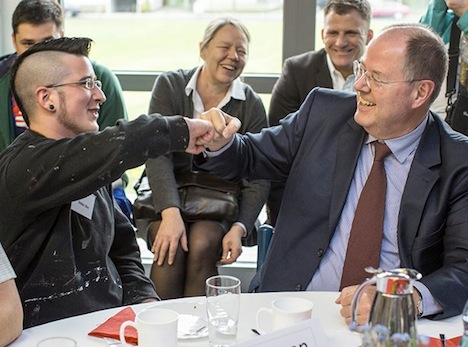
Steinbrück’s standing in opinion polls has worsened since it became clear he would become the chancellor candidate of the center-left Sozialdemokratische Partei Deutschlands (SPD, the Social Democratic Party) — the more that Germans get to know Steinbrück (pictured above), the more they dislike him, no matter how many Bavarian mountains he climbs between now and September 22.

It doesn’t necessarily mean that chancellor Angela Merkel is assured of reelection, because while her own Christlich Demokratische Union (Christian Democratic Union), together with the Bavarian Christlich-Soziale Union in Bayern (CSU, the Christian Social Union), leads the SPD in polls, it’s uncertain whether its smaller coalition partner, the Freie Demokratische Partei (FDP, Free Democrats), will win enough support to meet the 5% threshold to win seats in the Bundestag, the German parliament, though the FDP has ticked ever so slightly upwards in polls in the past couple of months.

Polls have been consistently remarkable since before 2013 began, and they make for grim reading if you’re an SPD supporter.  Here’s the state of things with about six weeks to go until voting:

0804pollofpollsgermany

That wouldn’t just mean a loss, it would mean a Bob Dole-style loss —  think back to the 1996 presidential election when Democratic incumbent Bill Clinton, who seemed so vulnerable after the 1994 midterm elections brought a Republican sweep of Congress, sailed to reelection against Dole.  Clinton aides disparagingly joked after the fact that it was like virtually running for reelection unopposed.  Dole won just 40.7% of the popular vote to 49.2% for Clinton — a landslide the likes of which hasn’t been seen in the United States since.

To put into perspective the kind of loss that Steinbrück and the SPD is facing, it’s important to remember what happened in the previous 2009 election, which at the time was the SPD’s worst postwar election result.  Under Frank-Walter Steinmeier, who had served as foreign minister and deputy chancellor in the Merkel-led ‘grand coalition,’ the SPD won just 146 seats in the Bundestag (a drop of 76 seats) with just 23% of the party vote and 28% of the constituency vote.  (Half of the 598 Bundestag seats are determined in first-past-the-post single-member constituencies, the other half are determined on the basis of proportional representation on the basis of statewide party lists).

But if Steinmeier’s 2009 performance was a tragedy, Steinbrück’s 2013 performance is turning out to be a farce.  It’s amazing to believe that Steinbrück is in danger of leading the SPD to an even poorer result that Steinmeier’s in 2009, especially with the Greens set to improve on their 2009 performance.  Continue reading How Peer Steinbrück became the Bob Dole of German politics

Much Ado about Nothing? The non-politics of privacy in Germany

allyourdataisbelongtous

Guest post by Mark Dawson and Jacob Krumrey

With German chancellors Angela Merkel’s personal approval rating at 62% and her CDU/CSU leading over the opposition SPD by around 15%, the result of Germany’s upcoming general election seems to be all but a foregone conclusion.  In the midst of a flaccid campaign, the U.S. National Security Agency whistleblower Edward Snowden has now not only revealed that Germany is one of the principal targets of the NSA’s internet surveillance operations (‘Prism’) but also accused the German intelligence services, the Bundesnachrichtendienst (BND), of collusion with the NSA – of being ‘in bed’ together.  These revelations could potentially stir up an otherwise all too quiet campaign.Germany Flag Icon

The opposition SPD (Sozialdemokratische Partei Deutschlands, Social Democratic Party) are sensing an opportunity to attack Merkel’s integrity and competence, her main assets in the campaign.  In a thundering editorial in Germany’s leading tabloid newspaper, Bild, last week, their parliamentary leader, Frank-Walter Steinmeier, demanded answers on the steps Merkel had taken to protect German interests.  The chancellor now seems to be facing a dilemma: either she was aware of the extent of data-sharing between the NSA and BND, and therefore lays accused of obfuscation, or was not aware at all – and therefore less competent than her public image suggests.  At the very least, the opposition hope to cast Merkel as an unprincipled populist: cozying up to the United States when spying on internet users in Germany and sharing intelligence beneficial to German security, while chastising the very same practice when it is found to be in breach of civil rights.

Merkel’s CDU (Christlich Demokratische Union Deutschlands, Christian Democratic Party) / CSU (Christlich-Soziale Union in Bayern, the Bavarian Christian Social Union) government, meanwhile, are trying to counter the allegations by adopting an assertive posture: Interior Minister Friedrich has travelled to Washington, D.C., to demand answers from the US government.  Merkel herself, in a packed press conference on Friday, insisted that, in Germany, German law has to apply unconditionally.  At the same time, however, Merkel was forced into delaying tactics.  The German weekly Der Spiegel had just published fresh allegations about the extent of collusion between German and American authorities: she would answer questions but only after having received further information from the Americans.

It is too early to gauge definitively the impact of these allegations on the election campaign.  So far, however, the SPD have not been able to turn the tide in their favour. The latest ZDF opinion polls show that even though the CDU/CSU have suffered small losses, the SPD remain at a dismal 29%.   Only the FDP, traditionally strong on civil rights, have gained: perhaps even enough to clear the five-per cent threshold necessary to allow them to stay in parliament. Ironically, the ‘spy scandal’ – through a reinvigorated FDP – could re-open the prospect of the current CDU/FDP coalition staying in power.

What could explain this paradox?  To begin with, the SPD face a credibility problem of their own.  As the government have been quick to point out, cooperation between U.S. and German authorities on intelligence is long-standing.  Steinmeier himself was responsible for Germany’s intelligence services during the previous ‘grand coalition’ government, during which many of the programmes now being investigated were launched.  When it comes to privacy, moreover, German votes usually credit niche parties such as Die Grünen (The Greens) or the libertarian FDP (Freie Demokratische Partei, Free Democratic Party).  More important perhaps, German voters show little appetite for a polarized campaign in the first place.  Asked in a recent ZDF poll about their desired coalition, a majority of Germans said they would like to see a grand coalition of the two main contenders.

Beyond campaign politics, the larger question is about the attitude of Germans towards privacy – supposedly the source of a transatlantic conflict of values. The same ZDF poll suggested that a vast majority of Germans find the charges of collusion credible: 79% believe that Merkel’s government were aware of the NSA’s activities in Germany.  At the same time, in a different poll, only 5% argued that the issue would have a significant impact on their voting intentions. The party with the strongest stance on data protection, Die Piraten (the Pirate Party), has struggled to even register in current polling in spite of the prominence of privacy on the campaign trail. The lesson may well be that German voters care about privacy in theory but are, in practice, unwilling to make it a make-or-break issue.

Mark Dawson is a professor of European law and governance at the Hertie School of Governance in Berlin and Jacob Krumrey is a graduate of the European University Institute. 

* * * *

A version of this piece was published at the Hertie School’s blog on Germany’s upcoming September 22 elections.

Read more of Suffragio‘s coverage on Germany here.

Goodbye WTO, hello TTIP — United States and Europe hope to create world’s largest free trade zone

CIMG3504

Guest post by Michael J. Geary

The United States and the European Union expect to begin negotiations next month on the Transatlantic Trade and Investment Partnership (TTIP) in Washington, DC.  Their ambitious aim is to create the world’s largest trade and investment bloc that covers a combined consumer population of over 800 million people.  If the U.S.-E.U. talks prove successful, TTIP will become the biggest trade deal in history.USflagEuropean_Union

U.S. president Barack Obama announced, to mild surprise, in his February 2013 state of the union address before the U.S. Congress that the United States would begin TTIP talks with the European Union.  His announcement followed the publication of a report from the High Level Working Group, which had spent a year examining  various options for expanding transatlantic trade and investment.  The HLWG concluded that any deal between the United States and the European Union, in order to capture the most gains, would have to be comprehensive and include sensitive issues such as government procurement, a reduction in non-tariff barriers (NTBs), intellectual property rights, and employment and labour sectors.  In May, Obama nominated his close economic advisor and free trade proponent, Michael Froman, to become the next U.S. trade representative.  Froman’s selection was, therefore, an important sign that the Obama administration is serious about completing not only TTIP, but the Trans-Pacific Partnership (TPP) as quickly as possible.

The trade and investment pact features a number of ambitious goals.  At the most fundamental level, U.S. and European leaders hope to reduce the existing transatlantic tariffs and other barriers that amount to approximately 3.5%or less on a range of goods.  That will be by far the easiest element of TTIP to negotiate.  A recent report from the Bertelsmann Foundation showed that a 3.5% reduction in tariffs would increase German exports to the United States by 1.13% and increase German imports, respectively, by 1.65%.  Deeper trade liberalisation, including a reduction in NTBs would lead to even greater economic benefits in for U.S.-German trade.  That, in turn, will significantly affect traditional intra-European trade flows, such that trade between Germany and other member states will decline significantly upon the completion of a comprehensive TTIP accord. The Bertelsmann report showed that, in the long term, French exports to Germany would fall by 23%, Italian exports to Germany would decline by 30% and British exports to Germany would drop by fully 41%. Such a comprehensive transatlantic deal would therefore mark a major realignment of traditional European trading patterns, offset by access to a wider US market.  That pattern, moreover, is likewise is reflected in Bertelsmann’s assessment.  For example, exports from Ireland, Italy, Greece, Portugal, and Spain to the U.S. increase by an average of 86%, which presents a major boost to those European countries most adversely affected by the ongoing sovereign debt crisis. Aside from the potential boost to transatlantic trade, the European Commission argues that TTIP will generate close to 2 million additional jobs, half of which would be created in the United States.

Securing a comprehensive transatlantic trade agreement, however, will not be easy.   Continue reading Goodbye WTO, hello TTIP — United States and Europe hope to create world’s largest free trade zone

Spying on the Europeans — PRISM repercussions as Obama heads to Europe

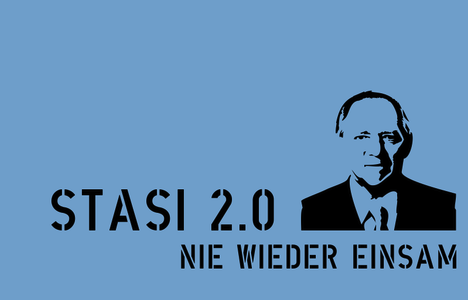
stasi 2.0

Michael J. Geary and I argue in The National Interest this morning that the repercussions of reports of the PRISM program within the U.S. National Security Agency mean that U.S. president Barack Obama will face tough questions when he goes to Europe for the G8 summit in Northern Ireland and additional meetings in Berlin. USflagEuropean_Union

At a time when Europeans are already concerned about the extent of their own governments’ intrusion into their private online lives, the revelations of the voluntary cooperation of service providers like Facebook and the like in allowing U.S. surveillance of foreign communications are already being met with skepticism from top U.S. allies at a crucial and ambitious time for the Obama administration’s European agenda:

The timing of the scandal could not have come at a worse time in EU-United States relations, with both sides set to embark on negotiations for what would be a landmark free-trade compact, the Transatlantic Trade and Investment Partnership (TTIP).

Above all, German chancellor Angela Merkel is expected to seek assurances from Obama in their one-on-one meetings in Berlin.  But with Germany having this week agreed to TTIP negotiations (leaving France as the remaining obstacle), and with the eurozone crisis still not fully over, certainly the Obama-Merkel meeting should have more important business than PRISM.

Ironically, the NSA gathered more pieces of intelligence within Germany during the month of March than any other EU country.  A spokesman for Merkel, the first chancellor from the former East Germany, where memories of Stasi surveillance are still fresh, said she would raise the issue with Obama. Her justice minister Sabine Leutheusser-Schnarrenberger stressed, “the suspicion of excessive surveillance of communication is so alarming that it cannot be ignored. For that reason, openness and clarification by the US administration itself is paramount at this point. All facts must be put on the table.”

Ultimately, the Obama administration and the NSA will be less vulnerable to the wrath of European regulators than the companies participating in PRISM themselves.

But Microsoft, Google and other service providers, including Facebook, YouTube, Apple and AOL, could face even more blowback than the U.S. government or the Obama administration. Their apparently voluntary participation in U.S. government’s PRISM program could open them to European lawsuits or otherwise subject them to additional regulatory scrutiny. Significant elements of their businesses are already subject to restrictions within Europe—Google faces strict restrictions on its StreetView program and Facebook’s facial-recognition capability is banned altogether. As PRISM continues to dominate world headlines, Facebook on Wednesday opened its first servers outside of the United States in northern Sweden—its presence there, which like much of Scandinavia is a bastion of government transparency and personal freedom, will come increasingly under the thumb of EU regulators.

I argued yesterday that Sweden is unlikely to come to the rescue anytime soon with respect to Facebook and PRISM.  More likely is that the European Parliament will work to pass the new data protection directive that it’s been considering for the past two years and that would place additional restrictions on the processing of personal data, though time is quickly running short with European elections set for May 2014.

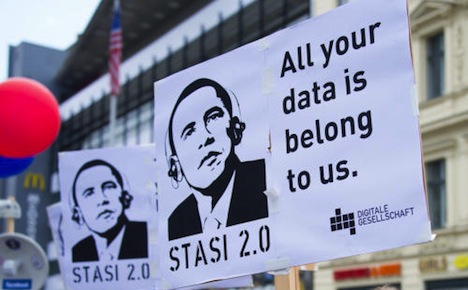
Photo above is a popular graffiti slogan in Germany, showing former interior minister (and now finance minister) Wolfgang Schäuble — critics claimed Schäuble’s focus on counterterrorism measures approached levels of civil liberties intrusion similar to the East German secret police and intelligence force, the Stasi.

As U.S. awaits DOMA decision, Germany’s constitutional court weighs in on gay rights

merkelwesterwelle

By the end of June, the U.S. Supreme Court will render decisions in two of the most important legal cases to affect same-sex marriage in the United States: Hollingsworth v. Perry, which could result in the repeal of California’s Proposition 8, a ballot measure that overturned the state legislature’s enactment of same-sex marriage, and United States v. Windsor, which could strike down the U.S. Defense of Marriage Act.  DOMA, a 1996 law that prohibits same-sex couples from federal benefits of marriage, has been struck down by lower U.S. courts as a violation of the ‘equal protection’ clause of the 14th amendment of the U.S. constitution.  Others have argued that it violates the right of states to determine their own marriage laws and the ‘full faith and credit’ clause of the U.S. constitution that requires states to recognize the law, rights and judgments of the other U.S. states. Germany Flag Icon

Both decisions are among the most highly anticipated opinions of the Court’s summer rulings.

But Germany’s top constitutional court, the Bundesverfassungsgericht, got out in front of the U.S. Supreme Court last week with a landmark decision of its own that in many ways mirrors what proponents of same-sex marriage hope will be a harbinger of the U.S. decision on DOMA.

In a decision that could place pressure on chancellor Angela Merkel in advance of Germany’s federal election in September, the constitutional court ruled that same-sex couples in registered civil partnerships are entitled to the same joint tax filing benefits as those in opposite-sex marriages, exactly the rights that DOMA was originally enacted to prohibit in the United States.  The decision put the fight for German same-sex marriage on the front page of European newspapers in a summer when the parliamentary battles to enact same-sex marriage in the United Kingdom and France have otherwise dominated headlines.

It’s surprisingly in many ways that France and the United Kingdom have been more progressive on same-sex marriage rather than Germany.  Although polls show nearly two-thirds of the British and the French support same-sex marriage, a February 2013 poll showed that three-fourths of Germans support same sex-marriage.  Moreover, UK prime minister David Cameron is the center-right leader of a Conservative Party that faces its most pressing political pressure today from the right, not from the center, and the virulent anti-marriage rallies in France and the widespread opposition to same-sex marriage on France’s center-right means that French president François Hollande’s push for marriage equality, a policy that he campaigned on in 2012, has met significant turbulence.

But Germany’s evolutionary approach to marriage equality has taken a more subdued path through the constitutional court in Karlsruhe as much as through the Bundestag, Germany’s parliament.  Former chancellor Gerhard Schröder and his coalition partner Volker Beck successfully pushed for the enactment of the Life Partnership Act in 2001 when the Sozialdemokratische Partei Deutschlands (SPD, Social Democratic Party) controlled the government in coalition with Beck’s Bündnis 90/Die Grünen (the Greens).  Following the German constitutional court’s blessing of the law in 2002, the Bundestag followed up in 2004 with revisions to the law that increase the rights of registered life partners, including rights to adoption, alimony and divorce, though not parity with respect to federal tax benefits.

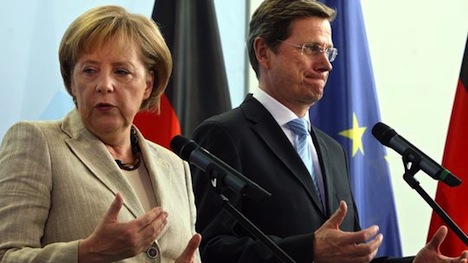
Since taking power in 2005, chancellor Angela Merkel has not pushed additional rights for same-sex couples, which puts her at awkward odds with her coalition partners, the Freie Demokratische Partei (FDP, Free Democratic Party), which supports marriage equality and whose former leader Guido Westerwelle (pictured above with Merkel), Germany’s foreign minister and its vice-chancellor from October 2009 to May 2011, is openly gay.

Both Merkel’s Christlich Demokratische Union Deutschlands (CDU, Christian Democratic Party) and the CDU’s sister party in Bavaria, the more socially conservative and Catholic-based Christlich-Soziale Union in Bayern (CSU, the Christian Social Union in Bavaria), have been traditionally opposed to gay marriage, and as recently as March, the CDU and the CSU reaffirmed their opposition to extending tax benefits to same-sex partners, even though the February 2013 poll showed that two-thirds of CDU-CSU supporters favored same-sex marriage outright.

Despite parliamentary inactivity in Berlin, last week’s decision by Germany’s constitution court, however, is just the latest decision from Karlsruhe that has edged same-sex registered partnerships ever closer to full marriage equality.  Continue reading As U.S. awaits DOMA decision, Germany’s constitutional court weighs in on gay rights

Entinhaltlichung: the best thing you’ve read so far on German politics this year

Angela Merkel gibt Einblicke in Privatleben

Neal Ascherson turns his gaze toward German chancellor Angela Merkel, her opponent Peer Steinbrück, the former East German ghosts that haunt Germany, and the Hartz IV labor reforms that also haunt it, in a superb essay for the London Review of Books that’s probably the best thing you’ve read so far this year on Germany, its politics, the importance of regional governance in an increasingly federal Europe and the north-south (and west-east) European divide.Germany Flag Icon

On Berlin, Ascherson captures in one paragraph the idiosyncratic nature of Berlin, which is really unlike any other city in Europe, which he argues ‘will never be a real capital again’:

When people talk about ‘Berlin’, they usually don’t mean the government of the most powerful nation in Europe. They mean Klaus Wowereit, the gay mayor, or the film festival, or a new café on the Oranienburgerstrasse, or the botched plan for yet another unnecessary airport. There is no centre. Even Bonn, in the years when the federal government was there, seemed more in command than Berlin is now.

Ascherson uses reunification as an analogical point — it’s the moment the West German social welfare model fell apart, for better and for worse:

And when the West Germans won that war and annexed East Germany (the best word for it), the aftermath was uncannily like Reconstruction after the American Civil War. Here was repeated the economic collapse, the inrush of greedy carpetbaggers from the victorious West, the purging of an entire elite from management, teaching and social leadership, the abolition of institutions and, of course, the liberation of the slaves – this time, into mass unemployment.

And as for Merkel herself, Ascherson nails it:

As for Merkel, sometimes she looks placid, sometimes she looks cross and disappointed, sometimes she smiles politely at foreigners over coffee and cakes. So she reminds people of Mum, and those who want to keep holding her hand think they know what she wants. Others, in despair, confess they have no idea what she wants. These days, she seems to have no policy of her own. Instead, after a suitable delay, she takes on opposition policies in a diluted form. Intellectual critics complain that she has no ‘idea’, no ‘concept’. And to describe what she does, or rather doesn’t, they have coined a frightful new German word: Entinhaltlichung. ‘It means what it says,’ a Berlin friend tells me: ‘Decontentification.’

Spiegel journalist Dirk Kurbjuweit summarized Merkel’s Entinhaltlichung earlier this month by comparing it to the Biedermeier era — the sleepy, happy period between 1815’s Congress of Vienna and the return of revolutionary spirit in 1848:

At the federal level, though, Merkel’s Germany is by and large somnolent, in part because of the government’s failure to present new ideas and plans. The chancellor gets by without them, and even the business-friendly Free Democratic Party (FDP), the junior partner in the ruling coalition, can’t seem to muster up much of an alternative, happy to avoid any danger of becoming a target of hostility…

By and large, things are calm in Merkel’s republic — and that really is something new…. as chancellor, she quickly became “mommy,” a nickname that seemed silly at first but has since proved apt, in the sense that a “mommy” is someone who takes care of the home, makes life pleasant and keeps worries at bay.

Ascherson’s essay strikes many parallel notes, even its title: ‘Hanging on to Mutti,’ a reference to an informal term for the German word for mother, Mutter, and both Kurbjuweit and Ascherson wrangle with the fundamental question of why Merkel herself remains so apparently popular despite leading a government that’s neither incredibly remarkable or popular.

What’s been clear for some time, at least since late last year when it became clear than the rather wooden Steinbrück would be the chancellor candidate of the center-left Sozialdemokratische Partei Deutschlands (SPD, Social Democratic Party), is that the September federal election is going to be all about Angela. Continue reading Entinhaltlichung: the best thing you’ve read so far on German politics this year

As Hollande marks one year in office, would Dominique Strauss-Kahn have been better for France?

DSK

Today is the one-year anniversary of François Hollande’s inauguration as the new president of France, having swept to the Elysée Palace with a mandate for a more subdued presidential administration and a leftward turn after the ‘bling bling’ administration of center-right president Nicolas Sarkozy.France Flag Icon

Hollande won’t face voters again for four more years, and by 2017, Hollande’s reputation may well have recovered, but at the one-year mark, he’s had a horrific presidency so far:

  • France slipped back, as a formal matter, into recession today, with a GDP growth rate of -0.2% for the first quarter of 2013 with an unemployment rate of over 10% and eclipsing the previous high in 1997. 
  • Barely a month into his administration, Monsieur Normal appeared to be unable to stop a fight between his current partner, Valerie Trierweiler, and his former partner, Segolène Royal, when Trierweiler tweeted her support for Royal’s opponent, thereby ending Royal’s chances to become the president of France’s parliament, the Assemblée nationale, and making Hollande look as if he couldn’t even control matters within his own relationship.
  • The traditional Franco-German axis that’s powered European integration for decades remains at a frigid impasse, despite the widespread belief that German chancellor Angela Merkel has outfoxed Hollande and is winning the policy war on how to address the ongoing eurozone economic crisis.
  • He worked to implement a 75% income tax rate on income above €1 million per year, though France’s constitutional court has ruled it unconstitutional on technical grounds, all the while keeping in place strict targets to reduce France’s budget deficit and retaining a rise in the retirement age from 60 to 62 implemented by the Sarkozy administration.
  • Budget minister Jérôme Cahuzac stepped down in April 2013 after it was revealed he had a Swiss bank account and had potentially committed tax fraud.
  • Altogether, Hollande’s approval ratings are the lowest of any president after one year in office, and fully 73% of French voters are dissatisfied with Hollande and 68% are dissatisfied with his prime minister, Jean-Marc Ayrault.

It’s been, from a political perspective — and even from a policy perspective — a bit of a disaster.  Hollande’s chief accomplishment, enactment of same-sex marriage in France, has been accompanied by vigorous opposition from Sarkozy’s party and from the far right, inspiring massive anti-marriage rallies and even an uptick anti-gay violence.

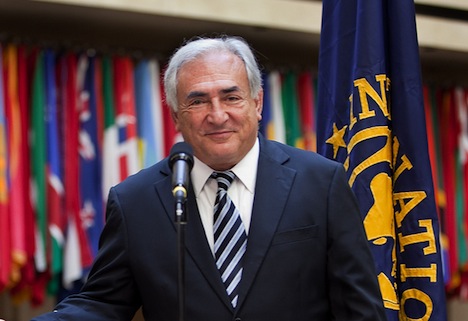
It’s enough to make you wonder — what would have happened if Dominique Strauss-Kahn had never been alleged to have sexually assaulted a maid in a New York hotel, had stepped down with his head held high as managing director of the International Monetary Fund to run for an almost certain nomination as the presidential candidate of France’s Parti socialiste (PS, Socialist Party) and proceeded to challenge Sarkozy?  Strauss-Kahn today, as a matter of coincidence, re-emerged to open a bank in South Sudan, one of his rare appearances since the debacle that led to his arrest in May 2011.  Although U.S. prosecutors dropped charges of attempted rape and other sexual abuse charges in August 2011, Strauss-Kahn’s political career was finished.

Though it’s subject to a ‘grass is always greener’ caveat, there’s good reason to believe that a Strauss-Kahn presidency would have been a smoother affair than the embattled Hollande administration.

Despite whether it would have been better or worse, a Strauss-Kahn presidency would have been an incredibly different beast from the outset.

It seems unlikely that Strauss-Kahn would have ever campaigned on a pledge to raise the top rate of tax to 75%, let alone attempted to enact it, when it’s such an outlier among peer tax regimes.  It seems more likely that Strauss-Kahn, as a relative moderate within the Socialist Party, would have been more receptive to implementing labor market reforms designed to make France more competitive — perhaps a gentler variant of the Hartz IV / Agenda 2010 reforms that Germany enacted under social democratic chancellor Gerhard Schröder in the early 2000s.

But as a former IMF chief and a former finance minister under the government of prime minister Lionel Jospin from 1997 to 1999 who worked to reduce the budget deficit to prepare for French entry into the eurozone, Strauss-Kahn would have come into office with an unrivaled economic credibility that would have allowed him to challenge Merkel on the direction of economic policy in the eurozone with vigor — and then some.  It’s not hard to imagine Strauss-Kahn pursuing a relatively ambitious reform program domestically while simultaneously calling for less punishing austerity measures in the more devastated southern European economies.

Certainly, Strauss-Kahn’s candidacy and his presidency would have been plagued with the same sort of scandalous affairs that brought his career to such a  screeching halt in 2011.  It’s difficult to imagine Strauss-Kahn being emasculated in his first month in office (fairly or not), unable to stop a very public spat between a current and former lover, one of whom happens to have been his party’s 2007 presidential candidate and a leading political figure in her own right.  Strauss-Kahn would have come to the French presidency after a career in the public eye, unlike Hollande, who had chiefly served a behind-the-scenes role — when he was half of France’s power couple, it was Royal, not Hollande, who was the public star.  Hollande, from 1997 to 2008, was the first secretary of the Socialist Party and, unlike Strauss-Kahn, he was never a minister in the Jospin government and he was certainly not among the presidential contenders in 2007.

Four years are a long time in politics, French or otherwise, and Hollande can at least point to a military intervention earlier this year in Mali that went relatively smoothly by accomplishing a narrowly defined goal, and the Mali operation represents the Hollande administration at its best.  Hollande could engineer his own comeback, especially if the economy improves this year or next — it’s hard to believe he can sink much lower in public opinion.  For now, Strauss-Kahn will still have some ways to go until he, if ever, reaches political redemption in France.  But he’s a formidable economic and political talent, and comebacks aren’t altogether unheard of in France.  Just look at the return of former prime minister Alain Juppé as foreign minister in the final 15 months of the Sarkozy administration, despite his 2004 conviction for mishandling public funds.

With such an uninspiring administration, Hollande could well turn to a cabinet shakeup in the future to replace Ayrault or other top minister, including finance minister Pierre Moscovici — and he might do well to bring Strauss-Kahn or Royal, whose political talents remain unutilized, back into the top tier of government.

What Iceland’s election tells us about post-crisis European politics

dusseldorf

Iceland was supposed to be different.Iceland Flag IconEuropean_Union

In allowing its banks to fail, neo-Keynesian economists have argued, Iceland avoided the fate of Ireland, which nationalized its banks and now faces a future with a very large public debt.  By devaluing its currency, the krónur, Iceland avoided the fate of countries like Estonia and others in southern Europe trapped in the eurozone and a one-size-fits all monetary policy, allowing for a rapid return to economic growth and rapidly falling unemployment.  Neoclassical economists counter that Iceland’s currency controls mean that it’s still essentially shut out from foreign investment, and the accompanying inflation has eroded many of the gains of Iceland’s return to GDP growth and, besides, Iceland’s households are still struggling under mortgage and other debt instruments that are linked to inflation or denominated in foreign currencies.

But Iceland’s weekend parliamentary election shows that both schools of economic thought are right.

Elections are rarely won on the slogan, ‘it could have been worse.’ Just ask U.S. president Barack Obama, whose efforts to implement $800 billion in stimulus programs in his first term in office went barely mentioned in his 2012 reelection campaign.

Iceland, as it turns out, is hardly so different at all — and it’s now virtually a case study in an electoral pattern that’s become increasingly pronounced in Europe that began when the 2008 global financial crisis took hold, through the 2010 sovereign debt crisis in the eurozone and through the current European-wide recession that’s seen unemployment rise to the sharpest levels in decades.

Call it the European three-step.

In the first step, a center-right government, like the one led by Sjálfstæðisflokkurinn (Independence Party) in Iceland in 2008, took the blame for the initial crisis.

In the second step, a center-left government, like the one led by Jóhanna Sigurðardóttir and the Samfylkingin (Social Democratic Alliance) in Iceland, replaced it, only to find that it would be forced to implement harsh austerity measures, including budget cuts, tax increases and, in Iceland’s case, even more extreme measures, such as currency controls and inflation-inducing devaluations.  That leads to further voter disenchantment, now with the center-left.

The third step is the return of the initial center-right party (or parties) to power, as the Independence Party and their traditional allies, the Framsóknarflokkurinn (Progressive Party) will do following Iceland’s latest election, at the expense of the more newly discredited center-left.  In addition, with both the mainstream center-left and center-right now associated with economic pain, there’s increasing support for new parties, some of them merely protest vehicles and others sometimes more radical, on both the left and the right.  In Iceland, that means that two new parties, Björt framtíð (Bright Future) and the Píratar (Pirate Party of Iceland) will now hold one-seventh of the seats in Iceland’s Alþingi.

This is essentially what happened last year in Greece, too.  Greece Flag IconIn the first step, Kostas Karamanlis and the center-right New Democracy (Νέα Δημοκρατία) initially took the blame for the initial financial crisis.  In the second step, George Papandreou and the center-left PASOK (Panhellenic Socialist Movement – Πανελλήνιο Σοσιαλιστικό Κίνημα) overwhelming won the October 2009 elections, only to find itself forced to accept a bailout deal with the European Commission, the European Central Bank and the International Monetary Fund.  In the third step, after two grueling rounds of election, Antonis Samaras and New Democracy returned to power in June 2012.

By that time, however, PASOK was so compromised that it was essentially forced into a minor subsidiary role supporting Samaras’s center-right, pro-bailout government.  A more radical leftist force, SYRIZA (the Coalition of the Radical Left — Συνασπισμός Ριζοσπαστικής Αριστεράς), led by the young, charismatic Alexis Tsipras, now vies for the lead routinely in polls, and on the far right, the noxious neo-nazi Golden Dawn (Χρυσή Αυγή) now attracts a small, but significant enough portion of the Greek electorate to put it in third place.

The process seems well under way in other countries, too.  In France, for examFrance Flag Iconple, center-right president Nicolas Sarkozy lost reelection in May 2012 amid great hopes for the incoming Parti socialiste (PS, Socialist Party) administration of François Hollande, but his popularity is sinking to ever lower levels as France trudges through its own austerity, and polls show Sarkozy would now lead Hollande if another presidential election were held today.

It’s not just right-left-right, though. The European three-step comes in a different flavor, too: left-right-left, and you can spot the trend in country after country across Europe — richer and poorer, western and eastern, northern and southern. Continue reading What Iceland’s election tells us about post-crisis European politics

What comes next for Cyprus and the EU following Friday’s haircut ‘bail-in’?

cyprus

nicenic

So much for ‘nice Nic’ — it’s not that he’s reverted back to ‘nasty Nic’ so much as ‘nonessential Nic.’European_Unioncyprus_world_flag

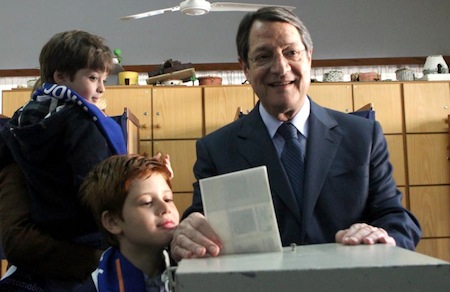
Fifteen days after his inauguration as Cyprus’s new president, Nicos Anastasiades (pictured above, bottom), was forced into what’s now become a growing domestic, eurozone and international crisis when European Union and International Monetary Fund leaders presented Anastasiades with a €10 billion bailout package.

The catch, of which you’re almost certainly aware at this point, is that an additional €5.8 billion of savings will come in the form of a one-time levy on all bank accounts in Cyprus — deposits of  €100,000 will pay a 9.9% levy and deposits of under €100,000 will pay a 6.75% levy, even those deposits are insured by a system similar to the FDIC guarantee in the United States.  Senior bondholders won’t take a haircut.

So if you’re a hedge fund, for now at least, you’ll receive fully 100% of the face value of any debt you hold in Cypriot banks.  If you’re, say, a widowed Cypriot pensioner with €30,000 saved in a Cypriot bank, you’ll wake up Tuesday morning to find that you now have just €27,975.

It’s impossible to overstate just how politically explosive the plan was — in one fell swoop, Europe’s leaders have single-handedly done all of the following:

  • undermined the Cypriot presidential administration just days after it was elected with the support of those same European leaders and a promise by Anastasiades that any bailout would not include deposit haircuts;
  • provided ammunition to every euroskeptic in Europe from Beppe Grillo in Italy to Nigel Farage in the United Kingdom by reinforcing the notion that European institutions suffer from a lack of democratic legitimacy and gratuitously trample national sovereignty;
  • pulled the rug out from under the financial industry in Cyprus, essentially the only growing sector in the Cypriot economy;
  • handed to Cyprus’s parliament — where Anastasiades’s center-right Democratic Rally (DISY, Δημοκρατικός Συναγερμός or Dimokratikós Sinayermós), controls just 20 out of 56 seats — a strong reason to vote against the deal, thereby exacerbating the uncertainty throughout the week;
  • undermined the concept of deposit insurance throughout the entire eurozone;
  • by Europeanizing — or even internationalizing — what should have been a small matter in a country with a GDP ten times smaller than Greece’s, potentially initiated bank runs in Italy, Spain, and who knows where else throughout Europe;
  • needlessly antagonized Russia in the process, and may have provoked Russia into making a politically explosive counter-offer to Cyprus; and
  • probably did nothing to help Cyprus’s long-term economic outlook, because if the levy weren’t enough to depress Cypriot growth and undermine its banking industry, further austerity designed to reduce Cyprus’s public debt is certain to send Cyprus’s GDP swooning for some time to come.

That’s right — the first major decision of the Eurogroup of eurozone finance ministers since choosing as its president Jeroen Dijsselbloem, a center-left finance minister newly elected in the Netherlands just last autumn, is to demand an increase in the Cypriot corporate tax rate from 10% to 12.5% and a further increase on Cyprus’s savings tax.

That’s in addition to the deposit haircut that everyone’s mostly focused upon.

Anastasiades seems to have had very little option but to accept the deal, despite the fact that European leaders, including German chancellor Angela Merkel, actively supported his presidential bid in last month’s election:

[Anastasiades] spoke on Saturday of a ready-made decision imposed on Nicosia in the form of a blackmail: Take it or have the eurozone crumble….

In a written statement he issued on Saturday afternoon, Anastasiades said “Cyprus came across a previously made decision, a fait accompli.” In his defense he said that the emergency situation “did not arise in the last 15 days that we have undertaken the country’s administration.”

In the February 24 presidential runoff, Anastasiades won a landslide victory, with 57.48% of the vote to just 42.52% for health minister Stavros Malas, the candidate of the socialist Progressive Party of Working People (AKEL, Aνορθωτικό Κόμμα Εργαζόμενου Λαού or Anorthotikó Kómma Ergazómenou Laoú).  

Anastasiades, in an address to the nation Sunday night, meekly argued that depositors would nonetheless receive bank shares in return for the one-time assessment and remained optimistic that recently discovered natural gas deposits in Cyprus might well boost Cyprus’s banks in the near future.

ATM Cyprus

The political fallout for Cyprus 

To the extent domestic politics is to blame for the current Cypriot crisis, AKEL is far from blameless — it’s unclear whether Cypriots will fault Anastasiades less than half a month into his administration more than his predecessor, Demetris Christofias, the country’s president from 2008 until last month.

Christofias and European leaders opened talks in June 2012 to secure a bailout, and Christofias even began to implement some small reforms, including a 5% VAT on food and drugs and an increase in the bank levy and tobacco taxes, but fell far short of European demands to reform public employment, the public pension system, and privatization of state-run industries in a country where unemployment has now risen to 14.7%.

In addition, the bailout talks were particular complex for other factors, including the outsized amount of the Cypriot banking sector’s debt, tied in large part to the Greek debt crisis.  In addition, many Russian oligarchs have deposited money in Cyprus’s banks, and Cyprus has been scolded in the past for the facilitation of money laundering from less-than-pristine Russian sources.

With Merkel up for reelection in September, it would have hardly been palatable for her to push through a German-funded bailout of dodgy Russian depositors, which was apparent enough in the latest round:

Merkel’s Finance Minister Wolfgang Schäuble had gone to Brussels with a firm mandate from Berlin: “no bail-in, no bailout”, said a member of her government. That meant: unless depositors took a hit, there would be no agreement and Germany would not contribute towards a package for Cyprus.

So talks never quite progressed, and with Cyprus facing imminent sovereign default, Anastasiades came rather easily to office with a plan to renew those talks, though he repeatedly refused to accept a deposit haircut of the kind now being implemented.

Although today was a bank holiday in Cyprus, banks were initially set to close on Tuesday, but will now be closed until Thursday as well, as the Cypriot parliament has repeatedly delayed taking up debate on the Cypriot package.

Anastasiades’s DISY, as noted above, controls just 20 out of 56 elected seats in the Cypriot House of Representatives (Βουλή των Αντιπροσώπων) and AKEL controls 19.  The centrist Democratic Party (DIKO, Δημοκρατικό Κόμμα or Dimokratikó Kómma), which backed Anastasiades in the presidential race, controls another nine seats.  Three additional parties that largely supported the center-left, independent Giorgos Lillikas in the presidential election control an addition eight seats, including five by the Movement for Social Democracy (EDEK, Κίνημα Σοσιαλδημοκρατών or Kinima Sosialdimokraton).

That means that if AKEL, EDEK and other small parties oppose the deal, DISY and DIKO hold just of 29 votes, just enough to pass the Cypriot package without any defections.

Moreover, DIKO’s leader has already called for changes to the bailout legislation, and it looks increasingly like Anastasiades lacks the support to win a vote in parliament, which means that European leaders will have to renegotiate the previous deal.  It’s not clear how much time Cyprus has before its banks (or its government) become insolvent.

Cold War redux?

Meanwhile, Russian president Vladimir Putin denounced the decision as ‘unfair, unprofessional and dangerous.’

Russia hasn’t indicated whether it will extend or otherwise change the terms of an existing €2.5 billion loan to Cyprus — if Russia refuses to extend the loan for another five years, the Cypriot bailout will need to be even larger.  So there’s that.

I wouldn’t be surprised if Anastasiades and members of the Russian government are discussing an alternative to the current European-IMF plan — the Republic of Cyprus, which occupies the southern half of the island of Cyprus, is not a member of the North Atlantic Treaty Organization, and a €17 billion bailout would be a small price for Russia to pay in exchange for closer military ties or a Russian naval base on the island.

Perhaps even more tantalizing for Russia, and its state-owned natural gas company Gazprom, are newly discovered natural gas deposits that Cyprus hopes will fuel future economic growth.  Indeed, there are already vague reports of a Russian counteroffer — the official Russian news agency seems to indicate that emergency talks have now been initiated:

Russia’s Gazprom has not offered the Republic of Cyprus financial assistance in restructuring the country’s banks in exchange for the right to gas production in the exclusive economic zone of Cyprus. Gazprombank initiated this offer, a spokesman for the gas giant told Tass.

That result would cause dismay among the United States and its European and NATO allies which, by the way, includes Turkey.  Turkey has occupied the northern half of the island of Cyprus since the 1970s — the Turkish Republic of Northern Cyprus declared its independence from the Greek Cypriot republic to the south in 1983, and the two have remained divided ever since.  So what’s an economic crisis and a domestic political crisis could also become a geopolitical security crisis soon enough.

The economic and political fallout for the eurozone

Reaction from economic commentators has been essentially universally negative since news broke early last weekend. Continue reading What comes next for Cyprus and the EU following Friday’s haircut ‘bail-in’?

Where Italy goes from today’s elections: a look at four potential outcomes

pierluigi

Although we still don’t know exactly how the results of the weekend’s Italian election will turn out entirely, we know enough to say that Italy’s short-term future will be beset with gridlock.Italy Flag Icon

We know that, unless there’s a major change among the final results (very unlikely at this point, but still a possibility — La Repubblica‘s latest count shows a 0.4% gap between the two major coalitions), Pier Luigi Bersani will have led his broad centrosinistra (center-left) coalition to a victory in Italy’s lower house, the 630-member Camera dei Deputati (House of Deputies).  That’s because the national vote winner of the lower house elections automatically wins at least a 54% majority of the seats in the lower house.

We know that, whatever the final result, both Bersani’s centrosinistra coalition and the centrodestra (center-right) coalition led by former prime minister Silvio Berlusconi will each hold between 110 and 120 seats or so in Italy’s upper house, the Senato, which is composed of 315 elected members and, currently, four additional ‘senators for life.’ (That’s because the majority ‘seat bonus’ is awarded to the winner of each regional vote rather than on a national basis like in the Camera dei Deputati).

It doesn’t really matter who holds the greatest number of senatorial seats, because no group or party will control enough seats in the Senato alone to form a majority government, including Bersani’s coalition.

So given Bersani’s lead in the lower house, whatever government emerges — if a government emerges — will have to include Bersani’s center-left bloc, with presumably Bersani heading the government as prime minister.  In the short term, that puts Bersani in the driver’s seat but not, perhaps, for long.

None of Bersani’s options, frankly, are very stable, for either his center-left coalition or for Italy.

Given the ongoing eurozone sovereign debt crisis, the pressure will be on Bersani and on the entirety of Italy’s political elite, which now must be said to include Beppe Grillo and the leaders of the Movimento 5 Stelle (the Five Star Movement).  Right now, Italy’s 10-year bond rate is 4.49%, much lower than the 7%-and-higher rates that led to the downfall of Berlusconi’s government in November 2011.  But that could change — and fast — if Italy’s political leadership seems unable to form a government.  Grillo and his allies are now stakeholders in ensuring that Italy doesn’t unravel.

If Bersani succeeds in forming a government at all, it will be less stable than any government in Italy’s so-called ‘second republic’ — i.e., the period from the early 1990s to the present that’s been characterized by the downfall of the former Christian Democrats during the 1992 Tangentopoli (‘bribesville’) scandal that implicated virtually all of Italy’s political elite, the emergence in 1994 of Silvio Berlusconi as the head of the mainstream Italian right, and the increasing consolidation of the mainstream Italian left through what’s now become the Partito Democratico (PD, Democratic Party).

Any Bersani-led government, at this point, will not only be less stable than Berlusconi’s governments, but even less stable than the four notoriously rocky governments of Italian prime ministers Romano Prodi, Massimo D’Alema and Giuliano Amato from 1996 to 2001 and Prodi’s short-lived and troubled return to government from 2006 to 2008.

In light of that bleak background, here are the four potential outcomes over the coming days that you should watch for:

Continue reading Where Italy goes from today’s elections: a look at four potential outcomes

Making sense of today’s Italian election results

beppe

UPDATE, 7:30 p.m.: Here’s an additional piece on where Italy goes from here — a look at four potential outcomes to watch for in the days ahead.

* * * * *

The election results from Italy’s general election have largely been counted, and they’re backing up the exit polls (not the initial instant polls from the preceding hours leading up to the election) that show a hung parliament — leaving the short-term future of Italy’s government unclear.Italy Flag Icon

Right now, it certainly looks like Pier Luigi Bersani’s centrosinistra (center-left) coalition will win a majority in the elections for Camera dei Deputati (House of Deputies), Italy’s lower house, while former prime minister Silvio Berlusconi’s centrodestra (center-right) coalition will win a majority in the elections for Italy’s upper house, the Senato (Senate).

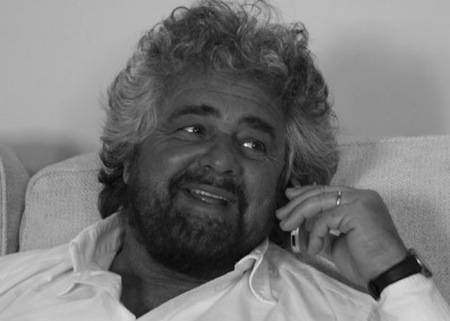
Nonetheless, the big winner is the Movimento 5 Stelle (M5S, the Five Star Movement), the protest group of blogger and comedian Beppe Grillo (pictured above), which has significantly outperformed polling expectations and may well become the single largest ‘party’ in the Italian parliament.

Bersani leads in Italy’s lower house

In the 630-member lower house, the latest projections show Bersani’s centrosinistra with a small lead of around 29% or 30% to just 28% or 29% for the centrodestra, and a whopping 25% or 26% for the Five Star Movement.  Far behind in fourth place is prime minister Mario Monti’s centrist coalition with around 11%.  The communist, green, anti-corruption Rivoluzione Civile (RC, Civil Revolution) headed by antimafia magistrate Antonio Ingroia has won barely over 2%.

If that result holds, it means Bersani will command an automatic majority in the lower house — the winner of the largest share of the votes wins 54% of the seats in the Camera dei Deputati, so Bersani is likely to hold 340 seats.

Berlusconi leads in Italy’s upper house

In the Senato, however, seats are awarded proportionally on a regional basis, with a regional ‘bonus’ — the winner of the largest share of the votes in each region automatically wins 55% of the seats in that region.

It’s too soon to tell whether Bersani or Berlusconi will win the greater number of votes nationally in the senatorial elections, but it’s likely that Berlusconi may emerge with the greatest number of the 315 seats up for election today (though far short of a majority) — the latest projections show the centrodestra with 114 seats, the centrosinistra with 113 seats, the Five Star Movement with 57 and Monti’s coalition with 17.

Berlusconi wins Piedmont, sweeps southern Italy in senatorial elections

When you look at the results region-by-region, you begin to see just how amazing the comeback has been for Berlusconi.

Right now, it appears that Berlusconi’s coalition has not only won Piedmont and Veneto in northern Italy, but also Lombardy, Italy’s most-populous region, by what appears to be a whopping 38.0% to 29.5% victory.  That doesn’t bode well for the centrosinistra in regional elections in Lombardy, where the centrodestra is trying to hold onto power under its candidate for regional president, Roberto Maroni, since 2012 the national leader of the Lega Nord (Northern League).  Maroni faces a tough challenge from the leftist candidate, Umberto Ambrosoli.  Exit polls showed a very close regional race. 

In southern Italy, where the centrosinistra was hoping to break through with a credible chance at sweeping the south, Berlusconi’s coalition has apparently won each region, excepting Basilicata.  That includes Campania and Sicily, Italy’s third- and fourth-most populous regions, respectively.  Berlusconi leads 37.2% to 29.1% in Campania and by 33.2% to 27% in Sicily (where Grillo’s Five Star Movement, not typically strong in the south, won 29.5%).  It also includes Puglia, the home of twice-elected regional president Nichi Vendola, the leader of the socialist Sinistra Ecologia Libertà (SEL, Left Ecology Freedom) that is part of Bersani’s coalition.  Although SEL won nearly 7% in Puglia, its best result nationwide, it wasn’t enough to power the centrosinistra to victory, where it was trailing with 28.3% to the centrodestra‘s 34.5%.

Grillo is the biggest winner, Monti the biggest loser

All in all, the result is a victory for Grillo — his movement outpolled Berlusconi’s party (though not his broader coalition), the Popolo della Libertà (PdL, People of Freedom) and it’s still too soon to tell, but there’s a chance the Five Star Movement outpolled Bersani’s party, the Partito Democratico (PD, Democratic Party) as well.

Going down the list of senatorial results, it looks like the Five Star Movement outpolled both the PD and the PdL in Veneto in the northeast, Liguria in the northwest, Marche, Abruzzo and Molise in the center of Italy, and Sicily and Sardinia as well, with Grillo’s movement winning around 30% in some of his strongest regions.

Monti, by contrast, appears to have finished in fourth place — and a far-off fourth place — in every region.  Despite his alliance with the Christian Democrats — long-dominant in Italy’s south — Monti polled worst in Italy’s south, and did best (winning double digits of up to 12%) in the northern industrial regions like Piedmont, Lombardy, Friuli and Veneto.

That means that, even if they could find a way to build a coalition, Monti and Bersani are unlikely to have sufficient strength in Italy’s upper house to form a coalition.

Other winners and losers Continue reading Making sense of today’s Italian election results

Anastasiades, Malas head to Cypriot presidential runoff next Sunday

nikos

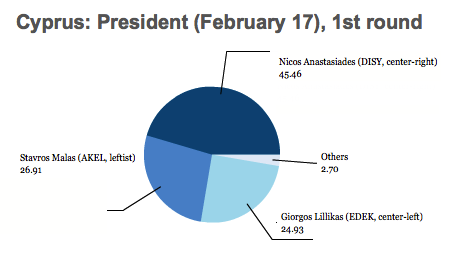
Center-right presidential candidate Nicos Anastasiades (pictured above) overwhelmingly triumphed in Sunday’s presidential election in Cyprus, outpacing his nearest rivals by nearly 20%.  Nonetheless, he fell about 4.5% short of the 50% absolutely majority he would have needed to win the election outright and avoiding a runoff that will now take place next Sunday on February 24, despite early exit polls that showed he might win up to 52% of the first-round vote. cyprus_world_flag

Anastasiades, the candidate of the center-right Democratic Rally (DISY, Δημοκρατικός Συναγερμός or Dimokratikós Sinayermós), will face health minister Stavros Malas, the candidate of the governing, leftist Progressive Party of Working People (AKEL, Aνορθωτικό Κόμμα Εργαζόμενου Λαού or Anorthotikó Kómma Ergazómenou Laoú), who edged out alternative leftist candidate Giorgos Lillikas:

cyrpus 1st roundSo the question now is whether Lillikas’s voters will move en masse to Malas in the runoff or, alternatively, they will split between Anastasiades and Malas, thereby giving the center-right candidate sufficient support to win the presidency next week.

Anastasiades has pledged to move forward as quickly as possible to secure a €17 billion bailout that Cyprus needs to avoid sovereign default in a country that’s seen its public debt rise to 140% of GDP.  Although talks have been ongoing for over a year with the far leftist administration of outgoing president Demetris Christofias, the current administration has not been willing to implement the privatization of state industries that European leaders would require, though it has implemented tax increases and budget cuts over the past year.  Those austerity measures have worn down the popularity of Christofias and of his party’s presidential candidate, Malas.

At first glance, an alliance between Lillikas and Malas makes sense — both are generally to the left of Anastasiades, and Lillikas has campaigned on a platform of refusing to lead Cyprus into a bailout with tough conditions, arguing instead that Cyprus should rely on recently discovered offshore natural gas deposits to boost its public finances.  Lillikas, a businessman and an independent candidate, was supported by several small centrist and leftist parties, including the center-left Movement for Social Democracy (EDEKΚινήμα Σοσιαλδημοκρατών or Kinima Sosialdimokraton).

Taken together, Lillikas and Malas polled nearly 6% more than Anastasiades in the first round, meaning that a majority of Cypriots appear to oppose the more austerity-focused bailout approach Anastasiades is very likely to pursue if elected.  But in order to upset Anastasiades in the runoff, Malas would have to sweep up over 93% of Lillikas’s first-round voters.  That seems unlikely, especially given that supporters of many of Cyprus’s political parties were split in the first round between Lillikas and Anastasiades, including the smaller Evroko (European Party) and Cyprus’s Ecological and Environmental Movement, both of which ultimately deadlocked over the issue of endorsing either Lillikas or Anastasiades.

But that’s especially true of Cyprus’s Democratic Party (DIKO, Δημοκρατικό Κόμμα or Dimokratikó Kómma), a centrist party that most recently held the presidency under Tassos Papadopoulos from 2003 to 2008, under whom Lillikas served as foreign minister from 2006 to 2007.

Although DIKO ultimately endorsed Anastasiades in the first round, many rank-and-file DIKO voters supported Lillikas, and that means it’s likely those voters will turn to Anastasiades in the runoff or, at least, abstain entirely from voting or protest-vote for neither Anastasiades nor Malas.

Once derided as ‘Nasty Nic’ for his reputation as a mean-streaked and hot-tempered politician, Anastasiades’s victory today marks a remarkable comeback since he fell from favor nearly a decade ago after supporting the ‘Annan Plan’ that would have reunited the Greek and Turkish sides of the divided island of Cyprus — over 76% of Greek Cypriot voters opposed the plan in a 2004 referendum, despite Turkish Cypriot backing for the plan.  The island remains split between the (largely Greek Cypriot) Republic of Cyprus and the (largely Turkish Cypriot) Turkish Republic of Northern Cyprus, following a 1974 Cypriot coup that led to an attempt by Greece to annex the entire island and a subsequent Turkish invasion of the north.

Although the Turkish/Greek issue has not been a significant issue during the campaign, if he’s elected as president next Sunday, Anastasiades may well find himself on the wrong end of Cypriot public opinion once again, given that he’s indicated he’s willing to make tough sacrifices in order to secure a bailout for Cyprus.  European leaders, including German chancellor Angela Merkel, have expressed support for Anastasiades, and it seems much likelier that Anastasiades could achieve a bailout deal for Cyprus.

Merkel and other European leaders would be likely to demand extremely onerous concessions though, certainly no less than the concessions imposed on Greece.  In light of the Cypriot banking sector’s less-than-pristine reputation on money laundering, it’s expected that a bailout would benefit dodgy Russian financiers and oligarchs whose money is currently deposited in Cyprus’s banks — a proposition that Merkel will likely find politically difficult with seven months to go until her own reelection campaign in Germany.