Tag Archives: Cameron

Madrid ignores Catalan vote at grave risk

9nartusmas

Though Sunday’s unofficial referendum on Catalan sovereignty may have been legally murky, it is nonetheless clear that Spanish prime minister Mariano Rajoy’s strategy of ignoring the groundswell of support for regional self-determination and autonomy has been a failure.cataloniaSpain_Flag_Icon

So what actually happened on Sunday — and where do the Catalan nationalist movement and the Spanish government go from here?

What happened in Sunday’s ‘consultation’ vote
2004155Photo credit to AFP.

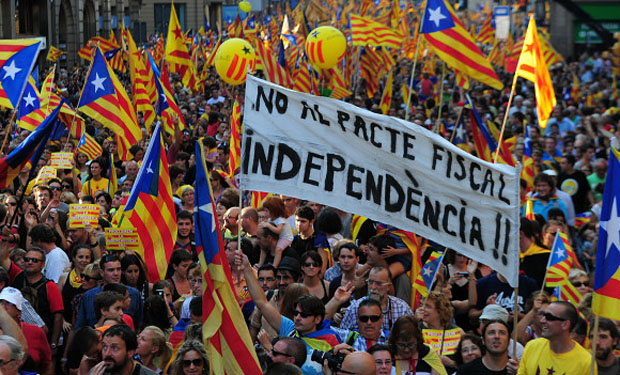
Catalans voted in a non-binding, unofficial ‘consultation’ that its Generalitat (or regional government) once hoped would be a legal referendum not unlike the recent September vote on independence in Scotland. But Rajoy has refused to countenance even the idea of negotiating the terms of such a referendum, and he has consistently ruled out any vote as unconstitutional.

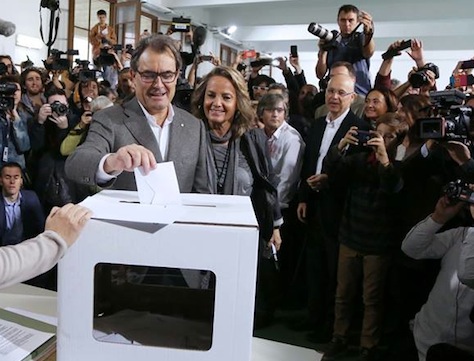
Nevertheless, Catalunya’s regional president Artur Mas (pictured above) has championed a referendum since at least 2012, and his party and other more radical groups in the Catalan regional parliament overwhelmingly voted to hold the referendum, setting the central and Catalan regional governments on what has been a divisive battle over the past year.

* * * * *

RELATED: Mas cancels official Catalan independence vote

* * * * *

Mas backed down on the ‘official’ nature of the referendum, which in any event was always designed to be non-binding, when Spain’s constitutional court ruled that the vote was illegal last month. Much to the chagrin of other, more leftist nationalists, however, Mas instead moved forward with an unofficial referendum, taking care not to use official Spanish government resources to conduct the vote.

The Spanish constitutional court ruled last week, in a second decision, that even this unofficial, non-binding ‘consultation’ should be delayed until it could have time to rule on its further legality. Mas went ahead with the vote, anyway, however, prompting a sharp rebuke from Rajoy’s government on Sunday:

Justice Minister Rafael Catalá described the November 9 vote as an “act of political propaganda with no democratic validity; a sterile and useless act.”

The minister went on to announce that the public prosecutor would evaluate the facts of Sunday’s vote and decide whether or not to begin legal action in the courts.

Though the law is squarely on the side of the Spanish government, the Catalans seem to have valid political and moral reasons for demanding at least a voice over their own future. In any event, at least 2.3 million Catalans turned out for the vote, representing around 35% of the total Catalan electorate, nearly all of them were pro-independence voters.

The vote asked two questions: first, ‘do you want Catalunya to be a state?’ and second, ‘if so, do you want Catalunya to be an independent state?’

The so-called ‘yes-yes’ vote won with around 80.8% of the vote. The so-called ‘yes-no’ vote (i.e., those supporters of a Catalan state, but not necessarily an independent state) won another 10.1%. ‘No’ won just 4.5% of the vote.

While that’s skewed in favor of the independence movement, it’s also not insignificant — and it indicates that a large portion of the Catalan people want a legal and valid vote on their status. The longer that Madrid assumes an ostrich position over what’s become a very real sense of grievance among everyday Catalans, the worse the standoff over independence will end. By refusing to discuss the possibility, Rajoy and the central government risk pushing moderate unionists into the arms of the Catalan nationalists.

Nevertheless, Sunday’s turnout fell far short of the 3.7 million voters who participated in the most recent November 2012 regional elections, indicating that a substantial number of voters (who presumably aren’t as enthusiastic about independence) didn’t bother to turn out. The two-pronged ballot question demonstrates the kind of too-cute-by-half ambiguity that British prime minister David Cameron refused to entertain when negotiating the Scottish referendum — what, after all, does it mean for Catalunya to be a state if not independent?

A frustrated electorate trapped between Rajoy and Mas
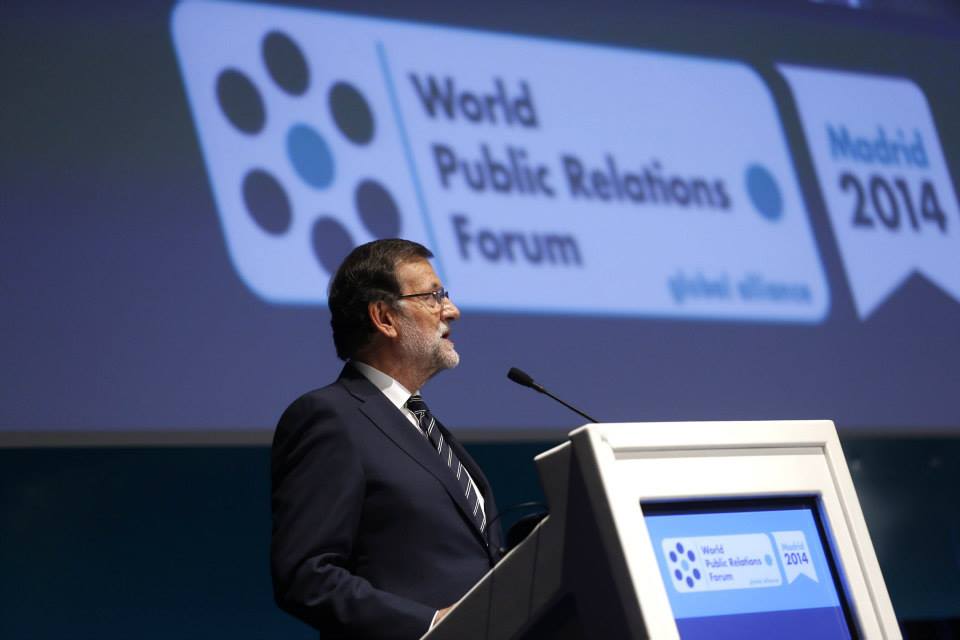
rajoy14

The most obvious solution to the standoff is a calm, rational conversation between the Mas and Rajoy governments that would result in greater autonomy for Catalunya’s Generalitat with respect to its own finances and spending. Incredibly, however, the two leaders went months earlier this year without even talking.

Rajoy, whose center-right Partido Popular (PP, People’s Party) won the November 2011 Spanish general elections, has consistently refused to discuss greater autonomy for Catalunya. In part, this is because Rajoy’s party has fairly little support within Catalunya — the Partit Popular de Catalunya (PPC, People’s Party of Catalonia) is just the fourth-largest bloc in the regional parliament. So Rajoy feels little immediate political pain from snubbing the region.

When he took office, Rajoy faced the likelihood that Spain would be essentially forced into a European bailout. As it turned out, Rajoy was forced into implementing budget cuts and tax increases to stave off a bailout — in addition to similar austerity measures introduced by his predecessor, José Luis Rodríguez Zapatero, the center-left prime minister whose Partido Socialista Obrero Español (PSOE, Spanish Socialist Workers’ Party) came to power in 2004 at the dawn of the Spanish construction and finance boom.

Accordingly, Rajoy has a decent argument for avoiding a full-fledged independence referendum: with a 23.7% unemployment rate as of September, Spain is still in the midst of the worst financial and economic crisis in decades. An independence referendum in Catalunya might credibly be followed by a referendum in the Basque Country/Euskadi, another economic powerhouse with an even more painful history of separatism. Copycat movements could thrive in Galicia and elsewhere. So Rajoy has a reasonably sympathetic argument that a Catalan referendum in the midst of the current crisis could eventually pose an existential threat to the Spanish nation.

But that’s not an excuse for ignoring the problem. What’s worse is that the Spanish economic crisis is itself also fueling greater discontent among Catalans, who believe they send far more in revenue to the Spanish central government than they receive back in services and infrastructure. Though the data isn’t entirely clear, the Catalans are essentially correct. It rankles that all high-speed trains in Spain run through Madrid, for example, and that almost all of the country’s international flights arrive at the Madrid airport. Catalunya, with just 7.5 million of Spain’s 47 million citizens, is responsible for 19% of the economy.

* * * * *

RELATED: In refusing Catalan vote,
Rajoy risks isolating himself and Spain’s future

* * * * *

The Scottish referendum was also about economics (nationalists believe they can thrive as a smaller, oil-rich country within the European Union) and about politics (like the PP in Catalunya, the Conservatives have relatively little support in Scotland). But the Catalan movement is also colored by additional layers of complexity that Rajoy shows virtually no sign of appreciating — notably decades of suppression of its language and culture by the dictatorship of Francisco Franco. When Rajoy’s education minister, a few years ago, suggested a stronger national program in the Castilian language, it particularly rankled Catalans, many of whom remember the days when the Catalan language was legally banned.

But Mas, the leader of the Convergència i Unió (CiU, Convergence and Union), a two-party, center-right nationalist coalition that’s traditionally been the most powerful force in Catalan politics since the return of democracy, is hardly an honest broker. CiU has always been more comfortable with greater autonomy than full independence, and Mas only recently converted to the cause in 2012 following widespread protests. Since taking power in 2010, Mas has made many of the same painful, unpopular budget decisions at the regional level that Rajoy has made at the national level. What’s more, Jordi Pujol, the former CiU leader and Catalan president between 1980 and 2003, has been subject of increasing scrutiny over his personal wealth and corruption accusations.

Accordingly, neither Mas nor Rajoy come out of the current showdown from a incredible position of strength. That might not necessarily matter if they could at least find a middle ground to discuss the most sensible solution to the political crisis — constitutional reform, greater regional autonomy and the possible creation of a federalist system in Spain.

As elections loom, what comes next?
podemos

So far, however, the chances of any productive talks between Madrid and Barcelona seem small.

Mas has given Rajoy a two-week deadline to begin negotiations for a formal referendum. Rajoy, however, is almost certainly unlikely to take Mas up on that offer.

What happens thereafter is murky, though.

Mas’s party, the larger, more moderate and more aggressive Convergència Democràtica de Catalunya (CDC, Democratic Covergence) within the CiU, would like to hold early regional elections, rolling the dice that they would become a de facto referendum on Catalan independence — or at least the right of the Catalan government to call a vote. The smaller, Christian democratic Unió Democràtica de Catalunya (UDC, Democratic Union) has always been less enthusiastic about Mas’s push for independence and would prefer to wait on snap elections.

Part of the political calculus for Mas, Rajoy and the CiU are polls that show that the most popular party in Catalunya is now the leftist Esquerra Republicana de Catalunya (ERC, Republican Left of Catalonia), an even more radical pro-independence party led by historian Oriol Junqueras.

On paper, at least, the PP and the CiU have much more in common than the PP and Esquerra, so both Rajoy and Mas have an incentive to reach some kind of face-saving deal in the next few days.

But at the rate Rajoy is going, he may not have the opportunity to negotiate anything in the long run.

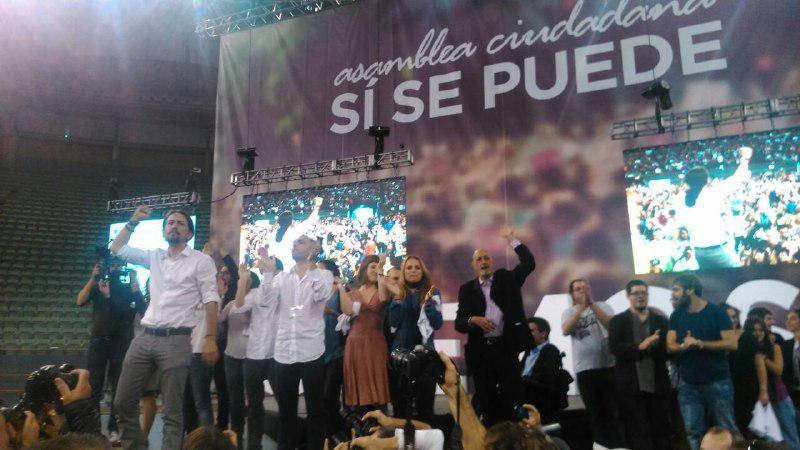
The rise of the anti-establishment Podemos (‘We can!’), the movement founded earlier this year by professor Pablo Iglesias (pictured above), has scrambled all pretenses of Spain’s two-party system. Winning five of the country’s seats to the European Parliament in May, Podemos wants to reevaluate Spain’s public debt, lower the retirement age to 60 to free up more jobs for younger workers and reverse the austerity of the past two PSOE and PP governments, using government spending to create jobs for a country that still has the highest unemployment within the European Union, despite signs of new growth. A Podemos win would be a significant setback to the orthodox policies that German chancellor Angela Merkel has attempted to establish throughout the eurozone, including the 2011 ‘fiscal compact’ that firmly limits national budget deficits to less than 3% of GDP.

Podemos, in a shock Metroscopia poll a couple weeks ago, gained the lead among potential voters in advance of the next Spanish general election, which must be held before December 2015 — it would win 27.7% to just 26.2% for the PSOE, under the leadership of Pedro Sánchez, who won his party’s July leadership contest, and 20.7 for Rajoy’s PP. Sánchez, for his part, opposes Catalan independence, but has indicated much greater willingness to hold discussions with regional leaders over constitutional reform.

The local Partit dels Socialistes de Catalunya (PSC-PSOE, Socialists’ Party of Catalonia) controlled the regional government between 2003 and 2010, and many of its members are sympathetic to the idea that Catalans should have the right to self-determination.

Though Podemos is widely viewed as a leftist alternative, it has attracted widespread support from many Spaniards who have lost faith in both major parties, especially among young voters who face the worst job prospects, and the indignados, the unemployed protestors who have given voice to the harsh effects of what are now a half-decade of austerity policies.

Ironically, Podemos has attracted little support within Catalunya, where voters have a nationalist (and leftist) alternative in Esquerra.

But as Spain nears the one-year mark until its elections, with the November 9 referendum now in the rear-view mirror, the brinksmanship between Rajoy and Mas won’t matter if they can’t find a path toward reconciliation. At this time next year, their respective governments could be headed by much more radical figures.
Gary Hart deserved better than the dregs of NI peace

GaryHartPhoto credit to Getty Images.

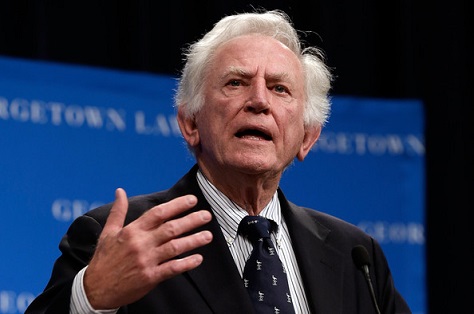
US secretary of state John Kerry appointed former Colorado senator and one-time presidential candidate Gary Hart as the latest US envoy to Northern Ireland’s five-party peace talks earlier today.USflagnorthernirelandUnited Kingdom Flag Icon

Nearly two decades after former US senator George Mitchell concluded the Good Friday Agreement, bringing a tenuous peace between republican Catholics and unionist Protestants across Northern Ireland, Hart’s role will not amount to midwifing a landmark peace deal — it will be ensuring its continued implementation:

Fresh negotiations involving the five parties in the power-sharing mandatory coalition convened by the UK Government commenced last Thursday and are due to resume tomorrow.

As well as the long-unresolved peace process disputes on flags, parades and the legacy of the past, over the coming weeks politicians will also attempt to reach consensus on rows over the implementation of welfare reforms in the region and on the very structures of the devolved Assembly.

Northern Ireland is thriving today, amid a growing economy in the long-troubled capital of Belfast. Peace has brought with it a rising standard of living. But, as was on full display upon the death of former Northern Irish first minister Ian Paisley last month, long-simmering tensions still exist. It’s possible, though far from probable, that the kind of widescale violence of the ‘Troubles’ will return to Northern Ireland anytime soon.

* * * * *

RELATED: No eulogies for Paisleyism

* * * * *

It’s great to see Hart — at long last — providing useful service to his country. But US envoys to Northern Ireland today are all destined to be cast as relief pitchers in comparison to Mitchell’s role in shepherding the historic 1998 accords.

For someone who was, to a person, the most prescient voice on homeland security and the threat of terrorism in 1990s, his high-profile turn as a US envoy represents a bittersweet return to public life. Hart’s second act should have started long before age 77. Continue reading Gary Hart deserved better than the dregs of NI peace →

Miliband shifts Labour’s focus from austerity to health care

miliband2014

If it wasn’t already clear, Ed Miliband’s final conference speech before next May’s general election indicated that he intends to wage his campaign on the basis of the United Kingdom’s National Health Service — and not a full-scale attack on the ‘austerity’ anti-deficit policies of David Cameron’s coalition government.United Kingdom Flag Icon

It’s hard to believe that Miliband has now been the leader of the United Kingdom’s Labour Party one year longer than former  prime minister Gordon Brown was, especially after the bravura performance that Brown delivered for the ‘Better Together’ campaign, which may have swayed enough Scottish voters to reject independence in the surprisingly close referendum.

When he won the leadership in September 2010, upsetting his opponent and brother, former foreign minister David Miliband, it was a shock. While Labour’s MPs and the party faithful narrowly preferred David, unions and other affiliated Labour groups gave Ed just enough of an edge to narrowly defeat the more seasoned Miliband, who promptly left frontline politics and moved to New York.

In the past four years, Ed Miliband has benefitted from the polling lead that Labour has consistently held against the Conservatives, who have been mired in unpopular decisions to slash the national budget after years of more permissive spending under Brown and his predecessor Tony Blair, for whom Brown served as chancellor of the exchequer.

* * * * *

RELATED: Why England needs a series of regional parliaments

RELATED: What to make of Cameron’s ‘night of the long knives’

* * * * *

In the first year of Tory-led government, the British economy grew by 1.7% — sluggish in absolute terms, but vigorous by what would follow. In 2012, British GDP fell to 0.3% before rebounding last year to 1.7% and a forecasted growth rate of 3.2% in 2014.

As the economy has improved, it means that it might not be enough for Miliband to attack Cameron and the current chancellor, George Osborne, for inflicting greater damage on the economy by cutting spending in a time of low economic growth. While it may be true that Osborne’s budget cuts didn’t necessarily promote growth, it’s unavoidable fact that the United Kingdom is now growing faster than the rest of the European Union, which emerged from the 2008-09 global financial crisis and the 2010-12 eurozone debt crisis to face a growing deflation threat today. Italy, which has struggled to enact reforms under its energetic new prime minister Matteo Renzi, recently entered a triple-dip recession.

Polls, meanwhile, show an increasingly tight race. Labour’s once dominant lead is shrinking, in the most recent September 18-19 YouGov/Sunday Times poll to just 4%. If the election were held today, Labour would edge out the Tories by a margin of 36% to 32%, with the eurosceptic United Kingdom Independence Party (UKIP) winning 16% and the junior coalition partners, the Liberal Democrats, just 7%. That could result in any number of outcomes, including a Labour minority government, a Conservative minority government, or the continuation of the Tory-Liberal Democratic coalition.

That goes a long way in explaining why Miliband is increasingly shifting from an anti-austerity message to a campaign that places greater funding for an increasingly burdened National Health Service (NHS) at the heart of his bid to defeat Cameron in eight months’ time. Continue reading Miliband shifts Labour’s focus from austerity to health care →

Why England needs a series of regional parliaments

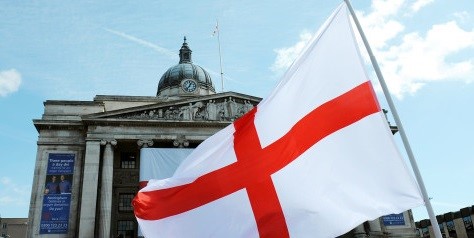
St George's Day - NottinghamPhoto credit to PA.

Following the historic vote on Scottish independence, British prime minister David Cameron emerged early Friday morning to deliver remarks praising Scottish voters for keeping the United Kingdom (‘our country of four nations’) together.United Kingdom Flag Icon england_640

He promised to keep a pledge to enact rapid legislation devolving further powers to the Scottish parliament (‘devo-max’), but he simultaneously promised to propose reforms addressing the role of Scottish MPs on matters that are exclusively English in nature, responding to loud grumbling from English Tories that Scottish MPs shouldn’t have a vote on English matters and who have long cried, ‘English votes for English laws.’

In tying the issue of the promised Scottish devolution to the West Lothian question, Cameron was hoping to calm his own backbenchers, who, even before voters cast ballots in the September 18 referendum, briefing against the unfairness of the ‘Barnett formula,’ whereby Scottish residents receive greater per-capita government subsidy than English residents.

But that left Downing Street scrambling after both the pro-independence Scottish National Party (SNP) and the pro-union, center-left Labour Party attacked Cameron for trying to tie the two issues together. Alex Salmond, who announced plans on Friday to step down as first minister after losing the referendum by a 10% margin, alleged that Cameron was already backing away from his promise to the Scottish people:

Salmond said that no voters in the referendum would feel they had been “misled”, “gulled” and “tricked”. The first minister told the Sunday Politics on BBC1: “I am actually not surprised they are cavilling and reneging on commitments; I am only surprised by the speed at which they are doing it. They seem to be totally shameless in these matters. The prime minister wants to link change in Scotland to change in England. He wants to do that because he has difficulty in carrying his backbenchers on this and they are under pressure from Ukip.

“The Labour leadership of course are frightened of any changes in England which leave them without a majority in the House of Commons on English matters. I think the vow was something cooked up in desperation for the last few days of the campaign and I think everyone in Scotland now realises that.”

Cameron strongly hinted that his approach would limit the ability of Scottish (or Welsh or Northern Irish) MPs to vote on matters that apply solely to English legislation. That echoes calls from other high-profile Conservative leaders like chief whip Michael Gove.

But it would be politically controversial for at least two reasons. Continue reading Why England needs a series of regional parliaments →

Scottish referendum results: winners and losers

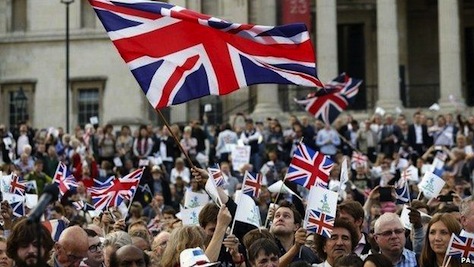
bettertogether

The results are in, and Scotland did not vote yesterday to become a sovereign, independent country.scotlandUnited Kingdom Flag Icon

Scottish residents — and all British citizens — will wake up today to find that, however narrowly, the United Kingdom will remain as united today as it was yesterday, from a formal standpoint.

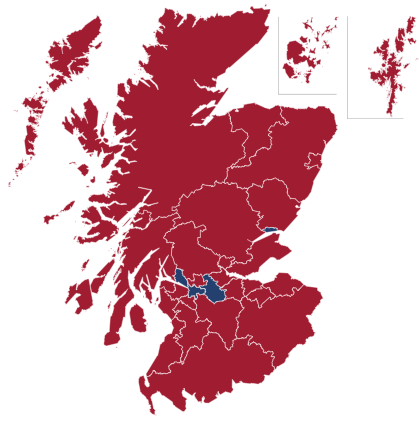
With all 32 local councils reporting, the ‘Yes’ camp has won 1.618 million votes (44.7% of the vote) against 2.002 million votes (55.3% of the vote) in favor of remaining within the British union, capping a 19-month campaign that resulted in a staggering 84.6% turnout in Thursday’s vote.

Moreover, ‘Yes’ won four councils, including Glasgow, Scotland’s largest city:

Screen Shot 2014-09-19 at 9.59.08 AM

But the close call has shaken the fundamental constitutional structure of the United Kingdom, and Scotland’s vote will now dominate the political agenda in the final eight months before the entire country votes in a general election next May, for better or worse.

So who comes out of the referendum’s marathon campaign looking better? Who comes out of the campaign bruised? Here’s Suffragio‘s tally of the winners and losers, following what must be one of the most historic elections of the 2010s in one of the world’s oldest democracies.

The Winners

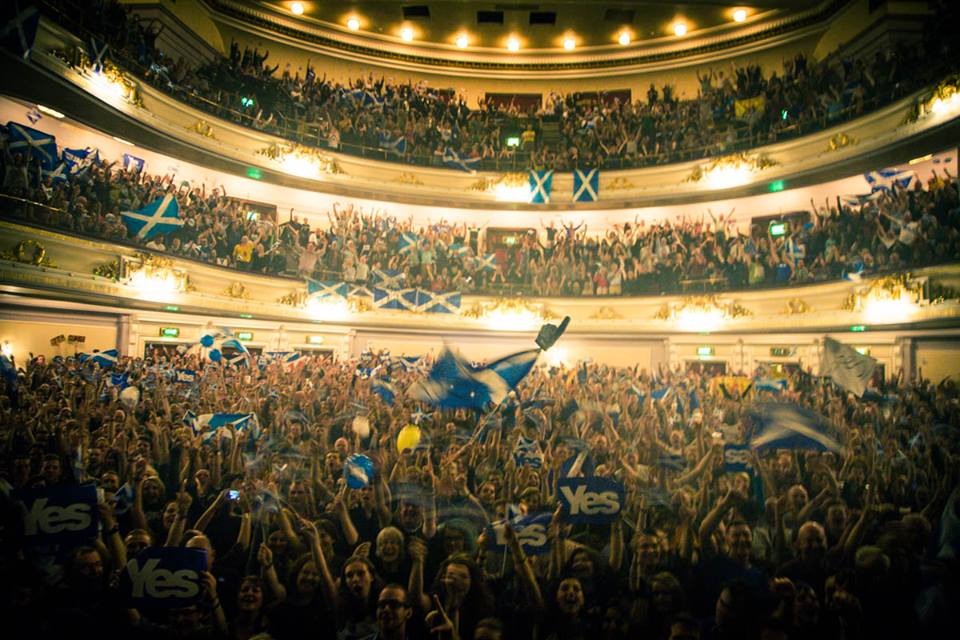
1. Scottish nationalism 

10646933_865686350108943_8042319944003093622_n

The nationalists lost Thursday’s referendum. So why are they still ‘winners’ in a political sense? Continue reading Scottish referendum results: winners and losers →

Scotland votes: Should it stay or should it go?

scotlandvotes

Today, residents of Scotland, a region of 5.3 million people, will vote in referendum that’s been scheduled for 19 months, and that will ask one simple question:scotlandUnited Kingdom Flag Icon

Should Scotland be an independent country?

The answer could change the economic, social and cultural outcomes of the lives of both English and Scottish residents for generations to come.

With polls set to open shortly, Suffragio looks at ten policy (and other) issues that Scots are considering as they cast their ballots, either to become an independent state or to remain part of the United Kingdom. Continue reading Scotland votes: Should it stay or should it go? →

If Scotland votes ‘No,’ what will devolution-max entail?

(35) Scottish Parliament

One of the biggest carrots that the ‘Better Together’ campaign is dangling to undecided voters in the week before tomorrow’s Scottish independence referendum is the concept of ‘devo-max’ — the idea that London will deliver ever greater devolution of policymaking powers to the Scottish parliament in Holyrood.United Kingdom Flag Iconscotland

Conservative prime minister David Cameron, Liberal Democratic deputy prime minister Nick Clegg and Labour leader Ed Miliband on Tuesday together signed a high-profile pledge to give Scotland greater powers, even without reducing the amount of financial support Scotland currently receives from Westminster.

That is, of course, if Scots vote ‘No’ to independence.

It’s a vow that nationalist leaders, including Scottish first minister Alex Salmond, were quick to dismiss as last-minute gasps of desperation not to be trusted. Salmond, among others, noted that it was Cameron’s insistence on a straight in-or-out vote that eliminated a possible third option for a more federal United Kingdom or some form of devo-max when the two leaders agreed the referendum in March 2013.

Former Labour prime minister Gordon Brown has argued for months that a ‘No’ vote would necessarily require a debate over additional devolution. It might have been strategically wiser if British party leaders, as well as the leaders of the ‘Better Together’ campaign like former Labour chancellor Alistair Darling, had acknowledged the devo-max option earlier. That may be one reason why Brown, who engineered Scottish devolution upon Labour’s 1997 electoral victory, has emerged as such a strong champion for the ‘No’ campaign, despite his national defeat in the 2010 general election. His speech today, less than 24 hours before polls open, was one of the best of the campaign (on either side) and maybe the best of his career.

If a ‘Yes’ vote could endanger Cameron’s premiership, a ‘No’ vote tomorrow could alter Brown’s legacy for the positive.

But as politicians from the left and the right have descended upon Scotland in the last week, with polls showing a much tighter contest than the anti-independence campaign ever anticipated, it’s worth considering three questions about the latest promise of further devolution:

  • Has Scotland effectively used its local governance powers in the past 15 years?
  • What additional powers might Scotland be granted as part of ‘devo-max’?
  • With a general election approaching in May 2015, and with the governing Conservative base firmly rooted in England, is the promise of devo-max something Cameron can legitimately deliver, in light of grumbling from English Tories increasingly frustrated about concessions to Scotland?

Continue reading If Scotland votes ‘No,’ what will devolution-max entail? →

The 13 key EU players in the proposed Juncker Commission

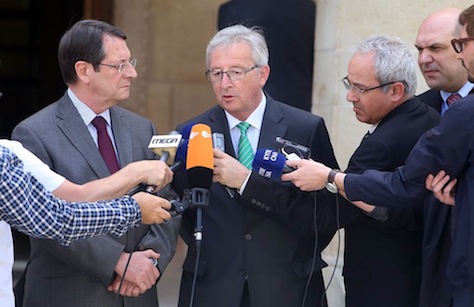
juncker

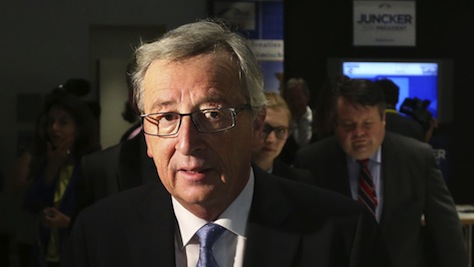
On Wednesday, the incoming president of the European Commission, Jean-Claude Juncker (pictured above), released full details on the proposed commissioners within his Commission, which will serve as the chief executive and administrative body of the European Union between 2014 and 2019.European_Union

The most important feature of the proposed Juncker Commission is that he’s introduced the greatest amount of hierarchy in an institution that used to be flat. It’s not a secret that some portfolios have always been more desirable than others, especially as the Commission has expanded to include all 28 member-states. But Juncker has introduced a first vice president and five vice presidents, who will also serve alongside Italy’s foreign minister Federica Mogherini, who was appointed two weeks ago to serve as Commission vice president and high representative for foreign affairs and security policy.

The delegation of so much power to five ‘super-commissioners’ with roving, supervisory briefs indicates that Juncker intends to be a much less hands-on Commission president that his predecessor, José Manuel Barroso. But it also reflects a Commission that, including Luxembourg’s Juncker, contains five former prime ministers (Finland, Slovenia, Latvia and Estonia).  It also contains four incumbents (Germany, Sweden, Bulgaria and Austria) who have served throughout the full second term of the Barroso Commission. That makes the Juncker Commission possibly the most distinguished in EU history.

Each commissioner must be approved by the European parliament and, while individual nominees have had troubles in the past, the parliament typically approves the vast majority of a Commission president’s appointments, all of whom were nominated by their respective national governments.

With nine women, it’s not as unbalanced as feared even a week or two ago, and with 14 members of the center-right European People’s Party (EPP), eight members of the center-left Party of European Socialists (PES) and five members of the Alliance of Liberals and Democrats for Europe (ALDE), it generally reflects the results of the May 25 European parliamentary elections, though some social democrats and socialists are grumbling that the left doesn’t have enough representation.

So what can we expect from this illustrious college of commissioners?

Here’s a look at the 13 most important players in the proposed Commission (aside from Juncker and Mogherini, of course). Continue reading The 13 key EU players in the proposed Juncker Commission →

How an independent Scotland could enter the EU

Scottish referendum debate urging yes vote

One of the most vexing questions of the current campaign for Scottish independence is how easily it might be for an independent Scotland to join the European Union.scotlandUnited Kingdom Flag IconEuropean_Union

As a constituent part of the United Kingdom, Scotland has been part of the European Union and its predecessor, the European Economic Community, since 1972, the date of the first EEC enlargement, when Ireland and Denmark also joined.

As such, Scotland has been exempt from several conditions that would be required of an independent country seeking EU membership today. Scotland hasn’t had to join the eurozone or become a member of the Schengen zone, which allows all EU citizens to travel freely throughout 26 of the 28 member states (Ireland and the United Kingdom are the exceptions). It has also received some of the benefit of those rebates that Margaret Thatcher clawed back from Europe in the 1980s.

An independent Scotland might be forced to accept, at least in principle, joining either or both of the the eurozone the Schengen zone as a condition of re-accession to the European Union. The former could complicate the assurances that Scottish first minister Alex Salmond has tried to give that Scotland could continue using the British pound and, like Ireland today, share open borders with what remains of the United Kingdom. Continue reading How an independent Scotland could enter the EU →

If Scotland votes for independence, will David Cameron resign?

cameronscotland

It was another Conservative prime minister, Harold Macmillian, who explained in just five short words how governments can crumble with such spectacular suddenness:scotlandUnited Kingdom Flag Icon

Events, my dear boy, events.

Today, his Tory successor, British prime minister, David Cameron faces one of the biggest events of the history of his country — the possible disintegration of the British union, as the chances of a Scottish vote in favor of independence in 10 days rise dramatically.

As polls show that the campaign has rapidly narrowed (the ‘No’ campaign had a 20-point lead just last month), and with handful of polls now showing that the ‘Yes’ campaign has taken a narrow lead just days before the September 18 referendum, Cameron now suddenly faces the prospect that he’ll be the prime minister on whose watch Great Britain simply dissolved.

* * * * *

RELATED: Why would an independent Scotland
even want to keep the pound?

* * * * *

It was Cameron, after all, who agreed with Scottish first minister Alex Salmond last year to hold a referendum, and it was Cameron who demanded a straight in/out vote — no third option for ‘devolution max’ or a federalized version of the United Kingdom.

So if Cameron loses Scotland, must Cameron go?

Victory for the independence camp would cause nearly as great a political earthquake in the rest of the United Kingdom as in Scotland. It would leave rest of the United Kingdom — England, Wales and Northern Ireland — to pick up the pieces of what was once a global superpower. All three major parties, including the center-left Labour Party and the junior coalition partner, the Liberal Democrats, fully opposed independence. So a ‘Yes’ victory would be a repudiation, from Scotland at least, of the entire political mainstream.

Cameron’s position, in particular, would be especially vulnerable as the prime minister who allowed the great British union to fall apart.

Continue reading If Scotland votes for independence, will David Cameron resign? →

Tusk, Mogherini appointed to top European offices. What next?

tuskrompuy

The European Council appointed Polish prime minister Donald Tusk as Council president and nominated Italian foreign minister Federica Mogherini as its new high representative for foreign affairs and security policy.Italy Flag IconEuropean_UnionPoland_Flag_Icon

The appointments of both Mogherini and Tusk were widely expected in the days and hours leading up to today’s EU summit.

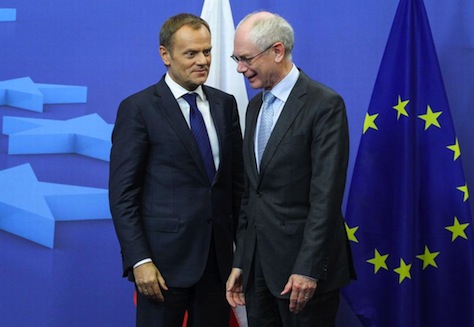
Tusk (pictured above, left, with his predecessor, Herman Van Rompuy), age 57, was first elected prime minister in 2007 and reelected in 2011 as the leader of the center-right Platforma Obywatelska (PO, Civic Platform), each time defeating the more conservative, nationalist Prawo i Sprawiedliwość (PiS, Law and Justice). Essentially a moderate liberal and European federalist, Tusk has governed Poland for seven of the 10 years during which it’s been a member of the European Union. His elevation to the Council presidency marks the first time that a central or eastern European has held a top EU office, and it reflects Poland’s growing clout as one of the engines of the European Union.

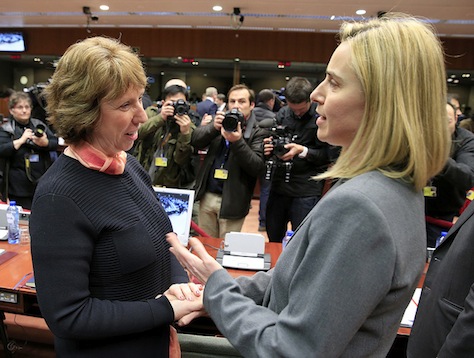
ashtonmogherini

Mogherini (pictured above, right, with her predecessor, Baroness Catherine Ashton), age 41, only recently became Italy’s foreign minister in February, when prime minister Matteo Renzi maneuvered his way into the premiership. Though some Baltic and eastern European leaders doubted her level of experience and questioned whether she might be too sympathetic to Russia, she’s received strong marks in her six months as Italy’s foreign minister, marking her as a rising star in the new generation of leaders in Renzi’s center-left Partito Democratico (PD, Democratic Party).

* * * * *

RELATED: Who is Federica Mogherini?

* * * * *

Together with Jean-Claude Juncker, the former Luxembourg prime minister, who was nominated by the Council in June as the president of the European Commission, the EU’s chief executive and regulatory body, Tusk and Mogherini will be responsible for setting EU policy through 2019.

The Council presidency was created by the Treaty of Lisbon, which came into effect only in 2009. Before Lisbon, the Council president was simply the leader of the country that held the six-month rotating Council presidency. Van Rompuy, a former Belgian prime minister, served as the inaugural Council president. Upon the Council’s decision today, Tusk will begin his first term of 2.5 years in December, with the option for reappointment to a second term of 2.5 years.

The high representative role existed prior to the Lisbon Treaty, but it was greatly expanded when Ashton, a former Labour member of the House of Lords, was appointed to the role in 2009. Technically, Mogherini will serve as Italy’s representative on the European Commission and, accordingly, her term will run for five years and is  subject to the approval of the European parliament. 

Given their different backgrounds, Tusk and Mogherini were viewed as a complementary team. Eastern and central Europeans are delighted to see Tusk, a relatively hawkish voice on Russia, elevated to the Council presidency. Meanwhile, Mogherini brings gender diversity to the Commission, and she will join Martin Schulz, a German social democrat, as the chief voice of the center-left at the top of the EU policymaking apparatus.

* * * * *

RELATED: Forecasting the EU power summit, part 1
Europe’s next high representative

RELATED: Forecasting the EU power summit, part 2
Europe’s next council president

* * * * *

But what does it mean for the next five years of European policy? Continue reading Tusk, Mogherini appointed to top European offices. What next? →

How Tony Abbott killed Australia’s carbon trading scheme

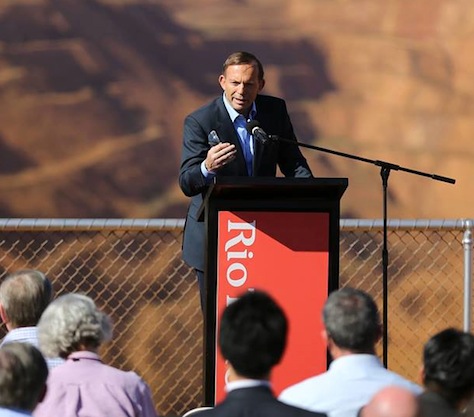
abbottclimate

In the end, Australian prime minister Tony Abbott didn’t have to call a special, massive ‘double dissolution’ election to roll back Australia’s carbon pricing scheme, the signature policy accomplishment of the six-year Labor government that preceded him.australia new

All it took was some deft maneuvering to cobble together a working majority in the 76-member Senate, where Abbott’s Liberal/National Party holds 33 seats, just short of a majority.

Nevertheless, Abbott (pictured above) won a narrow 39 to 32 victory last month in the upper house of Australia’s parliament, on the strength of six additional non-Coalition votes to repeal the carbon trading market. Having been one of the first countries to adopt a carbon trading market, Australia on July 17 became the first country to repeal a carbon trading market.

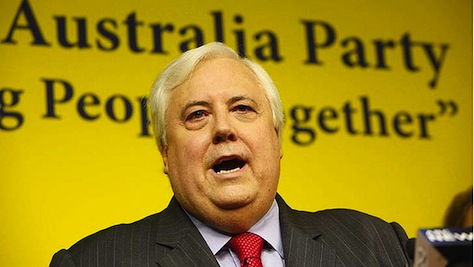
clive palmer

That included the support of a mercurial former mining magnate named Clive Palmer (pictured above), whose maverick conservative Palmer United Party (PUP) became the swing vote in determining whether Abbott’s repeal push would succeed or fail.

The Labor Party’s new leader, Bill Shorten, led an unsuccessful push in alliance with the Australian Green Party, to oppose the repeal. Labor holds 25 seats in the Senate, while the Greens hold another 10. 

Abbott’s resulting victory is primarily a triumphant tactical and policy victory for the Australian right, giving Abbott an easy talking point on reducing the price of electricity for the average Australian voter (though the real long-term impact of the repeal of a carbon scheme that had reduced emissions by less than 10 percent nationally is yet to be determined).

It’s also a narrative about the fragmentation of the country’s two-party system, as far as Australian senatorial elections go, with voters placing increasingly greater power in the hands of independent third-party candidates.

On the global scale, it marks a symbolic victory for opponents of similar climate change legislation worldwide, though the battle over carbon emissions was never going to be won or lost in Australia, a country of less than 23 million. Arguably, China’s decision in June, for the first time, to limit carbon emissions at the national level, will have a much wider impact on global climate change policy.

While British prime minister David Cameron continues to promote a progressive stand on climate change as an issue to pull his Conservative Party to the middle in the United Kingdom, there’s no indication that the UK is set to introduce any major climate change legislation on the scale of Australia’s experiment with carbon pricing beyond the EU’s own carbon trading scheme. Though there was a brief window in 2008 and 2009 when a carbon-based exchange system might have been enacted in the United States with bipartisan support, those days seem long gone. Nevertheless, the administration of US president Barack Obama and the US Environmental Protection Agency, however, introduced executive actions this summer that aim to reduce US carbon emissions by 30% by the year 2030.

Australia’s carbon scheme has its origins as one of the major promises of former prime minister Kevin Rudd’s widely successful 2007 campaign that brought the Labor Party back to government after more than a decade in opposition. It was, in part, Rudd’s decision to back away from climate change legislation that caused his Labor colleagues to dump him in 2010 in favor of then-deputy prime minister Julia Gillard.

After Gillard won a narrow reelection campaign of her own later that year, she enacted a comprehensive climate change bill in 2012, as well as a broader tax on mining profits (that hasn’t raised nearly as much revenue as expected). 

The problem, both in Australia and beyond, is that the global financial crisis of 2008-09 left many national electorates wary of climate change legislation that, almost overnight, suddenly seemed much too costly to introduce at a time when so many developed countries were struggling with the highest unemployment and lowest GDP growth in decades.

That made Abbott’s pledge to repeal what’s popularly become known in Australia as the ‘carbon tax’ one of the most popular aspects of his agenda, which won wide support the parliamentary elections last September that brought Abbott’s Coalition into government. His recent victory in winning Senate support to repeal the carbon scheme will almost certainly rank among the chief legislative successes of his first year as prime minister. Continue reading How Tony Abbott killed Australia’s carbon trading scheme →

European Council proposes Juncker as Commission president

juncker

Bowing to pressure from European parliamentary leaders, the European Council has proposed as its candidate for the presidency of the European Commission Jean-Claude Juncker, the former prime minister of Luxembourg and former head of the Eurogroup, the informal gathering of the eurozone finance ministers. European_Union

That makes it virtually certain that the European Parliament will elect Juncker (pictured above) as the next Commission president, likely with the full support of the two major pan-European parties in the Parliament, Juncker’s own center-right European People’s Party (EPP) and the center-left, social democratic Party of European Socialists (PES). It also likely means that the PES candidate for the Commission  presidency, Martin Schulz, will become the Commission vice president. 

It’s obviously a defeat for British prime minister David Cameron who, just last week, was still holding out hope that he could pull together a blocking minority to keep Juncker from receiving the Council’s endorsement. But by the time the Council gathered to vote, only Hungarian prime minister Viktor Orbán joined Cameron in opposing Juncker. Not only did Cameron fail to win over allies, he failed to keep both Dutch prime minister Mark Rutte and Swedish prime minister Frederik Reinfeldt, neither of whom are enthusiastic about the prospects of a Juncker candidacy.

Contacted by a reporter for the Moscow-based RIA Novosti earlier today, I had a chance to put together some quick thoughts on what the Juncker decision means. Here are my real-time responses, which will double as my real-time analysis on where things go from here.  

On how the choice reflects the European parliamentary elections on May 25:

The choice reflects the fact that Juncker was the candidate of the European People’s Party, the pan-European group of center-right, Christian democratic parties, and the EPP won the greatest number of seats in the European parliamentary elections on May 25. The EPP nominated Juncker as its candidate for the European Commission presidency prior to the May 25 parliamentary elections, just as several other European parliamentary parties nominated their own candidates. The candidates — the German term ‘Spitzenkandidaten‘ developed widespread use across Europe — campaigned throughout the spring, and they participated in a set of debates on the EU’s future.

Under the Lisbon treaty, the European Council is supposed to ‘propose’ a candidate for Commission president, which will be ‘elected’ by the European Parliament, with the Council ‘taking into account’ the results of the parliamentary election. No one knows exactly what that means, but Juncker and the other parliamentary leaders believe firmly that the Council must propose Juncker as its candidate. In so doing today, the Council has set an important precedent for future parliamentary elections, though national leaders will be loathe to admit it.

Proponents of the Spitzenkandidaten system argue that Juncker represents the will of the European electorate, because he’s the candidate of the party that won the most votes, but it’s not so simple as that. There’s no real indication that the majority of European voters were voting on the basis of this or that Commission presidential candidate. Voter turnout has dropped significantly since the first European elections in 1979, and voters often cast their ballots on the basis of national governments or other factors. To the extent there was a unifying theme to the elections, it was the rise of euroscepticism on both the far right and the far left, with the victories of groups like the United Kingdom Independence Party, France’s Front national (National Front) and Denmark’s Dansk Folkeparti (People’s Party). Whatever ‘mandate’ you take away from the European elections, it’s hard to argue there’s a groundswell of genuine democratic support for Juncker. It was only last October that Juncker’s own center-right Christian Social People’s Party suffered so many losses in Luxembourg’s national elections that he was forced out as prime minister after 18 years.

Continue reading European Council proposes Juncker as Commission president →

EU rewards Rama, Albania with candidate status

ramablair

Maybe the decision to hire former British prime minister Tony Blair as an advisor to Albania’s new government was an astute move after all.albania

The European Council will formally name Albania as a candidate for eventual EU membership at its summit this weekend, following a decision by British prime minister David Cameron to allow Albania’s candidacy to move forward on its fourth attempt to win candidate status since 2009. As the EU membership negotiations unfold for Albania, as well as for other Balkan countries such as Serbia and Montenegro, Cameron is expected to seek carve-outs that make it more difficult for laborers from new EU member-states to enjoy free movement throughout the EU single market.

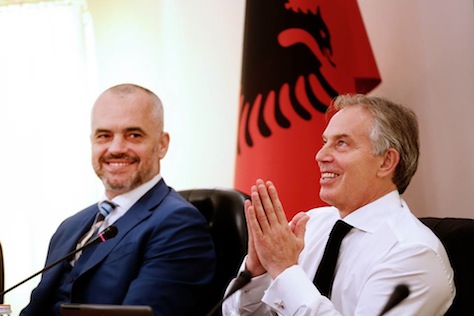
The move follows a largely successful parliamentary election in June 2013 and aggressive steps by Albania’s new, energetic prime minister Edi Rama (pictured above, left, with Blair, right) to stamp out corruption and organized crime. Albanian police moved last week, for example, to subdue Lazarat, a village in southern Albania that’s known as a chief source of marijuana throughout Europe, with an estimated annual production of €4.5 billion. Continue reading EU rewards Rama, Albania with candidate status →

It won’t necessarily take much to block Juncker in Council vote

David Cameron and Angela Merkel

One fact that’s becoming increasingly clear in the current tussle over electing a new president of the European Commission is that the eventual candidate must win a qualified majority on the European Council, as well as an absolute majority in the European Parliament. European_Union

Though the rules for qualified majority voting on the Council are greatly simplified under the Treaty of Lisbon, it’s worth noting that those rules don’t take effect until November 2014.

That means that the old rules, under the Treaty of Nice, will be in effect during the current fight this summer over whether former Luxembourg prime minister Jean-Claude Juncker, the candidate of the European People’s Party (EPP), can become the next Commission president.

* * * * *

RELATED: Here come the Spitzenkandidaten! But does anybody care?

RELATED: The mother-of-all-battles over
European integration has begun

* * * * *

With the current president of the Council, Herman Van Rompuy, currently taking the lead on the process, the Council will submit a formal proposal for Commission president during its next official summit on June 26 and 27.

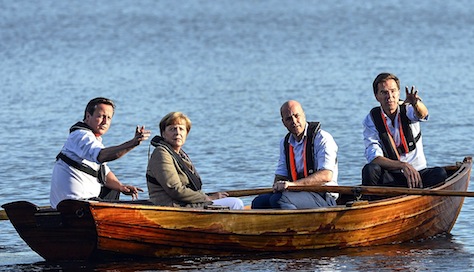
That explains why the focus of the fight over Juncker has moved from the Parliament to a fight between German chancellor Angela Merkel and British prime minister David Cameron (pictured above, last week, left, with Swedish prime minister Frederik Reinfeldt and Dutch prime minister Mark Rutte).

Under the Lisbon rules, qualified majority voting means that a proposal under consideration by the Council must meet three requirements:

  • a majority of countries within the European Union (15 out of 28 countries);
  • a supermajority (74%) of countries according to a formula of voting weights; and
  • a supermajority of countries representing  at least 62% of the EU-wide population.

The trickiest hurdle is meeting the 74% hurdle. The system assigns weights, roughly corresponding to population, to each country, with a maximum of 29 for each of Germany, France, the United Kingdom and Italy, and a minimum of three for the smallest member, Malta. With a total of 352 weighted votes after Croatia’s July 2013 EU accession, that means Juncker must win at least 260 weighted votes. Conversely, it means that a minority consisting of 93 weighted votes can block Juncker.

Cameron is committed to opposing Juncker.

Hungarian prime minister Viktor Orbán, who belongs to the EPP, has also opposed Juncker in retribution for Luxembourg’s outspoken role on the Commission in the past five years attacking Orbán’s questionable respect for democratic norms and press freedom in Hungary.

Reinfeldt, the Swedish prime minister, has also voiced doubts about Juncker’s candidacy, even though he also belongs to the EPP. If Juncker fails to pass muster in the Council, Reinfeldt himself has been mentioned as a compromise candidate, given the likelihood that his center-right Moderata samlingspartiet (Moderate Party) is expected to lose national elections in September.

Rutte, the Dutch prime minister, has joined Reinfeldt in his hesitation over Juncker. Rutte, like Cameron and Reinfeldt, is generally a Merkel ally on European economic policy and the need for trimming national budgets, but he belongs to the Alliance of Liberals and Democrats in Europe (ALDE), the third-largest European parliamentary bloc.

If Sweden (10 weighted votes) and The Netherlands (13 votes) join Hungary (12 votes) and the United Kingdom (29 votes), Cameron will have 64 votes to block Juncker — and he’ll need just 29 more votes to do so.

Those votes could come from Italy, where prime minister Matteo Renzi has demanded a more flexible interpretation of EU budget rules and a greater emphasis on economic growth stimulation (instead of austerity) in exchange for backing Juncker. A deal seemed imminent earlier this week, though Renzi hasn’t yet declared either support or opposition for Juncker.

Right now, the momentum seems to be with Merkel and Juncker, and flowing away from Cameron. Either Rutte or Reinfeldt could back down from their criticisms. Furthermore, Renzi might be wary of alienating Merkel just four months into his premiership and days before Italy assumes the six-month rotating Council presidency. But Cameron, who has suggested Denmark’s social democratic prime minister Helle Thorning-Schmidt as an alternative Commission president, might yet persuade Renzi to join him for at least one shot at obtaining a more reformist Commission president than Juncker.

It’s worth noting that French president François Hollande, like Renzi, would like to see a greater emphasis on growth at the European level, and he hasn’t firmly indicated that he’ll support Juncker, either.

Continue reading It won’t necessarily take much to block Juncker in Council vote →