Tag Archives: obama

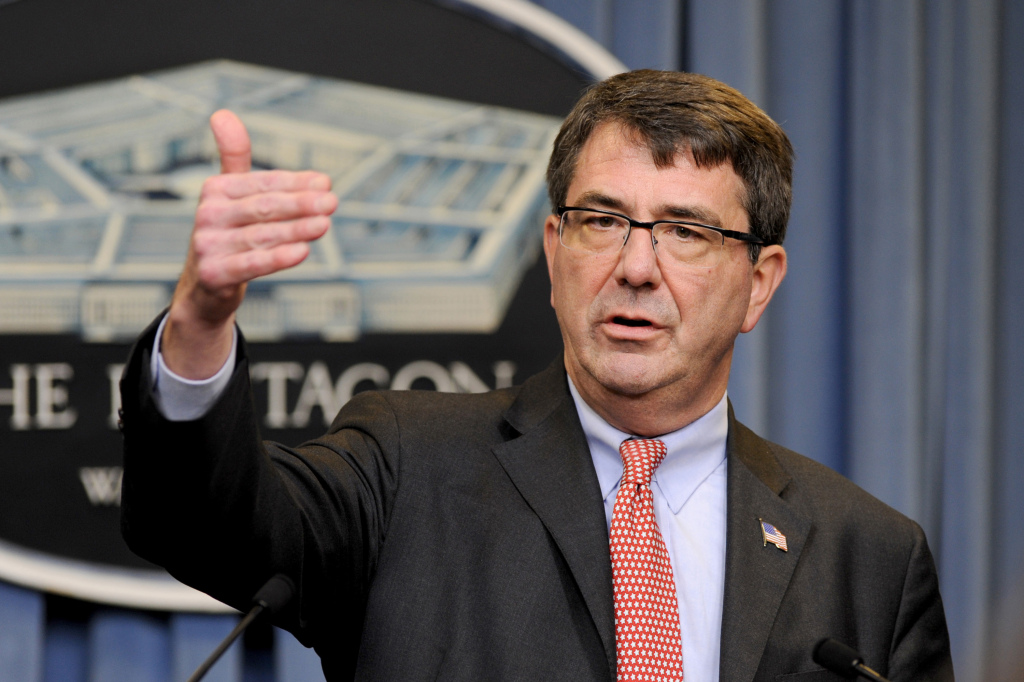
Ashton Carter will be Obama’s fourth defense secretary

100628-D-9880W-113.JPG

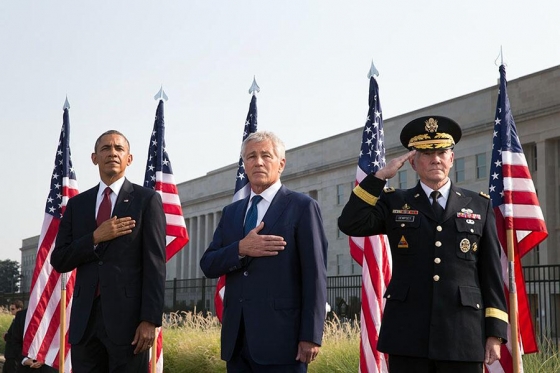
Just a week after US president Barack Obama in essence fired his defense secretary, former Republican senator Chuck Hagel of Nebraska, he has apparently found a successor — Ashton Carter.USflag

Carter served as deputy secretary of defense between October 2011 and December 2013 under both Hagel and Hagel’s predecessor, Leon Panetta, a longtime Democratic operative, former budget chief, Clinton administration chief of staff and California congressman.

Carter, who graduated from Yale University with majors in medieval history and physics, has an extensive background as under secretary of defense for acquisition, technology and logistics. He is a Rhodes scholar with a doctoral degree in physics as well.

As a defense secretary, he will be more like Panetta or Robert Gates, a master of the Pentagon and its bureaucracy and budget. He isn’t expected to be a visionary, like former Bush-era defense secretary Donald Rumsfeld, which is just as well, given that so much national defense policymaking is centered in the White House, not at the Pentagon. Nevertheless, The Atlantic‘s editor-at-large, Steve Clemons noted earlier on Tuesday on Twitter that Carter is hawkish with respect to Iran, which could nudge administration policy, a week after stalled negotiations over Iran’s nuclear weapons program were extended until July 2015.

* * * * *

RELATED: Hagel’s exit symbolizes Obama policy shift

* * * * *

Unlike Hagel (or even Panetta), Carter is not a politician, but rather a career technocrat and policy wonk.  As an assistant secretary of defense under US president Bill Clinton, Carter was responsible for international security policy, and he has written extensively on the topic of nuclear non-proliferation.

When Obama was looking to replace Panetta two years ago, Carter was on the short list as well, and there were indications that Hagel and Carter didn’t always see eye-to-eye at the Pentagon, one reason why Carter may have stepped down as deputy secretary late last year.

His background from the immediate post-Cold War period makes Carter especially cognizant of many issues in the former Soviet Union, perhaps an especially relevant qualification as Russia’s aggression toward Ukraine (and perhaps the Baltic states and Georgia) increases.

Carter is easily expected to win confirmation by the US Senate, which will be Republican-controlled as of early January, following Republican gains in both houses of the US Congress in November’s midterm congressional elections.

Kuomintang loses Taipei as premier resigns

dr.ko

Forget Japan’s election in two weeks — the political earthquake in east Asia today come in the form of a new pro-independence mayor in Taipei, the capital city of Taiwan, also known as the Republic of China (ROC).taiwanChina Flag Icon

The result is a stinging defeat for the ruling Kuomintang (中國國民黨), and prime minister Jiang Yi-huah stepped down in response to the Kuomintang’s defeats in municipal elections held Saturday across the island of Taiwan. The scale of the ruling party’s defeat in the November 29 elections indicates that it will be hard-pressed to hold onto Taiwan’s presidency in 2016,  paving the way for a more stridently pro-independence president.

Following the local elections, the Kuomintang lost power in eight of the country’s 22 various city and county governments.

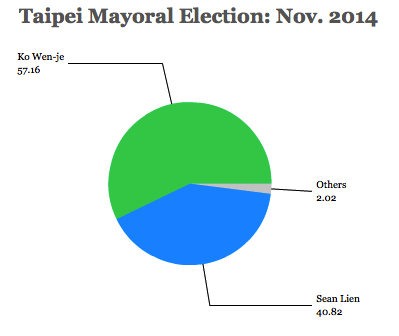
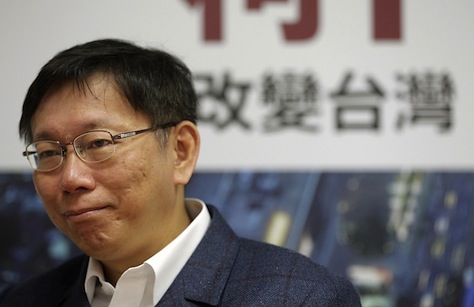
In Taipei, Dr. Ko Wen-je, a respected surgeon and an independent candidate supported by the opposition, pro-independence Democratic Progressive Party (DPP, 民主進步黨), easily won the capital’s mayoral election, ending 16 years of Kuomintang control.

Ko defeated Sean Lien, a financier, and, as the son of a former vice president, a scion of the Kuomintang elite. Lien was never the strongest candidate for Taipei’s mayoral election, and Ko headed the trauma hospital unit that saved Lien’s life four years ago. A surgeon team supervised by Ko successfully removed a bullet from Lien’s head after he was shot at a 2010 campaign rally.

taipel14

While Lien promised to bring international capital (including, presumably, from Beijing, Shanghai and elsewhere in the PRC) to Taipei, Ko focused on social justice in a country that faces growing income inequality and rising housing prices, familiar concerns across the developed world.

The elections were something of a referendum on the Kuomintang’s push to create closer economic ties with the Chinese mainland. So while the results are a setback for Kuomintang and Taiwan’s president Ma Ying-jeou (馬英九), they are even worse for the People’s Republic of China.

* * * * *

RELATED: Taiwan watches battle of wills
between Beijing and Hong Kong

* * * * *

Earlier this year, young Taiwanese students protested in full force to stop the Cross-Strait Service Trade Agreement (CSSTA), which would have significantly liberalized trade in services with mainland China. Ma’s attempt to push the agreement through the Taiwanese legislature met with furious opposition, and the CSSTA hasn’t yet been passed into law, a significant victory for the self-proclaimed ‘sunflower student movement.’ Continue reading Kuomintang loses Taipei as premier resigns

Hagel’s exit symbolizes Obama policy shift

bt5vhvjcuaag5ye

The headline should have read yesterday:USflag

“US President elected to end military quagmires in the Middle East fires prominent anti-quagmire Defense Secretary, ramps up for ambiguous Middle Eastern quagmire.”

Whatever the reasons for US president Barack Obama’s decision to fire defense secretary Chuck Hagel, it’s clear that Hagel’s brand of foreign-policy realism is falling ever further out of favor, as the Obama administration moves toward a more interventionist approach to foreign policy in its final two years.

Though the decision, in superficial ways, is similar to the 2006 resignation of former defense secretary Donald Rumsfeld, which also followed a devastating midterm election for president George W. Bush, Hagel’s experience at the Pentagon had little in common with Rumsfeld’s tenure.

Hagel, his worldview forged as a squad leader in the US army infantry during the Vietnam War, was always a cautious prairie conservative. As a former US senator from Nebraska, Hagel stood up to his own Republican Party over the conduct of the US occupation of Iraq in the mid-2000s.

That skepticism seemed to be pitch-perfect for the Obama administration in earlier years, when it was taking pains to extricate the United States from internal conflicts in the Middle East.

Obama successful ended the US occupation of Iraq, he studiously avoided taking sides in the Syrian civil war (even when it meant swallowing criticism for backing away from his ‘red line’ statement about the use of chemical weapons), and he kept US military assistance to a minimum in the NATO-led effort to support anti-regime rebels in Libya.

Critics have argued that the Obama administration has pursued a disengaged approach to world affairs, thereby explaining both Libya’s disintegration into chaos and, in no small measure, the vacuum that allowed the Islamic State group (الدولة الإسلامية‎) to wreak havoc throughout traditional Mesopotamia — eastern Syria and western Iraq.

That criticism seems to have resonated with Obama and his foreign policy and national security team, and Obama’s apparent decision to make a personnel change seems more important than the fact that Hagel is out and someone new is in. Telescoping that decision comes with the real costs involved with pushing a high-profile nomination through what will be a Republican-controlled Senate in January 2015. Hagel stumbled from the beginning, starting with the Congressional hearings upon his appointment and who seemed to lack the presence for the role. But neither he nor his successor is likely to call the shots on foreign policy.

Continue reading Hagel’s exit symbolizes Obama policy shift

Throughout ‘reform’ debate, US ‘immigration’ has changed

bushfox

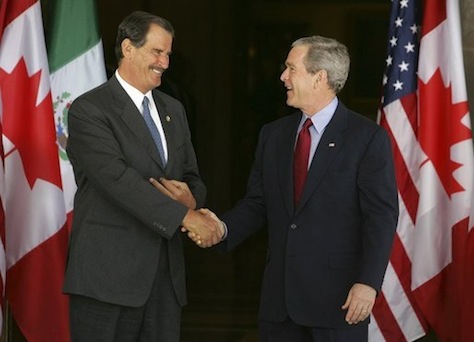
In 2001, when George W. Bush came to power in the United States, three factors — his record as a Texas governor, the strong relationship that he had developed with his conservative Mexican counterpart, Vicente Fox, and his hope to make the Republican Party more attractive to US-based Latino voters — meant that immigration reform was suddenly back on the agenda for the first time since 1986.USflag

Three US presidential elections, two Mexican presidential administrations and a 2001 terrorist attack and a 2008 financial crisis later, Bush’s successor, Democratic president Barack Obama, will take a leap toward immigration reform today through executive action, pushing as far to the line as possible without exceeding his authority vis-à-vis the US Congress.

Obama will announce today a plan that will de-emphasize the deportation of undocumented immigrants to the United States who have lived in the United States for at least five years, and he will do so with a prime-time Thursday night speech and a campaign-style rollout in Las Vegas on Friday:

Up to four million undocumented immigrants who have lived in the United States for at least five years can apply for a program that protects them from deportation and allows those with no criminal record to work legally in the country, President Obama is to announce on Thursday, according to people briefed on his plans.

An additional one million people will get protection from deportation through other parts of the president’s plan to overhaul the nation’s immigration enforcement system, including the expansion of an existing program for “Dreamers,” young immigrants who came to the United States as children. There will no longer be a limit on the age of the people who qualify.

But farm workers will not receive specific protection from deportation, nor will the Dreamers’ parents. And none of the five million immigrants over all who will be given new legal protections will get government subsidies for health care under the Affordable Care Act.

It’s a strong first step toward reforms that both Republican and Democratic politicians have attempted (unsuccessfully) to pass through the US Congress since the Bush administration. Obama’s action could affect between 4 to 5 million of the currently 11.4 million undocumented immigrants in the United States today.

Why now? And why without Congress?

A pro-reform Republican president couldn’t pass a bill with either a Republican-led Congress (from 2005 to 2007) or a Democratic-led Congress (from 2007 to 2009). Nor has a pro-reform Democratic president passed a bill with either a Democratic-led Congress (2009 to 2011) or, currently, with a Republican House. Obama’s action indicates that he doesn’t believe that the switch to a fully Republican-led Congress will make much different. Despite howling from the Republican opposition about the ‘monarchial‘ nature of Obama’s executive action

While Washington debated immigration for over a decade, the nature of immigration in the United States has changed dramatically. Even if the basics of ‘reform’ today still look and feel like they did in 2001 or 2005 or 2008, the world has changed, and the nature of immigration to the United States has changed with it.

* * * * *

RELATED: 2014 US midterms showcase rise of Asian Americans

* * * * *

For example, in 2013, more Asians migrated to the United States than Latin Americans, part of a new wave of immigration from an even more diverse array of cultures, languages and backgrounds that’s rising. In 2008-09, as the global financial crisis sent the United States into its worst recession in decades, net migration from Mexico actually decreased, reflecting a larger trend that began in the mid-2000s. Continue reading Throughout ‘reform’ debate, US ‘immigration’ has changed

China has self-interested incentives for a bilateral climate deal

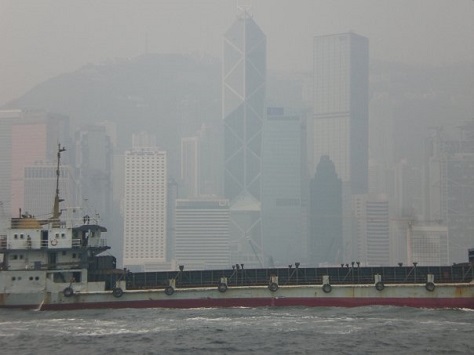
hongkong

When you walk through the streets of New York or Washington or even Houston or Los Angeles today, the air is clear — by at least global standards.USflagChina Flag Icon

That’s due, in part to the 1963 Clean Air Act in the United States, which together with wide-ranging 1970 and 1990 amendments that have largely brought air pollution under control within the United States. Sure, Los Angeles is still known for its smog, but the worst day in Los Angeles is barely a typical day in Beijing.

The PM2.5 reading (a measurement of particulates in the air) for Los Angeles last year averaged around 18. In Beijing? A PM2.5 reading of 90, on average. Los Angeles’s worst day was 79, while Beijing’s was 569.

That’s one of the reasons that the landmark carbon emissions agreement between the United States and the People’s Republic of China, announced in the wake of the Asia-Pacific Economic Cooperation (APEC) summit is such a big deal — it’s not necessarily a coup for US diplomacy, but it’s definitely a signal that Chinese authorities are taking pollution seriously. It shows that Chinese leaders under president leader Xi Jinping (习近平) recognize that in order to showcase their seriousness about environmental hazards, they have to engage the international community on climate change.
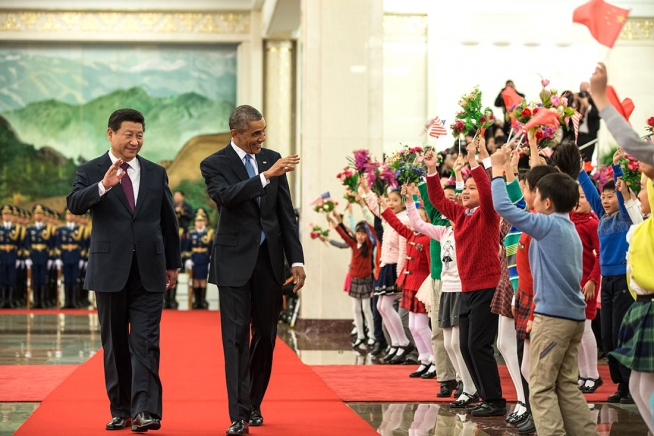
xibama

Landmark though the US-Chinese bilateral agreement may be, it is still much more about domestic Chinese priorities than trans-Pacific good will. As James Fallows writes in The Atlantic, pollution and environmental harms are the single-most existential challenge to the now 65-year rule of the Chinese Communist Party (中国共产党):

But when children are developing lung cancer, when people in the capital city are on average dying five years too early because of air pollution, when water and agricultural soil and food supplies are increasingly poisoned, a system just won’t last. The Chinese Communist Party itself has recognized this, in shifting in the past three years from pollution denialism to a “we’re on your side to clean things up!” official stance.

If you want to showcase to 1.35 million citizens that you’re serious about the environment, there’s no better way than signing a high-profile agreement with the world’s largest economy (and the world’s second-largest carbon emitter).

Xi himself has admitted earlier this year that it’s China’s most vexing policy issue, when he plainly stated that pollution is Beijing’s most pressing problem. Shortly thereafter, in March, premier Li Keqiang (李克强) declared a ‘war on pollution’ within China:

“Smog is affecting larger parts of China, and environmental pollution has become a major problem,” Mr. Li said, “which is nature’s red-light warning against the model of inefficient and blind development.”

That’s already having an effect, with the first drop in coal use in China in over a century, a result that’s possibly affecting global coal prices, though part of the effect might be explained by a slowing Chinese economy — it’s expected to grow at a pace of just 7.5% this year. That’s still robust by most standards, but it would be the lowest reported GDP growth in China since 1990.

Republicans in the United States grumbled that the pact was ‘one-sided,’ and perhaps it was (though you’d expect grumbling from incoming US Senate majority leader Mitch McConnell, a Republican from Kentucky, the heart of the US coal mining industry). But if so, it’s one-sided in the way that unilaterally lowering tariffs is good for trade. But US president Barack Obama’s commitment to lower US carbon emissions by 2025 by between 26% and 28% (compared to 2005 levels) is only going to accelerate the transition of the US economy from fossil fuels to cheaper, cleaner alternatives, including renewable energy.

China, on the other hand, has agreed to reduced emissions that it expects to peak in the year 2030, when it hopes to raise 20% of its energy from zero-carbon emission sources under the agreement. But Obama has already, through executive action, committed the US Environmental Protection Agency to work to reduce emissions levels by 17% through the year 2020, so the United States (for now) is already committed to carbon reductions on a unilateral basis.

Of course that’s lopsided, to some degree, but only if you ignore that the United States and Europe polluted without abandon in the 18th and 19th centuries when they were going through the same level of industrialization and development — and they surely didn’t do it with national populations of over a billion consumers.

Today, China is by far the largest emitter of carbon into the global atmosphere, responsible for 29% of the world’s total carbon emissions, while the United States is responsible for 15%, the European Union 10%, India 7.1% and Russia another 5.3%.  As White House correspondent Josh Lederman writes for the Associated Press, however, one of the agreement’s benefits might be in the power it will have to nudge other countries to join the fight against carbon emissions and its role in climate change with the 2015 Paris conference fast approaching:

Scientists have pointed to the budding climate treaty, intended to be finalized next year in Paris, as a final opportunity to get emissions in check before the worst effects of climate change become unavoidable. The goal is for each nation to pledge to cut emissions by a specific amount, although negotiators are still haggling over whether those contributions should be binding. Developing nations like India and China have long balked at being on the hook for climate change as much as wealthy nations like the U.S. that have been polluting for much longer. But China analysts said Beijing’s willingness to cap its future emissions and to put Xi front and center signaled a significant turnaround.

But there’s an even stronger benefit in the US-Chinese accord, insofar as it demonstrates that Xi is willing to work with the United States on tricky issues, even as China scrambles to compete with the more developed US efforts (through the Trans-Pacific Partnership) to form an Asia/Pacific trade bloc.

As Chinese military and political influence grows throughout the Asia/Pacific region, agreements like today’s on carbon emissions show that US and Chinese diplomats are establishing strong working relationship for potential collaboration in the future — cooperation that could be vital in the decades to come in maintaining a peaceful Asia and world.
 

2014 US midterms showcase rise of Asian Americans

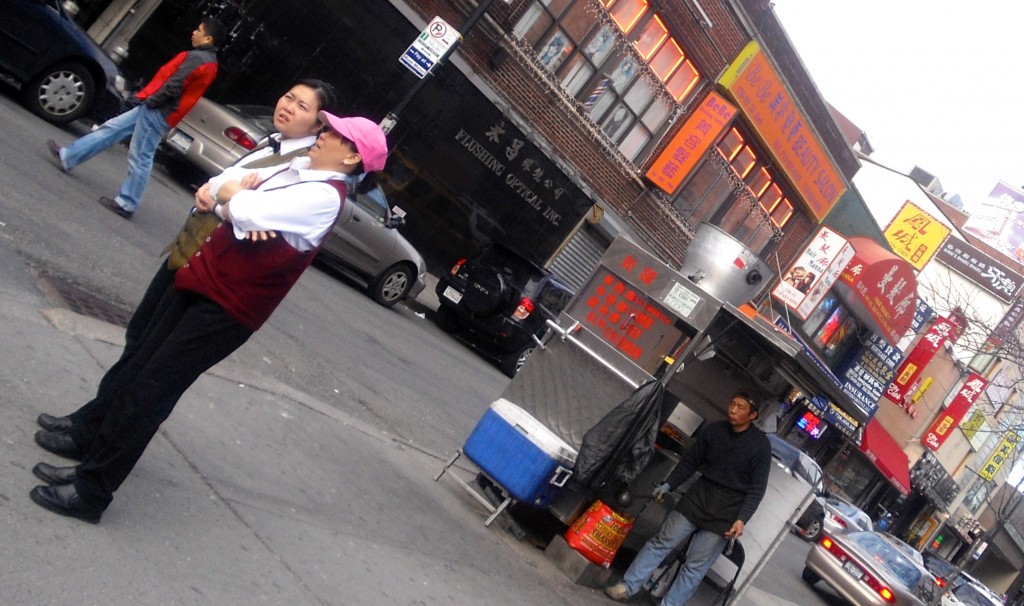
CIMG9933Flushing, in Queens, is one of the most Asian neighborhoods in the United States.

Apparently, the swing among Asian Americans between the 2012 general election in the United States and the 2014 midterm elections was a staggering 46%:asia iconUSflag

Note the big swing in the Asian voting bloc, too. In 2012, strong support for the president among Asian-American voters was a surprise. Asian voters preferred the president by 47 points. In 2014, the (low turnout) group split about evenly. It was a 46-point swing.

That still translates to a fairly robust tilt among Asian Americans toward Democrats — just not the overwhelming trend that we saw in 2012 and 2008 and, even to some degree, 2010. Other exit polling shows that Asian Americans still strongly supported Democrats — in Virginia, they favored incumbent Democratic senator Mark Warner over Republican challenger Ed Gillespie by a margin of 68% to 29%, for example.

But why should Asian Americans necessarily lean to the left? The Asian American experience in the United States is extremely varied, and it’s a growing bloc of disparate cultures and experiences. In that regard, Asian Americans are just like Latin Americans, who come from an equally broad range of national and ethnic background. Mexican Americans in California may have different political views that Mexican Americans in Texas, to say nothing of Salvadorans in Maryland, Cubans in New Jersey or Dominicans in Florida.

The same goes for Asian Americans.

So what are we talking about when we say, ‘Asian Americans?’ Continue reading 2014 US midterms showcase rise of Asian Americans

Putin tops world power rankings

putinpower

It’s far from scientific, but less than 24 hours after Republicans appeared to defeat US president Barack Obama in midterm congressional and gubernatorial elections, Russian president Vladimir Putin defeated him to the top spot on Forbes‘s 72 Most Powerful People in the World.USflagRussia Flag Icon

The rankings don’t really mean that much in the grand scheme of things, of course.

The Forbes rationale?

We took some heat last year when we named the Russian President as the most powerful man in the world, but after a year when Putin annexed Crimea, staged a proxy war in the Ukraine and inked a deal to build a more than $70 billion gas pipeline with China (the planet’s largest construction project) our choice simply seems prescient. Russia looks more and more like an energy-rich, nuclear-tipped rogue state with an undisputed, unpredictable and unaccountable head unconstrained by world opinion in pursuit of its goals.

Hard to argue with that, I guess.

But the rankings represent a nice snapshot of what the US (and even international) media mainstream believe to be the hierarchy of global power. Though I’m not sure why Mitch McConnell, soon to become the U.S. senate majority leader, isn’t on the list.

So who else placed in the sphere of world politics this year?

  • Obama ranked at No. 2 (From the Forbes mystics: ‘One word sums up his second place finish: caution. He has the power but has been too cautious to fully exercise it.’).
  • Chinese president Xi Jinping, who took office in late 2012 and early 2013, ranked at No. 3. (Tough break for the leader of the world’s most populous country!)
  • Pope Francis, ranked at No. 4, even though Argentina lost this year’s World Cup finals to Germany.
  • Angela Merkel, ranked at No. 5, third-term chancellor of Germany and the queen of the European Union.
  • Janet Yellen, ranked at No. 6, the chair of the US Federal Reserve.
  • Mario Draghi, ranked at No. 8, the president of the European Central Bank.
  • David Cameron, ranked (appropriately enough) at No. 10, the Conservative prime minister of the United Kingdom, who faces a tough reelection battle in May 2015.
  • Abdullah bin Abdul Aziz Al Saud, No. 11, the king of Saudi Arabia.
  • Narendra Modi, No. 15, India’s wildly popular new prime minister.
  • François Hollande, No. 17, France’s wildly unpopular president.
  • Ali Khamenei, No. 19, Iran’s supreme leader, especially as Iranian nuclear talks come to a crucial deadline this month.

Continue reading Putin tops world power rankings

What the world can teach the United States about DC voting rights

DSC00905

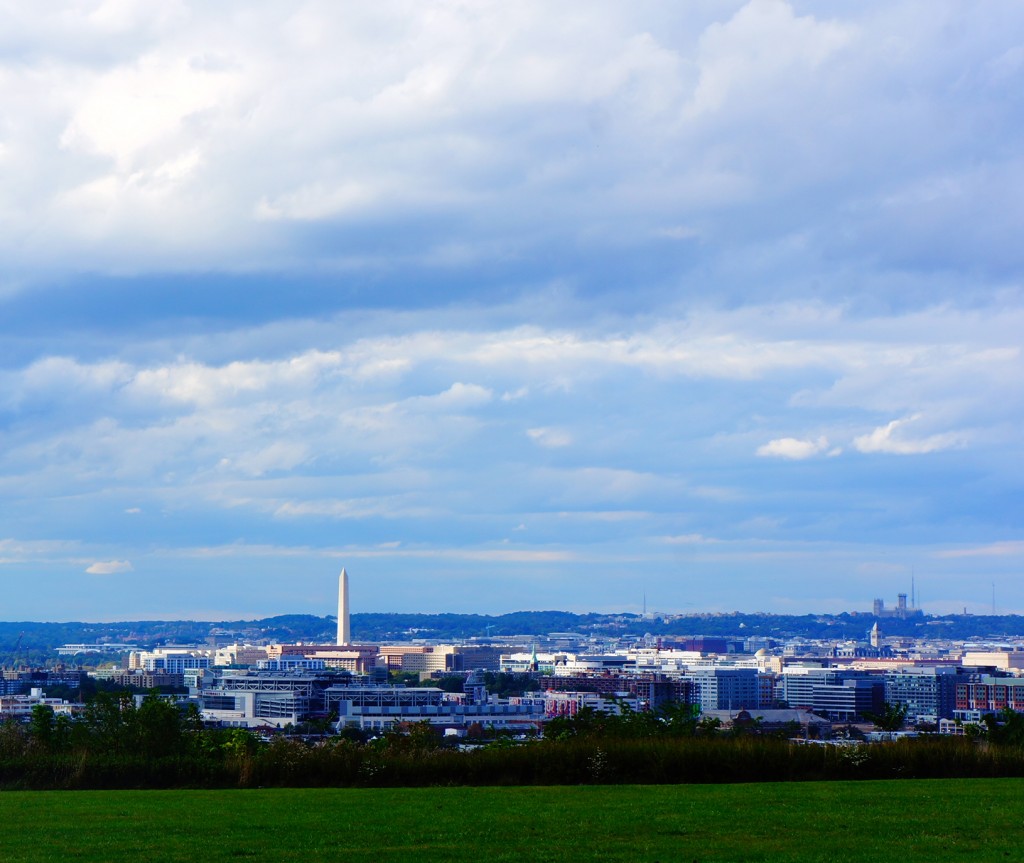
A view of DC from the top of Anacostia in East Washington.

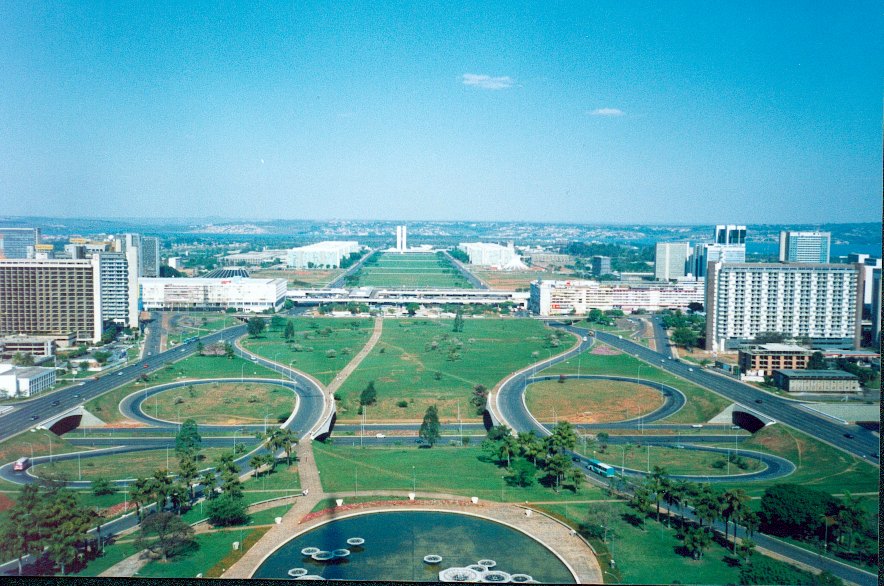
If you walk through parts of Brasília, it’s hard to believe that it wasn’t modeled, at least architecturally, upon Washington, D.C. when it was built in the late 1950. But when it comes to the voting rights of its capital’s citizens, Brazil has looked beyond the American example.Washington_DC_IconUSflag

Last month, when Brazil held a general election, some 2.5 million voters in the Brazilian Distrito Federal voted for a new governor, eight members to the Chamber of Deputies, the lower house of Brazil’s National Congress, and one of its three members to the Senate, its upper house. In that regard, Brazil’s DF is not unlike any other state in the country. Remarkably, with one deputy per 310,000 residents, that’s a better ratio of representation than the residents of Brazil’s largest state, the far more populous São Paulo.

It’s a typical and unremarkable arrangement around the world, and it’s not unlike Mexico’s Federal District (Mexico City), India’s Delhi Capital Territory and even places with a much more limited history of democracy, including Nigeria’s Federal Capital Territory (Abuja) and Malaysia’s Federal Territory of Kuala Lumpur.

But not in the District of Columbia.

The United States of America, otherwise a beacon of democratic rule for over two centuries, is essentially the North Korea of federal district voting rights, a clear outlier for democratic best practices across the world. As voters across the country elect members of the House of Representatives, District voters have nothing. Continue reading What the world can teach the United States about DC voting rights

What a Republican Senate means for world politics

potomacview

On Tuesday, when tens of millions of US voters go to the polls, they are very likely to deliver a US Senate majority to the Republican Party.USflag

Six years into the administration of Democratic president Barack Obama and four years after the midterm elections that delivered control of the US House of Representatives to the Republicans and conservative speaker John Boehner, most polls and poll aggregate forecasts give the Republicans anywhere from a strong (70%) to moderate (74%) to an overwhelming (96%) chance to retake the Senate.

It’s not uncommon for the ‘six-year itch’ to reward the non-presidential party with gains in midterm elections. Throughout the post-war era, in every midterm election during the second term of a reelection president, the opposition party has made gains each time — with the exception of 1998, when the Democrats benefited from a strong economy and Republican overreach in pursuing  what would eventually become impeachment hearings against US president Bill Clinton over alleged perjury in the Monica Lewinsky affair.

It’s also not unheard of that foreign policy can drive larger narratives about presidencies.

Most recently, in 2006, Democrats recaptured both houses in midterm elections, forcing then-president George W. Bush to accept the resignation of his defense secretary Donald Rumsfeld, in light of the war in Iraq’s unpopularity and the unfolding sectarian civil war taking place there despite US military occupation. As it turns out, the 2006 midterms paved the way for a much more moderate tone to the final two years of the Bush administration and a change in strategy under Robert Gates, Rumsfeld’s successor, who ultimately stayed on as defense secretary until 2011, lending a sense of continuity to the Obama administration’s approach to defense policy.

So what exactly would a Republican Senate mean for US foreign policy in the final two years of the Obama administration? Continue reading What a Republican Senate means for world politics

Modi showcases newly muscular Indian foreign policy

modiworld

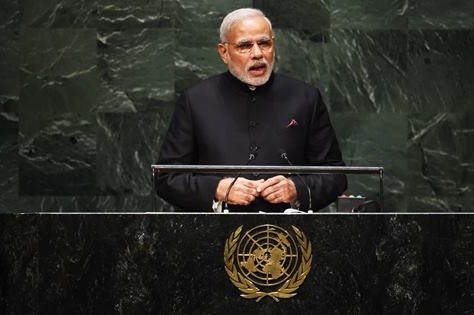
Indian prime minister Narendra Modi took power less than five months ago, but he’s already made five major world visits, including to Japan, to the BRICS summit in Brazil and this week, Modi is sweeping through an action-packed five-day visit to the United States.India Flag Icon

His current visit to New York and Washington has the air of triumph about it, and his speech to nearly 19,000 fans at Madison Square Garden certainly marks one of the very few times that a foreign leader has drawn such genuine support from an American audience. It’s all the more amazing, given that for much of the last decade, the US government refused Modi a visa to travel to the United States, due to his questionable role in the 2002 Hindu-Muslim riots, which took place four months after Modi became the chief minister of Gujarat state.

India’s foreign relations with major world powers like the United States, Russia and China aren’t always easy, and its relationships with other south Asian neighbors, especially Pakistan, can often be downright frosty.

Nevertheless, there are at least two reasons why Modi has such a strong opportunity to maximize India’s role on the world stage today — and none of it has to do with India’s economy, which is growing far slower than it needs to sustain truly transformational gains.

The first is the world’s growing multipolarity, which must seem especially multipolar from New Delhi’s view. Neighboring China is poised to become the world’s largest economy within a decade. India also has longstanding ties with Russia dating to the Soviet era that are now especially relevant as Russian president Vladimir Putin reasserts his country’s might in its ‘near-abroad.’ That makes cooperation with India, the world’s second-most populous country, a strategic advantage for any major power, and it gives India considerable leverage.

The second is the nature of Modi’s election in May. With 336 seats in the Lok Sabha (लोक सभा), the lower house of the Indian parliament, Modi’s Bharatiya Janata Party (the BJP, भारतीय जनता पार्टी) has the strongest majority and boldest mandate than any Indian government since 1984. While no one knows whether Modi can use that strength to revitalize India’s public sector and institute reforms to boost its private sector, the magnitude of his victory forced the world to take notice. If, as Modi promises, he can introduce robust economic reforms, a more liberalized Indian economy could birth a lucrative market of over 1.25 billion consumers, especially if Modi can lift India’s poor into a middle-class standard of living.

modiclinton

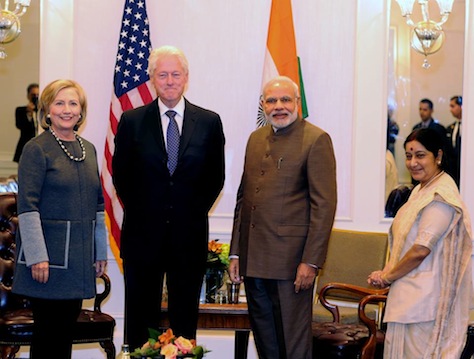
When Modi appointed Sushma Swaraj (pictured above earlier today with Modi, former US president Bill Clinton and former US secretary of state Hillary Clinton), the former leader of the Lok Sabha, as India’s new external affairs minister, it was a gesture of respect for an ally of the BJP old-guard leaders, such as LK Advani, who have largely been pushed aside in the Modi era. But it should have also been a sign that Modi, known for his micromanaging style, would take a hands-on approach to foreign policy.

Given the emphasis that Modi placed on good governance and economic reform, it might be surprising that he’s spent so much time in his first five months on international relations. Modi has so far been cautious on economic policy — for example, his first budget in July featured far more continuity than rupture, disappointing some of his booster.

So what do five months of Modi’s foreign policy tell us about what we might expect over the next five years?

Plenty — especially on the basis of his international efforts as Gujarat’s 13-year chief minister.

Here’s a look at how Modi’s efforts in reaching out to five other global powers already provide strong hints to the Indian prime minister’s worldview, and how we might expect India to engage the rest of the world for the foreseeable future. Continue reading Modi showcases newly muscular Indian foreign policy

Photo of the week: Cameron meets Rowhani

379932_Cameron-RouhaniPhoto credit to PressTV.

In Iran, the United States may be the ‘Great Satan,’ but it’s the United Kingdom has an even longer and more complicated history with Iran.Iran Flag IconUnited Kingdom Flag Icon

It’s not uncommon, among the most conspiratorial Iranian politicians, to hear fulminations against British plots, even today. And to be fair, there’s some basis for Iranian antipathy toward nearly two centuries of antipathy between the Persian and British empires.

The British increasingly sidelined the Persian empire in the 19th century during the so-called ‘Great Game,’ as the Russian and Turkish empires increasingly encroached on historical Persia. In 1908, with the discovery of oil, British interests quickly swooped in to negotiate favorable terms for themselves, to the detriment of the Iranians. During World War II, though Iran was officially neutral, the United Kingdom and the Soviet Union jointly invaded Iran in 1941 as part of efforts to secure Iranian oil, installing the young Mohammad Reza Pahlavi as the country’s new shah. The resulting chaos led to famine, economic mismanagement and starvation throughout Iran for the rest of the war. Though the United States Central Intelligence Agency carried out the 1953 ouster of prime minister Mohammad Mosaddegh, British intelligence greatly facilitated the operation.

More recently, a mob invaded the British embassy in Tehran in 2011, setting fire to the British flag, which caused the United Kingdom to cut relations with Iran.

So it’s no exaggeration to say that the United Kingdom might today be even more hated in the Islamic Republic of Iran than the United States of America.

* * * * *

RELATED: As Rowhani takes power, US must now move forward to improve US-Iran relations

* * * * *

All of which makes this week’s bilateral meeting between Iranian president Hassan Rowhani and British prime minister David Cameron so fascinating. Continue reading Photo of the week: Cameron meets Rowhani

Kurdish opportunity rises as US airstrikes hit Syria

mayfieldPhoto credit to Brendan Smialowski/AFP/Getty Images.

Guest post by Christopher Skutnik

Most of the public blowback within the US policy debate over Syria’s civil war revolves around who, among the confusing mishmash of anti-Assad rebels, Western governments might possibly aid in the conflict.  USflagSyria Flag Iconkurdistan

Even as the body count climbed and the war crimes mounted, much of the West declared a policy of non-interference. The inability to find a suitable Western-friendly champion is key among the factors that have most restrained the foreign response to Syria, even as US president Barack Obama yesterday ordered the first airstrikes against Islamic State group (الدولة الإسلامية‎) after six weeks of strikes meant to subdue them in northern Iraq.

In 2011, the US Congress introduced a bill placing sanctions on actors committing human rights abuses in Syria, and which simultaneously and explicitly prevented US president Barack Obama from declaring war or otherwise using force against the Syrian regime. Later in 2012, Congress introduced another bill that began exploring ways to ‘…deny or significantly degrade the ability of [Syrian president] Bashar al-Assad…to use air power against civilians and opposition groups in Syria….’

Like the one before it, this bill also maintained that ‘the United States ground troops [shall] not be deployed onto Syrian territory.’

* * * * *

RELATED: Five thoughts on Obama’s ISIS announcement

* * * * *

The United States was not alone in its reticence. In August 2013, the United Kingdom’s parliament famously voted 285 to 272 against prime minister David Cameron’s push for a British role in any potential American military action against Syria.

This proved to be a ‘two-fer.’ Not only were the British now going to stay out of Syria, but without the legitimacy of multilateralism, Obama was forced to withdraw to the principles that got him elected five years earlier. Aimed at a different war in a different country, Obama famously argued that the US war and occupation in Iraq that began in 2003 was ‘ill-considered’ and ‘unnecessary,’ and was steadfastly preempting political opponents of a possible response to Syria by proclaiming a ‘no boots on the ground’ policy. 

In doing so, the leader of the strongest liberal democracy in the world was leaving the victims of sarin gas attacks; the moderate, if nebulous, Free Syrian Army (FSA, الجيش السوري الحر‎); and the innocents on the periphery stuck between a vice grip of growing religious extremism and a government prone to attacking villages with helicopter gunships.

Fast forward to 2014.
Continue reading Kurdish opportunity rises as US airstrikes hit Syria

Five thoughts on Obama’s ISIS announcement

yeswetan

So much for US president Barack Obama’s statement last week* that the United States doesn’t have a strategy to combat the Islamic State group (الدولة الإسلامية‎) in Syria, which has taken control of eastern Syria and, more alarmingly, large parts of northern and western Iraq.USflag

In a stunning address for a president whose 2008 election owed greatly to his stand against the US war, Obama announced that he would lead a broad coalition to ‘degrade and ultimately destroy’ Islamic State, and it will include airstrikes in both Iraq and Syria and the deployment of 425 more ‘military advisers’ to Iraq.

Obama compared the new US military action against Islamic State in the same category as the Obama administration’s targeted efforts in Yemen and Somalia and against al-Qaeda. Furthermore, he warned that the operations would not involve combat troops or significant ground forces. In that sense, it’s true that Obama’s latest mission against Islamic State is more like its previous efforts against Islamic radicals elsewhere and less like the US invasion of Iraq in 2003.

But that’s not the whole story. As the Obama administration’s efforts continue to unfold, here are five points worth keeping in mind that explain why the United States is entering arguably its fourth war (Afghanistan, Iraq and Libya) in the Middle East since the September 11, 2001 terrorist attacks, what’s at stake going forward, and what the future might hold for the United States and the region.  Continue reading Five thoughts on Obama’s ISIS announcement

The idea of a nuclear war with Russia is absolutely crazy

putinski

As if timed to coincide with this week’s NATO summit in Wales, which could mark the most important gathering of Western allies since the end of the Cold War, US-based commentary this week took a huge leap forward in its assessment of the Russian threat — though not necessarily in a way that’s incredible rational.Russia Flag Icon

Call it the ‘underpants gnome’ theory of understanding Russia today:

Russian aggression in Ukraine + ????? = World War III!

But even as a ceasefire takes effect today between the Ukrainian military and the Russian-backed separatists based in Donetsk in eastern Ukraine, based on a plan put forward earlier this week by none other than Russian president Vladimir Putin and brokered by talks hosted by increasingly nervous officials in Belarus, US writers are nevertheless openly contemplating the audacious notion of a potential Russian nuclear strike. Continue reading The idea of a nuclear war with Russia is absolutely crazy

Afghanistan’s election becomes a farce — and a US policy disaster

kerryandtheafghans

It’s hard, exactly, to pinpoint the exact moment when Afghanistan’s presidential election became a complete absurdity.afghanistan flag

With a US-brokered audit process of the election already behind schedule, and with outgoing president Hamid Karzai declaring September 2 as the swearing-in day for the country’s next leader, the election process suffered yet another blow on Wednesday when Abdullah Abdullah, a former foreign minister and the winner of the election’s first round, angrily pulled out of a UN-led audit process that’s designed to validate the results of Afghanistan’s June presidential election. 

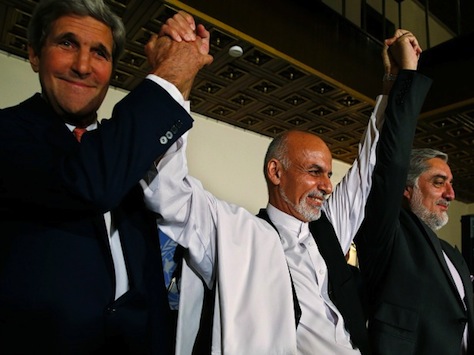
As next week’s deadline approaches and the United Nations continues the vote audit, Abdullah is expected to meet with his rival, Ashraf Ghani Ahmadzai (pictured above, center, with Kerry, left, and Abdullah, right) as well as US officials who are desperate to bring the two candidates into a national unity government.

Despite the last-minute talks, it’s hard to think of a recent national election that has been so thoroughly botched — with such dire consequences for the country’s future.  

In 2014 alone, Egypt and Syria held non-credible presidential votes and parliamentary elections in Iraq and Libya were overshadowed by the breakdown of any semblance of national order. 

It’s been a difficult summer for US president Barack Obama and US foreign policy interests — the ongoing tensions between Ukraine and Russia threaten Europe’s security, the rise of the Islamic State (IS/ISIS/ISIL) in Sunni Iraq and Syria goaded US military strikes in retaliation, and Israel’s summer war against Hamas in the Gaza Strip destroyed two years of efforts by US secretary of state John Kerry to pursue an Israeli-Palestinian peace deal. 

But Afghanistan’s growing political and security crisis represents a fourth major foreign policy headache for Kerry and the rest of the Obama administration.

* * * * *

RELATED: Afghanistan hopes for calm as key presidential election approaches

RELATED: Is Ghani’s Afghan preliminary electoral victory a fraud?

RELATED: Will Kerry’s deal with Afghanistan’s
presidential contenders work?

* * * * *

Though the audit is only slightly more than two-thirds complete, a premature inauguration of either candidate next week could splinter Afghanistan on ethnic lines, giving the next presidential administration virtually no hope of uniting a country already struggling to combat a Taliban-led insurgency.

Months of post-election accusations between the Ghani and Abdullah camps have polarized Afghanistan more than ever. What’s so staggering is that Afghanistan’s election season started off on such promising terms.  Continue reading Afghanistan’s election becomes a farce — and a US policy disaster