Tag Archives: labour

Irish vote to retain the Seanad deals blow to Kenny, who pledges parliamentary reform instead

Kiss me, I'm David Norris

Irish voters delight in contrarianism.Ireland Icon

When Irish voters were supposed to endorse the Treaty of Nice in 2001, they rejected it instead.  After nine months of renegotiation with the European Union to secure recognition of Ireland’s traditional military neutrality, Dublin held a second referendum and Irish voters adopted the revised Nice treaty.  Irish voters did the same thing in June 2008, when they rejected the Treaty of Lisbon by an equally narrow margin (again, Dublin set about renegotiating and held a successful referendum shortly thereafter).

When Irish voters, suffering under severe budget cuts and tax increases, may have had a gripe with last year’s European ‘fiscal compact’ (not a treaty, in the formal sense, because of the United Kingdom’s veto), they instead approved the fiscal compact by a wide margin in the June 2012 referendum.

In Sunday’s referendum, Ireland’s stubborn voters were expected to vote to abolish the Seanad Éireann (Irish senate), the upper house of the Oireachtas, Ireland’s parliament, on the promise of a future with fewer politicians instead of more.

Political leaders across all lines — the Irish left, the Irish center-right and even Irish nationalists — supported moving to a unicameral system to cut up to $20 million in annual costs and to eliminate a chamber that’s largely seen as unrepresentative, undemocratic and wasteful, while using the opportunity to register disgust with a political elite that remains unpopular in the wake of a sovereign debt crisis, the failure of Irish banks, and a humiliating European bailout that has imposed a new era of austerity in a country that, only a decade ago, was known as the ‘Celtic Tiger’ for its surging economy.

But perhaps the Irish electorate decided to register its contrarianism at the very notion of being perceived as anti-politician contrarians.

For whatever reason, not enough Irish voters elected to abolish the Seanad, and the October 4 referendum was defeated by a narrow margin of 51.7% voting ‘No,’ and just 48.3% voting ‘Yes.’

The result broke down on largely regional lines.  Voters in Munster and Connacht in the west of the country largely voted to abolish the Irish senate, while the northern state of Ulster and the eastern state of Leinster (including all of the constituencies in Dublin) voted to retain the senate.  In particular, Ulster voters worried that the elimination of the Irish senate would also eliminate the one forum where Northern Irish voices have been historically heard within the government of the Republic of Ireland.
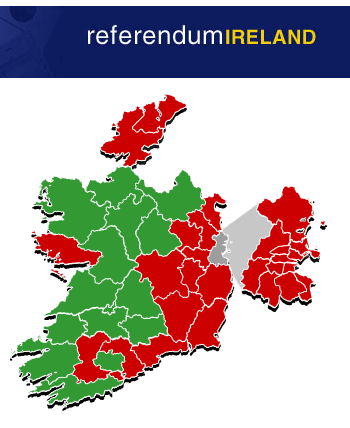
Screen Shot 2013-10-08 at 1.34.52 AM

The result left the Taoiseach (Ireland’s prime minster), Enda Kenny, with perhaps the biggest defeat since taking power in March 2011.  Kenny campaigned on the promise of eliminating the Irish senate, and the referendum fulfills a promise to bring the issue to a direct referendum.  But as Kenny said following the result: ‘Sometimes in politics you get a wallop.’

The defeat is another warning sign of the growing unpopularity of Kenny’s government — though voters blamed Fianna Fáil for the initial Irish banking crisis and its aftermath, they seem to be holding Fine Gael responsible for the austerity that’s followed since the 2011 elections.

A recent October 1 RTE poll showed that Kenny’s liberal center-right Fine Gael has plummeted to 26% support (after winning 36.1% in the last election), while its coalition partner, the progressive Labour Party wins just 6% support, the lowest level in decades (after winning 19.4% in 2011).  Though the conservative center-right Fianna Fáil has regained some ground at 22% (up from 17.4% in 2011), the real winner is the Irish nationalist party Sinn Féin, which polled 23% support (up from 9.9% in 2011).

Among the supporters of abolishing the Irish senate were Fine Gael, Labour, Sinn Féin and Ireland’s Socialist Party.  Politically speaking, the result was a victory for Ireland’s most successful post-independence party, the conservative center-right Fianna Fáil, which suffered a historical loss in the 2011 election.   Fianna Fáil campaigned against eliminating the Irish senate in favor of reforming it, arguing that it served as a necessary watchdog against poor government.  Kenny had received criticism prior to the vote for refusing to debate Fianna Fáil leader Micheál Martin, and those criticisms amplified in the aftermath of the referendum’s defeat.

It’s also a victory for many of Ireland’s longtime independent senators, some of whom are incredibly colorful and thoughtful figures, including David Norris (pictured above kissing a supporter), a scholar of James Joyce and Ireland’s first major openly gay presidential candidateContinue reading Irish vote to retain the Seanad deals blow to Kenny, who pledges parliamentary reform instead
Norway’s new center-right minority government is official

jensen-solberg

Having narrowed coalition talks from four to two parties last week, it didn’t take long for Norway’s new government to emerge formally on Monday.norway

As I wrote late last week, Norway is set to have a minority government that will likely be its most right-wing government in postwar history:

As widely anticipated, the leader of the center-right Høyre (literally the ‘Right,’ or more commonly, the Conservative Party), Erna Solberg, will become Norway’s next prime minister, but she’ll lead a minority government in coalition with just one of Norway’s three other political parties, the controversial anti-immigrant Framskrittspartiet (Progress Party) after two smaller center-right parties pulled out of coalition talks earlier this week.

I wrote before the election that pulling together all four parties on the Norwegian right might prove problematic.  Sure enough, both the Kristelig Folkeparti (Christian Democratic Party) and Venstre (literally, ‘the Left,’ but commonly known as the Liberal Party), which will hold 10 and nine seats, respectively, in the next parliament, will not join the government.  Though both parties have agreed to provide support to Solberg from outside the government, it’s not an auspicious start for the broad four-party coalition that Solberg hoped to build after last month’s victory.

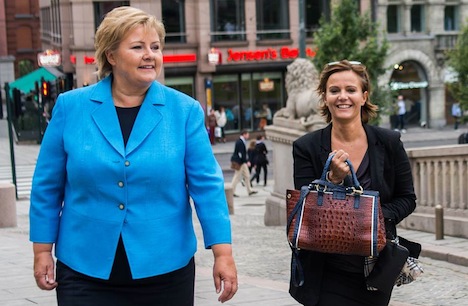
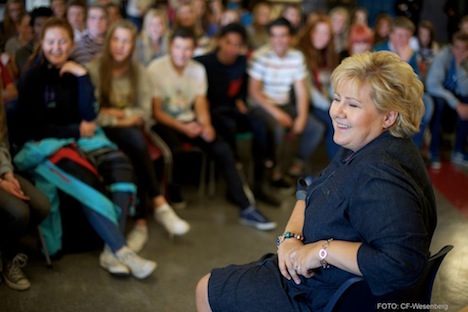
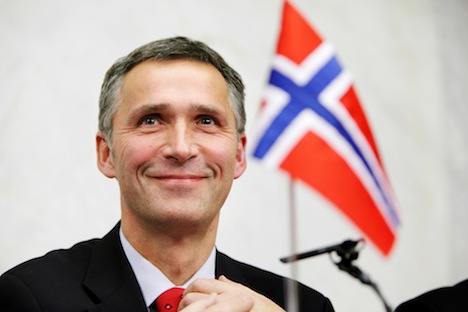
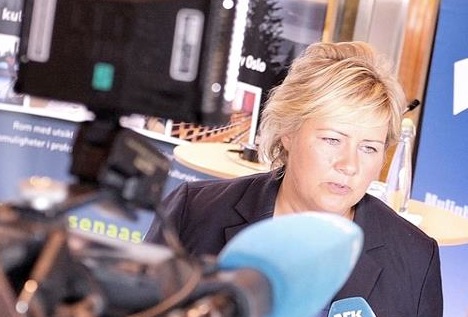
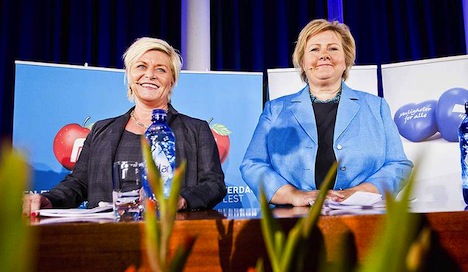
It was no surprise on Monday to see Erna Solberg, the leader of the Conservatives and Norway’s likely next prime minister (pictured above, right) and Siv Jensen, the leader of the Progress Party (pictured above, left) announce their governing agenda.

That agenda came with few surprises from the general framework largely set forth last week — a push to tightening Norway’s immigration laws (for non-Europeans), lowering Norway’s tax burden and, importantly, an agreement not to deviate from the ‘4% rule’ that prohibits more than 4% of the country’s massive $790 billion oil fund to be used in the annual Norwegian budget, and a commitment to avoid exploration for resources in protected Arctic areas.

Both parties generally hope to unlock economic growth and modernization through tax cuts and decentralization of power from Norway’s central government.

But perhaps the most ambitious item is a plan to develop a new infrastructure fund of up to 100 billion kroner ($16.75 billion) for what Solberg and Jensen hope will a five-year mission to improve Norway’s roads and railroads — as well as its educational system:

Kristin Skogen Lund, director-general of the Confederation of Norwegian Enterprise, welcomed the “shift in direction for Norwegian politics”….

Ms Skogen Lund also welcomed the shift in focus of the oil fund from consumption to investment. The outgoing government had spent only about 14 per cent of annual proceeds from the fund, she said, when all of it was supposed to be directed into infrastructure, education and tax reduction.

That’s important in light of Solberg’s goal to reduce the value of the krone, Norway’s currency — inflation, along with high labor costs that have made Norway’s exports relatively uncompetitive, are the largest challenges to an economy that’s at risk of overheating (to the contrary of much of the rest of Europe).  Though the ‘investment’ will surely stimulate Norway’s economy, it will do so for long-term benefits.  That makes the Solberg ‘investment fund’ plan unlike, say, the 2009 US stimulus package enacted into law by US president Barack Obama designed to do the opposite — boost short-term aggregate demand.

Solberg’s government will also explore the possibility of splitting the country’s oil fund, the world’s largest sovereign wealth fund, into two smaller entities to encourage competition and maximize Norway’s investment returns.

The two parties remain at odds over cabinet posts, though it’s widely expected than Jensen will hold the finance portfolio.

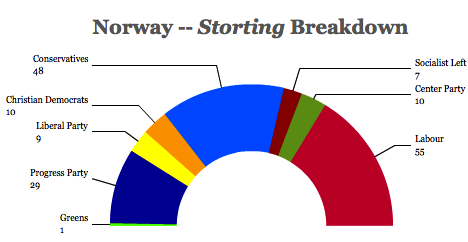
By way of background, the Conservative/Progress coalition will hold 77 seats — and all four center-right parties will hold 96 seats — in the 169-member Storting, Norway’s parliament.  Though the center-left Arbeiderpartiet (Labour Party) of outgoing prime minister Jens Stoltenberg won more seats than any other party in the September 9 election, its coalition allies suffered huge losses — the Conservatives placed a close second and the Progress Party finished third, and a broad center-right government had been widely expected even before the election.

storting

Top photo credit to Vegard Grøtt / NTB scanpix.

Norway’s new government will be more right-wing and more fragile than expected

ernaPM

Just less than a month after Norwegians went to the polls, the contours of Norway’s new government are taking shape — and it’s not exactly what everyone expected.norway

As widely anticipated, the leader of the center-right Høyre (literally the ‘Right,’ or more commonly, the Conservative Party), Erna Solberg, will become Norway’s next prime minister, but she’ll lead a minority government in coalition with just one of Norway’s three other political parties, the controversial anti-immigrant Framskrittspartiet (Progress Party) after two smaller center-right parties pulled out of coalition talks earlier this week.

The difference is that instead of a 96-seat majority in the 169-member Storting, Norway’s parliament, Solberg’s government will hold just 77 seats, eight short of an absolute majority:

storting

I wrote before the election that pulling together all four parties on the Norwegian right might prove problematic.  Sure enough, both the Kristelig Folkeparti (Christian Democratic Party) and Venstre (literally, ‘the Left,’ but commonly known as the Liberal Party), which will hold 10 and nine seats, respectively, in the next parliament, will not join the government.  Though both parties have agreed to provide support to Solberg (pictured above) from outside the government, it’s not an auspicious start for the broad four-party coalition that Solberg hoped to build after last month’s victory.  The absence of the Christian Democrats is particularly difficult, given that they led the last center-right Norwegian government — that of prime minister Kjell Magne Bondevik between 1997 and 2000 and 2001 to 2005.

The Progress Party, meanwhile, will enter government for the first time since its foundation in the 1970s.  Founded as an anti-tax movement determined to roll back the Norwegian social welfare state, the Progress Party has also become increasingly anti-immigrant.  While it’s certainly tame compared to many of Europe’s more xenophobic anti-immigrant parties, it’s easily the most controversial party in Norway (not least because mass killer Anders Behring Breivik was once among its members).  Anxiety about the Progress Party’s new, unprecedented role in government is one of the reasons that the Christian Democrats and Liberals may have been wary of formally joining Solberg’s coalition, which will now become Norway’s most right-wing government in a century.

Solberg, on the other hand, slowly gained the trust of Norwegians after rebranding the Conservatives into a more welcoming, more national party that’s transcended its base catering to business interests in Oslo.  Although the Conservatives and the Progress Party agree on economic policies like tax cuts, the Conservatives have positioned themselves as an ever-so-slightly right-of-center party who would leave in place much of the mainstream policy preferences of the outgoing center-left Arbeiderpartiet (Labour Party) — you can characterize ‘mainstream’ in Norway as full commitment to a  generous social welfare state, mixed with strict fiscal discipline that diverts much of Norway’s oil largesse into its $780 billion investment fund, the world’s largest sovereign wealth fund.

Given that the Labour Party, led by the popular outgoing prime minister Jens Stoltenberg, still managed to win more votes than any other party — and seven more parliamentary seats than the Conservatives — last month (a feat Labour has repeated in every national election since 1918), that’s a wise move on Solberg’s part.  But balancing the moderation that Norwegians expect from her with the Progress Party’s expectations was always going to be difficult, and Solberg’s dream of a broad four-party coalition will be the first casualty of those competing expectations.

That balancing act informs much of the resulting agreement between the Conservatives and Progress and, more generally, among the four right-wing parties that Solberg will need to satisfy to keep her minority coalition in government — it’s more notable for what the government won’t do than what it will.  The government faces a much different challenge than the rest of Europe — with GDP growth holding steady at around 2%, it’s overheating, not recession, that threatens the economy.  Solberg’s challenge is how to keep the Norwegian krone from further appreciating, given that the country’s high wages are already making exports less competitive.

Notwithstanding the election campaign, lowering the value of the krone might ultimately be the Solberg’s most pressing policy imperative.

Here are the highlights of how Norway’s next government will unfold under Solberg’s leadership:  Continue reading Norway’s new government will be more right-wing and more fragile than expected

Should Ireland abolish its Seanad (Senate) and go unicameral?

kenny

Irish voters will determine on Friday whether to eliminate the Seanad Éireann (Irish senate), the upper house of the Oireachtas, Ireland’s parliament.

Ireland Icon

Before you think that this is such a transformative step in Irish governance, it’s important to keep in mind that the Irish senate doesn’t have nearly the powers of, say, the United States senate because it doesn’t have veto power over Irish legislation — at worst, the Irish senate can delay lawmaking, not bring it to a halt.  Furthermore, its members aren’t directly elected by the people, leading to charges that the upper house is a wasteful, undemocratic, unrepresentative anachronism.

If, as expected, Irish voters approve the referendum, the Irish senate will cease to exist as of the next Irish general election, which must take place before 2016.

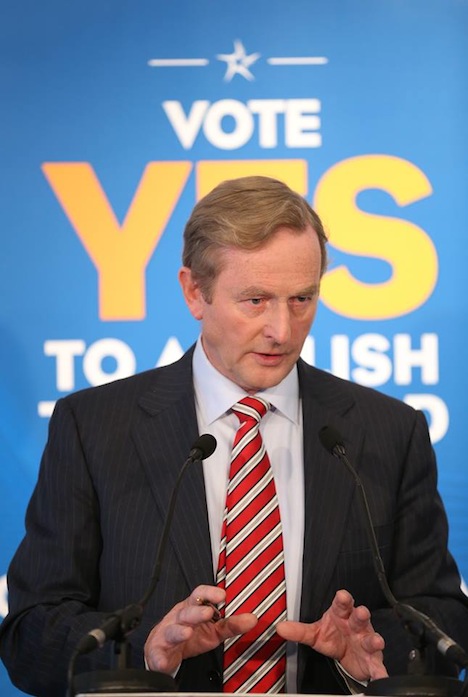
It’s one of the campaign pledges that Taoiseach Enda Kenny (pictured above) promised in advance of the February 2011 parliamentary elections that swept his liberal center-right Fine Gael into power, in coalition with the social democratic Labour Party.  In an odd-bedfellows coalition, most of Ireland’s major parties support abolishing the Senate, including Fine Gael and Labour, but also the Irish nationalist Sinn Féin.  Only the conservative center-right Fianna Fáil, which suffered a historic defeat in the 2011 election, opposes the referendum and prefers to retain the senate, albeit a reformed, more representative, more productive senate.

The system by which the upper house’s 60 senators are appointed is truly anachronistic — the Taoiseach appoints 11 and graduates of the University of Dublin and the National University of Ireland are each entitled to elect three senators.  The remaining 43 are nominated from five ‘vocational panels’ that span the public/administrative, agricultural/fishing, cultural/educational, industrial/commercial, and labour sectors.  In practice, this means that the Irish senate is  where a lot of failed political candidates land.  The remaining house, the Dáil Éireann, is composed of 166 deputies.

Given that Ireland has been rocked by economic crisis following the 2008-09 financial crisis that saw Ireland nationalize some of its banks and assume their obligations, Kenny and other supporters of the referendum argue that the Irish senate is an unnecessary and undemocratic expense for such a small country as Ireland (with 4.6 million people), especially in light of its 40-year membership in the European Union, which remains responsible for an increasing amount of regulatory standards within Ireland.

Many Irish voters agree — an IPSOS poll earlier this week showed 44% favored abolition, 27% opposed abolition, while 21% were unsure, though when undecideds had to choose, the pro-abolition side won 62% to 38%.

Although countries don’t abolish entire legislative chambers every day, it’s not wholly unprecedented, either.  New Zealand abolished its unelected Legislative Council in 1950, Denmark abolished its upper house in 1953 and Sweden followed suit in 1970.  Generally speaking, unicameral parliaments are more common on the periphery of the European Union than in its core — they exist in Portugal, all of the Scandinavian states (including Iceland), all three Balkan state, Slovakia, Croatia, Bulgaria, Hungary, Greece, Cyprus and Ukraine.

The arguments for unicameralism, generally, mirror those that Kenny and ‘Yes’ supporters are making in Ireland.   Continue reading Should Ireland abolish its Seanad (Senate) and go unicameral?

Toward a pink-blue coalition: how House Democrats can rescue Boehner’s speakership

boehner

Last week, I noted that German chancellor Angela Merkel succeeded in achieving the post-partisanship in Germany that US president Barack Obama had hoped to achieve when he ran for president in 2008.USflag

While that’s somewhat of an unfair comparison given the collegiality and consensus that’s developed in Germany’s postwar politics, there’s perhaps a lesson for US politicians to learn from the example of German politics in resolving the current standoff that has shut down the federal government of the United States and threatens to precipitate a sovereign debt crisis later this month over the US debt ceiling.

Even after Merkel’s center-right Christian Democrats won a once-in-a-generation landslide victory, she remains five seats of an absolute majority in Germany’s Bundestag (the lower house of the German parliament) and well short of a majority in the Bundesrat (the upper house), so she’s locked in negotiations — likely for the rest of the year — to form a viable governing coalition with either her rival center-left Social Democrats or the slightly more leftist Green Party.

Contrast that to the United States, where a minority of a party that controls one-half of one branch of the American government has now succeeding in effecting a shutdown of the US government.

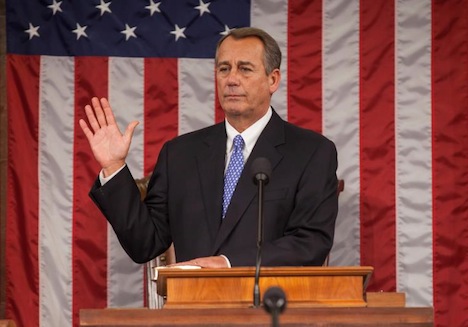
In the US House of Representatives today, speaker John Boehner (generally) operates on the ‘Hastert rule.’  He’ll only bring bills to the floor of the House that are supported by a ‘majority of the majority’ — a majority of the 232-member Republican caucus.  So even if 115 Republicans and all 200 Democrats in the House support a bill, such as a clean ‘continuing resolution’ to end the current shutdown, they won’t be able to do so if 117 Republicans prefer to condition a continuing resolution upon a one-year delay of the Patient Protection and Affordable Care Act, popularly known as ‘Obamacare.’

It’s not uncommon in parliamentary systems for the ‘loyal opposition’ to sometimes lend their support for an important piece of legislation.  Earlier this year in the United Kingdom, British prime minister David Cameron passed a marriage equality law only with the support of the opposition Labour Party in the House of Commons in light of antipathy within a certain segment of the center-right Conservative Party to same-sex marriage.

In country after country in Europe, including Greece, Ireland and Latvia, traditional rivals on the left and right have sucked up the political costs of austerity and voted to accept difficult reforms, tax increases and tough budget cuts in the face of rising unemployment and depression-level economies in order to avoid the further tumult of being pushed out of the eurozone’s single currency.  If Italy’s left and right could support former prime minister Mario Monti’s technocratic government for 15 months, it’s not outside the realm of democratic tradition to believe that Boehner could form a working coalition in the US House to resolve a crisis that threatens not only American political credibility in the world and the American economy, but the entire global economy.

But as Alex Pareene at Salon wrote earlier today, the United States doesn’t have a parliamentary system, it has a presidential system where an opposition party that controls one house of Congress can cause a crisis if it wants to do so:

An American parliamentary system with proportional representation wouldn’t immediately or inexorably lead to a flourishing social democracy, but it would at least correct the overrepresentation of an ideological minority, and cut down on intentional tactical economic sabotage. The reason we’re in permanent crisis mode isn’t “extremism,” but a system of government that guarantees political brinkmanship.

There’s a bit of ‘grass is always greener’ mentality to that counterfactual.  Parliamentary systems come with their own set of difficulties, and governments in parliamentary systems can wind up just as paralyzed as the current American government seems to be — former Italian prime minister Silvio Berlusconi is causing a political crisis this very week in Italy that will culminate in a vote of no confidence on Wednesday against the fragile coalition headed by center-left prime minister Enrico Letta.  Though the government’s been in power for just five months, Italy could face its second set of elections in 12 months if Letta’s government falls.  Belgium famously went without a government for 535 days between 2009 and 2011 because no majority coalition could form a government.  Moreover, minority governments in parliamentary systems often lurch from crisis to crisis, with individual lawmakers willing and able to ‘hold up’ the government’s legislation.

But the United States need not change its entire system of government to take away a few lessons from Merkel and from Germany.

Juliet Eilperin and Zachary A. Goldfarb at The Washington Post suggested earlier Tuesday that Boehner make a push to become the first truly bipartisan speaker:

[T]he press tends to trumpet two unflattering themes: that Boehner can neither manage his own conference nor make a credible deal with the White House. As a result, the narrative runs, Americans are left careening from fiscal crisis to fiscal crisis, and Congress can’t even tackle popular initiatives such as immigration reform. A host of other potential changes supported by huge swaths of both parties — from tax and entitlement reform to infrastructure spending — are also left on the table just because of the fallout Boehner faces from a few dozen, ultra-conservative Republicans.

At least that’s the rap against Boehner, whose speakership so far has been defined by blocking Obama’s priorities rather than producing significant laws. But that could all change if he were just to decide to say to House Minority Leader Nancy Pelosi (D-Calif.): “Let’s enter a grand coalition. Democrats will vote for me for speaker as long as Republicans hold a majority. And we’ll do a budget deal that raises a little bit of tax revenue and reforms entitlements. We’ll overhaul the tax code for individuals and businesses. We’ll pass immigration reform and support the infrastructure spending that the U.S. Chamber of Commerce and labor unions want.”

Call it a pink-blue coalition — the moderate Republicans and the Democrats.  (Or maybe the donkey-rhino‡ coalition). Continue reading Toward a pink-blue coalition: how House Democrats can rescue Boehner’s speakership

Despite the success of pro-EU parties in Norway, don’t expect EU membership anytime soon

EUnoray

One of the odder results of this week’s Norwegian election is that while it boosted the numbers of seats for the two parties that are most in favor of membership in the European Union, Norway is today less likely than ever to seek EU membership.European_Unionnorway

Together, the center-left Arbeiderpartiet (Labour Party) and the center-right Høyre (the Conservative Party) will hold 103 seats as the largest and second-largest parties, respectively, in the Storting, Norway’s 169-member parliament — that’s a larger number of cumulative seats than the two pro-European parties have won since the 1985 election.

But EU membership is firmly not on the agenda of Norway’s likely new prime minister, Erna Solberg, just like it wasn’t on the agenda of outgoing  prime minister Jens Stoltenberg during his eight years in government.

One of the obvious reasons is that EU membership is massively unpopular among Norwegians — an August poll found that 70% oppose membership to just 19% who support it.

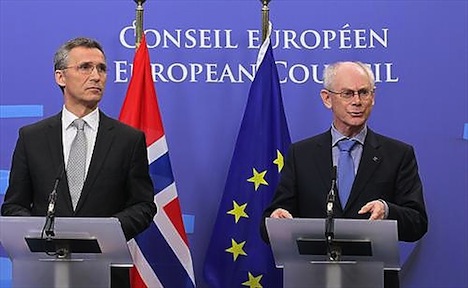
Proponents of EU membership argue that because Norway is part of Europe’s internal market, it is already subject to many of the European Union’s rules. (Norway is also a member of the Schengen free-travel zone that has largely eliminated national border controls within Europe)  But until Norway is a member of the European Union, it has absolutely no input on the content of those rules.  Stoltenberg (pictured above left with European Council president Herman Van Rompuy) has called the result ‘fax diplomacy,’ with Norwegian legislators forced to wait for instructions from Brussels in the form of the latest directive.

Since 1994, when Norwegians narrowly rejected EU membership in a referendum, Norway has been a member of the European Economic Area (EEA), an agreement among the EU countries, Norway, Iceland and Liechtenstein that allows Norway and the other non-EU countries access to the European single market.

Opponents argue that Norway, with just 5 million people, would have a negligible input in a union that now encompasses 28 countries and nearly 508 million people.  They also argue that with one of Europe’s wealthiest economies, Norway would be forced to contribute part of its oil largesse to shore up the shakier economies of southern and eastern Europe.  There are also sovereignty considerations for a country that didn’t win its independence from Sweden until 1905 — and then suffered German occupation from 1940 to 1945.  Though Norwegians also often cite the desire to keep their rich north Atlantic fisheries free of EU competition, Norway already has a special arrangement with the European Union on fisheries and agriculture, and it’s likely that it would continue to have a special arrangement as an EU member, in the same way that the United Kingdom has opted out of both the eurozone and the Schengen area and has negotiated its own EU budget rebate.

Though Solberg herself is from Norway’s western coast, her party’s base is comprised largely of business-friendly elites in Oslo and Norway’s other urban centers, where support for EU membership runs highest.  But that enthusiasm doesn’t always flow down to voters who support Solberg, and it certainly doesn’t extend to Norway’s other right-wing parties.  Continue reading Despite the success of pro-EU parties in Norway, don’t expect EU membership anytime soon

Solberg set to lead broad center-right coalition in Norway after today’s election

ernawins

Erna Solberg, the longtime leader of Norway’s Conservative Party, will become Norway’s next prime minister after results from today’s Norwegian parliamentary election showed all four of Norway’s center-right parties winning enough seats to form an absolute majority in Norway’s Storting (parliament).norway

Prime minister Jen Stoltenberg has conceded defeat, and will resign shortly after presenting Norway’s next budget in mid-October.

The result’s a lot more complicated than that — for starters, Stoltenberg’s party, the center-left Arbeiderpartiet (Labour Party) actually won more votes than Solberg’s party, the center-right Høyre (literally the ‘Right’) — so much so that Labour will have around 55 seats to just 48 for the Conservatives.  It’s not an unexpected result because while polls earlier this summer showed the Conservatives leading Labour, support for Labour has increased as Norwegians focused on the campaign.  Moreover, Labour has emerged in every election since 1924 with more support and seats than Norway’s various opposition parties, and its long pedigree as the natural party of government means that it has a deeper wellspring of support among the Norwegian electorate.

Here’s the breakdown of voter support with nearly all the votes counted:

norway results

Here’s the projected allocation of seat in Norway’s new parliament:

storting

But that wasn’t enough to pull off a victory for two reasons.  First, Labour’s support — around 30.9% — is smaller than the 35.4% it won in the September 2009 election, natural enough for a party that’s been in power for eight years and is seeking a third consecutive term.  Secondly, the two small parties that comprise the ‘red-green’ coalition that Stoltenberg heads, Sosialistisk Venstreparti (Socialist Left Party) and the Senterpartiet (Centre Party), did incredibly poorly, so the ‘red-green’ coalition is projected to win just a cumulative 72 seats in the 169-member Storting.

Meanwhile, Solberg’s Conservatives cannot govern by themselves, but must form an alliance among the four major center-right parties that will join parliament.  That includes the Kristelig Folkeparti (Christian Democratic Party), a moderately conservative party that led Norway’s last center-right government under prime minister Kjell Magne Bondevik between 1997 and 2000 and again from 2001 to 2005, and it includes Venstre (literally, ‘the Left,’ but commonly known as the Liberal Party).  All three parties worked together in government between 2001 and 2005 and all three parties generally accept the fait accompli of the Norwegian social welfare state and Labour’s rules to stash much of Norway’s annual budget surplus in the country’s massive oil wealth fund.  The Conservatives, in particular, have spent the election arguing for slight changes to the status quo, such as lower business taxes and tweaks to Norway’s health care system, after a major rebranding exercise to grow beyond their base of Oslo business interests.

But the coalition must also include the more controversial Framskrittspartiet (Progress Party).  Most reports highlight that the party is relatively populist and anti-immigrant, and that it was the party of Norway’s Anders Behring Breivik, who was responsible for the deadliest killings in Norway’s history in twin attacks in 2011.  That’s all true, but the party’s roots are in the anti-tax movement of the 1970s, and its goal is a massive rupture from the status quo — it would claw back many of Norway’s social benefits, drastically reduce the role of government in Norwegian life, but it would also push to spend more of the Norwegian oil surplus (or return it in the form of lower taxes).   Continue reading Solberg set to lead broad center-right coalition in Norway after today’s election

Solberg favored to become prime minister as Norway votes today

ernajens

In Norway, voters will decide today whether to deliver prime minister Jens Stoltenberg a third term in government.norway

Stoltenberg, in his eighth year of office, leads the center-left Arbeiderpartiet (Labour Party) that dominates Norway’s governing ‘red-green’ coalition.  But while the center-right Høyre (literally the ‘Right,’ or more commonly, the Conservative Party) consistently led polls as the most popular party throughout the summer, Labour has caught back up in the polls, and the two are neck-in-neck to determine which will win the most votes today.

But even if Labour wins the largest share of the vote (as it’s done in every election since 1927), the Conservatives remain heavily favored to form Norway’s next government because the center-right parties, taken together, far outpoll the center-left parties.  Labour’s two smaller allies, in particular, are faring poorly in polls.

That means that Conservative leader Erna Solberg (pictured above, left, with Stoltenberg, right) is predicted to become Norway’s next prime minister with the support of the Folkeparti (Christian Democratic Party) and the Venstre (the Liberal Party), but also the Framskrittspartiet (Progress Party), a far-right, populist anti-immigration, anti-tax, anti-social welfare party formed in the 1970s.  Solberg leads a party that’s undergone a major rebranding in recent years — Solberg, from western Norway, leads a relatively moderate center-right party that hopes to lower taxes but otherwise promises quite a bit of continuity with Stoltenberg’s policies.  With a base in Oslo, the Conservatives are very business-friendly, and are likely to continue both the fiscal prudence of the Stoltenberg government (which diverts much of Norway’s annual budget surplus into its oil fund) as well as the social welfare state that’s come to define Norwegian government.

Although the Progress Party is currently the second-largest party in Norway’s Storting (Parliament), it’s never been part of a government in Norwegian history.  So even though it’s likely to lose seats today, its leader Siv Jensen will have the votes to bring Solberg a broader right-wing majority — and to demand the finance portfolio, despite the fact that Progress has radically different views about Norway’s finances than Labour and the Conservatives.

If Labour holds on, it will be due to Labour’s historically strong political base in the Norwegian heartland and its get-out-the-vote efforts, but also due to hesitation over putting the Progress Party in power, not any hesitation about Solberg.

Norway, a country of just five million in Scandinavia, is one of the wealthiest countries in the world, with a GDP per capita of about $50,000 to $60,000, due in large part to Norway’s oil wealth.  Voters will elect all 169 members of the unicameral Storting on the basis of proportional representation by choosing candidates from among 19 multi-member districts.  The electoral threshold for entering parliament is 4% of the vote.  Although Norway has twice rejected joining the European Union (most recently in a 1994 referendum), it is a member of the European Economic Area, so like Iceland and Liechtenstein, it is a member of the European single market, even though it doesn’t have any input on policymaking as a European Union non-member.

For more of Suffragio‘s coverage on Norway’s parliamentary elections:

  • here’s a look at how Solberg and the Conservatives ended up such strong frontrunners in 2013;
  • here’s a look at why no one should count out Stoltenberg and Labour today; and
  • here’s a look at tensions among Norway’s center-right parties and why a broad center-right government is still more likely than a ‘grand coalition.’

Cameron loses House of Commons vote on Syria military intervention

cameronloses

The joint US and European will to respond to last Wednesday’s chemical attack on the eastern outskirts of Damascus has received a blow after the British House of Commons voted narrowly 283 to 272 against a resolution that would have provisionally authorized British military intervention in Syria — a staggeringly rare defeat for a British government on a matter of foreign policy.Syria Flag Icon freesyriaUnited Kingdom Flag Icon

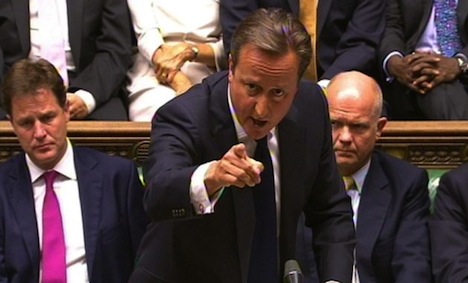
The vote comes as a blow not only to UK prime minister David Cameron, who suffered defections from nearly three dozen skeptical Conservatives as well as additional Liberal Democratic members of his own governing coalition, but also interventionists in the United States who are urging US president Barack Obama to launch an aggressive attack on the regime of Syrian president Bashar al-Assad.  It is very unlikely that the United States would proceed with unilateral military action without British support, which is unlikely to come anytime soon in light of Cameron pledge to respect the parliamentary decision:

I can give that assurance. Let me say, the House has not voted for either motion tonight. I strongly believe in the need for a tough response to the use of chemical weapons, but I also believe in respecting the will of this House of Commons. It is very clear tonight that, while the House has not passed a motion, it is clear to me that the British parliament, reflecting the views of the British people, does not want to see British military action. I get that and the government will act accordingly.

It’s a vote that has the potential to turn the US-UK relationship upside down, to turn Middle Eastern realpolitik upside down, to turn British politics upside down and even to turn US politics upside down.  For a sitting prime minister to lose a vote like this is a huge reversal in the relationship between an ever-more powerful British executive and an ever-more feeble parliament on issues like security policy and foreign affairs.

Most immediately, it means that a U.S.-led missile strike, which seemed imminent yesterday, will now be postponed until early next week, at the earliest, when chemical weapons inspectors from the United Nations have had an opportunity to provide their initial assessment of what happened in Ghouta and eastern Damascus.  The vote also comes after several news organizations reported that U.S. and allied intelligence agencies are assured that while the chemical attack came from pro-Assad forces, they are uncertain who ordered the attack amid indications that Assad and his top military brass were caught unaware.  Meanwhile, French president François Hollande has backed off earlier, more urgent calls for military action.

Cameron’s massive defeat does not necessarily preclude a vote next week after the United Nations reports back as to which party — and which chemical agent — is to blame for the horrific Damascus attack.  If the UN report, together with US and European intelligence, all points to Assad’s culpability, Cameron and Obama will have a much stronger case for an aggressive response, either inside or outside the United Nations Security Council.

Meanwhile, the vote is perhaps the largest political victory in Ed Miliband’s three-year tenure as leader of the Labour Party.  Miliband firmly opposed the resolution even after Cameron offered to submit to a second vote before authorizing military action, making today’s resolution essentially a vote for the principle of the British government’s potential military intervention.  The vote capped a tumultuous 24 hours in Westminster, with Cameron’s allies accusing Miliband of giving ‘succour’ to the Assad regime, which probably didn’t make it likelier that Labour would close ranks with the Tories over a potential Syria intervention.  It was a principled stand for Miliband and, though he’s closer to British public opinion on Syria than Cameron, it was also a courageous stand for a young opposition leader to oppose a sitting government on such a crucial matter of foreign policy.

Miliband’s line boils down to one sentence from his statement earlier today: ‘Evidence should precede decision not decision precede evidence’: Continue reading Cameron loses House of Commons vote on Syria military intervention

Despite doubts about far-right Progress Party, no talk of Norwegian ‘grand coalition’

siv jensen

Though the Høyre (‘Right,’ or Conservative Party) consistently leads polls as the party mostly likely to emerge with the most support in Norway’s September 9 elections, there’s still uncertainty about the future of Norway’s government.norway

That’s because while Conservative leader Erna Solberg is very likely to become Norway’s next prime minister and the Conservatives are widely tipped to win on September 9, the policies that her government will pursue will depend on the relative strength of the other center-right parties — notably the populist, anti-government, anti-immigration Framskrittspartiet (Progress Party), which remains the most controversial of Norway’s major parties.  If it joins the Conservatives in government as predicted, it will be the first time that the Progress Party has joined any government since it was founded in the 1970s.

If the election unfolds as polls predict, the Conservatives would win the largest share of the vote, around 32% and around 56 seats, which would be a historical victory against the Arbeiderpartiet (Labour Party), which is polling around 29% and around 51 seats.  The Progress Party currently polls as the third-most popular party with around 14.5% support and around 27 seats.  That means that the next government will require some kind of coalition between two of those three parties.

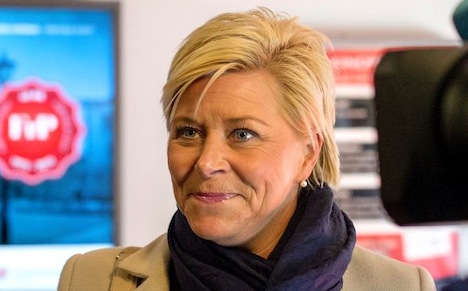
So while it’s not surprising that tensions are emerging during the campaign between Solberg and Progress Party leader Siv Jensen (pictured above) and that it’s clear coalition negotiations among the Conservatives, the Progress Party and other center-right allies are likely to be incredibly difficult, it is perhaps surprising that no one has really suggested a ‘grand coalition’ between Labour and the Conservatives as an alternative.  While there’s no real precedent of ‘grand coalitions’ in recent Norwegian history, neither is there precedent for a Conservative-Progress government — both options would mark new ground for Norway.

Solberg is riding high in polls today after a long stint in the wilderness for the Conservatives and a rebranding exercise designed to pull the Conservatives more fully to the center and expand the party’s relevance beyond its traditional image as a party solely for Norway’s business elite.  That means that it has moved more closely to Labour’s position on many issues and it’s much closer to Labour than to the Progress Party on both economic and social issues alike.  Nonetheless, there’s curiously little discussion about a ‘grand coalition,’ even as Norwegians assume that the Conservative-Progress coalition is virtually a done deal.  That means that the Conservatives, a party that favors continuity over rupture, will govern with the Progress Party, which has historically favored rupture over continuity.  It will also likely mean that Jensen will become Norway’s next finance minister, an outcome that could scare moderate voters otherwise disposed to a Solberg-led government into supporting Labour instead.

If, for some reason, the Conservatives win the election and don’t form a coalition with Progress, because negotiations stall or because Progress’s vote collapses, the Conservatives would more likely form a coalition with two smaller center-right parties or even try a minority government before pairing up with Labour, not least of which because Labour prime minister Jens Stoltenberg has spent much of his campaign warning about all the damage that a right-wing government would cause to Norwegian society.

But on policy terms, there’s a lot to recommend a Norwegian ‘grand coalition.’  And if it can happen in Germany, Austria and Italy, why not in Norway too?  Continue reading Despite doubts about far-right Progress Party, no talk of Norwegian ‘grand coalition’

Would a Miliband-led Labour government be an improvement on British civil liberties?

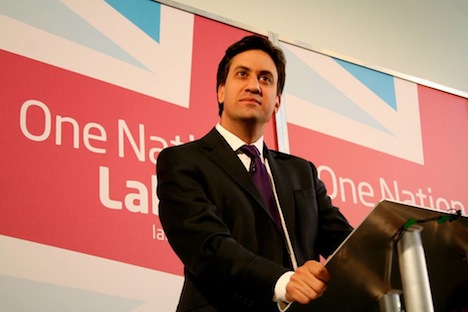
onenationed

The troubling case of David Miranda, the partner of Guardian reporter Glenn Greenwald, who was detained by British police at Heathrow yesterday for nine hours under schedule 7 of the U.K. Terrorism Act, is now a full-blown fully international incident. United Kingdom Flag Icon

The case has implications not only for U.S. politics (Greenwald has been the chief source for the leaks about the U.S. National Security Agency’s Internet intelligence-gathering programs) and even Brazilian politics (Greenwald lives in Brazil with Miranda, a Brazilian native), but for British politics as well, where the issue of civil liberties has been contentious for the past decade and a half under both the Labour governments of Tony Blair and Gordon Brown and the Conservative-led government of current prime minister David Cameron.

Political strategist Ian Bremmer is already suggesting that the United States and/or the United Kingdom may be preparing an indictment against Greenwald (presumably under the U.S. Espionage Act), which would explain why Miranda’s laptop computer and other personal effects were confiscated in London.  We already know that the United States, by the admission of White House deputy press secretary Josh Earnest was given a heads-up by London prior to Miranda’s detention, though Earnest has denied that the United States requested or collaborated with the detention.  It’s equally plausible that overeager police officials in London jumped at an opportunity to gather information they thought top U.S. and U.K. officials would appreciate — if the United States and the United Kingdom really are pursuing an international case against Greenwald, you’d think they would be careful not to commit what seems like a prima facie violation of the U.K. Terrorism Act.

With both Scotland Yard and Cameron saying little about the incident, and with U.S. officials remaining relatively mum, most of today’s discussion has been dominated by vehement critics of the detention on both sides of the Atlantic.

One of the most striking has come from Labour Party’s shadow home secretary, Yvette Cooper, a rising Labour star who may herself one day lead the party, who has called for an investigation into whether the detention was appropriate under the Terrorism Act:

Schedule 7, which applies only at airports, ports and border areas, controversially allows officers to stop, search, question and detain individuals. Miranda was held for nine hours, the maximum the law allows before officers must release or formally arrest the individual.

According to official figures, most examinations under schedule 7 – over 97% – last less than an hour, and only one in 2,000 people detained are kept for more than six hours. It has been widely criticised for giving police broad powers under the guise of anti-terror legislation to stop and search individuals without prior authorisation or reasonable suspicion – setting it apart from other police powers.

As we approach the annual convention period in British politics, pressure on Labour leader Ed Miliband is growing to draw a deeper contrast with the current coalition government on many issues, including civil liberties.  Soon after his election as Labour leader in September 2010, Miliband criticized his party’s overreach on civil liberties, identifying in particular the Blair government’s plan to hold suspects for 90 days without trial and the broad use of anti-terrorism laws.  At the time, Miliband argued that he wanted to lead Labour to reclaim the British tradition of liberty, though Miliband also indicated at the time he supported Blair’s widespread introduction of what are now over 4 million closed-circuit television surveillance cameras throughout the country.

As the parties begin to jostle for position for an election that’s now just 21 months away, Cameron certainly won’t be able to run for reelection on as vigorous a pro-liberty position as he did in 2010, though his junior coalition partners, the Liberal Democrats, can point to their success in repealing Labour’s plan to introduce national ID cards and scrapping the Tories’ proposed communications data bill this year.

That leaves a key opening for Miliband to champion civil liberties, but given the durability of the British surveillance state and Labour’s role in creating the legal framework last decade for the British surveillance state, it is unclear whether Miliband will do so, though Cooper delivered a high-profile speech in July arguing for more oversight and protections in relation to the U.K. intelligence and security services.  It’s likelier, however, that a future Labour government will pursue many of the same pro-security policies that each of the Blair, Brown and Cameron governments have pursued.

British voters will certainly remember the truly dismal record of the past Labour government under Blair and Brown on liberty (whether the efforts made the United Kingdom more secure is another question) — the list of curbs on personal freedom is long, and it includes not only the push for CCTV cameras: Continue reading Would a Miliband-led Labour government be an improvement on British civil liberties?

Four reasons why cab-driving Stoltenberg has a chance at winning Norway’s election

stoltenberg

Though he’s making headlines this week for his stunt as a barely-disguised cab driver cruising the streets of Oslo to get a sense of the frustrations of Norwegian voters less than a month before Norway’s parliamentary elections, prime minister Jens Stoltenberg has long seemed destined to lose the September 9 vote. norway

Stoltenberg, who leads the Arbeiderpartiet (Labour Party) and has served as Norway’s prime minister since 2005, is running for a third consecutive term, and poll shave consistently shown his party running behind the Høyre (literally the ‘Right,’ or Conservative Party), and Norway has braced throughout the year for the likelihood that its voters will elect a center-right government.  It’s not unprecedented for Norway to have a right-leaning government — most recently, the Conservatives were part of a governing coalition led by Kjell Magne Bondevik and the Kristelig Folkeparti (Christian People’s Party) from 2001 to 2005.  But if polls today are correct, the Conservative Party will actually win more votes than the long-dominant Labour Party, and therefore hold more seats in the Storting, Norway’s parliament, and that hasn’t happened in a Norwegian election since 1924.

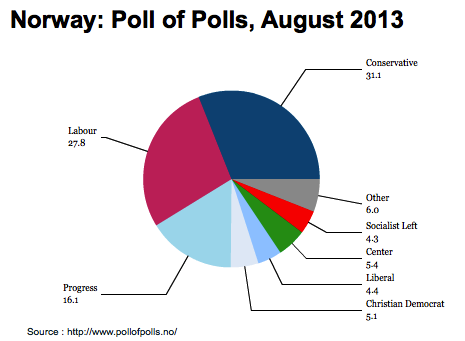
But the polls are narrowing — the Conservative Party still leads the Labor Party, and taken together, the broad center-right parties expected to form Norway’s next government hold a double-digit lead over the broad center-left parties that currently comprise Stoltenberg’s governing coalition.  One recent poll from TNS Gallup over the weekend showed the Conservatives with just 31.6% to 30.1% for Labour, much narrower than the five-point lead the Conservatives held only in July.  Here’s the latest August poll-of-polls data:

poll august norway

As I wrote earlier this summer, Erna Solberg, the leader of the Conservative Party since 2004, became the frontrunner in next month’s elections by rebranding the Conservatives as an acceptably moderate alternative to Labour.  In many ways, Solberg’s Conservatives today share more in common with Labour than with their largest presumptive coalition partner, the more populist, far-right Framskrittspartiet (Progress Party), a party.  But there’s still more or less a month to go before voting begins, and many Norwegians are still focused on their summer holidays than on the late-summer campaign.  That means there’s more than enough time for Labour to make up the difference before September 9.

While that doesn’t necessarily mean that Labour will return to government, it does mean that Labour has a shot at retaining its place as the largest parliamentary party in Norway and, in a best-case scenario, could potentially form a new, broader coalition, perhaps even with the Conservatives, to keep the Progress Party out of government.

Here are four reasons why that outcome isn’t as farfetched as it seems:

Continue reading Four reasons why cab-driving Stoltenberg has a chance at winning Norway’s election

How Erna Solberg became the frontrunner in Norway’s upcoming election

erna

Norway kicks off a busy month of elections in Europe with parliamentary elections on September 9, and if the past year’s worth of polls are to be trusted, Norwegians seem set to take a right turn, despite one of the best economies in Europe. norway

If they do so, Norway is likely to have only the second female prime minister in its history — Erna Solberg, who since 2004 has been the leader of the Høyre (literally the ‘Right,’ or more commonly, the Conservative Party).

With less than two months to go, Solberg’s Conservatives have built a growing and steady lead over the governing Arbeiderpartiet (Labour Party) and prime minister Jens Stoltenberg, a popular prime minister who’s governed Norway since 2005.

A familiar face as the Conservative leader for nearly a decade, Solberg served previously as a minister of local government and regional development from 2001 to 2005 in Norway’s previous center-right government, a role that earned her the nickname of ‘Jern-Erna,’ or ‘Iron Erna,’ and she bears some similarity to the other, more familiar center-right leader who’s running for reelection in September as well (catch an English interview with Solberg from April on the U.S.-based CNBC here).

Winning a third consecutive term in office is difficult for any government because, as years go by, the front line of policymakers either leave government or become increasingly fatigued, and governing parties, who have an increasing political stake in the status quo, don’t often regenerate the same quality of new ideas that outside parties do while in opposition.

But it’s hard to understand just why Labour seems so likely headed out of government, especially in light of Stoltenberg’s continued popularity.  It’s even more baffling when you consider that Norway is one of the best governed states in Europe, let alone the world.  Despite the fact that most of Europe is in recession or zero-growth mode, Norway grew by an estimated 3% in 2012, and the unemployment rate is a laughably low 3.5%.  Thanks to its oil wealth, it has had balanced budgets for nearly two decades, the government routinely banks its surplus (an estimated 15% of GDP in 2012) in investment funds for future use, and Norway’s GDP per capita now exceeds $60,000.

That leads to two questions: why are Norwegian voters so adamant about voting out its current government? And how did Solberg and the Conservatives become such clear frontrunners?

Background: politics in the Stoltenberg era

The 2005 election (and the ensuing 2009 election) brought about the balance that’s largely held steady for the past eight years.  Stoltenberg currently governs with the support of a ‘Red-Green’ coalition dominated by Labour and its two smaller allies, the democratic socialist Sosialistisk Venstreparti (Socialist Left Party) and the Senterpartiet (Centre Party), a chiefly agrarian party that’s moved from the political right to the political left in recent years.  Note that ‘green’ in Norway’s Red-Green coalition indicates the Center Party’s roots in rural life, not its environmental activism.

The 2005 fall of the previous center-right government of prime minster Kjell Magne Bondevik brought a drop in support for both Kristelig Folkeparti (Christian Democratic Party) and his coalition partners, the Conservatives.  That left the Framskrittspartiet (Progress Party), a relatively populist party known chiefly for its opposition to much of the Norwegian social welfare state, its advocacy of lower taxes, smaller government and deregulation, and its controversial anti-immigration stance, as the second-largest party in Norway’s parliament.  Unlike Labour and the Conservatives, both of which were founded in the late 19th century, the Progress Party emerged only in the 1970s as a modern conservative anti-tax movement.  Though it’s grown to become a major force in Norwegian politics over the 1990s and 20o0s, Progress has never formally joined any government, though that seems likely to change, as Solberg is expected to bring Progress into government if her party maintains its polling lead on September 9.

Though if Solberg’s Conservatives win their expected landslide, they will do so in large part by consolidating left-leaning moderates that have supported Labour and right-leaning moderates that have supported Progress.

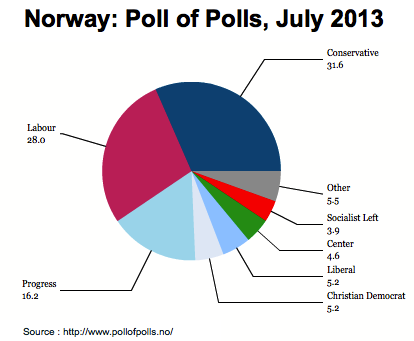
The latest July 2013 poll-of-polls shows the Conservatives with nearly 32% of the vote, which would give them around 58 seats in the Storting, Norway’s unicameral 169-seat parliament:

norway poll of polls

That’s a huge jump from the 30 seats the Conservatives hold now, and it’s a massive jump from their 2005 debacle, when they won just 14.1% of the vote and a measly 23 seats.

Even more striking is that Labour might not win the largest plurality of votes and the largest bloc of seats in parliament — for the first time since 1924. Continue reading How Erna Solberg became the frontrunner in Norway’s upcoming election

A tale of two referenda: How the EU debate could poison the Scotland debate

farageflees

In a static world, it’s easy to believe that UK prime minister David Cameron’s call in January 2013 for a referendum on the United Kingdom’s continued membership in the European Union will never come to pass — it depends upon the reelection of a Conservative-led in the 2015 general election, Cameron’s continued Tory leadership and a lengthy process of negotiation thereafter with EU leaders. United Kingdom Flag Iconscotland

So when Cameron agreed with Scottish first minister Alex Salmond two months later to hold a referendum on Scottish independence in September 2014, he had every reason to believe that he had bought enough time to keep the European issue relatively calm.  After all, poll after poll shows the pro-independence vote lagging far behind the anti-independence vote and, despite a relatively large number of undecided Scottish voters, many polls throughout 2012 and early 2013 showed the ‘no’ vote with over 50% support.  One Ipsos poll earlier this month showed that 59% support union and just 31% support independence.

But what’s increasingly clear is that the two referenda are becoming inseparable — Scotland’s future role in the United Kingdom depends on the United Kingdom’s future role in Europe.  With Westminster now increasingly turning to its toxic obsession with its union with Europe, a group of largely English parliamentarians may well be endangering the more longstanding three-century union with Scotland.

It’s easy to follow Cameron’s arithmetic here:  Allow the United Kingdom Independence Party (UKIP) and the more euroskeptic members of his own party their opportunity for an anti-Europe outlet in the May 2014 European Parliament elections.  Then sail through the September 2014 Scottish referendum with both the Labour Party and the Liberal Democratic Party united against Scottish independence, maybe even by promising ‘devomax,’ a form of further devolution of tax and spending powers to the Scottish parliament that came into existence in 1999.  Cameron could therefore put the specter of Scottish independence behind him before looking to the next general election and, if successfully reelected, the EU negotiations that would precede the long-promised EU referendum.

What Cameron didn’t count on was the growing chorus of euroskeptic rage from within his own party, which seems destined to repeat the Tory infighting of the 1990s that so destabilized former prime minister John Major’s government  Education minister Michael Gove’s insisted last week, for example, that he would support leaving the European Union if a vote were held immediately.  Over 100 Tory backbenchers are calling for a law to guarantee a referendum later this decade or even for a referendum before 2015, and one Tory MP is even arguing for a full joint Tory/UKIP electoral coalition in 2015.  Some Tories are even trying to look beyond Cameron to a more Euroskeptic leader, perhaps even Gove.  It comes at a time when UK voters insist in poll after poll that they would overwhelmingly vote to leave the European Union in a referendum.

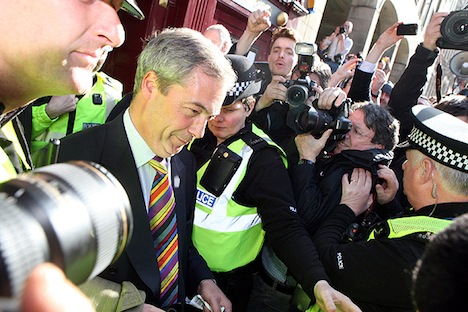
UKIP’s rise hasn’t helped, and Nigel Farage’s insistence at contesting a Scottish by-election led to the somewhat humorous result of his being chased out of a pub in Edinburgh last week (pictured above).  Though it’s a safe bet that Farage and UKIP won’t make many inroads in Scotland, it’s hard to see how his active presence in Scotland could do anything but make things worse for unionist supporters.  His party is currently polling as much as 20% in national polls, outpacing the Liberal Democrats and, in some cases, pulling to within single digits of the Conservatives (giving Labour a sizable lead).  Even if Labour wins in 2015, if UKIP wins the support of one out of every five UK voters, it will pull not only the Tories, but probably even Labour, further toward euroskepticism and eventual rupture with Europe.  Continue reading A tale of two referenda: How the EU debate could poison the Scotland debate

What Iceland’s election tells us about post-crisis European politics

dusseldorf

Iceland was supposed to be different.Iceland Flag IconEuropean_Union

In allowing its banks to fail, neo-Keynesian economists have argued, Iceland avoided the fate of Ireland, which nationalized its banks and now faces a future with a very large public debt.  By devaluing its currency, the krónur, Iceland avoided the fate of countries like Estonia and others in southern Europe trapped in the eurozone and a one-size-fits all monetary policy, allowing for a rapid return to economic growth and rapidly falling unemployment.  Neoclassical economists counter that Iceland’s currency controls mean that it’s still essentially shut out from foreign investment, and the accompanying inflation has eroded many of the gains of Iceland’s return to GDP growth and, besides, Iceland’s households are still struggling under mortgage and other debt instruments that are linked to inflation or denominated in foreign currencies.

But Iceland’s weekend parliamentary election shows that both schools of economic thought are right.

Elections are rarely won on the slogan, ‘it could have been worse.’ Just ask U.S. president Barack Obama, whose efforts to implement $800 billion in stimulus programs in his first term in office went barely mentioned in his 2012 reelection campaign.

Iceland, as it turns out, is hardly so different at all — and it’s now virtually a case study in an electoral pattern that’s become increasingly pronounced in Europe that began when the 2008 global financial crisis took hold, through the 2010 sovereign debt crisis in the eurozone and through the current European-wide recession that’s seen unemployment rise to the sharpest levels in decades.

Call it the European three-step.

In the first step, a center-right government, like the one led by Sjálfstæðisflokkurinn (Independence Party) in Iceland in 2008, took the blame for the initial crisis.

In the second step, a center-left government, like the one led by Jóhanna Sigurðardóttir and the Samfylkingin (Social Democratic Alliance) in Iceland, replaced it, only to find that it would be forced to implement harsh austerity measures, including budget cuts, tax increases and, in Iceland’s case, even more extreme measures, such as currency controls and inflation-inducing devaluations.  That leads to further voter disenchantment, now with the center-left.

The third step is the return of the initial center-right party (or parties) to power, as the Independence Party and their traditional allies, the Framsóknarflokkurinn (Progressive Party) will do following Iceland’s latest election, at the expense of the more newly discredited center-left.  In addition, with both the mainstream center-left and center-right now associated with economic pain, there’s increasing support for new parties, some of them merely protest vehicles and others sometimes more radical, on both the left and the right.  In Iceland, that means that two new parties, Björt framtíð (Bright Future) and the Píratar (Pirate Party of Iceland) will now hold one-seventh of the seats in Iceland’s Alþingi.

This is essentially what happened last year in Greece, too.  Greece Flag IconIn the first step, Kostas Karamanlis and the center-right New Democracy (Νέα Δημοκρατία) initially took the blame for the initial financial crisis.  In the second step, George Papandreou and the center-left PASOK (Panhellenic Socialist Movement – Πανελλήνιο Σοσιαλιστικό Κίνημα) overwhelming won the October 2009 elections, only to find itself forced to accept a bailout deal with the European Commission, the European Central Bank and the International Monetary Fund.  In the third step, after two grueling rounds of election, Antonis Samaras and New Democracy returned to power in June 2012.

By that time, however, PASOK was so compromised that it was essentially forced into a minor subsidiary role supporting Samaras’s center-right, pro-bailout government.  A more radical leftist force, SYRIZA (the Coalition of the Radical Left — Συνασπισμός Ριζοσπαστικής Αριστεράς), led by the young, charismatic Alexis Tsipras, now vies for the lead routinely in polls, and on the far right, the noxious neo-nazi Golden Dawn (Χρυσή Αυγή) now attracts a small, but significant enough portion of the Greek electorate to put it in third place.

The process seems well under way in other countries, too.  In France, for examFrance Flag Iconple, center-right president Nicolas Sarkozy lost reelection in May 2012 amid great hopes for the incoming Parti socialiste (PS, Socialist Party) administration of François Hollande, but his popularity is sinking to ever lower levels as France trudges through its own austerity, and polls show Sarkozy would now lead Hollande if another presidential election were held today.

It’s not just right-left-right, though. The European three-step comes in a different flavor, too: left-right-left, and you can spot the trend in country after country across Europe — richer and poorer, western and eastern, northern and southern. Continue reading What Iceland’s election tells us about post-crisis European politics