Tag Archives: labour

Why would an independent Scotland even want to keep the pound?

scottishpound

Who cares about the pound anyway? scotlandUnited Kingdom Flag Icon

In the campaign for Scottish independence, key ‘Yes’ camp leaders consistently argue that a sovereign Scotland could retain the British pound as currency, and they’ve decried statements from British officials that Scotland wouldn’t be permitted to use the pound in the event that Scottish voters opt for independence in the September 18 referendum.

But putting aside whether, as a technical matter, Scotland would be able to adopt the pound, the greater issue is why it would actually want to do so — either in a formal currency union with the rest of the United Kingdom or by informally adopting the pound sterling as Scotland’s currency (‘Sterlingisation’).

Even though polls show the ‘Yes’ campaign narrowing the gap with the ‘No’ side, (the latest YouGov survey, taken between September 2 and 5, gave the ‘Yes’ camp its first lead of 47% to 45%, with 7% undecided), almost every poll in the last year shows more Scottish voters  opposed to independence than in favor of it.

If the ‘Yes’ side falls short, one of the key questions will be whether the decision to embrace the pound as an independent Scotland’s currency was wise as a strategic matter. But if the ‘Yes’ side carries the referendum, Scotland’s first minister Alex Salmond will have to confront what kind of independence he’s actually won for a new country yoked on Day One to monetary policy dictated by the Bank of England.

It’s odd that the campaign’s fight over the pound has become such a central debate, but it’s possibly even odder that Salmond would cling to the pound (and other indicia of the union, such as the British monarchy) in his campaign for independence.

George Osborne, chancellor of the exchequer, has attempted to maintain a united front among his own Conservative Party, the Liberal Democrats and Labour that Scotland would not be able to avail itself of the pound if it becomes an independent country. But there’s plenty of skepticism that the remaining United Kingdom of England, Wales and Northern Ireland would actually be able to stop Scotland from doing so. Continue reading Why would an independent Scotland even want to keep the pound? →

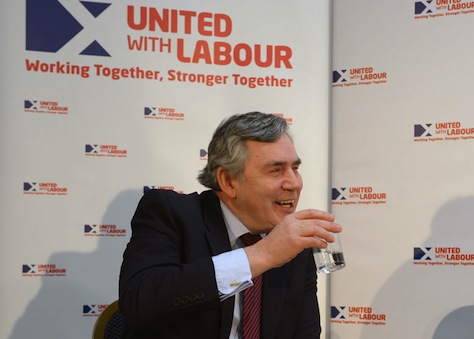
Gordon Brown: the not-so-secret weapon of the ‘No’ campaign

brown

Pity Gordon Brown, the long-suffering, long-plotting chancellor who assumed the British premiership only after Tony Blair’s three successive terms tested the British electorate’s patience on everything from Iraq to civil liberties.scotlandUnited Kingdom Flag Icon

By the time Brown finally wrested the keys to No. 10 Downing Street from Blair, the ‘New Labour’ project was in serious political trouble, and Brown, lacking the easy charm of either his predecessor or then-opposition leader David Cameron, waged a doomed, if feisty, 2010 general election campaign.

Unlike Blair, Brown didn’t take a high-profile role on the speaker circuit or announce a global initiative to bring about Middle Eastern peace. He mostly just went back to Scotland, where he wrote a wonky tome on reforming the global financial system. Brown’s strong reputation today, more so abroad than at home, reflects his adroit handling of the 2008-09 financial crisis, when he prodded other European and US officials to follow his aggressive and proactive example.

Today, he remains the MP for Kirkcaldy and Cowdenbeath, a southern Scottish constituency in Fife. Accordingly, it’s no surprise that Brown is emerging as a key leader of the campaign against Scottish independence — to the surprise of many both north and south of the Tweed.

Continue reading Gordon Brown: the not-so-secret weapon of the ‘No’ campaign →

What to make of Cameron’s night of the long knives

queenhague

It wasn’t a surprise that British prime minister David Cameron sacked Kenneth Clarke, the one-time self-proclaimed ‘big beast’ of the Conservative Party from government. United Kingdom Flag Icon

At age 74, the pro-Europe former chancellor, who began his ministerial career in Edward Heath’s government of the early 1970s, had already been demoted once from justice secretary, his progressive ideas for penal reform and lighter sentencing guidelines  thwarted by the Tory right two years ago.

But it was something of a surprise that Cameron sacked so many other high-profile members of his cabinet last night.

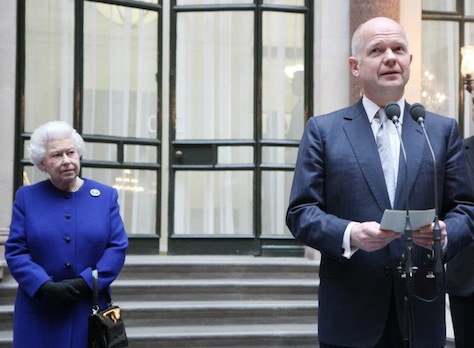
Foreign secretary William Hague (pictured above with Queen Elizabeth II), one of the most high-profile Tories inside or outside government will now become the Commons leader. Hague, once a strident eurosceptic, was elected leader of the Conservative Party in the aftermath of Tony Blair’s massive victory in 1997. He stepped down in 2001 after his failed campaign to return the Tories to power. Though just 53 years old, Hague also announced he would also leave office at the 2015 elections, cutting short what’s been a solid career, if not one that might have elevated Hague to the premiership under different conditions.

hammond

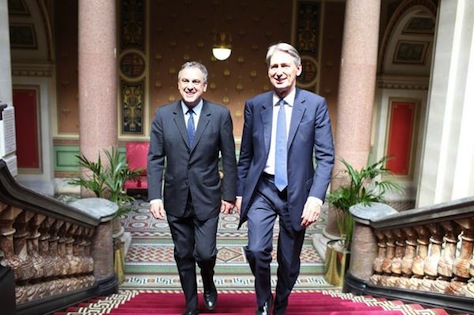
His replacement is defence secretary Philip Hammond, another Conservative firebrand, who has ably worked with chancellor George Osborne to reign in spending while the United Kingdom has reduced its role in the US-led occupation in Afghanistan. Hammond, who served as Osborne’s deputy in opposition, comes from the right wing of the party, however, having opposed Cameron’s push to legalize same-sex marriage last year. He’s not known as a particularly charismatic figure, and he’ll have a hard time shaking the notion that he’s No. 11’s man at the foreign office. 

Having argued that the United Kingdom should leave the European Union without significant, additional British carve-outs, Hammond will now be tasked with salvaging the UK-EU relationship.

But the knives went longer and deeper still — David Willetts, the minister for universities and science, nicknamed ‘Two Brains’ and deemed one of the cabinet’s most thoughtful members; David Gove, the combatively conservative and stridently eurosceptic education minister; Dominic Grieve, the attorney general; Owen Patterson, the environmental secretary.

The semi-official word is that Cameron’s reshuffle represents an effort to put his cabinet and his government on footing to wage next May’s general elections, with a particular focus on elevating the number of women and younger Tories to higher positions.

To borrow a phrase from former US president Bill Clinton, a ‘cabinet that looks like Britain.’

Continue reading What to make of Cameron’s night of the long knives →

A detailed look at the European parliamentary election results (part 3)

Nearly a week after the European elections, the reverberations are still shaking the entire continent, on at least two levels — the consequences of the historic level of eurosceptic parties elected across Europe and in terms of the growing battle between the European Parliament and the European Council over electing the next European Commission president. European_Union

In the first part of a Suffragio series examining the results of the May 25 European parliamentary elections, I focused on the five most populous countries in the European Union: the United Kingdom and France, where eurosceptic parties won the greatest share of the vote; Germany, where chancellor Angela Merkel won another strong victory; Italy, where prime minister Matteo Renzi won a near-landslide mandate just three months into his premiership; and Spain, where both traditional parties lost support to a growing constellation of anti-austerity movements — so much so that Alfredo Pérez Rubalcaba, the leader of the Partido Socialista Obrero Español (PSOE, Spanish Socialist Workers’ Party), Spain’s traditional center-left party, resigned. 

In the second part, I examined the results in nine more countries — Poland, Romania, The Netherlands, Belgium, Greece, the Czech Republic, Portugal, Hungary and Sweden.

In the third and final part, I examine the results in the remaining 14 countries of the European Union. Continue reading A detailed look at the European parliamentary election results (part 3) →

Why Clegg should step down as LibDem leader

cleggeuro

Though he may well survive his party’s horrendous defeat in Sunday’s European elections, Nick Clegg’s decision to cling to the leadership of the Liberal Democrat will almost certainly doom it to equally damaging losses in the May 2015 British general election. United Kingdom Flag Icon

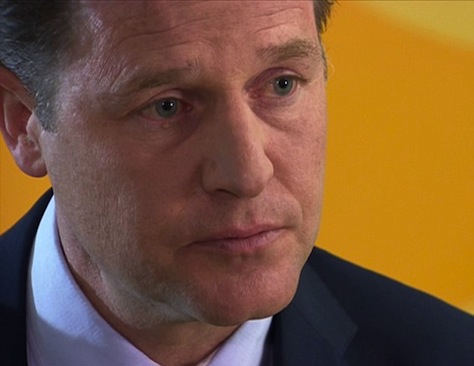
Appearing weary in a television interview after his party lost 10 of its previous 11 seats in the European Parliament, Clegg (pictured above) defied calls yesterday from both inside and outside his party to step down as leader.

It’s axiomatic that junior coalition partners tend to suffer in elections. The Freie Demokratische Partei (FDP, Free Democratic Party), which joined German chancellor Angela Merkel in government between 2009 and 2013, lost all of its seats in the Bundestag, the lower house of the German parliament, for the first time since World War II in last September’s federal elections. It, too, suffered on Sunday, losing all but three of its previous 12 MEPs in Sunday’s election as well. 

In Ireland, the center-left Labour Party, the junior partner in a government led by center-right Fine Gael, lost all three of its MEPs and won just 5.3% of the vote. Its seven-year leader, Eamon Gilmore, who has served as Ireland’s Tánaiste, its deputy prime minister, and foreign affairs minister, since 2011, resigned on Monday, taking responsibility for Labour’s horrendous showing. 

Gilmore’s example makes Clegg’s position even more awkward.

Paddy Ashdown, a member of the House of Lords, and the party’s leader between 1988 and 1999, defended Clegg, as did former leader Sir Menzies Campbell. But private polls, leaked to the press, show that Clegg’s Liberal Democrats are headed for an equally jarring defeat in 12 months, and that Clegg himself could even lose his seat.

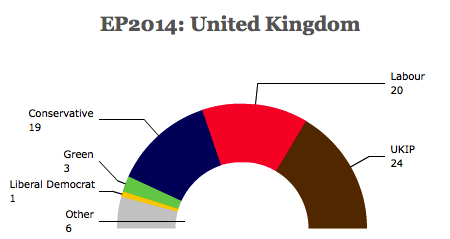
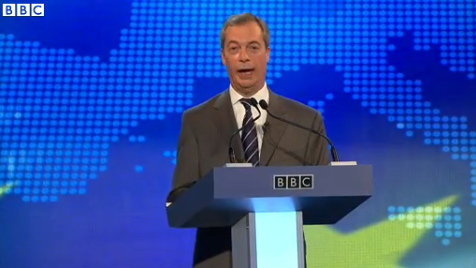
Clegg is widely viewed as having lost a series of debates with the leader of the United Kingdom Independence Party, Nigel Farage, who led UKIP to a stunning victory on Sunday, winning 27.5% of the vote and 24 seats in the European Parliament:

UK

Farage credited his victory, in part, to the debates with Clegg, though he crowed on Monday that Clegg’s position as leader is untenable, and that he would be ‘surprised’ if Clegg leads the LibDems into the next election.

To Clegg’s credit, neither Conservative prime minister David Cameron nor Labour leader Ed Miliband were willing to debate Farage by strongly defending European integration and the continued British role in the European Union. Former Labour prime minister Tony Blair noted Clegg’s integrity yesterday for doing so, while accurately highlighting the more fundamental problem for the LibDems heading into election season:

Blair praised the way in which Nick Clegg had shown leadership in confronting the anti-EU mood in the country. “To be fair to Nick Clegg – I don’t want to damage him by saying this – over the past few years he has shown a quite a lot of leadership and courage as a leader.

“The problem for the Lib Dems is nothing to do with Europe. The problem they have is very simple: they fought the 2010 election on a platform quite significantly to the left of the Labour party and ended up in a Conservative government with a platform that is significantly to the right of Labour.

Partly in response to UKIP’s rise, David Cameron agreed last year that, if reelected, he will hold a referendum on British EU membership in 2017. Continue reading Why Clegg should step down as LibDem leader →

A detailed look at the European parliamentary election results (part 1)

BogvmPUIUAACkxJ

We now have most of the results from across Europe in the 28-state elections to elect all 751 members of the European Parliament.European_Union

At the European level,  the center-right, Christian democratic European People’s Party (EPP) emerged with about 25 more seats than the center-left, social democratic Party of European Socialists (PES).

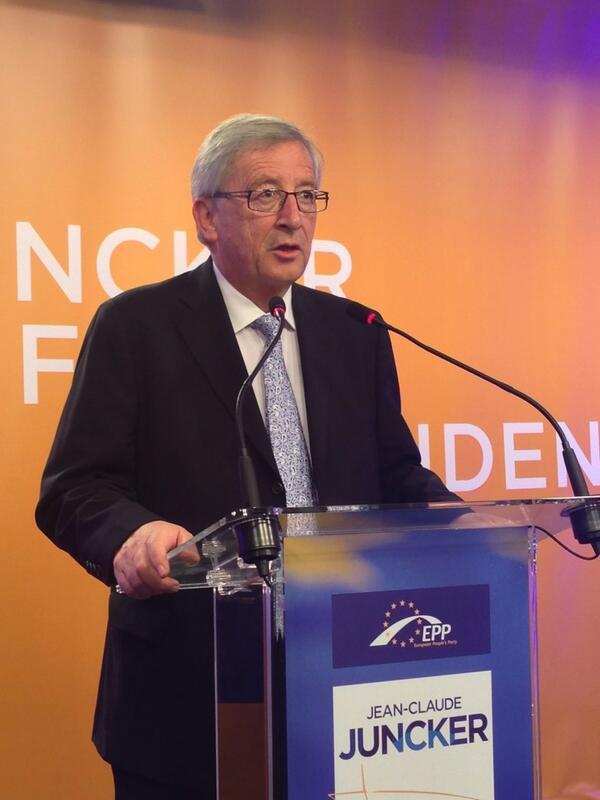
That immediately gives former the EPP’s candidate for the presidency of the European Commission, former Luxembourgish prime minister Jean-Claude Juncker, a boost in his efforts to actually become the Commission president. But it’s still far from automatic, despite Juncker’s aggressive posture at a press conference Sunday evening:

“I feel fully entitled to become the next president of the European Commission,” Juncker, a former Luxembourg prime minister, told supporters late yesterday in Brussels after the release of preliminary results. Premier for 18 years until he was voted out of office in December, Juncker also gained recognition in his dual role as head of the group of euro-area finance ministers during the debt crisis.

Juncker (pictured above) still must to convince the European Council to propose him as Commission president, and he’ll still need to win over enough right-wing or center-left allies to win a majority vote in the European Parliament.

* * * * *

RELATED: Here come the Spitzenkandidaten! But does anybody care?

* * * * *

That process, which could feature a major battle between the European Council and the European Parliament, will unfold in the days, weeks and possibly months ahead.

But what do the results mean across Europe in each country? Here’s a look at how the European elections are reverberating across the continent.  Continue reading A detailed look at the European parliamentary election results (part 1) →

Grybauskaitė headed for easy reelection as Lithuania’s president

grybauskaite

Though the disputed independence referenda in Ukraine’s troubled eastern oblasts attracted considerably more international attention, Lithuania also went to the polls on May 11 to elect a president.Lithuania Flag Icon

Dalia Grybauskaitė, the incumbent since 2009, easily led the first round with 46.61% of the vote, just shy of an outright victory, and she is almost certain to win reelection in the May 25 runoff against Zigmantas Balčytis, a member of the European Parliament, a former finance minister and, briefly for a month in 2006, acting prime minster. Balčytis is the candidate of the governing center-left Lietuvos socialdemokratų partija (LSDP, Social Democratic Party of Lithuania).

The runoff will coincide with elections for the European Parliament, where Lithuania holds 11 of its 751 seats.

Balčytis, a relatively uncharismatic candidate, won just 13.84% of the vote, however, only narrowly edging out Artūras Paulauskas, the candidate of the Darbo Partija (DP, Labour Party), who 12.20%.

Grybauskaitė, who lists the late British prime minister Margaret Thatcher among her political heroes, has been dubbed, somewhat unimaginatively, as Lithuania’s ‘Iron Lady,’ after amassing one of the most prolific political careers of any figure in post-Soviet Lithuania. A former finance official, Grybauskaitė served as Lithuania’s representative to the European Commission between 2004 and 2009, for much of that time as the commissioner for financial planning and the budget. As commissioner, Grybauskaitė worked to reduce agricultural subsidies from the European budget and she was responsible for passing the first such budget that held funding for the Common Agricultural Policy to below 50% of European funds for the first time in European Union history.

Upon returning to Lithuania, she easily won a first-round election running as a conservative independent against token opposition. Though Lithuania’s parliamentary government means that the prime minister is responsible for most of Lithuanian domestic policy,  Grybauskaitė holds a key role in setting foreign policy. She has championed Lithuania’s place in the heart of the European Union, the eurozone and in NATO, and she has fiercely resisted Russian designs on influencing its ‘near-abroad,’ especially during the most recent security crisis over the Russian annexation of Crimea and possible designs to influence eastern Ukraine.   Continue reading Grybauskaitė headed for easy reelection as Lithuania’s president →

What’s going on with Gerry Adams and the Northern Irish police?

gerry

With just less than a month until voters in both Ireland and Northern Ireland choose their representatives to the European Parliament, the Belfast police have for the past four days given the Irish republican Sinn Féin a potent campaign issue — and exacerbated tensions nearly two decades after the struggle between Irish Catholics and Protestants moved from killing and violence to the realm of politics. northernirelandIreland Icon

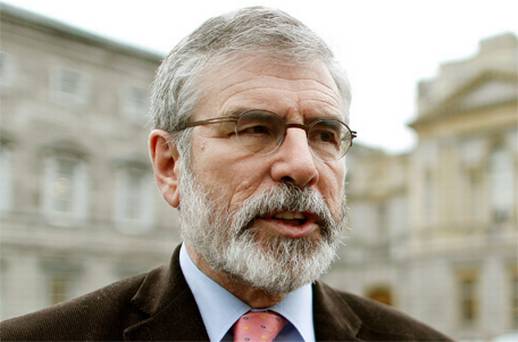
Northern Ireland’s police force arrested Gerry Adams, the leader of the republican Sinn Féin since the early 1980s on Wednesday, holding him for four days in relation to one of the most brutal murders of the Northern Irish violence. Other Sinn Féin leaders, including Northern Ireland’s deputy first minister Martin McGuinness, have attacked the arrest as a political stunt, but other politicians in both Northern Ireland and the Republic of Ireland have been more reticent to comment on what’s become an unpredictable turn of events.

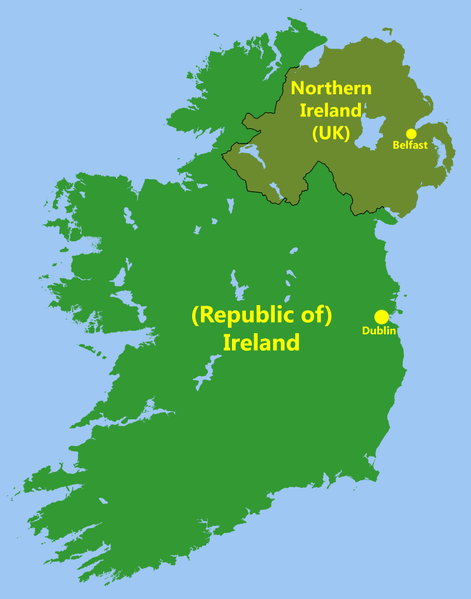
The  arrest relates to the 1972 murder of Jean McConville, a mother of 10 who was pulled from her home by armed gunmen within  the Irish Republican Army. She was later killed and ‘disappeared,’ her remains found only in 2003. It was a particularly cruel murder among many such killings during Northern Ireland’s  ‘Troubles,’ the violent struggle between unionist Protestants who largely supported Northern Ireland’s status within the United Kingdom, and Irish nationalist Catholics, who wanted northern Ireland to be part of a unified Irish republic.

The struggle dates to 1921, when the United Kingdom partitioned Ireland into the largely Protestant Northern Ireland and the largely Catholic Southern Ireland. A year later, Southern Ireland became the ‘Irish Free State,’ but most of Northern Ireland’s residents remained committed unionists, despite a strong, organized Catholic minority that favored Ireland’s unification. When the Republic of Ireland gained full independence in 1949, Northern Ireland remained part of the United Kingdom, a status that continues to this day. The IRA began an armed struggle against British rule in Northern Ireland in the late 1960s.

Throughout the worst of the political violence in the 1970s and the 1980s, Sinn Féin emerged as the political arm of the IRA. Though Adams (pictured above) claims that he was never a member of the IRA, there were always strong links between the two organizations, and Adams has never apologized for advancing the IRA’s political interests.

Adams surrendered to police on Wednesday in connection to the re-opening of the investigation, and they held him in custody through the weekend, going so far as to obtain a court order in request of an additional 48 hours to interrogate Adams. He was released earlier Sunday without charge — for now.

Former IRA leader Brendan Hughes accused Adams of having organized and ordered the killing on suspicion that McConville was a British spy. Hughes died in 2008, but made the claim to a Boston College historian compiling an oral history of the Troubles. Hughes strenuously broke with Adams after the Sinn Féin leader accepted the terms of the Good Friday Agreement, so his accusations must come with some amount of skepticism — he’s also been dead for six years, making his charge against Adams problematic from an evidentiary point of view.

Shaun Woodward, a British Labour MP and former secretary of state for Northern Ireland, argues in The Guardian that Adams’s arrest highlights the need for a way to address the atrocities committed during the Troubles in a manner that doesn’t jeopardize the future of Northern Ireland’s government and what’s still very much an ongoing peace process:

South Africa dealt with its past through a Truth and Reconciliation Commission. I can already hear the politicians screaming no, but that’s to be expected: the thing is to take the argument directly to the people. Nor is it for outsiders to choose whether this model could work for Northern Ireland. What is clear is that we need something that allows justice to be seen to be done, without crippling the peace process or simply avoiding the issue. Without a mechanism that is both fair and based on quasi-judicial principles, it is impossible to imagine that Northern Ireland will ever successfully move out of the clenched jaws of its grisly past.

So what does this latest development mean for politics in Northern Ireland and in the southern Republic of Ireland?

471px-Ireland-Capitals

Adams’s arrest could derail 16-year peace in Northern Ireland

The 1998 ‘Good Friday’ agreement largely brought the sectarian violence to an end, and Adams now leads Sinn Féin as a force within both Northern Ireland, where the party sits on the Northern Ireland Executive — it largely governs alongside its rivals, the Democratic Unionist Party (DUP), and other parties. Sinn Féin holds four ministries, the DUP holds five ministries, and three other parties hold another four ministries. Adams’s colleague McGuinness has served as the deputy first minister of Northern Ireland since 2007. Continue reading What’s going on with Gerry Adams and the Northern Irish police? →

Momentum shifts in favor of Scottish independence

Gordon-Brown-3228133-1You know the unionist campaign against Scottish independence may be flagging when its strategists believe that its secret weapon is…  former British prime minister Gordon Brown:scotlandUnited Kingdom Flag Icon

Tavish Scott, the Lib Dem member of the Scottish parliament (MSP) for Shetland, says Mr Darling and Better Together have done well at providing an intellectual case for remaining in the UK, but have failed to connect with crucial sections of the electorate such as traditional Labour voters. Mr Scott wants major Labour figures in Scotland such as former prime minister Gordon Brown and former UK minister John Reid to take a greater role in shoring up “soft Labour” support for the union.

What’s clear is that the ‘Yes, Scotland’ campaign in favor of independence is gaining momentum, while the ‘Better Together’ campaign is losing steam.

A Panelbase poll conducted between April 27 and May 4 shows that the ‘No’ side would win 46% of the vote and the ‘Yes’ side would win 41% of the vote, with 14% undecided. Though Panelbase has typically shown a stronger ‘Yes’ vote than other polls, its findings are consistent with other surveys over the past month. While ‘No’ continues to lead ‘Yes,’ sometimes by double-digit margins, there’s no escaping that the polls are tightening.

That’s causing some alarm within both government and opposition circles. Though British prime minister David Cameron almost certainly believed that most Scottish voters wouldn’t support independence when he agreed to the terms of the referendum with Scottish first minister Alex Salmond last May, his governing Conservative Party must now face the prospect of a too-close-to-call referendum in Scotland just eight months before the wider UK general election in May 2015.

If Scotland votes ‘yes,’ or even comes close to endorsing independence, some senior Tories are already wondering if Cameron will have to resign — after 307 years of union with  England, he’ll be the prime minister who ‘lost’ Scotland.

With the Scottish Labour Party largely leading the charge against independence, what will it say about the generation of national Labour leadership, including includes Scottish-born prime minister Tony Blair, that delivered devolution  Scotland in 1997?

More fundamentally, however, why, so suddenly, does the ‘Yes’ campaign — once deemed hopeless — now seem like it has a chance? Continue reading Momentum shifts in favor of Scottish independence →

UKIP’s Farage is winning the British debate on Europe

Screen Shot 2014-04-02 at 6.04.14 PM

It’s not hard, watching the two debates over future British membership in the European Union, to see why Nigel Farage, the leader of the euroskeptic United Kingdom Independence Party (UKIP), is such a successful politician.United Kingdom Flag IconEuropean_Union

In the last of two debates with deputy prime minister Nick Clegg, the leader of the Liberal Democrats, Farage asked voters in his closing remarks to ‘join the people’s army and topple the establishment that got us into this mess.’

British viewers apparently agree — in an instant Guardian poll following the debate, they believed that Farage won the debate by a margin of 69% to 31%. The debate precedes the May 22 elections to determine the United Kingdom’s 73 members in the European Parliament.

If former prime minister Margaret Thatcher was the British answer to US president Ronald Reagan, Farage (pictured above) is its answer to Newt Gingrich in his ability to lead an anti-establishment political revolution. In the same way that Thatcher reshaped the Conservative Party in the anti-government, pro-market mould of the US-style conservatism, Farage is reshaping the way that Britons conceive the debate over EU membership, just as Gingrich rewired the nature of political debate in the United States — by attacking the consensus of a longstanding political elite through a simple, compelling message that scrambles the traditional lines between left and right.

Farage is doing to ‘Brussels’ exactly what Gingrich did to ‘Washington.’

Farage’s performance has been so smooth, it’s tantalizing to wonder just how well he might do in a four-way televised debate in the campaign for the May 2015 parliamentary elections alongside not only Clegg, but also Conservative prime minister David Cameron, and Labour Party leader Ed Miliband — or how effective Farage might be leading the ‘no’ campaign in the pending 2017 EU membership referendum, a vote that Cameron was forced to promise to hold (if reelected next year) largely as a result of UKIP’s rise in popularity over the past two years.

Here are just three examples from Wednesday’s debate that show just how effective Farage can be — he manages to argue against EU membership as a champion of greater globalization, of protecting minorities and the working class, and of greater world peace.

You don’t have to buy what Farage is peddling in order to acknowledge that he’s devastatingly effective in framing the UK-EU debate in uniquely new and powerful ways.

It’s no longer an academic point.

A March 26-27 YouGov poll for The Sun shows a three-way race in the European elections: Labour wins 28%, UKIP wins 26% and the Tories win 24%, leaving the LibDems far behind at 11%. Nearly one in two Conservative voters from 2010, and nearly one in five Labour voters, plans to back UKIP. Among the most likely to vote, UKIP leads with 30%.

Continue reading UKIP’s Farage is winning the British debate on Europe →

Who is Alexander Pechtold?

1236469_10152179794657550_13898520_n

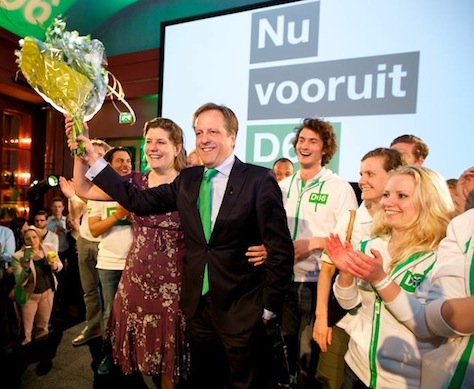
Though Geert Wilders and his anti-Moroccan comments dominated  headlines following last month’s municipal elections throughout The Netherlands, the clear winner was the Democraten 66 (D66, Democrats 66) and its leader Alexander Pechtold (pictured above).Netherlands Flag Icon

Nearly a year and a half after the last Dutch general election, D66 is emerging in polls as the strongest party in The Netherlands today, in light of the government’s increasing unpopularity under the strain of budget cuts and a continued sluggish economy.

Notably, D66 became the largest party in both Amsterdam and Utrecht. That’s a big deal because Amsterdam since 1946 has been the stronghold of the Partij van de Arbeid (PvdA, Labour Party), the junior partner in the current Dutch government. It’s a sign of just how unpopular the government has become, and how specifically unpopular the Labour Party has become.

Nationally, the Christen-Democratisch Appèl (CDA, Christian Democratic Appeal) won the highest share of the vote with 17.7%, largely on the strength of rural voters.

The center-right, liberal Volkspartij voor Vrijheid en Democratie (VVD, People’s Party for Freedom and Democracy), the leading partner of the national government placed second with 12.7%, a significant decrease.

But D66 placed third with 9.6% of the vote and, in light of the advances in Amsterdam and Utrecht, emerged from the March 19 elections as the party with the most momentum in Dutch politics today.

It’s somewhat of an odd party.

Founded in (you guessed it!) 1966 by journalist Hans van Mierlo, its original goal was to make The Netherlands a more democratic country, with a two-party presidential republic and greater direct participation through referenda. 

Today, it doesn’t necessarily want to enact a presidential republic, but it’s still split between an older radical wing and a newer liberal wing, and it has essentially become a just-left-of-center party that’s both socially liberal and economically liberal, with chiefly urban appeal limited to The Netherlands’s large cities and progressive university towns. 

An art historian by training, Pechtold was the mayor of Wageningen before making the leap into national politics. He briefly served in the second government of Jan Pieter Balkenende between 2005 and 2006 as minister for government reform and kingdom relations. Continue reading Who is Alexander Pechtold? →

Miliband’s EU hedge makes a disastrous referendum more likely

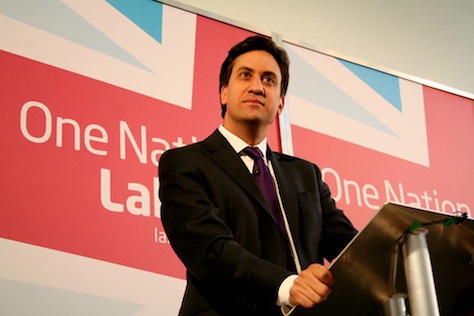
edmiliLabour leader Ed Miliband announced yesterday that, if elected prime minister after next year’s general election, he would not hold a referendum on the United Kingdom’s continued (now 41-year) membership on the European Union.United Kingdom Flag Icon

At first glance, it sounds like exactly the type of pledge that plenty of pro-European British constituencies, including much of the business community, would applaud — eliminating the uncertainty of the United Kingdom’s future within the European Union that features prominently in the current government’s referendum promise.

It’s hard to see what Miliband has to gain politically or strategically with his new pronouncement on a future EU referendum, a essentially in reaction to Cameron’s position from last year.  It will satisfy neither pro-European nor anti-European voices, allows Cameron to bill himself as a champion of democratic choice, adds additional uncertainty (especially with the likelihood of a new Berlin-led EU treaty effort in the years ahead), and locks Miliband into what could be incredibly short-sighted  policy.

Most of all, it shows why so many Brits, including plenty of Labour supporters, fear that Miliband doesn’t have the skills to make it to 10 Downing Street. Continue reading Miliband’s EU hedge makes a disastrous referendum more likely →

Scotland passes same-sex marriage, joining England and Wales

scotiapride

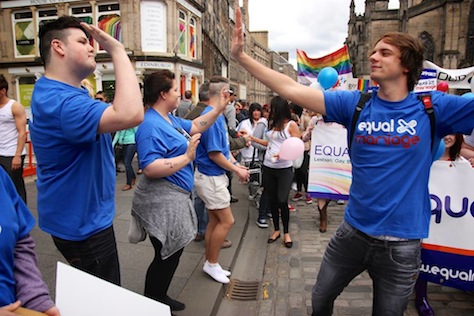
Though the UK parliament in Westminster enacted same-sex marriage in July 2013 to great fanfare, the nature of devolution in the United Kingdom meant that Scotland’s parliament in Holyrood would have to pass its own version.United Kingdom Flag Iconscotland

The devolution process that began in 1997 under Labour prime minister Tony Blair created parliaments for Wales, Scotland and Northern Ireland.  But regional devolution ran deepest in Scotland — Wales opted for fewer regional powers than Scotland, and Northern Ireland’s parliament, created as part of the 1998 Good Friday Agreement, spent much of the 2000s suspended.  Ironically, that meant that for a brief period, same-sex marriage would be the law of the land in England in Wales, but not in the more socially liberal Scotland.

That changed today, when the Scottish parliament voted 105 to 18 in favor of enacting same-sex marriage.  First minister Alex Salmond, who leads a pro-independence government of the Scottish National Party (SNP) fast-tracked the bill to keep pace with Westminster.  Though the bill wasn’t without controversy, especially from within the Church of Scotland and other religious groups, support within the Scottish Labour Party and the Scottish Liberal Democrats meant that the bill was always likely to sail through Holyrood.

ruth

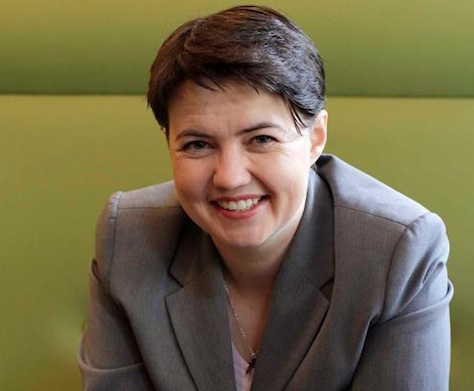
Though the major opposition to same-sex marriage in England and Wales came from within the Conservative Party of prime minister David Cameron (who himself supported marriage equality), the leader of the Scottish Conservative and Unionist Party, Ruth Davidson (pictured above), is herself gay and strongly supported the marriage equality effort in Scotland. Though the Tories hold just 15 seats in the 129-member Scottish parliament (compared to 65 seats for the SNP and 37 for Labour), Davidson and Cameron have shown that conservatism and marriage equality aren’t necessarily incompatible.

The lengthier Scottish consultation process on the same-sex marriage bill included outreach to hear the views of religious groups, and churches will have the right (though not the obligation) to ‘opt in’ to same-sex marriage in Scotland when the law takes effect later this year.  That makes the Scottish same-sex marriage act somewhat stronger than the English version, which provides a blanket ban on same-sex ceremonies within the Church of England.

The first same-sex marriages in England and Wales will take place in March, and the first marriages in Scotland will take place later in autumn 2014.

It also leaves Northern Ireland as the only part of the United Kingdom without same-sex marriage — and as I wrote last summer, don’t expect the Northern Irish assembly at Stormont to take up the cause of LGBT equality anytime soon:  Continue reading Scotland passes same-sex marriage, joining England and Wales →

Tsunis nomination draws scorn from Norwegians

tsunis

Not only does George Tsunis not speak Norwegian, he’s never even set foot in Norway.USflagnorway

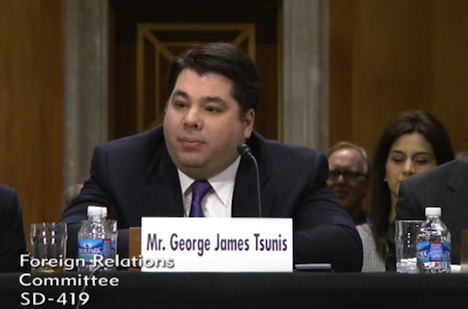
Yet, even as he stumbled through an embarrassingly poor performance at a hearing on Thursday before the US Senate Foreign Relations Committee, Tsunis is set to become the next US ambassador to Oslo.

As US senator John McCain asked Tsunis about the ‘anti-immigration’ Framskrittspartiet (Progress Party), which is the junior member in Norway’s center-right governing coalition, the future ambassador stumbled with his answer or, as Norway’s newspapers phrased it, tråkket i salaten (trampled through the salad bowl).  

“You get some fringe elements that have a microphone and spew their hatred,” he said in the pre-appointment hearing. “And I will tell you Norway has been very quick to denounce them.”
McCain interrupted him, pointing out that as part of the coalition, the party was hardly being denounced.
“I stand corrected,”  Tsunis said after a pause.  “I would like to leave my answer at… it’s a very,very open society and the overwhelming amount of Norwegians and the overwhelming amount of people in parliament don’t feel the same way.”

Good grief.  This came after Tsunis referred to Norway’s ‘president’ — of course, there’s no such office because Norway is a constitutional monarchy.  By way of background, Tsunis is an attorney and a businessman from Long Island.  He founded Chartwell Hotels, which operates properties for InterContinental Hotels and other hotel chains.  Though he supported McCain, a Republican, in the 2008 US presidential election, he bundled nearly $1 million in contributions for US president Barack Obama, a Democrat, in the subsequent 2012 presidential election, and he personally donated $267,244 to the Democratic Party in 2012 and $278,531 in 2010.  Tsunis is an active member of the Greek-American community and the Greek Orthodox Church, which begs why anyone in the Obama administration would send him… to Norway.

McCain, not thrilled with the response, thanked Tsunis and the ‘incredibly highly qualified group of nominees.’  But perhaps McCain should leave aside the snark himself — Norwegians might also take issue with his characterization of the Progress Party solely as an anti-immigration party.  In fact, the party has its genesis in the anti-tax movement of the 1970s.  It’s certainly in favor of tougher immigration restrictions, and it’s probably Norway’s most controversial major party.  But it’s not nearly as xenophobic as some of Europe’s other parties (e.g., Marine Le Pen’s Front national in France), and it represents something greater in Norway as a party of rupture.

Other mainstream center-left and center-right parties largely support Norway’s social welfare state, just as they support the relatively fiscal conservative steps to limit spending from Norway’s oil largesse.  The Progress Party wants to break away radically from the state-heavy welfare model, and it wants to spend more of Norway’s oil fund today.

That’s why Erna Solberg, the leader of Høyre (the ‘Right,’ or more commonly, the Conservative Party) is Norway’s prime minister today instead of Progress Party leader Siv Jensen.  Solberg pulled the Conservative Party toward a more moderate policy path that’s essentially the center-right analog to the long-governing Arbeiderpartiet (Labour Party), which lost the September 2013 elections after two terms in power under former prime minister Jens Stoltenberg.

It doesn’t seem like it would be so incredibly hard for the Obama administration to bring even someone woefully uniformed about Norway’s political, cultural and economic basics up to speed — even Tsunis!  That the Obama administration chose not to do so is perhaps the most egregious oversight of all. 

The previous ambassador to Norway, Barry White, who served from 2009 to 2013, had at least some basis in international affairs as the longtime managing partner of Foley Hoag LLP, and as the chair of Lex Mundi, a global association of international, independent law firms.  His predecessor, Benson Whitney, served from 2005 to 2009 under former president George W. Bush.  A native of Saint Paul, Minnesota, Whitney came from the US state with the greatest number of Norwegian-Americans by far.  As then-president of the Minnesota Venture Capital Association, he could argue that his experience in venture capital and investments would bode well to serve as a representative to the country with the world’s largest sovereign wealth fund.

It’s not just Tsunis. The Obama administration’s nominee to serve as the ambassador to Hungary, by the way? Colleen Bradley Bell, a television producer and — you guessed it — philanthropist and top Obama campaign donor.  At a time when Hungary faces some of the most troubling accusations of democratic backsliding within the European Union, and with Hungarian prime minister Viktor Orbán set to win another majority under a new (troubling) electoral system in April, the United States is sending the producer of television daytime soap opera ‘The Bold and the Beautiful.’


I wrote last June that the nomination of James Costos, a Hollywood executive and Obama donor with no Spanish language skills and no apparent ties to Spain, to become the US ambassador of Spain was a prime example of why the current practice of sending wealthy donors (instead of career diplomats from the US state department) is so flawed: Continue reading Tsunis nomination draws scorn from Norwegians →

14 in 2014: Scotland independence referendum

scotlandin14

12. Scotland referendum on independence from UK, September 18.United Kingdom Flag Iconscotland

Separatists from Québec to Barcelona will be watching Scotland’s historic vote on independence in the autumn, which could end over three centuries of union between Scotland and England, bringing the United Kingdom as we know it to an end.

Scottish nationalists, buoyed by the economic hopes of North Sea oil, have increasingly floated the idea of independence since the 1970s.  Scotland’s rift with Tory prime minister Margaret Thatcher in the 1980s only alienated the country further from Westminster, and the election of Labour prime minister Tony Blair in 1997 led to the devolution of many Scottish domestic matters to a new regional parliament at Holyrood.  Since 2007, the Scottish government has been led by the Scottish National Party (SNP) and first minister Alex Salmond.  In the most recent May 2011 Scottish elections, the SNP was so popular that it won a majority government — a feat that the Scottish electoral system was specifically designed to avoid.

Salmond and his popular deputy first minister Nicola Sturgeon will lead the ‘Yes’ campaign for Scottish independence following the agreement that Salmond and British prime minister David Cameron struck in March 2013 on the referendum’s date and its terms.  Proponents are likely to paint a vision of Scotland as an independent nation that has more in common with the Nordic welfare states than with Anglo-American capitalism.  Though Scotland’s 5.3 million residents comprise just around 8.4% of the total UK population, Scotland has retained a proud and distinct culture and a discrete linguistic and intellectual tradition, and it veers politically to the left of England.

Cameron, the leader of the center-right Conservative Party, will help lead the ‘No’ campaign, which has already been christened the ‘Better Together’ campaign.  But the relative unpopularity of Cameron and the Tories in Scotland means that he’ll need help from the centrist Liberal Democratic Party and the center-left Labour Party.  In particular, Alistair Darling, the former Labour chancellor of the exchequer under prime minister Gordon Brown (both of whom are Scottish) is chairing the ‘Better Together’ effort.  Although the ‘No’ campaign will try to convince Scots that they are, in fact, better off staying in the United Kingdom, it will also point to obstacles that an independent Scotland could face.  Chief among those obstacles might be Scotland’s position in the European Union — although Scots are generally more pro-EU than their English counterparts, it’s not clear whether an independent Scotland would automatically join the European Union or would be forced to apply for readmission.  Scotland would also face protracted negotiations with England (or perhaps the ‘United Kingdom of England, Wales and Northern Ireland’) over splitting the current UK debt burden, as well as defense, currency, immigration, citizenship and other myriad arrangements.

Polls show that Scottish voters today oppose independence — around 40% to 55% of voters would vote ‘No,’ and just around 25% to 35% would vote ‘Yes.’  But the campaigns won’t hit top speed until later in 2014 after the UK vote to elect members to the European Parliament.

Next: Brazil