First Past the Post: August 14

Québec premier Jean Charest attacks the newly ascendant Coalition avenir Québec (CAQ).

Corruption is becoming the main theme of the Sept. 4 election in Québec.

Doug Schoen argues that the recent conviction of former Mongolian president Nambar Enkhbayar is politically motivated.

Spiegel considers the troika of potential leaders of the Sozialdemokratische Partei Deutschlands (the Social Democratic Party) in advance of Germany’s federal election in 2013 (but doesn’t mention Hannelore Kraft!)


Altankhuyag appointed as new prime minister in Mongolia

Mongolia today has a new prime minister in Norov Altankhuyag (Норовын Алтанхуяг), the leader of the Democratic Party (Ардчилсан нам, Ardchilsan Nam).

The landlocked central Asian country of just under 3 million, nestled between Russia and China, is undergoing somewhat of a mining-based boom these days — for decades, it was locked in the socialist shadow of the Soviet Union, but today is riding the crest of China’s state capitalist wave and its capital, Ulan Bator, is being transformed like many of China’s provincial capitals from dusty backwater to a thriving boomtown.  Its largest coal mine, Tavan Tolgoi, is due to be listed on Hong Kong- and London-based stock exchanges next year, and investors are already looking to the next administration for signs that it will be business-friendly:

Over the next four years, the country’s vast mineral wealth will be exploited and the state coffers will begin to fill, putting the new government in a strong but testing position.

“The importance of this next term cannot be overstated,” says Travis Hamilton, founder of the Khan Mongolia Equities Fund. “The stakes are a lot higher now, and the actions over the next four years will determine the coming decades. Mongolia is still heavily dependent on foreign investment, but when they run at capacity they will be able to go on their own. The country is on the precipice of financial independence.”

The appointment comes after weeks of coalition talks following the June 28 election of the 76 members to Mongolia’s State Great Khural (Улсын Их Хурал, Ulsyn Ikh Khural).  In that election, the pro-free market Democratic Party won 31 seats to just 25 for the ruling Mongolia People’s Party (Монгол Ардын Нам, Mongol Ardiin Nam), formerly the communist party that ran Mongolia from 1921 to 1996.

A third party, formed in 2010 by former president Nambaryn Enkhbayar, the Mongolian People’s Revolutionary Party (Монгол Ардын Хувьсгалт Нам, Mongol Ardyn Khuvsgalt Nam), won 11 seats, and will join the coalition with the Democratic Party.  That’s somewhat, troubling, in part because Enkhbayar himself was just sentenced to four years in prison last week on corruption charges.

Nonetheless,Reuters reports that Mongolia’s new leaders are taking a much more favorable position toward foreign investment: Continue reading Altankhuyag appointed as new prime minister in Mongolia

Gillard’s 180-degree turn and what it means for Australian asylum policy

It’s not just American politicians who have a hard time dealing with illegal immigration.

Unravelling stability in Afghanistan, where the United States has led an 11-year military effort, may be exacerbating a rise in boat-bound refugees to Australia, causing headaches for its Labor-led government.

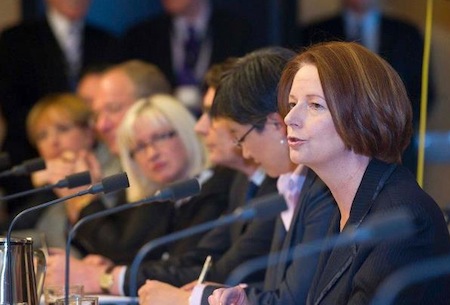
Australian prime minister Julia Gillard yesterday announced that her government would seek to enact the recommendations of a nonpartisan review and adopt a version of the ‘Pacific Solution’ adopted by Labor’s predecessor Liberal government of John Howard — Gillard has called on Australia’s parliament to pass a new law allowing for the reopening of detention centers on Nauru and on Manus Island in Papua New Guinea within as soon as a month.

The move will result in a return to offshore processing for asylum-seekers trying to arrive by boat to Australia.  That means that such refugees would face years of detention in Nauru or PNG if apprehended by Australian authorities at sea.

It’s a 180-degree turnaround for Labor, although Gillard had promised (during her latest interparty leadership contest with former prime minister Kevin Rudd in February) to reverse what’s been a five-year upswing in illegal arrivals by sea to Australia — and a correspondingly higher number of refugee deaths.  So although Gillard may be weakened by the sudden turn, it’s an issue that’s long been a political albatross for her and for Labor.  When Labor returned to power in 2007 under Kevin Rudd, the party quickly scrapped the ‘Pacific solution’ by enacting what Rudd considered more humane policies, closing the Nauru and PNG detention centers in favor of onshore processing centers.

The key question over the past five years is why the number of refugees by boat rose so dramatically in 2007 — proponents of the Pacific Solution, such as Liberal/National Coalition leader Tony Abbott, argue that the leniency of Labor asylum policies encouraged more refugees to arrive by sea.  Abbott supports the return to using offshore detention, has harshly criticized Labor policy for resulting in over 600 refugees deaths by drowning, and is today crowing over Gillard’s reversal:

“I’ve been saying for four years that the Prime Minister should pick up the phone to Nauru,” says the Opposition Leader.

“We have had enormous cost, untold tragedy and trauma that could have been avoided if the Prime Minister had been prepared to do this at any time in the last four years,” says Tony Abbott.

“We’ve had 22,000 illegal arrivals, almost 400 illegal boats.”

Although many of the refugees come directly by boat from Indonesia or Malaysia, asylum-seekers often begin their journey from throughout greater Asia, including China, Vietnam, Iraq, Iran and Afghanistan.  Even under the Pacific Solution, most refugees who arrived by boat were bona-fide refugees and around two-thirds were either granted asylum in Australia or resettled in other countries.

Opponents of the Pacific Solution, such as former prime minister Malcolm Fraser, say that the number of refugees rose due to external factors.  Fraser, a former Labor prime minister of Australia from 1975 to 1983, yesterday called Gillard’s propsed approach ‘racist’: Continue reading Gillard’s 180-degree turn and what it means for Australian asylum policy

First Past the Post: August 13

Newly-minted Republican U.S. vice presidential candidate Paul Ryan has voted in the past to lift the U.S. embargo of Cuba.

Speaking of Cuba, Fidel Castro turns 86 today. Granma’s coverage here.

An interview with Chinese artist-dissident Ai Weiwei.

Anders Åslund at the Peterson Institute for International Economics looks to the breakups of Yugoslavia, the Soviet Union and the Austro-Hungarian Empire for lessons to the current eurozone crisis.

Australian prime minister Julie Gillard backs down over boat refugees, will support processing centers in Nauru and Papau New Guinea.


Morsi, in firing defense minister, asserts presidential control over Egypt

Of course, the significance of the decision by Egyptian president Mohammed Morsi on Sunday to announce the resignation of not just Field Marshal Hussein Tantawi as defense minister, but his deputy, General Sami Anan, cannot be understated.

It is easily the most significant moment in Egyptian governance since Morsi’s election — and it, surprisingly, comes just over a week after Morsi’s first cabinet was sworn in — a cabinet that seemed destined to feature Egypt’s military, with little civilian participation from beyond the Muslim Brotherhood and its sphere of allies.

But it also comes very soon after Morsi fired his intelligence chief in the wake of increased attacks and a growing Islamic fundamentalist threat on the Egypt-Israel border in Sinai.

Tantawi, the leader of the Supreme Council of the Armed Forces that led Egypt’s transitional government between the fall of Hosni Mubarak and Morsi’s election, has essentially been the head of Egypt’s military since his appointment as secretary of defense in 1991.  His reappointment as defense secretary in the cabinet of Morsi’s prime minister, Hisham Qandil, was seen as a sign that the Egyptian military had reached somewhat of an uneasy truce with Morsi — Morsi may be the elected president, but the military would have enough residual power to veto Morsi on key issues, especially where national security is involved.

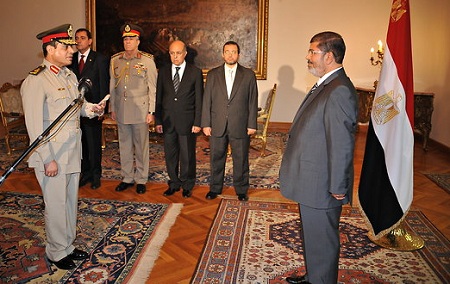
That changed Sunday — and the Tantawi and Anan retirements are not all that Morsi (pictured above, right)accomplished.

Morsi amended the last-minute June 17 declaration by SCAF that has attempted to limit presidential powers; instead, Morsi issued a new Constitutional Declaration that gives the president full executive and legislative authority, as well as power to set Egyptian public policy and sign international treaties.  He also appointed Mahmoud Mekki, a respected deputy head of the Cassation Court, as his vice president (although in doing so, Morsi seemed to break a promise to appoint a woman and a Coptic Christian as his vice presidents).

Morsi appointed as the new defense minister a little-known general, Abdel-Fattah El-Sisi (pictured above, far left).  In a profile today, Al Ahram noted that the 57-year-old El-Sisi, who previously served as Egypt’s military attaché to Saudi Arabia, will be the first Egyptian defense minister who also doesn’t hold the title of field marshal.  El-Sisi is best known internationally as the general who announced that the military had conducted virginity tests on female protestors at Tahrir Square in order to prove soldiers had not raped them.  SCAF subsequently backtracked on El-Sisi’s somewhat embarrassing statement.

Much of Egypt’s independent media and figures such as Mohamed ElBaradei have welcomed Morsi’s move.  A wide spectrum, from youth protest leaders to Salafists are applauding what seems to be a bona-fide transfer of power from the military to the civilian president.

Mark Lynch at Foreign Policy dubbed Egypt’s president “Lamborhini Morsi” and offers three alternative (not incompatible) takes: Continue reading Morsi, in firing defense minister, asserts presidential control over Egypt

Newly-formed third party CAQ rises in Québec

A new poll out in Québec Friday from Leger Marketing shows an increasingly three-way race in advance of the snap September 4 election.

The two longstanding parties in Québec are essentially tied.  The sovereigntist (and more leftist) Parti québécois (PQ) wins 32% of Québécois voters, while the federalist (and more centrist) Parti libéral du Québec (Liberal Party, or PLQ) of premier Jean Charest wins 31%.  Charest, who has led Québec since 2003, is seeking his fourth consecutive mandate.

But the real surprise is the newly-formed Coalition avenir Québec (CAQ), which got 27% — although the CAQ led polls briefly when it was formed in January 2012, it had steadily lost support.

And, perhaps, for good reason — it’s a relatively aimless group that has been vague about its position on key issues, such as a proposed hike in student tuition fees.  It’s been just as cagey on more fundamental stands: whether its economic program is right or left, or whether it is more sovereigntist or federalist.

Founded by François Legault (pictured above, left), a longtime minister in the PQ governments of the 1990s and a leader of the pro-independence movement in the 1995 sovereignty referendum, the CAQ incorporates some other PQ stragglers and much of the old Action démocratique du Québec, the party led by Mario Dumont that made significant gains in the 2007 Québec election (only to watch those gains evaporate in the subsequent 2008 election).

Yet there’s precedent from recent Québécois elections to indicate that voters are weary of both the Liberals and the PQ:

  • As noted, in 2007, Mario Dumont’s ADQ won 41 seats to Québec’s 125-seat Assemblée nationale, leaving Charest’s Liberals with a 48-seat minority government and pushing the PQ (with just 36 seats) out as the official opposition.
  • In the 2011 general election, the progressive New Democratic Party won 59 of Québec’s 75 ridings for seats in the House of Commons.  The NDP, led by the late Jack Layton, had previously not been a factor in Québec’s federal elections; in 2011, it reduced the PQ’s federal counterpart, the Bloc québécois to just four seats, despite its domination of Québec’s federal delegation since 1993.

Like the ADQ in 2007, the CAQ is leading polls in and around Québec City.  But also like in 2007, anglophone Quebeckers are still overwhelmingly in favor of the Liberals, the PQ has a steady lead among francophone voters, and the CAQ lags behind both parties in and around Montréal.  That result would lead to three-way deadlock that favors a minority Liberal government — unless the CAQ can somehow break through to the core supporters of either the PQ or the Liberals.

Two recent developments indicate that the CAQ could pull off that kind of upset.

Legault has emphasized the recruitment of high-profile candidates, which paid off last week when popular anti-corruption figure and former Montréal police chief Jacques Duchesneau (pictured above, right) announced last week that he would stand as a candidate for the CAQ.  That put Charest on the defensive — his government is under investigation for corruption charges related to tying government construction contracts to political cash.  Meanwhile, prominent anglophone Quebecker Robert Libman gave his support to the CAQ and trashed Charest for using scare tactics against the CAQ.

But the election remains three weeks away and it’s unclear if the CAQ may be surging too soon — to say nothing of whether voters trust Legault and his slippery platform enough to make him premier.

Continue reading Newly-formed third party CAQ rises in Québec

U.S. Republican vice presidential candidate Paul Ryan’s foreign policy views

If sources are true, former Massachusetts governor Mitt Romney has selected Wisconsin congressman Paul Ryan as his running mate, with the formal announcement to come Saturday morning.

Ryan is most well-known for his strong views on budget policy — think of him as the United States’s version of George Osborne.

He’s become something of the intellectual spokesman for the Republican Party on budget matters in the post-Bush era — his proposed budget would cut massive amounts of spending out of the federal government, transform Medicare into a voucher program and render other federal programs virtually unrecognizable from their current form.  To the massive anti-government ‘tea party’ view that has emerged in the U.S. center-right since the bailouts of former U.S. president George W. Bush and former Treasury secretary Hank Paulson and the election of U.S. president Barack Obama, Ryan represents somewhat of a true believer in effecting a reduction in government spending.

In other words, Ryan’s not being picked for his foreign policy bona fides, but rather for other concerns — his Midwestern background, his conservative credentials and his wonky credibility (to the American right, at least) on budget matters.

But what would a Vice President Ryan add to foreign policy?  Given that the vice presidential pick is perhaps the most important decision Romney will make before his (potential) election as U.S. president, given that the pick telescopes Romney’s own worldview to some degree, given the influence of recent former vice presidents Dick Cheney and Joe Biden on foreign policy, and given the reality that Ryan would be a heartbeat away from the presidency, it’s a question worth asking.

Uri Friedman, writing for FP Passport, tried to answer the question back in April in a primer on Ryan’s foreign policy — the consensus is that Ryan prescribes a healthy dose of American exceptionalism, but fundamentally remains a more realist, liberal hawk than a neoconservative crusader.

When it comes to slashing U.S. military spending, however, it seems that the Pentagon is the one area Ryan would spare from his federal budget cuts:

Ryan’s 99-page “Path to Prosperity” plan, released last month, provoked an outcry in calling for boosting military spending while slashing the international affairs budget — funding for entities such as the State Department and USAID — by nearly $5 billion. When Ryan said “we don’t think the generals are giving us their true advice” in reference to the military budget, he was quick to walk back his comments. “I really misspoke,” he explained.

Otherwise, when it comes to foreign policy, Friedman notes, in sum, Ryan’s a blank slate:

Ryan’s worldview, in other words, appears to be a bit of a Rorschach test. And in a general election where appealing solely to the Republican base just won’t cut it, that might be exactly what Romney needs.

The Weekly Standard, marking a key Ryan foreign policy speech in June 2011, applauded his stance in favor of American exceptionalism:

“A world without U.S. leadership will be a more chaotic place,” Ryan said. “A place where we have less influence, and a place where our citizens face more dangers and fewer opportunities. Take a moment and imagine a world led by China and Russia.”

Ryan spoke at length about American exceptionalism as it relates to America’s role in the world. “America is an idea,” he said. “And it was the first nation founded as such. The idea is rather simple. Our rights come to us from God and nature. They occur naturally, before government.”

This belief in the American idea, Ryan said, should inform the nation’s foreign policy. “Now, if you believe these rights are universal human rights, then that clearly forms the basis of your views on foreign policy,” he said. “It leads you to reject moral relativism. It causes you to recoil at the idea of persistent moral indifference toward any nation that stifles and denies liberty, no matter how friendly and accommodating its rules are to American interests.”

 Jonathan Chait, writing for The New Republic in 2011, deemed Ryan’s foreign policy “Norquistian-Churchillian,” pitted the budget-cutting Ryan against the foreign policy version of Ryan:

In reality, Ryan’s budget is unworkable and something would have to give. Many Republicans, and especially the neoconservatives forming the draft-Ryan committee, loath the idea of pressuring the defense budget. Ryan’s forceful endorsement of neoconservative principles, along with his continued opposition to defense spending cuts, reassures his base. In the neoconservative world, mighty declarations of willpower always trump puny arithmetic.

The world press has not spent much time vetting Ryan, for what it’s worth.

For example, Israel’s Haaretz mentions Ryan in an article back in February on the cutting of $6 billion from the U.S. budget on Israeli missile defense.  The United Kingdom’s Guardian features coverage mostly going to Ryan’s role in American politics, not to his view on US-UK relations.


First Past the Post: August 10

I somehow missed it from the May/June issue of the American Interest, but it’s good weekend reading from Tyler Cowen on U.S. export growth and what it means for the global (and U.S.) economy.

Not entirely unrelated, an expat on China on why he’s leaving the People’s Republic (for good).

Also not entirely unrelated, Edward Hugh at A Fistful of Euros makes the case for pessimism on Italy.

Brazil gets a new affirmative action law in higher education for Afro-Brazilians, mestizos and indigenous students.

Could Germany hold a referendum on transferring more power to Brussels?

All of China is watching the trial of Gu Kailai (wife of former Chongqing chief Bo Xilai), who’s now admitted to committing murder.

Tensions start to appear in Tory-Lib Dem coalition in the UK

There might be no more yawn-inducing issue in UK politics than House of Lords reform.

But that issue has led to the greatest moment of crisis between the Conservative Party and the Liberal Democratic Party, which together govern the United Kingdom in a first-of-its-kind Tory-Lib Dem coalition government.

The importance of the week’s jousting is not about electoral reform, to save the suspense.

It’s about the that it marked the first major tear in the Coalition: a Tory bid to stymie Lords reform led Lib Dem leader and deputy prime minister Nick Clegg (pictured above, right) to declare that he would direct his party to vote against another electoral reform measure supported by the Tories.  It’s the first time Clegg has so aggressively and directly fought back against his Coalition partner.

Right-wing newspapers are already savaging Clegg.  But for its faults, the two-party Coalition still remains more united and disciplined than the Tories were (when they were governing by themselves!) in the last years of John Major’s government in the mid-1990s, when Europe and scandal hopelessly split an undisciplined party.  It’s probably more united than the New Labour government in its last years, hopelessly split between Blairites and Brownites on the basis of no true underlying policy differences.

The most alarmist talk about the danger to Cameron’s government is overstated — more most surprising, perhaps, is that the Coalition made it nearly halfway through the natural term of the parliament with so much unity.  Clegg has not yet flinched in giving his party’s support to Tory leader and prime minister David Cameron (pictured above, left), even as the budget cuts of a severe austerity program implemented by Tory chancellor of the exchequer George Osborne seem to be dragging the UK economy back into a double-dip recession, to say nothing of student fees or other policies that are less than satisfying to the Lib Dem rank-and-file, which has typically been more of the left than of the right.

As The Guardian notes, Clegg can claim a moderating influence on the current government:

Most of the cases that [Clegg] can demonstrate are negative ones. The Lib Dems have played a vital role in making Tory legislation less extreme, less red meat. The health reforms could have been worse; Europe policy would have been more barking; welfare changes would have hurt the vulnerable even more.

But voters don’t seem to be giving Clegg much credit.  The center-left Labour now has a five-point lead over the Tories (39% to 34%) in the latest Guardian/ICM poll from late June, but the Lib Dems have taken the greatest electoral brunt with just 14% support, a sharp fall from its 23% vote in May 2010.

Luckily for Clegg and Cameron, most of the UK was too busy on holiday or watching the Olympic Games in London to notice (although Cameron must not be thrilled that his semi-rival, London mayor Boris Johnson, has received such fawning attention).

So what happened? Continue reading Tensions start to appear in Tory-Lib Dem coalition in the UK

First Past the Post: August 9

The great Teddy Bear War of 2012 between Sweden and Belarus intensifies.

Per The Economist‘s Banyan, India gets a new anti-corruption party.

Will Anglophone Quebeckers be tempted away from Jean Charest’s Liberals by the center-right Coalition Avenir Québec?

All eyes in China (and Hong Kong) are fixed on the the murder trial of Gu Kailai, the wife of disgraced Chongqing chief Bo Xilai.

Lebanon’s current “March 8” government, headed by Tripoli businessman Nijab Mikati, has not surprisingly drafted an elections law that would benefit the “March 8” coalition against the “March 14” coalition.

Libya’s National Transition Council hands over power to the new 200-seat electoral assembly in the other Tripoli.

Why the Israeli left can’t effectively market itself.


How many days (weeks) away are we from another Greek solvency crisis?

When the world last left Greece, it was breathing a sigh of relief upon the news that Antonis Samaras would be able to cobble together a coalition following a narrow win in the June elections — the second such election in as many months.

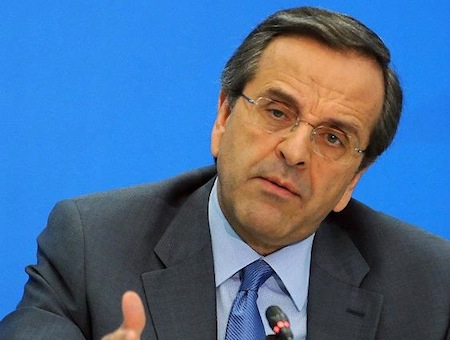
Samaras (pictured above), now a little over six weeks into his government, is finding it increasingly difficult to get his coalition to agree on €11.5 billion in cuts, required by Greece’s bailout from the European Central Bank, the European Commission and the International Monetary Fund.  Those entities, known as the ‘troika,’ have pushed off a long-delayed review of Greece’s bailout program from September to October, but that means only that Greece’s government will have until mid-September to make the cuts. The ‘troika’ will then make a decision about disbursing the next €31 billion tranche of bailout funds to Greece, and Greece will then try to push for a renegotiation of the bailout terms to lighten the austerity that has added pressure to Greece’s downward economic spiral.

It’s clear that the ‘troika’ is getting impatient: the IMF has started to balk at throwing more money at Greece, has called on the European Union to take the lead on any further bailouts and the ECB in late July stopped accepting Greek bonds as collateral altogether.

But the Greek economy is in shambles, and is expected to contract by a full 7% this year — much more than an original forecast of 4.7%.  Greece’s recession is only getting worse, not better, and that’s after the economy contracted almost 14% in the past four years.  As tax receipts correspondingly shrink, Greece’s debt sinkhole becomes ever larger.  Greater debt requires more austerity, which cripples the economy, which leads to greater debt, and so on.

The only solutions seem to be:

  1. a miraculous economic turnaround. Not likely anytime soon.
  2. a full bailout from the European Union. Whether that means a direct cash bailout or “eurobonds” or a more inflationary ECB monetary policy, it all boils down to a transfer of wealth from Germany to Greece  — it’s an option that German chancellor Angela Merkel has resisted and which has become increasingly unpopular in domestic German politics.
  3. the “Grexit”. Greece leaves the eurozone, adopts a new drachma, and devalues it until its debts are manageable and its exports are cheap.  But that could lead to snowballing worries about Spain, Portugal, Italy and the rest of the eurozone and precipitate Europe’s own “Lehman” moment of financial panic.

The next deadline is August 20, when Greece must pay a €3 billion maturing to the ECB — and the ECB (despite its edict that it will no longer accept Greek bonds as collateral) is weighing the option of lending money directly to the Greek central bank (which can accept Greek bonds as collateral), so that Greece in turn can pay back the debt it owes to the ECB.

It’s a tidy Alice-in-Wonderland arrangement in which only a central banker could delight.

ECB president Mario Draghi deserves credit for getting Greece past yet another hurdle, but it doesn’t inspire any long-term confidence in either Europe or Greece to get the country out of its nosedive.  It takes little imagination to see how Greece could bumble out of the eurozone in short order without further intervention if and when it runs out of cash (which could now still happen in September): Greece would then be forced to pay its employees and pensioners in IOUs (think of the kind of IOUs that California issued — registered warrants — when it fell short of cash reserves in 2009), Greece would take longer and longer to pay back the IOUs, individual Greeks would start trading the IOUs for euros, and a market would develop that sets a price for the IOUs in euros.

In time, the IOUs will have become de-facto drachmas.

Meanwhile, the coalition that everyone thought would easily come to an agreement on those additional budget cuts has stalled. Continue reading How many days (weeks) away are we from another Greek solvency crisis?

It’s “National Night” in Singapore…

…and here’s what the Singapore Development Unit (yes, there’s an official matchmaking agency for Singapore) is promoting for the night after National Day, which is today, August 9.

“We gotta go all the way for Singapore, you know what I’m saying.”


Singapore has one of the lowest birth rates in the world at around 115, according to the World Bank’s 2010 list.  By contrast, the demographically challenged Italy is at 1.4 and Russia at 1.54.

So: ‎”It’s National Night, let’s make Singapore’s birthrate spike.”

H/T to James Fallows at The Atlantic, one of the most consistently thoughtful voices in Western media on Asia (and if anyone’s looking for a good August book recommendation, his new book, China Airborne, is out):

About the only thing that needs explaining is when, around time 2:18, the video talks about “putting a bao in the oven,” a bao is like a little bundle or dumpling or bun. And before that, in the line: “I know you want it / so does the SDU,” here is what they’re talking about. But even if you didn’t know that you’d get the idea. There’s a little more explanation to the right, which says a lot about Singapore in just a few lines.

The Singapore government has often been criticized for being too Gradgrind-like and strait-laced. So, no joke, congrats to whoever broke the stereotype by doing this. And … ummm, Happy National Day / Night!


Is Bavarian finance minister Markus Söder really the most dangerous politician in Europe?

Der Spiegel ranks the top 10 most dangerous politicians in Europe, and you might be surprised at who comes out on top.

The piece targets Markus Söder, the finance minister of Bavaria since November 2011:

The politician from the [Christlich-Soziale Union in Bayern (CSU, the Christian Social Union)], the conservative sister party to Chancellor Angela Merkel’s Christian Democratic Union, is known for his tub-thumping rhetoric and has stepped up a gear in the euro crisis with vitriolic comments about Greece. “An example must be made of Athens, that this euro zone can show teeth,” he told the Bild am Sonntag tabloid newspaper this week. “Everyone has to leave Mom at some point and that time has come for the Greeks.”

It also points the finger at Alexander Dobrindt, general secretary of the CSU to which Söder also belongs — Dobrindt has also called on Greece to exit the eurozone by paying its debts in drachmas instead of euros.

Söder, an up-and-coming politician in the CSU, has previously served as minister for environment and health from 2008 to 2011 and from 2007 to 2008, as minister for federal and European affairs.  He’s a solid populist, to be sure — for example, he’s in favor of Bavaria’s ban on the wearing of Muslim head scarves (but not nun’s habits).

But it’s easy enough to explain away the relatively strident tone from Söder and the CSU as political posturing in advance of Bavarian state elections that must take place sometime in 2013.  The CSU will be struggling to maintain the grip that its held on Bavarian state politics since the 1950s.  At the federal level, although the CSU-backed Angel Merkel has walked a tight line when it comes to balancing national and federalist European interests, but her leftist opponents are even more federalist when it comes to Europe and the eurozone.

The Spiegel list is dominated by some of the nationalist right’s usual suspects: Nigel Farage, leader of the UK Independence Party (UKIP) and a member of the European Parliament; Marine Le Pen, leader of the Front national in France; Timo Soini, leader of the Perussuomalaiset (PS, True Finns) party, also a member of the European Parliament; Geert Wilders, head of the Dutch Partij voor de Vrijheid (PVV, Party for Freedom); and Heinz-Christian Strache, head of the Freiheitliche Partei Österreichs (FPÖ, Austrian Freedom Party).

They seem like odd choices, though, because none of them (except perhaps Strache) seem to be on the upswing.  Wilders is polling quite dreadfully in advance of the Dutch elections on Sept. 4.  Farage and Soini are sideshows at best.  Despite her strong showing in the French presidential election in April and the shadow she casts over the French center-right, Le Pen failed to win a seat in France’s national assembly in the June elections — and her party won just two seats in total.

To me, the following politicians are far more “dangerous” — by “dangerous,” I mean the ability to win real power or to be more effective in making mischief: Continue reading Is Bavarian finance minister Markus Söder really the most dangerous politician in Europe?

First Past the Post: August 8

FT Alpahville has a nice primer on the appreciation of the Australian dollar (or the South Pacific Swiss franc).

Fresh out of prison, Conrad Black calls Pauline Marois a “mediocre sovereigntist bag-lady.”

Italian prime minister Mario Monti walks back his comments from yesterday that Italy’s debt yield spread would be 1200 basis points if his predecessor, Silvio Berlusconi, were still in charge.

Former French president Nicolas Sarkozy makes his first public comments since losing the May presidential election in calling for France and international intervention in Syria.

The Dutch Socialists takes the lead in the poll in advance of Sept. 12 elections.

Pia Kjærsgaard, who founded Denmark’s populist right-wing party, the Dansk Folkeparti (Danish People’s Party) in 1995 (which is now the third-largest party in the Danish parliament, is stepping down as leader.

Egyptian president Mohammed Morsi fires his intelligence chief (with the military’s blessing).

Sovereigntist PQ leader Marois walks a fine line on tuition fees in Québec

The day after Jean Charest, Québec’s premier, launched a snap election for September 4, his principal rival, Pauline Marois, came out in clear contrast to Charest on perhaps the most high-profile issues in the election (short of Québec’s sovereignty): tuition hike fees for students.

Marois (pictured above, right), the leader of the leftist, sovereigntist Parti québécois (PQ), promised to take a radically different approach to tuition fees in the province: cancel the planned hikes, revoke the controversial emergency protest law (Bill 78) and convene a summit within 100 days of election on the issue of university funding.

While Marois is taking a very understated position on Québécois sovereignty and any future referendum on an independent Québec, she is not shying away from embracing a contrast to Charest on the student tuition issue.  Indeed, one of the most impressive and eloquent of the student leaders from those negotiations, Léo Bureau-Blouin (pictured above, left), at age 20, is among the PQ’s marquee candidates in the upcoming election — he’ll be running against a junior minister in Charest’s government in a riding in Laval, a suburb of Montréal.

Earlier this year, a battle between Charest’s government and student protesters ended in somewhat chaotic protests throughout Montréal.  Students protested the hikes, which amounted to a $1,625 increase over seven years — a 75% increase over what Québec students pay today (although the total would be far less than what students in other Canadian provinces pay).  Ultimately, Charest’s education minister, Line Beauchamp, resigned over the impasse with student leaders in negotiations over the hikes, and Charest’s current education minister is not running for reelection.

Charest responded to the protests by passing Bill 78, which makes any gathering of over 50 people illegal unless they tell police in advance the start time, finish time and route of such gathering.  Although the bill is just a temporary measure, expiring on July 1, 2013, it brought international condemnation as an unconstitutional restraint on protesters’ rights.

With the protests dying as summer approached, however, the issued faded in both provincial and international headlines.

Polls have shown that Québec’s electorate is essentially even — they may not like the increasingly heavy-handed approach that Charest took with protesters, but nor were they especially keen on protester shutting down schools (not to mention entire neighborhoods) in Montréal.

So it’s not without some risk that Marois has embraced the student movement — by doing so, she is hoping to energize Québec’s young voters and otherwise capitalize on doubts about the Charest government’s effectiveness without alienating other voters who support Charest’s approach and who take a wary view of the student protests.

Charest, who has been premier since 2003, is looking to win a fourth consecutive mandate for his federalist, centrist Parti libéral du Québec (Liberal Party, or PLQ).  Polls show the PLQ and the PQ tied for first place, with the center-right Coalition Avenir Québec (CAQ) polling a strong enough third place to make it likely that Québec’s next government will be a minority government.

MAKING WORLD POLITICS LESS FOREIGN