Merkel tops Forbes list of top 100 powerful women

German chancellor Angela Merkel is the most powerful woman in the world in 2012, according to Forbes magazine.

It’s a bit whimsical, but that’s probably the right call, considering that no one person has more power, probably, to determine whether the eurozone sticks together or falls apart.

Also on the list are several women of important to world politics:

  • U.S. secretary of state Hillary Clinton (#2),
  • Brazilian president Dilma Rousseff (#3),
  • Indian National Congress Party leader Sonia Gandhi (#6),
  • International Monetary Fund managing director Christine Lagarde (#8),
  • Argentine president Cristina Fernández de Kirchner (#16),
  • Burmese National League for Democracy leader Aung San Suu Kyi (#19),
  • Australian prime minister Julia Gillard (#27),
  • Malawi president Joyce Banda (#71),
  • Nigerian finance minister Ngozi Okonjo-Iweala (#80),
  • Liberian president Ellen Johnson Sirleaf (#81), and
  • UAE minister of foreign trade Shiekha Lubna Al Qasimi (#92)

Predictions, questions and thoughts:

  • Where is Danish prime minister Helle Thorning-Schmidt? Robbed!
  • And where is Icelandic prime minister Jóhanna Sigurðardóttir, the world’s first openly lesbian head of government? Also robbed!
  • Josefina never had a chance.
  • Too soon for Pussy Riot, I suppose.
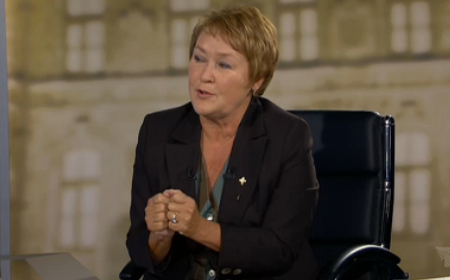
  • Might Parti québécois leader Pauline Marois make it on next year’s list if she wins the Sept. 4 election in Québec and schedules a referendum on Québec’s independence?
  • Next year, Park Geun-hye could well be South Korea’s new president, which would make her automatically top 20, I presume.
  • Also next year, I wouldn’t be surprised to see Hannelore Kraft become Merkel’s chief opposition.
  • If Silvio Berlusconi makes a comeback in Italy, why not his favorite MP Michaela Biancofiore and the rest of Silvio’s angels?

Is Kenneth Clarke — and his experiment with prison reform — finished in British politics?

Longtime observers of British politics will note with some alarm recent reports that justice minister Kenneth Clarke may be headed out of UK prime minister David Cameron’s cabinet, pursuant to a widely expected cabinet reshuffle in early September.

To contemplate this is to see the final curtain drawn on one of the ‘big beasts’ of British politics in the past three decades — as has been noted, Clarke won his first ministerial role when UK chancellor of the exchequer George Osborne was just one year old.

The Telegraph reports that Cameron is considering replacing Clarke with Iain Duncan Smith, the work and pensions secretary (and the ill-fated former leader of the Tories from 2003 to 2005), or Nick Herbert, a junior justice minister.  Even more odd is the way in which Clarke has issued a statement on the potential reshuffle:

“I have never had any conversations of any kind with the Prime Minister or anyone acting on his behalf about a reshuffle. I am totally laid back about a reshuffle and am waiting to see whether or not it affects me,” he said.

Clarke is, simply put, one of a kind: a bloke in a party of toffs.

Second to Boris Johnson, perhaps, Clarke connects with the British people in a way that few Tories have managed in recent times. Continue reading Is Kenneth Clarke — and his experiment with prison reform — finished in British politics?

Live-blogging the Québec debates: Charest v. Legault

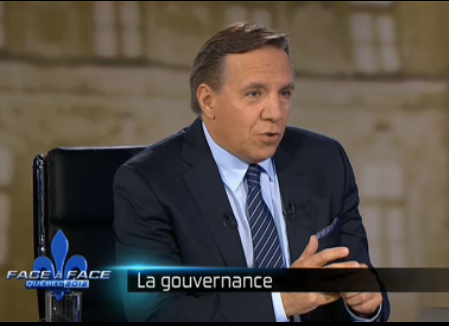
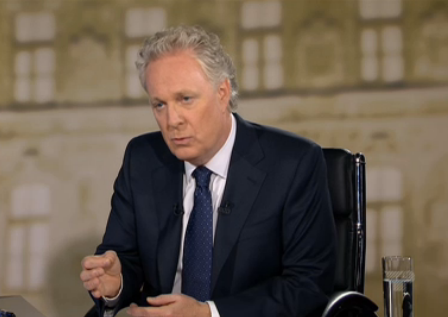
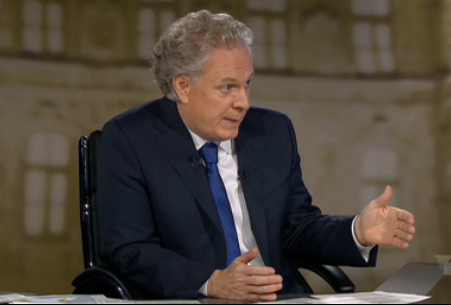
I’ll be live-blogging tonight’s hourlong debate — the second in a series of three one-on-one debates — between Québec premier Jean Charest, the leader of the centrist, federalist Parti libéral du Québec (Liberal Party, or PLQ) and François Legault, leader of the newly formed, sort-of maybe center-right Coalition avenir Québec (CAQ).

Sunday night featured a four-way debate and last night featured a raucous one-on-one between Charest and Pauline Marois, the leader of the leftist, sovereigntist Parti québécois (PQ).  Tomorrow’s final debate will feature Marois and Legault, and Wednesday will bring showcase Marois and Legault.

Given Charest’s feisty, aggressive tone against Marois last night, I expect to see the same against Legault, who himself is a former PQ minister.  Legault left the PQ to form the CAQ late last year, and I would expect Charest to make the argument that Legault is a closet sovereigntist and that the CAQ has been too vague about its plans for government.  I expect you’ll also see Charest attack Legault for cuts made to Québec’s health care system — Legault once served as minister for health and social services under PQ premier Bernard Landry from 2001 to 2003.

Québec’s voters go to polls on September 4 to choose 125 members of Québec’s Assemblée nationale.

Read Suffragio’s prior coverage of the Québécois election here.

Well, it was another exciting debate and the last debate for Charest.

Charest managed to come across as a little less aggressive tonight, but perhaps a little more effective — he could point (and he did!) to Legault’s past experience in government and contrast it with the (unreliable?) positions Legault has taken as the leader of the CAQ.

Legault seemed more effective, perhaps, than he did on Sunday night, but seemed less sure throughout the night.  He’s not as good a debater as Charest.

I wonder if Legault’s strong defense of French and Bill 101 at the end of the debate will leave a bad taste in anglophone voters’ mouths — he’ll need those if the CAQ is to win the election.

All in all, I think Charest did a strong job defending his government and an even stronger job attacking the CAQ’s platform (or the slipperiness of the platform vis-a-vis Legault’s record).

Full live-blog after the jump.

* * * *  Continue reading Live-blogging the Québec debates: Charest v. Legault

First Past the Post: August 21

Jeffrey Goldberg thinks a personal visit from U.S. president Barack Obama could forestall any unilateral Israeli action against Iran.

A look at Indian-Peruvian relations.

Reuters looks at possible successors to Ethopian prime minister Meles Zenawi, who died Tuesday.

Renewed clashes in Sunni-dominated Tripoli, in Lebanon’s north, are increasing cautions about Syrian spillover.

Dutch Socialist Emile Roemer is bearish on the euro crisis.

FT Alphaville turns to the Dutch elections.

Romania’s Constitution Court invalidated the referendum on impeaching the president, Traian Băsescu, and prime minister Victor Ponta accepts the ruling.

Longtime pro-Euro Tory and justice minister Kenneth Clarke seems nervous in advance of a planned cabinet reshuffle expected from UK prime minister David Cameron in early September.

Liberal Party fundraiser Jean-Paul Boily calls on Liberal supporters to support the newly-formed Coalition avenir Québec in the Sept. 4 election as a strategic manuever to stop a sovereigntist Parti québécois government.

NOTE: I will be live-blogging tonight’s Québec election debate between Liberal premier Jean Charest and CAQ leader François Legault.

Ethiopia’s Meles Zenawi has died

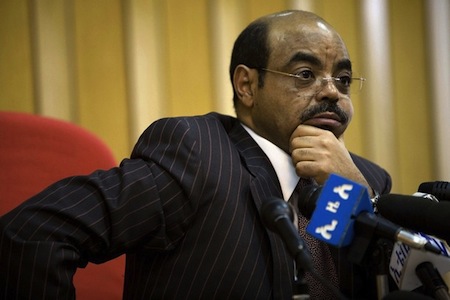
The prime minister of Ethiopia, Meles Zenawi, has died after a long illness. He was 57.  Deputy prime minister Haile-Mariam Desalegne will be sworn in as acting prime minister.

Since taking power in 1991, Ethiopia really hasn’t known a leader in the post-Cold War era other than Meles.  He inherited a country decimated from a grinding famine in the 1980s and a war with Eritrea (that resulted in Eritrea’s independence in 1991) and transformed it into a stable regional power in a country that’s relatively untouched by the colonial experience, but which is the second-most populous African nation after Nigeria.

Meles’s death comes just days after the death of the patriarch of the Ethiopian Orthodox church, Abune Paulos, at age 77, who was himself appointed by Meles.

Meles came to power after participating in the coup that removed Mengistu Haile Mariam, a leader of the Derg that governed Ethiopia from 1974 to 1987 — Mengistu ruled in his own right through 1991. He presided over the writing of a new federalism-based constitution for Ethiopia in 1994, and he kind of opened Ethiopia to the ritual of regular elections, however rigged in favor of Meles.

In his last election in 2010, Meles and his Revolutionary Democratic Front (EPRDF, or የኢትዮጵያ ሕዝቦች አብዮታዊ ዲሞክራሲያዊ ግንባር) won the majority in the Ethiopian parliament, despite widespread allegations of fraud.  His victory in the relatively fairer 2005 election was met with massive — and sometimes violent — protest, which Meles met with a general crackdown on political dissidents.  For all the stability that Meles brought to Ethiopia, democratic norms and institutions were not among his chief reforms.  For example, opposition leader Birtukan Medeksa was imprisoned from 2007 to 2010.

But Meles can certainly be credited with taking steps to strengthen Ethiopia’s economy — it has grown fantastically since Meles came to power, but for two blips in 1998 and in 2003.  Last year saw the lowest GDP growth since 2004, but it still managed to top 7%.  Ethiopia’s significant growth belies its horrific starting point as one of the poorest countries on the planet — its GDP per capita is just barely over $1,000. Continue reading Ethiopia’s Meles Zenawi has died

Live-blogging the Québec debates: Charest v. Marois

I’ll be (hopefully — giving my French quite a test!) live-blogging tonight’s hourlong debate between Québec’s premier since 2003, Jean Charest, the leader of the centrist, federalist Parti libéral du Québec (Liberal Party, or PLQ) and Pauline Marois, the leader of the leftist, sovereigntist Parti québécois (PQ). 

Last night featured a four-way debate, tomorrow will see a debate between Charest and François Legault, leader of the newly formed Coalition avenir Québec (CAQ), and Wednesday will bring the final debate between Marois and Legault.  Québec’s voters go to polls on September 4 to choose 125 members of Québec’s Assemblée nationale

Read Suffragio’s prior coverage of the Québécois election here.

So that was exciting! Jean Charest, so smiley in the Sunday night debate, sneered throughout tonight’s debate.  Whether on corruption, on tuition fees, on Plan Nord, on debt, on sovereignty, Charest went on the offensive all night long in a very aggressive manner (“Madame Marois! Madame MAROIS!”).

I’m not sure that will play so well with viewers, but it’s clear there’s no love lost here and that Charest knows he’s behind, and that he’s going to have to fight back against both the PQ and the CAQ in order to win the election.

Marois looked poised and more measured, even when playing offense.  But her party still has no clear competing budget plan, and she’s still not being clear on whether she’s seek a referendum if the PQ wins in two weeks.

I’m not sure whether the debate will have changed any minds — Charest looked angry and evasive and aggressive, and Marois still has no answer when it comes to the biggest doubt voters have about her party winning office.

Tomorrow night, we’ll see Charest and Legault — if anything, Charest has been more aggressive in his attacks on Legault in the past week or so, so I think it’s very likely we’ll see the fully adversarial Charest tomorrow as well.

Full live blog below the jump.

* * * *  Continue reading Live-blogging the Québec debates: Charest v. Marois

First Past the Post: August 20

Spiegel interviews Russian blogger Alexi Navalny.

Park Guen-hye wins the formal nomination of the Saenuri Party in South Korea for the presidential election in December.

The new cold war on the South China Sea.

What comes next for fallen Chongqing leader Bo Xilai?

The French right wants a comeback for French president Nicolas Sarkozy.

Former Front de gauche presidential candidate Jean-Luc Mélenchon is calling out the Hollande administration for doing too little in its first 100 days.

Greece’s government may have found €13.5 billion in cuts.

The Constitutional Court of Romania will decide tomorrow whether to validate the referendum on president Traian Băsescu’s impeachment.


Charest comes out swinging in first Québec debate

The party leaders of each of the four main political parties in Québec held their first debate Sunday in advance of the province’s September 4 election, with three additional one-on-one debates to follow tonight, Tuesday and Wednesday.

It’s always difficult to tell whether debates will change the dynamic of an election campaign, and it’s no different in this election.

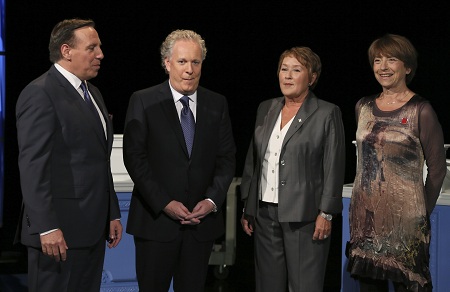
Going into the debate, it was expected that the leader with the biggest target would be Jean Charest (pictured above, second to left), the leader of the centrist, federalist Parti libéral du Québec (Liberal Party, or PLQ) and premier of Québec since 2003.

The PLQ, according to recent polls, is struggling against the leftist, sovereigntist Parti québécois (PQ), and the new sorta-center-right-ish, sorta autonomous-ish Coalition avenir Québec (CAQ) is polling an increasingly strong third place — a poll released Friday night showed the PQ with 35% to just 30% for the Liberals and 25% for the CAQ.  Most ominously, the poll shows that for the first time, anglophone voters are not supporting the Liberals en masse: although the Liberals still lead among non-francophone voters with 62% to just 20% for the CAQ, that result marks a fairly staggering loss for a party that normally has a monopoly on native English speakers, which comprise 10% of the Québécois electorate.

So on Sunday night, it was thought that PQ leader Pauline Marois (pictured above, second to right) and CAQ leader François Legault (pictured above, far left), as well as spokeswoman for the far-left Québec solidaire, Françoise David (pictured above, far right) would all target Charest — on his record on tuition fees, on a damaging and ongoing corruption inquiry, on his controversial plan to develop northern Québec.

That quite didn’t happen, as Marois and Legault and David targeted one another — and an aggressive Charest went on the offensive against both Maoris and Legault.  For example, he went directly at Marois and Legault for supporting cuts in the PQ-led administration of the 1990s (Legault is a former PQ minister), he attached the PQ for its past corruption scandals and he went directly on the attack on the issue of sovereignty:

Mr. Charest charged that the PQ’s main objective will be to achieve sovereignty and hold a referendum “as quickly as possible. She has set up a committee to achieve it,” he warned.

Tonight, Charest will face off in a one-on-one debate against Marois.  Tuesday night will feature Charest and Legault, while Wednesday night will feature Marois and Legault.

The French-language La Presse‘s recap and the English-language Montréal Gazette‘s recap largely concurred: Continue reading Charest comes out swinging in first Québec debate

Correa reelection in Ecuador a key motive in Assange asylum incident

One of the most fascinating aspects of the latest turn in the Julian Assange drama is why Ecuador — of all places — is so keen on offering Assange asylum. 

Assange, the founder of Wikileaks, made public a huge trove of classified cables from the U.S. State Department, starting in February 2010.  Assange has also been charged on a warrant by Sweden for sexual assault and voluntarily entered English custody in December 2010.

Assange claims that in Sweden (unlike in the Great Britain), he will be subject to extradition or illegal rendition to the United States, where he also claims he will be charged with espionage and other crimes in relation to the release of the U.S. classified cables.  I will leave aside the issue of whether that’s a valid concern or paranoid delusion, but given the global attention now on Assange, it seems certain that the United States would face massive criticism and a significant soft-power blow, even among its allies, for such a move.

In any event, on June 19, Assange fled to the Ecuadorian embassy in London, and Ecuador granted asylum to Assange on August 16.  The United Kingdom, for its part, refuses to guarantee the safe passage of Assange, who now faces the puzzle of getting from Ecuador’s embassy out of the country.  The United Kingdom apparently sent a letter last week to the Ecuadorian embassy that seemed to threaten invasion of Ecuador’s embassy to reclaim Assange — that would appear to be  a fairly significant break with the international law that governs diplomatic relations, which is one of the few areas of international law that countries take seriously as law.

Besides, the idea of UK foreign minister William Hague ordering a military siege in posh Knightsbridge to capture Assange is so outrageous (and hilarious) that I doubt the British government would ever stoop to something like that.  Far better to wait it out until Assange tries to flee, or simply strip Ecuador of its diplomatic status by cutting off ties.

Assange raised the temperature even more Sunday with a scathing denunciation of the United States from the balcony of the Ecuadorian embassy.

But why would Ecuador even bother to step into such a fraught battle of international intrigue that has already become a headache for the United Kingdom, the United States, Sweden and Assange’s native country of Australia?

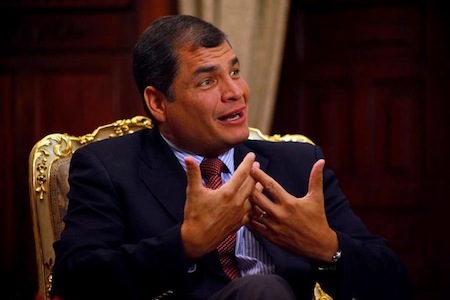
Max Fisher at The Atlantic makes the case that Ecuadorian president Rafael Correa is angling to pick a fight with a stalwart of Western government:

Though we can’t know the Ecuadorian government’s motivation for sure, engineering a high-profile and possibly protracted confrontation with a Western government would actually be quite consistent with Correa’s practice of using excessively confrontational foreign policy in a way that helps cement his populist credibility at home.  It would also be consistent with his habit of using foreign embassies as proxies for these showdowns — possibly because they tend to generate lots of Western outrage with little risk of unendurable consequences.

That seems just about right, and it doesn’t hurt that South American ally Argentina already detests the United Kingdom over the status of the Falkland Islands (Islas Malvinas) since the 1982 war and before.

But there’s a vital element missing from this narrative: Correa faces reelection in February 2013.

Continue reading Correa reelection in Ecuador a key motive in Assange asylum incident

Medina takes power as Dominican president

Danilo Medina was inaugurated yesterday as the new president of the Dominican Republic — with 10 million people, it’s the most populous country in the Caribbean after Cuba. 

A member of the ruling center-left Partido de la Liberación Dominicana (the Dominican Liberation Party), Medina won the presidential election with 51% in May over former president Hipólito Mejía.

Medina succeeds the popular Leonel Fernández, who served as president from 1996 to 2000 and who has served as president since 2004.

So what to look for as Medina takes power? Continue reading Medina takes power as Dominican president

Lebanon remains tense after kidnappings, hopes to avoid Syrian chaos spillover

Lebanon’s prime minister Najib Mikati yesterday appeared to call for something like a unity government, with further signs that the Syrian civil war next door could cause chaos in neighboring Lebanon.

The situation in Beruit remains tense— the latest episode involved the kidnapping Wednesday of over two dozen Syrians (and a Turkish and Saudi national) by the Meqdad clan (a Shi’a group from the Bekaa Valley, a Shi’a region in eastern Lebanon near Syria) in retaliation for the abduction of one of its kinsman in Damascus.  Although the isolated kidnappings involve just a handful of Syrians, the incident has left Lebanon very much on guard.

The clan claimed that the kidnapped victims were members of the Free Syrian Army, the main opposition group to Syrian president Syrian president Bashar al-Assad in the ongoing civil war in Syria, a country that’s had an outsized influence on Lebanon for the past three decades.

The clan has released several hostages and has announced that it will not abduct any further victims, but the move was nonetheless troubling for a country that stands more to lose from the escalation of the Syrian civil war than any other country in the Middle East.  It caused Air France and other airlines to divert flights from Beirut to other cities after reports of a blockage of the road from the airport to Beirut, and it’s been calamitous enough for Saudi Arabia, Qatar, the United Arab Emirates and Kuwait to urge their nationals to leave Lebanon.

Another group, the al-Mukhtar al-Thufki brigade, announced that it abducted 10 Free Syrian Army members in Beirut and the Bekaa Valley, and it will furthermore target anyone that is a Free Syrian Army supporter.

Lebanon, which endured a grueling sectarian civil war from the late 1970s through the entire 1980s, has done an admirable job of avoiding spillover from the Syrian chaos for the past year and a half — aside from some unrest in the largely Sunni city of Tripoli on Lebanon’s north coast earlier this year in May, Lebanon has avoided much of the bloodshed and chaos that has enveloped Syria in the past 18 months and Lebanon, despite current tensions, remains far from the hell of its civil war.

It remains to be seen if Mikati can form a new unity government to stand in the face of growing shockwaves from the Syrian war, given that Lebanon’s two main political blocs are defined on the basis of their pro-Syria and anti-Syria stances.  A new general election in Lebanon is due in 2013.

Multi-volume books could be written that barely begin to reveal the intricacies of Lebanese politics — it’s safe to say that the confessional system, whereby each of Lebanon’s 18 religious groups are allocated power, is complex.  Furthermore, the Syria axis defines Lebanese politics even more than the traditional left-right axis.  Continue reading Lebanon remains tense after kidnappings, hopes to avoid Syrian chaos spillover

First Past the Post: August 16

Emile Roemer is under fire in the Dutch election for his statement that he would refuse to pay fines to the European Union if the Dutch budget exceeds 3% of GDP.

More evidence that the Angolan election on August 31 will be neither free nor fair.

In Canada, François Legault, the leader of the upstart new Coalition avenir Québec, wants young Quebeckers to be more like Asians.

Brazil gets a $66 billion stimulus package.

The incredibly shrinking Geert Wilders

The past decade in Dutch politics has been fraught with what in the United States would be called “culture war” issues.

It may be surprising when you think of the Netherlands and its liberal attitude towards many of the hot-button issues in the U.S. — marijuana legalization, euthanasia, prostitution, same-sex marriage — but the Netherlands has had more than its share of tensions over Muslim immigration in the past decade.

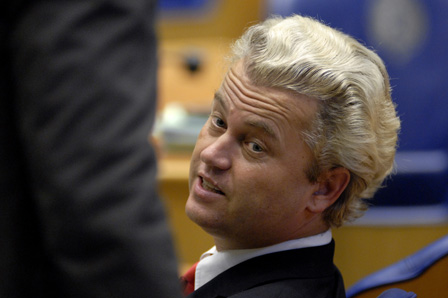
The current standard-bearer of anti-Islam politics is Geert Wilders, somewhat of a Dutch Cultural Warrior, version 2.0 (following in the tradition of the late Pim Fortuyn, filmmaker Theo van Gogh and, to some degree, former Dutch parliamentarian Ayaan Hirsi Ali).  Wilders, the platinum blonde enfante terrible of Dutch politics, has highlighted the influx of Muslim immigrants to the Netherlands as a threat to the culture and way of life of the Netherlands (and Europe, generally).

His Partij voor de Vrijheid (PVV, Party for Freedom) swept the last general election in 2010, winning nearly one-sixth of the seats in the Tweede Kamer, the third-highest total.

Wilders dominated that election campaign with his views — he would ban all Muslim immigration to the Netherlands, pay current immigrants to leave and ban the Koran. He then dominated the months of coalitions talks that resulted when no party won enough seats to govern.  And then, as an outside supporter of Mark Rutte’s government, he has dominated Dutch governance — right up to April 2012, when he withdrew his support for additional budget cuts, leading to the snap elections on September 12.

So it’s with some surprise to see that the PVV is not dominating this election campaign: polls show that Rutte’s liberal, free-market Volkspartij voor Vrijheid en Democratie (VVD, the People’s Party for Freedom and Democracy) is tied with Emile Roemer’s Socialistische Partij (SP, the Socialist Party).  Rutte is running a campaign defending his push to bring the Dutch budget within 3% of Dutch annual GDP, while Roemer (and not Wilders) has emerged as the voice of opposition to austerity.

What’s clear is that, for the first time in over a decade, next month’s Dutch election is about spending, growth and the economy and less about Muslim immigration and ‘culture war’ issues — and early polls indicate that Wilders has not been as germane to the 2012 debate as he was in 2010.

Maybe it’s because Wilders has been so thoroughly identified as an anti-Muslim candidate (rather than an anti-Europe or anti-austerity).  Maybe it’s because there’s no mistaking the message of anti-austerity that voting for the Socialists sends.  Maybe it’s because Wilders originally provided support to prop up Rutte’s minority government.

But for whatever reason, Wilders has watched Roemer’s party rush to the front of the pack.  Although Wilders would normally seem mostly likely to benefit from a strong protest vote this year, he’s been relegated to watch as the unlikely Roemer drinks his milkshake — Wilders and the PVV remain trapped in a four-way tie for third place alongside the progressive Democraten 66 (Democrats 66) bloc, and the two struggling parties that dominated postwar Dutch politics until the last decade, the center-right Christen-Democratisch Appèl (CDA, Christian Democratic Appeal) and the center-left Partij van de Arbeid (PvdA, Labour Party).  It’s a little odd, considering that Wilders has a populist style that dwarfs that of either the technocratic Rutte or the plodding Roemer.

That doesn’t mean Wilders is going down gently, and Dutch voters are just starting to tune into what’s been a subdued campaign that coincides with summer holiday season.

His latest bid has been to expand his brand of populism to Europe — the PVV’s platform for 2012 reads, “Their Brussels, Our Netherlands.”  In typical Wilders fashion, it’s not nuanced — it proclaims, “other parties may choose Islam or EU nationalism, our party is for the Netherlands!”  Continue reading The incredibly shrinking Geert Wilders

Everything you need to know about the showdown between the Pakistan People’s Party and the Supreme Court of Pakistan

So you already know that Pakistan is, well, kind of a hot mess, as far as governance is concerned.

You also know that the Muslim country of 180 million has had, since Partition from India in 1947, a helter-skleter relationship with democratic institutions, with periods of civilian rule interspersed with healthy intervals of autocratic military regimes.  You know that on many vectors, Pakistan falls short of what even its neighbors have accomplished, not just with respect to democracy, but also with respect to rule of law, corruption, terrorism, press freedom and so on.  (Think of Pakistan, perhaps, as a 21st century version of mid-20th century Argentina, or any other South American country where democracy didn’t quite take, despite strong party identification.)

You know that Pakistan is a traditional U.S. ally and a key strategic relationship in the ongoing U.S. efforts in Afghanistan (and along the Af-Pak border), but that Pakistan’s political and military establishment rarely speaks with one voice and that Pakistan’s government more often hinders than helps the U.S. government in its ongoing anti-terror efforts.

But what of the latest political crisis there?  The prime minister has been dismissed by the Supreme Court? And the new prime minister may be dismissed as well? All because of some corruption charges against the president? But isn’t basically every public official in Pakistan corrupt?

It’s understandable that a crisis like this could leave your head spinning in a run-of-the-mill democracy, but in a place like Pakistan, with so many extrapolitical considerations, it’s nearly incomprehensible.

Without further ado, Suffragio presents a quick primer on what’s happened so far in the showdown, and what we might expect in the near future. Continue reading Everything you need to know about the showdown between the Pakistan People’s Party and the Supreme Court of Pakistan

First Past the Post: August 15

Venezuela’s latest model for Bolivar is actually French.

The geopolitical future of the Arctic.

ThreeHundredEight‘s latest forecast shows a potential majority government for the Parti québécois after the Sept. 4 election in Québec.

Politics is starting to resume in Ghana following the death of president John Atta Mills.

One man’s view on the Lugo ‘coup’ in Paraguay (spoiler: it has to do with the United States and oil).

Bunga, bunga is costly, costly: Silvio Berlusconi is no longer among the top 10 richest in Italy.

A troubling sign with regard to press freedom in Mohammed Morsi’s Egypt.

Libya’s new national assembly president is moderate Islamist and Qadaffi opponent Mohamed al-Magariaf.

London mayor Boris Johnson tells fellow Tory and UK prime minister David Cameron to stop ‘pussyfooting around’ on expanding London airports.

Benjamin Netanyahu appoints Kadima legislator Avi Dichter as new home front defense minister and potentially a deciding vote in Israel’s inner security cabinet on the issue of launching a strike on Iranian’s nuclear facilities.

Australia contemplates how to get its offshore asylum-seeker detention center up and running in Nauru.

MAKING WORLD POLITICS LESS FOREIGN