Tag Archives: australia

What the world can teach the United States about DC voting rights

DSC00905

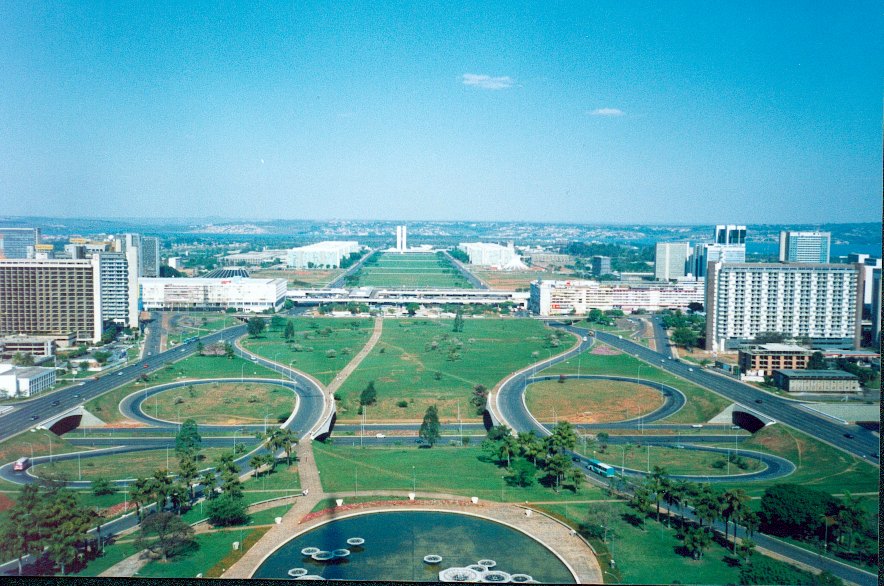
A view of DC from the top of Anacostia in East Washington.

If you walk through parts of Brasília, it’s hard to believe that it wasn’t modeled, at least architecturally, upon Washington, D.C. when it was built in the late 1950. But when it comes to the voting rights of its capital’s citizens, Brazil has looked beyond the American example.Washington_DC_IconUSflag

Last month, when Brazil held a general election, some 2.5 million voters in the Brazilian Distrito Federal voted for a new governor, eight members to the Chamber of Deputies, the lower house of Brazil’s National Congress, and one of its three members to the Senate, its upper house. In that regard, Brazil’s DF is not unlike any other state in the country. Remarkably, with one deputy per 310,000 residents, that’s a better ratio of representation than the residents of Brazil’s largest state, the far more populous São Paulo.

It’s a typical and unremarkable arrangement around the world, and it’s not unlike Mexico’s Federal District (Mexico City), India’s Delhi Capital Territory and even places with a much more limited history of democracy, including Nigeria’s Federal Capital Territory (Abuja) and Malaysia’s Federal Territory of Kuala Lumpur.

But not in the District of Columbia.

The United States of America, otherwise a beacon of democratic rule for over two centuries, is essentially the North Korea of federal district voting rights, a clear outlier for democratic best practices across the world. As voters across the country elect members of the House of Representatives, District voters have nothing. Continue reading What the world can teach the United States about DC voting rights

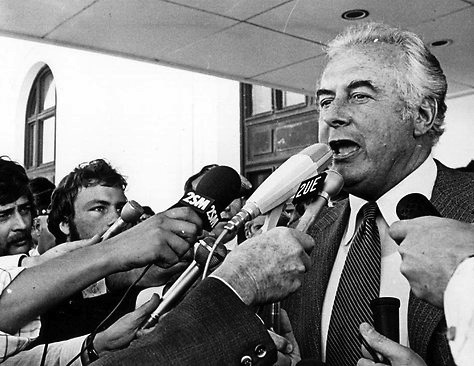
Remembering Gough Whitlam, Australia’s progressive martyr

whitlamPhoto credit to UPI/Bettman Newsphotos.

Gough Whitlam served as Australia’s prime minister for just three years, but the tumultuous Whitlam era gave the country its most severe constitutional crisis, a universal health care program,  diplomatic ties with the People’s Republic of China and a progressive statesman whose spirit continues to guide the Australian left today. Notably, his short-lived government was the only one headed by the center-left Australian Labor Party between 1949 and 1983.australia new

Whitlam, who died today at age 98, left office in 1975 after Australia’s governor-general, Sir John Kerr, controversially dismissed him as prime minister, transforming Whitlam into something of a martyr. Whitlam lived for nearly four decades to watch seven more prime ministers come and go, including the internecine battles between the two prime ministers from within his own Labor Party between 2007 and 2013, Kevin Rudd and Julia Gillard.

Whitlam personified the hope of the new post-war generation when he came to power in 1972, the first center-left prime minister in over two decades. Despite the opposition of the newly dethroned center-right Coalition of the Liberal Party and the Country National Party, Whitlam introduced a whirlwind of legislation. He  created a national healthcare system, Medicare (initially ‘Medibank’), abolished student university fees, eliminated the federal death penalty, withdrew Australian troops from Vietnam and, most controversially at the time, recognized Beijing over  Taipei. Within Australia, Whitlam delivered to the Northern Territory and the Australian Capital Territory representation in the Australian parliament’s upper house, the Senate, fought for environmental protections for the Great Barrier Reef (including a ban on offshore oil drilling) and delivered greater control over tribal lands in the Northern Territory for Australia’s indigenous population.

He introduced Australian, rather than British, passports and he replaced ‘God Save the Queen’ with an Australian national anthem. Decades later, he would team up with his former Liberal rivals to support an Australian republic in an unsuccessful 1999 referendum.

There’s no real direct analog to Whitlam in the United States, but you might think of him as Australia’s combination of John Kennedy, Lyndon Johnson and Jimmy Carter — all in one person and packed into three very tumultuous and very active years in office.  Continue reading Remembering Gough Whitlam, Australia’s progressive martyr

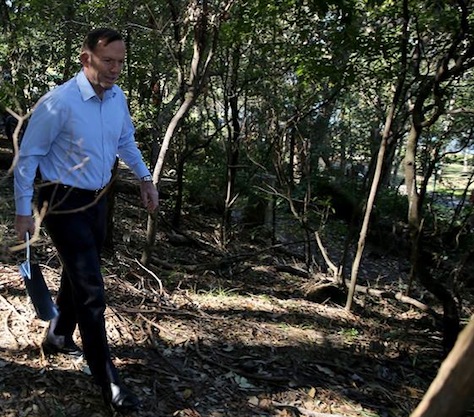
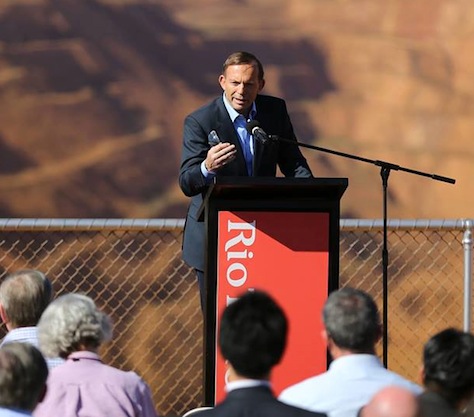
Revoking mining tax, Abbott dismantles Labor achievements

tonygoesmining

If the carbon trading scheme was the signature accomplishment of six years of Labor government, perhaps its second-most important policy achievement was the promulgation of a mining profits tax that came into effect in 2012.australia new

But a month after Australian prime minister Tony Abbott successfully scrapped the carbon scheme, he’s now also managed to repeal the mining tax as well, which levied a 30% tax on mining profits. Ironically, the tax failed to raise anything close to the projections that the Australian Labor Party hoped, due in part a slowdown in demand for Australian commodities as China’s economy decelerates. Eliminating the tax was one of the chief campaign pledges that Abbott made in his campaign to defeat Labor last September.

Nevertheless, with the decision by Australia’s Senate to scrap the tax by a margin of 36 to 33, Abbott will easily pass the repeal through Australia’s lower house, the House of Representatives, where Abbott’s Liberal Party / National Party coalition holds a more solid majority.

As with the carbon scheme, Abbott secured the legislative victory with the support of Clive Palmer, a former mining magnate, and his new Palmer United Party, an alternative to the center-left Labor and to the center-right Coalition. Palmer holds the party’s sole seat in the House of Representatives, but the PUP holds three seats in the Senate, making it a key power broker in enacting Abbott’s policy agenda.  Palmer himself is an often beguiling mix of ideologies, but he seems more at home on the right than on the left.

Palmer, who made millions as the owner of several coal and nickel interests, agreed to the repeal after securing the government’s support for several family-based initiatives. He also received a promise to freeze government contributions to Australia’s superannuation plan for nine years, forcing Abbott to rescind a campaign pledge, thereby halting a planned rise from 9% to 12% — employer contributions  are now capped at 9.5%.

* * * * *

RELATED: How Tony Abbott killed Australia’s carbon scheme

* * * * *

Under a policy introduced by former prime minister Paul Keating in the 1990s, agreed with business and labor unions, employers are required to make annual contributions to each employee’s ‘superannuation’ fund. The contribution level began at 3%, rose to 9.5% and was set to climb to 12% before the Abbott government’s latest decision, which would freeze contributions at 9.5% through 2025. That, in turn, has caused Keating and other Labor leaders to denounce the mining tax deal, arguing that it could derail the full potential of the superannuation program, which itself was designed to meet the rise of retirement-age Australians set to expand in the current decade and beyond.

Nevertheless, the deal leaves Labor in somewhat of a quandary under the leadership of former education minister Bill Shorten.

Australian voters aren’t exactly keen on Abbott’s government, which hasn’t had an incredibly easy first year in office — it’s been captive to small parties like Palmer’s in the Australian Senate and Abbott was also forced to shelve his plan to expand paid parental leave, one of his top campaign pledges last summer. 

But it makes the drama of the last Labor government even more pointless. It now seems less relevant than ever if Kevin Rudd or Julia Gillard was prime minister in 2010, because Abbott has, in about one month’s time, dismantled Labor’s two policy cornerstones. To have spent his first months as opposition leader railing impotently on the sidelines doesn’t make Shorten look like a prime minister in waiting, even as Abbott’s government suffers from its decisions on superannuation and paid parental leave.

How Tony Abbott killed Australia’s carbon trading scheme

abbottclimate

In the end, Australian prime minister Tony Abbott didn’t have to call a special, massive ‘double dissolution’ election to roll back Australia’s carbon pricing scheme, the signature policy accomplishment of the six-year Labor government that preceded him.australia new

All it took was some deft maneuvering to cobble together a working majority in the 76-member Senate, where Abbott’s Liberal/National Party holds 33 seats, just short of a majority.

Nevertheless, Abbott (pictured above) won a narrow 39 to 32 victory last month in the upper house of Australia’s parliament, on the strength of six additional non-Coalition votes to repeal the carbon trading market. Having been one of the first countries to adopt a carbon trading market, Australia on July 17 became the first country to repeal a carbon trading market.

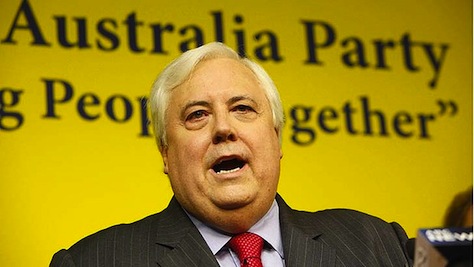
clive palmer

That included the support of a mercurial former mining magnate named Clive Palmer (pictured above), whose maverick conservative Palmer United Party (PUP) became the swing vote in determining whether Abbott’s repeal push would succeed or fail.

The Labor Party’s new leader, Bill Shorten, led an unsuccessful push in alliance with the Australian Green Party, to oppose the repeal. Labor holds 25 seats in the Senate, while the Greens hold another 10. 

Abbott’s resulting victory is primarily a triumphant tactical and policy victory for the Australian right, giving Abbott an easy talking point on reducing the price of electricity for the average Australian voter (though the real long-term impact of the repeal of a carbon scheme that had reduced emissions by less than 10 percent nationally is yet to be determined).

It’s also a narrative about the fragmentation of the country’s two-party system, as far as Australian senatorial elections go, with voters placing increasingly greater power in the hands of independent third-party candidates.

On the global scale, it marks a symbolic victory for opponents of similar climate change legislation worldwide, though the battle over carbon emissions was never going to be won or lost in Australia, a country of less than 23 million. Arguably, China’s decision in June, for the first time, to limit carbon emissions at the national level, will have a much wider impact on global climate change policy.

While British prime minister David Cameron continues to promote a progressive stand on climate change as an issue to pull his Conservative Party to the middle in the United Kingdom, there’s no indication that the UK is set to introduce any major climate change legislation on the scale of Australia’s experiment with carbon pricing beyond the EU’s own carbon trading scheme. Though there was a brief window in 2008 and 2009 when a carbon-based exchange system might have been enacted in the United States with bipartisan support, those days seem long gone. Nevertheless, the administration of US president Barack Obama and the US Environmental Protection Agency, however, introduced executive actions this summer that aim to reduce US carbon emissions by 30% by the year 2030.

Australia’s carbon scheme has its origins as one of the major promises of former prime minister Kevin Rudd’s widely successful 2007 campaign that brought the Labor Party back to government after more than a decade in opposition. It was, in part, Rudd’s decision to back away from climate change legislation that caused his Labor colleagues to dump him in 2010 in favor of then-deputy prime minister Julia Gillard.

After Gillard won a narrow reelection campaign of her own later that year, she enacted a comprehensive climate change bill in 2012, as well as a broader tax on mining profits (that hasn’t raised nearly as much revenue as expected). 

The problem, both in Australia and beyond, is that the global financial crisis of 2008-09 left many national electorates wary of climate change legislation that, almost overnight, suddenly seemed much too costly to introduce at a time when so many developed countries were struggling with the highest unemployment and lowest GDP growth in decades.

That made Abbott’s pledge to repeal what’s popularly become known in Australia as the ‘carbon tax’ one of the most popular aspects of his agenda, which won wide support the parliamentary elections last September that brought Abbott’s Coalition into government. His recent victory in winning Senate support to repeal the carbon scheme will almost certainly rank among the chief legislative successes of his first year as prime minister. Continue reading How Tony Abbott killed Australia’s carbon trading scheme

How a bottle of wine brought down one of Australia’s top politicians

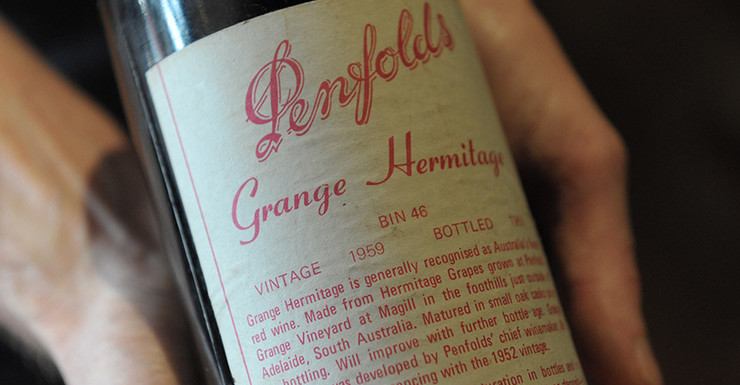
newdaily_170414_grange

In the end, all it took for Barry O’Farrell to lose his job as the premier of New South Wales, Australia’s most-populous state, was a $3,000 bottle of wine.australia newnew south wales flag

Though he came to power in 2011 in a landslide victory over the Australian Labor Party, O’Farrell resigned last week as premier after just three years in office and seven years leading the NSW division of Australia’s center-right Liberal Party.

O’Farrell, who appeared before the Independent Commission Against Corruption (ICAC), denied having received a gift bottle of 1959 Grange Meritage from  from an executive at Australian Water Holdings. Unfortunately for him, the commission had found a handwritten thank-you note to AWH’s CEO Nick Di Girolamo, which read:

Dear Nick & Jodie, We wanted to thank you for your kind note & the wonderful wine. 1959 was a very good year, even if it is getting even further away! Thanks for all your support. Kind regards, Baz & Rosemary.

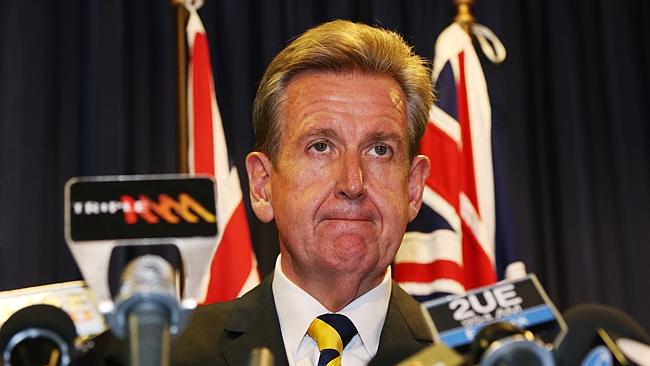
ofarrell

A day after the thank-you note came to light, O’Farrell (pictured above) claimed that, in a ‘massive memory fail,’ he had no recollection of the gift, but nevertheless announced his resignation.  He stepped down officially on Thursday, and the New South Wales treasurer Mike Baird became the state’s new premier the same day.

It’s a fairly well-trodden path for a politician caught in a bind like this — if you believe your position untenable, better to resign as early as possible, take credit for ‘falling on your own sword,’ and hope for future rehabilitation via the private sector or, in time, a political sinecure. Sure enough, at the end of the week, Liberal prime minister Tony Abbott was praising O’Farrell for having ‘taken the honorable step’ of resigning.

O’Farrell’s resignation came so fast that some commentators wondered whether he did so because he realized more revelations would come out through the commission’s investigation.

In political terms, his resignation is unlikely to dent Abbott’s Liberal/National Coalition government. But it turns state politics upside down in New South Wales, home to 7.3 million Australians — nearly one-third of the country’s entire population. Continue reading How a bottle of wine brought down one of Australia’s top politicians

Labor nearly shut out of Australian state government

weatherill

After today’s state elections in two Australian states, the center-left Australian Labor Party has lost power after 16 years in Tasmania and it may yet still lose power in South Australia, where the race remains too close to calltasmania_flagsouth australia flagAustralia Flag Icon

If Labor hangs onto government in South Australia under premier Jay Weatherill, he’ll be the last Labor premier left standing in any Australian state, capping a catastrophic electoral run — just six years ago, Labor controlled the government in every Australian state.  If the center-right Liberal Party emerges victorious in South Australia, Labor will control no state governments (though it remains in power in the Australian Capital Territory of Canberra).

In Tasmania, where Labor was believed to have had a better chance of hanging onto power, premier Lara Giddings lost her bid to win a fifth consecutive Labor government.  With around 80% of the vote counted, Labor had won just 27% of the vote and six of the Tasmanian House of Representative’s 25 seats.  The Liberal Party, under the leadership of Will Hodgman, who is set to become Tasmania’s new premier, will win at least 14 seats.

In South Australia, however, Weatherill could still remain premier, given the tight margin.  Labor has lost ground, but not nearly as much as expected, and it’s been to the benefit of not only the Liberals, but also the South Australian Green Party.  Going into today’s election, Labor controlled 26 seats in the 47-member House of Representatives (the lower house of the South Australian parliament), the Liberals controlled 18 and independents controlled three.  As the final votes are counted, Labor now has 23 seats, Liberals hold 22 seats, and two independents seem increasingly likely to determine who will form the next government.

A conservative Liberal/National Coalition government under prime minister Tony Abbott swept into power last September at the national level, ending six years of rocky Labor government marked by infighting between supporters of prime ministers Kevin Rudd and Julia Gillard.  Rudd initially brought Labor to power in 2007, but his Labor caucus pushed him out of office in favor of Gillard in 2010.  Shortly before last year’s election and facing a landslide defeat under Gillard, the Labor caucus turned back to Rudd, who served as prime minister again for the final three months of Labor’s government.  Both Rudd and Gillard have retired from politics, and former financial services minister Bill Shorten was elected Labor’s new national leader in October.

State-level setbacks have become something of a gruesome spring ritual for Labor over the past few years: Continue reading Labor nearly shut out of Australian state government

Will New Zealand get a new flag later this year?

key

New Zealand prime minister John Key opened the door to a national referendum later this year on changing the country’s flag, which would end a longstanding debate over whether it too closely resembles Australia’s flag.new zealand icon

That’s not a joke.

Key (pictured above, hoisting the Australian flag) suggested the referendum might be held at the same time as parliamentary elections in the island country of 4.4 million, and it’s an idea that proves relatively popular among Kiwis:

The idea has gained support from former Governor-General Dame Catherine Tizzard.  “Our flag and the Australian flag is so often confused for one another and the symbolism of our flag is a bit out-dated,” she says.

While Phoenix and All Whites Footballer Ben Sigmund agrees the trans-Tasman flags are too alike.  “Our flag is too much like the Australian flag so John Key I think you should change it mate.”

Here’s the Australian flag:
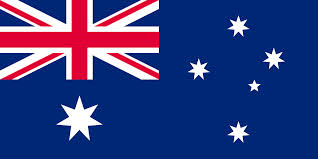
australia

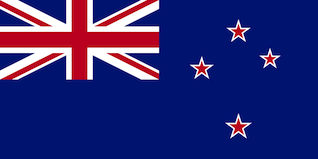
Here’s the current New Zealand flag:

new zealnd

Critics may have a point.  Canadian officials made a famous protocol faux pas in 1984 when former Australian prime minister Bob Hawke was met New Zealand flag instead of the Australian.

Both share in common the Union Jack in the upper left quadrant, a nod to their status as former British colonies, members of the Commonwealth and countries that have retained the British monarch — Queen Elizabeth II is the queen of Australia and the queen of New Zealand, too, though both countries have a governor-general that acts as the head of state when the British monarch isn’t in town.  Both share a blue ensign (Pantone 280C for color nerds) as the background to their flags.

Both flags also reference the four main stars in the Southern Cross constellation visible in the southern hemisphere, though the Australian version includes a fifth star that shines less brightly and a sixth star below the Union Jack, the seven-pointed ‘Commonwealth’ star — six points represent Australia’s six states and the last point represents the territories.

The current New Zealand flag replaced the British Union Jack in 1902.

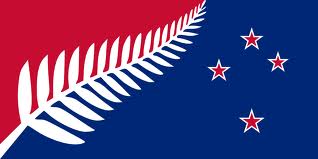
As anticipated by Key, any referendum would present a choice between the current flag and another alternative put forward by the government.  One option that Key has mooted is the ‘silver fern’ flag — the silver fern, an unofficial symbol of New Zealand that dates back to the country’s military insignia during the South African War, adorns the one-dollar coin and the coat of arms:

324px-Silver_fern_flag.svg

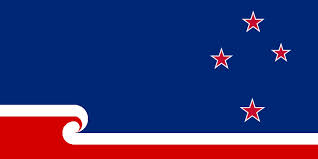
A new flag might also reference the Māori, the indigenous Polynesian people in New Zealand, a group that today represents 14.6% of the country’s population and has mobilized to develop increasing political power.  Hone Harawira, the leader of the Māori Party, would support a new flag, but would prefer that it include the motif of the current Māori flag:

maori

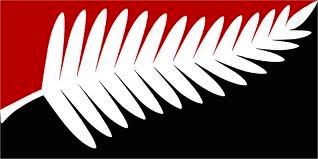
Taken together, the desire to differentiate New Zealand’s flag from Australia’s, the inclusion of the silver fern, the push to remove the Union Jack, and the push for Māori representation on the flag opens an unlimited number of potential choices:

nojack

maorifern

maoricrux

edgyfern

Proponents of the current flag point to tradition and to the country’s common cause with the United Kingdom:

John Banks, leader of New Zealand’s ACT party said: “No. Men fought under that flag and sacrificed their lives in many war campaigns.  “I’m a bit old-fashioned, I don’t want the name of the country changed, or the flag, or God Save the Queen.”

Key leads the center-right New Zealand National Party, and he must call elections before November 2014.  He’ll be looking to win a third consecutive term in office.  Since coming to power in 2008, Key’s administration has raised the goods and services tax, privatized some public sector assets, responded to a major earthquake in Christchurch (New Zealand’s second-most populous city), enacted the Wellington Agreement to provide greater defense cooperation with the United States and propelled the Trans-Pacific Partnership among the United States, several Asian countries and several Latin American countries.

Key doesn’t advocate New Zealand’s transition from a constitutional monarchy to a republic, unlike Russel Norman, the co-leader of the Green Party, which hold 14 seats in the 120-member House of Representatives.

Key’s party controls 59 seats, and his government commands the support of 64 members, including independent and small-party allies.  The opposition New Zealand Labour Party controls just 34 seats.  David Cunliffe, the former health and communications minister, won the party’s leadership last year, despite wider support among the parliamentary caucus for his opponent, Grant Robertson.
14 potential game-changers for world politics in 2014

2014crystalball

Though I rang in the new year with a list of 14 world elections to watch in the coming year (and 14 more honorable mentions to keep an eye on), I wanted to showcase a few more thoughts about what to watch for in world politics and foreign affairs in 2014.

Accordingly, here are 14 possible game-changers — they’re not predictions per se, but neither are they as far-fetched as they might seem.  No one can say with certainty that they will come to pass in 2014.  Instead, consider these something between rote predictions (e.g., that violence in Iraq is getting worse) and outrageous fat-tail risks (e.g., the impending breakup of the United States).

There’s an old album of small pieces conducted by the late English conductor Sir Thomas Beecham, a delightfully playful album entitled Lollipops that contains some of the old master’s favorite, most lively short pieces.

Think of these as Suffragio‘s 14 world politics lollipops to watch in 2014.

We start in France… Continue reading 14 potential game-changers for world politics in 2014

Rudd’s departure from Australian politics vital to Labor’s future

ruddquits

It’s hard to find anyone in Australia who lacks strong feelings about former prime minister Kevin Rudd.Australia Flag Icon

Some Australians believe that Rudd is among the most talented politicians of his era, who led Australia’s Labor Party out of the wilderness and into government in 2007, who set the stage for a landmark carbon pricing scheme (that Australia’s new center-right prime minister Tony Abbott now hopes to repeal), and who earlier this year salvaged what would have been a landslide loss of devastatingly historical proportions under Labor prime minister Julia Gillard.

Some Australians believe that Rudd, for all his political gifts, is a temperamental figure who failed to push through legislative accomplishments and  whose dysfunctional leadership inevitably led to the 2010 putsch that ousted him and installed Gillard as Labor Party leader and as prime minister.  They also believe that his constant briefing after the 2010 leadership change almost fatally wounded Gillard and Labor in the August 2010 election, and that as foreign minister between 2010 and 2012, Rudd continued to harm Gillard to the point that a desperate Labor caucus turned to Rudd at the last minute in June 2013 to save them from impending electoral doom.

That’s why there was simply no way that Labor can fully move forward from the poisonous Rudd-Gillard era while Rudd continues to sit in the Australian parliament — and that’s why Rudd stepped down on Wednesday from his Queensland seat in the House of Commons, which he had held continuously since 1998.

As Rudd himself noted in his announcement that it was ‘time to zip,’ it’s become a precedent that former prime ministers on both the left and the right leave parliament shortly after losing elections:

“It was right and proper that I report my decision to the Parliament at the earliest opportunity. “That day is today. I have chosen to do so now to create minimal disruptions to the normal proceedings of the house.

“My predecessors as prime minister, Whitlam, Fraser, Hawke and Keating, reached similar decisions to leave the Parliament before the subsequent election.  As did would-be prime ministers, Costello and Downer, perhaps prime minister Howard would have done the same had he retained the seat of Bennelong, although we will never know.”

The sharp ding at Howard was classic Rudd — Howard famously lost his seat in the 2007 landslide that ushered Rudd and Labor to power.  Rudd himself faced a difficult fight in the September 2013 election, though he ultimately survived a strong Liberal challenge (moreover, it’s not certain that Labor will retain the seat now that Rudd is resigning).
Continue reading Rudd’s departure from Australian politics vital to Labor’s future

Shorten set to lead Australian Labor through its wilderness period

shorten

Hardly a month after the Australian Labor Party lost its bid for a third consecutive term in power under former prime minister Kevin Rudd, Australia’s chief center-left party has a new leader — Bill Shorten.Australia Flag Icon

But Shorten, who won the leadership without the support of the party’s rank-and-file membership, will face an immediate showdown with prime minister Tony Abbott over scrapping Australia’s carbon pricing scheme, which in turn could lead to early ‘double dissolution’ elections within months that would favor Abbott’s Liberal Party (which governs in coalition with the National Party) — and that could see Labor switch leaders just as easily.

Shorten has his work cut out for him.

For now, however, the leadership victory caps a meteoric rise for Shorten (pictured above), who came to national prominence as the head of the Australian Worker’s Union between 2001 and 2007, when he was first elected to the House of Representatives on the wave that brought Rudd and Labor to power.  As the AWU’s national secretary, Shorten attained national prominence for his role during the Beaconsfield mine collapse in Tasmania in 2006.  Reelected in 2010, he was appointed minister for financial services and superannuation under prime minister Julia Gillard, and he took on the workplace relations portfolio in 2011.  Shorten, who supported Gillard when Labor kicked Rudd out of office in June 2010, played a key role in backing Rudd in June 2013 when an increasingly desperate Labor Party caucus believed Gillard would lead them to an electoral disaster, and Shorten served for two and a half months under Rudd in 2013 as education minister.

But even under the more popular Rudd, Labor still lost the September 2013 elections, and the Coalition won a solid (if not quite landslide) victory, Gillard left parliament last June, and though Rudd was narrowly reelected in his Queensland district, no one expects him to play much of a role going forward — and if he follows the well-trod path of former prime ministers, Rudd will step down from parliament sometime within the next year.

Picking up the pieces of a defeated Labor Party — and facing down the conservative Abbott government — now falls to Shorten, who will benefit from a fairly united Labor Party supporting him.  He certainly won’t face the toxic interpersonal, intraparty Rudd-Gillard schism that plagued Labor when it was in government, and new party rules adopted when Rudd most recently returned to the leadership mean that it will be especially difficult to remove Shorten from power.

In addition to the new rules for the leadership contest (described below), a 60% supermajority of the Labor parliamentary caucus (or 75% in government) is now required to remove a leader.  That should slow Labor’s propensity to change leaders with such frequency — at least, unless Labor decides to change the rules to lower the threshold.  The rules change dates not only from the poisonous Rudd-Gillard rivalry that so damaged Labor’s last stint in government — Labor went through five leadership changes the last time it was in opposition: former deputy prime minister Kim Beazley from 1996 to 2001, Simon Crean from 2001 to 2003, Mark Latham from 2003 to 2005, Beazley (again) from 2005 to 2006, and finally, Rudd until the successful 2007 election.

In the most recent leadership race, Shorten faced former deputy prime minister Anthony Albanese in Australia’s first dual leadership ballot — unlike prior leadership spills determined solely by the parliamentary caucus, the new rules require that the Labor caucus and the rank-and-file party membership hold dual votes — each vote has 50% weight in determining the final result.

That means that a leader can be elected despite losing a majority of the Labor caucus or of the Labor party membership and, sure enough, that’s what happened in the first contest under the new rules.  While Shorten, traditionally Labor’s right wing, won 55 of the 86 Labor MPs (62.95% of the Labor caucus), Albanese, from Labor’s left wing, won 59.92% of the rank-and-file vote.  So although Shorten lost the party membership by a wide margin, he won the combined vote with 52.02% due to his superior strength among Labor’s MPs.  Continue reading Shorten set to lead Australian Labor through its wilderness period

At the dawn of the Abbott era of Australian politics, what comes next?

abbotthockey

You’d be excused if you thought that Australian prime minister Kevin Rudd’s concession speech earlier today sounded more like the victory speech of a man who had just won the election.Australia Flag Icon

In a sense, Rudd did win the battle against expectations — just barely.  Even though Rudd will soon become a former prime minister and has already announced he will step down as the leader of the center-left Australian Labor Party, he can breathe a sigh of relief that Labor did not fare as poorly as some worst-case scenarios projected — either under Rudd’s return to the leadership or under former prime minister Julia Gillard.  So Rudd was probably right to gloat in his speech that he preserved Labor as a ‘viable fighting force for the future.’  What Rudd didn’t have to say was his belief that Gillard would have led Labor to an absolute collapse.

With three seats left to be determined, the center-right Coalition government led by Liberal Party leader Tony Abbott has 91 seats in Australia’s  150-member House of Representatives to just 54 seats for Labor and two independents, with Adam Bandt, the sole MP of the Australian Greens, holding onto his Melbourne seat despite a strong Labor push.  That’s a very strong victory for Abbott, who has picked up 18 seats, but it’s not a historic landslide — four of those gains come from seats formerly held by independents.

Rudd, on the other hand, can claim that his three-month leadership of the party helped avert a catastrophe, though we’ll never know whether Gillard would have done better or worse (and there are some reasons to believe that Labor should have simply stuck with Gillard through September).

You can get all of the seat-by-seat results here, and you can read the pre-election analysis of the marginal seats here.

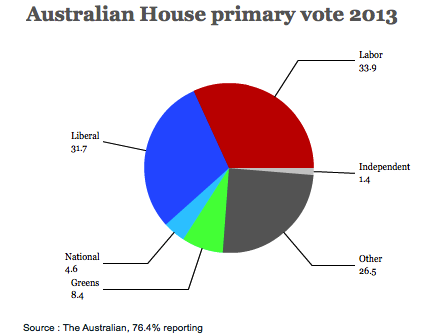
Here’s the result of the primary vote count:

primaryvote

The most striking piece is that more than one of every four voters chose as their first preference someone other than a Labor, Coalition or Green candidate, and it corroborates that the election was more a statement of disapproval of the Rudd-Gillard governments than an embrace of Tony Abbott.

So what comes next?  Within a week, Abbott will likely become Australia’s new prime minister.  What does that mean for Australian politics?  Continue reading At the dawn of the Abbott era of Australian politics, what comes next?

What should Australia expect from prime minister Tony Abbott?

abbott

Before the Kevin and Julia show, there was the Tony and Malcolm show.Australia Flag Icon

The rivalry between the dueling camps of Labor prime minister Kevin Rudd and former Labor prime minister Julia Gillard is now legendary — Rudd came to power in November 2007 after waging a near-perfect campaign (‘Kevin 07’) that brought the Australian Labor Party back to power after over a decade in opposition.  But his deputy prime minister Julia Gillard became prime minister in June 2010 after Rudd’s parliamentary colleagues wearied of his leadership style.  Gillard led Labor to the narrowest of reelections in August 2010 in what remains a hung parliament.  Rudd, who returned to government as Gillard’s foreign minister shortly after the election, challenged Gillard for the Labor leadership in February 2012 — and lost.  But as Gillard’s poll standing deteriorated throughout 2013, Rudd’s supporters engineered another vote in June 2013, and so Rudd (not Gillard) is leading Labor into Australia’s election on Saturday.

What’s less well-known is that opposition leader Tony Abbott (pictured above) emerged as the leader of the Liberal Party (and the center-right Liberal/National Coalition) after engineering a leadership spill of his own in December 2009.  After former prime minister John Howard lost his seat in the 2007 election, the Liberals turned initially to Brendan Nelson, but finally to Malcolm Turnbull as its leader in 2008.  But when Turnbull pushed his party to support the Labor government’s carbon reduction scheme, Abbott challenged Turnbull and improbably won a 42-41 victory on the second ballot, giving the Liberals their fourth leader in three years.

It’s an understatement to say that Abbott has proven a hard sell to the Australian public — in some ways, Abbott is akin to the Barry Goldwater or even the Ronald Reagan of Australian governance, a conviction politician and a conservative’s conservative who will undoubtedly pull Australia to the right.

A staunch Catholic who once studied in seminary for a career in the church (nicknamed early in his career by the press as the ‘Mad Monk’), a boxer with plenty of appetite for aggression in Australia’s House of Representatives, and a conservative who once studied at Oxford on a Rhodes scholarship, Abbott is multifaceted and talented.  But there’s no doubt that he’s socially and economically more conservative than Turnbull, Howard or Malcolm Fraser (prime minister from 1975 to 1983).  Abbott also had more ties to the recently rejected Howard government than Turnbull, having served as employment minister from 1998 to 2003 and health minister from 2003 to 2007.  Australian voters remained too hesitant about Abbott to hand the government back to the Coalition in 2010, but just barely.  Today, the Coalition holds one more (72 to 71) seat than Labor in the  House of Representatives, but independents and the Australian Greens have provided the Gillard/Rudd government a 76-74 majority since 2010.  It’s a similar story in the Senate, where the Coalition already holds a 74 to 71 advantage over Labor, which governs with the support of nine Green senators.

Just as Rudd routinely garnered higher approval ratings than Gillard between 2010 and 2013, Turnbull posted higher ratings as well.  Commentators in early 2013 daydreamed over the possibility that both of Australia’s major parties would dump their unpopular leaders in favor of their more charismatic alternatives.

But while Rudd and Gillard plotted and schemed over leadership, dragging Labor’s government and Australia into what amounted to a personality contest, Turnbull refrained from challenging Abbott for the Liberal leadership.  The difference between the Labor approach and the Liberal approach is one reason why Abbott is a certain favorite to become Australia’s next prime minister.

Since returning as prime minister in June, Rudd has spent most of his time flailing — although a Newspoll survey showed Rudd’s Labor tied with Abbott’s Coalition as recently as July 8, Labor now trails the Coalition in the two-party preferred vote (i.e., after all third-party voter preferences have been distributed to Labor and the Coalition) by a 54% to 46% margin, according to the latest September 1 Newspoll survey.

But Rudd’s campaign has managed to do what even Gillard’s government could not — turn Abbott into a plausible prime minister.  For the first time in the campaign, more voters prefer Abbott as prime minister (43%) than prefer Rudd as prime minister (41%) — that’s an astounding turnaround, given that an early August poll showed that voters widely preferred Rudd to Abbott by a 47% to 33% margin.  Ironically, though Rudd was supposed to be Labor’s secret weapon in winning a third term in power, Abbott has so completely transformed his image through the course of the campaign that Rudd may now be saddled with the kind of landslide defeat that terrorized his Labor colleagues into sacking Gillard just three months ago.

If Abbott delivers the kind of victory that polls predict on Saturday, it will be in large part due to the self-destructive factional battles within Labor, but it will also have much to do with Abbott’s steady happy-warrior approach over the past four years.

So what will Abbott’s likely win mean for Australia as a matter of policy, beyond the presumable end to the instability of the Rudd-Gillard era?

Here’s a look at seven issues to keep an eye on in what’s become an increasingly likely Abbott government. Continue reading What should Australia expect from prime minister Tony Abbott?

Feisty debate leads Abbott to ask Rudd, ‘Does this guy ever shut up?’

Screen Shot 2013-08-21 at 12.23.04 PM

The consensus is that prime minister Kevin Rudd, behind narrowly in the polls, had a better performance in the second leaders’ debate earlier in Brisbane, turning his underdog status as a way to poke holes in the platform of his rival, opposition leader Tony Abbott.Australia Flag Icon

At one point, Rudd harped so much about the cuts that Abbott might make as prime minister that Abbott snapped, ‘Does this guy ever shut up?’

It’s a sentiment many of Rudd’s rivals — from former Liberal/National Coalition prime minister John Howard to Labor prime minister Julia Gillard, who Rudd deposed as Labor leader only in June.

But Rudd’s tenacity resulted in at least one major concession from Abbott — that Abbott’s plan to cover the costs of a $5.5 billion paid parental leave scheme are insufficient.

Rudd parried with Abbott on the carbon tax that Rudd initially championed, Gillard ultimately enacted and Abbott hopes to repeal.  Rudd warned Abbott that the rest of the world, including the People’s Republic of China, is moving toward Australia’s carbon scheme — China launched its first experimental carbon scheme earlier this year in Shenzhen.

Rudd returned to his pledge from the first debate to introduce a bill legalizing same-sex marriage if Labor wins a third consecutive term, and Abbott reiterated his opposition to marriage equality, however gingerly — Abbott’s sister is gay:

All I can do is candidly and honestly tell people what my view is. I support the traditional definition of marriage as between a man and a woman. I know that others dispute this, because I have lots of arguments inside my own family on this subject now.

The two also bickered over asylum policy, an issue upon which Rudd and Gillard have now both made such a 180-degree turn that Labor’s policy on granting asylum to migrants who attempt to arrive in Australia by boat is now much tougher than the Howard government’s policy in the mid-2000s.

Rudd also repeatedly singled out Abbott’s record as health minister and he cheerfully alleged that Abbott cut $1 billion from public hospital budgets while in government.  Abbott denied the charges, arguing that the Howard government cut the rate of growth in spending, and he asked Rudd to stop telling fibs.

Commentators did not necessarily believe it was the kind of debate that marked a massive turning point in the campaign, though most agreed Rudd performed better than in his first debate:

In an early sign that the Labor leader needed a punchier performance than he had put in at the first debate nearly a fortnight ago, Mr Rudd capitalised first on the more flexible format of the people’s forum in Brisbane’s Broncos Leagues Club to accuse Mr Abbott of having ”ripped” $1 billion from hospital budgets and of planning further cuts. It was a charge Mr Abbott flatly denied after using his opening remarks to remind voters of Labor’s record in office.

Michael Gordon, political editor for The Age, argues that Rudd won narrowlyContinue reading Feisty debate leads Abbott to ask Rudd, ‘Does this guy ever shut up?’

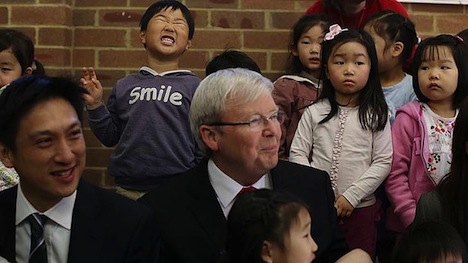
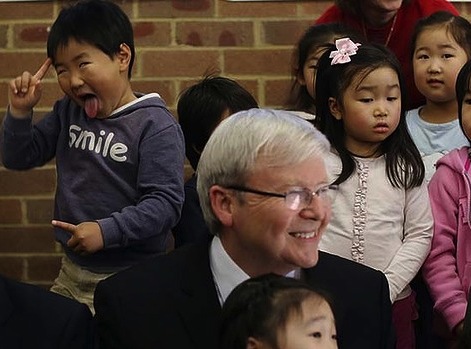
Photo of the day: Adorable Korean kid photo bombs Kevin Rudd

ruddbomb

Another day on the campaign trail for Labor prime minister Kevin Rudd, though yesterday’s star was Joseph Kim, a five-year-old who delighted in making faces as the cameras rolled away at a Rudd campaign stop at a Korean church in Sydney on Wednesday.Australia Flag Icon

Australians vote in exactly one month on September 7 to determine whether to give Rudd a full term as prime minister, six weeks after his fellow Labor colleagues reinstated him as party leader when polls showed that former prime minister Julia Gillard had virtually no chance of winning this autumn’s election.  Gillard had replaced Rudd as prime minister in June 2010 after griping over Rudd’s management style.

All together, Labor is seeking a third consecutive term — Rudd led the party to a robust victory in November 2007, and Gillard led the party to the narrowest of victories in August 2010.

Rudd faces Tony Abbott, the leader of the National/Liberal Coalition, which governed the country under former prime minister John Howard in the early 2000s.

One more photo:

ruddbomb2

Photo credit: Andrew Meares, Sydney Morning Herald

Rudd’s new policy for asylum seekers tops campaign agenda in Australia

ruddjuly

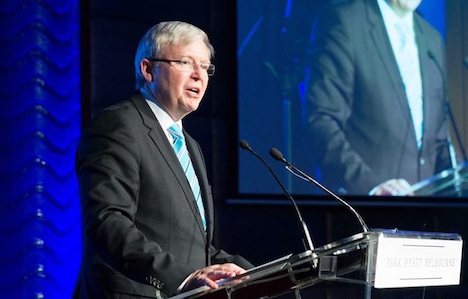
Australian prime minister Kevin Rudd kicked off his campaign for reelection over the weekend after setting September 7 as Australia’s election date — just over a month from today.Australia Flag Icon

Chief among the issues that will dominate the campaign debate is the Australia’s current immigration conundrum, which has been the subject of Rudd’s most controversial policy reversal since he ousted former prime minister Julia Gillard five weeks ago in the latest of years of intraparty battles to become the leader of the Labor Party and, once again, prime minister.  Rudd last month reintroduced elements of the ‘Pacific solution’ of former prime minister John Howard — a solution that Rudd abandoned as prime minister in 2007 — in a shift on asylum policy that leaves Labor now arguably to the right of anything the Howard government ever enacted.

Imagine, for a moment, that back in 2001, then-president George W. Bush introduced a policy that any foreign national apprehended crossing the southern U.S. border would be shipped to either, say, Greenland or Grenada, with whom U.S. officials negotiated a special arrangement to hold and process migrants bound for the United States.

Now imagine that Democratic president Barack Obama won election in 2008 on a promise to end that policy, and that he promptly did so — only to reintroduce the ‘Greenland solution’ a month before seeking reelection — with the added caveat that foreign nationals will never be resettled in the United States, just in Greenland and Grenada.

Though that’s not exactly what Australia is doing, it’s pretty close.  Rudd, who initially came to power on a promise to reverse the ‘Pacific solution’ six years ago, has now embraced a version of the ‘Pacific solution’ on steroids just one month before Australia’s general election — asylum seekers traveling to Australia by boat will be transferred to Papua New Guinea and Nauru where, if they qualify for asylum, will be resettled in Papua New Guinea or Nauru, not in Australia.

Rudd’s shift has left opposition leader Tony Abbott, flat-footed on an issue that Abbott was expected to use to advantage in the coming election, but it’s left Rudd subject to criticism that he’s carelessly tossing aside the human rights of asylum seekers, to say nothing of his previous principles, in order boost his own reelection chances.

Although Australia has always been a popular draw for migrants, the latest crisis stems from the late 1990s and early 2000s, when the number of refugees from Iraq and Afghanistan (and also from Vietnam, Myanmar/Burma and Sri Lanka) began to rise.  Howard instituted the ‘Pacific solution’ in 2001 — Australian naval officials who apprehended refugees off the coast of Australia would no longer escort them to Australia, but instead transfer them to processing centers on Christmas Island, on Manus Island in Papua New Guinea and on Nauru where, eventually, each refugee’s asylum case would be reviewed.  While some refugees were eventually granted asylum in Australia and New Zealand, around a third of the refugees were refused asylum and sent home.

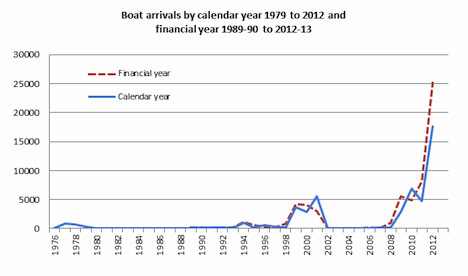
The policy seems to have worked because boat migration fell rapidly by the mid-2000s.

But when Rudd came to power in November 2007, his Labor government quickly ended the policy, in part due to criticism from human rights organizations over the sanitary conditions at the processing centers and the lengthy amount of time that asylum-seekers would spend in detention at the centers.   It was one element of Rudd’s ‘Big Australia’ campaign to reduce barriers to immigration and boost the country’s population.

But look what’s happened since 2007:

BoatArrivals-2

Ending the ‘Pacific solution’ eliminated what had become a massive disincentive to the decision to risk life and safety to seek a better future in Australia.  So the Rudd policy encourage an unprecedented wave of migration, supplemented by six years of suppressed demand, and all of the horrors that come with it, including the horrors of people trafficking, higher incidence of fatal crashes at sea.  For Australian policymakers, asylum policy had become a lose-lose proposition: the ‘Pacific solution’ left the Australians subject to charges of humanitarian lapses and of subcontracting its moral responsibility to the much-poorer Papua New Guinea; the revocation of the ‘Pacific solution’ encouraged dangerous migration that led to habitual headlines of death and exploitation in its northern seas. (Here’s one narrative of the long and arduous journey from Afghanistan to Australia from Amnesty International).  Continue reading Rudd’s new policy for asylum seekers tops campaign agenda in Australia