Who is Jeroen Dijsselbloem?

jeroen

Most indications are that the next Euro Group head will be a relative newcomer to the group of eurozone finance ministers — Dutch minister Jeroen Dijsselbloem, who declared his formal candidacy for the job today.European_UnionNetherlands Flag Icon

As I noted at the beginning of the year in my piece on 13 up-and-coming politicians to watch in 2013, the current head of the Euro Group since 2005, Jean-Claude Juncker, also prime minister of tiny Luxembourg since 1995 and the Luxembourgian finance minister from 1989 to 2009, is stepping down from the role.

Dijsselbloem belongs to the anti-austerity social democratic Partij van de Arbeid (PvdA, Labour Party) — that has joined a coalition that’s headed by the decidedly more budget-obsessed Volkspartij voor Vrijheid en Democratie (VVD, the People’s Party for Freedom and Democracy) and prime minister Mark Rutte.

The second Rutte cabinet took office as a ‘purple’ Lib-Lab coalition in November 2012 after a closely fought election in September 2012, during which Labour leader Diederik Samsom fought for a more gradual process of budget cuts to bring the Dutch budget within 3% of GDP.

The Euro Group came into being in the late 1990s in advance of the introduction of the single currency as an informal group.  In 2005, Juncker became the group’s first president amid a push to formalize the group’s role in 2009 though a protocol to the Treaty of Lisbon:

The Ministers of the Member States whose currency is the euro shall meet informally. Such meetings shall take place, when necessary, to discuss questions related to the specific responsibilities they share with regard to the single currency. The Commission shall take part in the meetings. The European Central Bank shall be invited to take part in such meetings, which shall be prepared by the representatives of the Ministers with responsibility for finance of the Member States whose currency is the euro and of the Commission.

The Euro Group typically meets a day before the Economic and Financial Affairs Council of the Council (Ecofin) of the European Union — Ecofin is comprised of the wider group of all 26 EU member state finance/economics ministers.  Accordingly, the Euro Group typically dominates economic policymaking at the Council level.  At the Council, policies related to fiscal matters must be adopted unanimously, though other policies can be adopted by the EU’s qualified majority voting mechanism (i.e., essentially a supermajority formula that requires both a majority of the 27 member states and a majority of the EU population).

The Euro Group president is appointed for a term of 2.5 years, by majority vote of the Euro Group, and the next president could be appointed as early as Monday, though French finance minister Pierre Moscovici has called for a more formal and transparent process of selecting the next president.  Moscovici has also called on Dijsselbloem to outline his views on the future direction of the Euro Group, and Dijsselbloem is set to discuss goals at Monday’s meeting, though Juncker has been dropping all sorts of hints that Dijsselbloem’s selection is all but assured.

Dijsselbloem has been a member of the Tweede Kamer (the lower house of the Dutch parliament) since 2000, after spending four years as an assistant at the ministry of agriculture, nature management and fisheries.

In parliament, Dijsselbloem has been a moderating voice on highly charged issues like the role of Muslims in Dutch society.  In 2007, he spearheaded a commission on educational reform.  Earlier in 2012, when former Amsterdam mayor Job Cohen resigned as Labour leader, Dijsselbloem was chosen to serve as the party’s interim leader until Samsom was elected as the permanent Labour leader, and he was the fifth candidate on Labour’s list in the 2012 elections.

As early as the 2003 election, Dijsselbloem was seen as a Samsom confidante — they campaigned together in that year as the ‘rode ingenieurs‘ — the ‘Red Engineers’ — due to their red overalls and scientific backgrounds, Samsom in nuclear energy and Dijsselbloem in agricultural economics.

Despite just two months on the job as a pro-growth minister in a government that will seek to reduce the Dutch budget to within 3% of GDP in 2013, Dijsselbloem literally personifies the current fiscal debate in Europe.  It helps that the Netherlands was one of the original six countries that formed the predecessor to the European Union and that it retains one of Europe’s last remaining ‘AAA’ credit ratings.

On one side, as personified by Moscovici and French president François Hollande of the center-left Parti socialiste, only aggressive government policies to boost aggregate demand can reduce unemployment and jumpstart Europe’s economic engine.  Although even Hollande admits the need to bring France’s budget in line with the European Union standard, generally, of within 3% of GDP, Hollande’s government has preferred to implement tax increases rather than cut spending too deeply.

On the other side, as personified by German finance minister Wolfgang Schäuble and German chancellor Angela Merkel of the center-right Christlich Demokratische Union Deutschlands (CDU, Christian Democratic Union), the key to prosperity — even in the face of recession — is to cut spending and narrow the budget deficit, thereby bringing more investment and business confidence by shoring up public finances. Continue reading Who is Jeroen Dijsselbloem?
Taking a closer look at the centrafricaine ceasefire and prospects for CAR elections

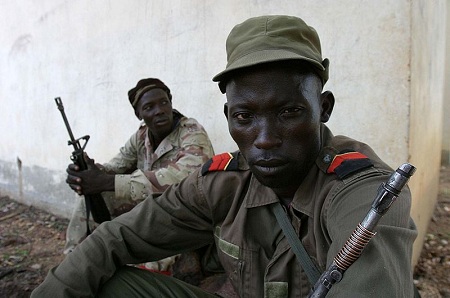
CAR rebels

It’s not every day that the Central African Republic makes world headlines, but it has become a global hotspot in the last two months, with Séléka coalition rebels increasingly taking control of the landlocked nation of 4.5 million and threatening to advance on the CAR’s capital, Bangui, on the Congolese border. centrafrique flag

Over the weekend, the rebels signed a ceasefire with the current president, François Bozizé, and today, opposition lawyer Nicolas Tiangaye has been named the new centrafricaine prime minister.

Under the ceasefire, the parties have agreed that Bozizé should continue to serve as president until 2016, when new elections will be called.  The centrafricaine national assembly will be dissolved, and Tiangaye will head a coalition government designed to stabilize the country, re-integrate the Séléka rebels into the national military, release Séléka political prisoners, and reform the country’s judicial system, with an eye to further economic and social reforms, especially in the crisis-weary north of the country where the government’s presence — military or otherwise — is nearly non-existent.

The new government, which cannot be dissolved or removed by Bozizé, is expected to run for at least the next 12 months, when new parliamentary elections will thereupon be held, though it remains possible for the government to continue for a longer period.

The Séléka coalition is comprised of several groups in the northern part of the country, and their gripes with the government follow from a previous ceasefire that ended the three-year Central African Republic Bush War in 2007 — that war, in turn, began as a response to the 2003 coup that brought Bozizé to power initially.

The ceasefire also seems to have ended the immediate threat that the Séléka rebels, who already control much of the northern half of the country, will invade Bangui and oust the Bozizé government, an increasingly likely threat until the weekend’s ceasefire.  The instability caused by the latest tumult also threatened to destabilize neighboring Sudan, Uganda and Chad — Chadian forces have assisted Bozizé from the time of the 2003 coup and throughout the tenure of his government.

The chances for building a stable centrafricaine democracy, while not hopeless, certainly have long odds in a country where there have been many more military coups than democratic elections:

Larger than France, the Central African Republic is a paragon of the ‘fragile state’. Some political scientists, such as the former ambassador of the CAR in Brussels, go further than that and even call it a “hollow state”. Continue reading Taking a closer look at the centrafricaine ceasefire and prospects for CAR elections

First Past the Post: January 17

East and South Asia

Pakistan’s election will come on or before May 6.

Pakistan and India will de-escalate tensions over Kashmir.

Hong Kong chief executive Chun-ying Leung addresses housing.

In advance of June elections in Malaysia.

North America

Current U.S. deputy national security adviser Denis McDonough is set to become the Obama administration’s fourth permanent chief of staff.

Latin America / Caribbean

President Evo Morales wants to bring more tourists to Bolivia.  [Spanish]

Venezuela will face a post-Chávez economic hangover.

Grenada goes to the polls on February 19.

Africa

What The Washington Post thinks you need to know about Mali. h/t Andrew Novak.

Former Liberian leader Charles Taylor would like his pension, please.

Tensions arise over a successor to Uganda’s president since 1986, Yoweri Museveni.

Europe

Germany wants its gold back.

Austria is holding a referendum on mandatory national service on January 20.

Vince Cable, perhaps the UK’s most beloved Liberal Democratic leader, warns coalition leader David Cameron on Europe from the left.

Methinks UK Labour leader Ed Miliband is not the second coming of Margaret Thatcher. But who am I to judge?

French tanks head towards northern Mali.

Germany’s Rhineland-Palatinate has a new state premier.

Middle East

Tajikistan has blocked access to Facebook.

A third week of escalating protests against the Iraqi government.

The Lebanonization of Israeli politics and next week’s Knesset elections

bibisnowball

Daniel Levy, director of the Middle East and North Africa program at the European Council on Foreign Relations, has written in Foreign Policy what’s perhaps the best piece I’ve read in the U.S. media — or the Israeli media, for that matter — on next Tuesday’s upcoming Israeli elections, where he makes the point that Israeli politics has become both incredibly fragmented and ossified: ISrel Flag IconLebanon

Alongside [Naftali] Bennett’s rapid rise, Jan. 22 is best understood as a “Tribes of Israel” election — taking identity politics to a new level. Floating votes may exist within the tribes of Israel, but movement between tribes, or political blocs, is almost unheard of. Israelis seem to relate their political choices almost exclusively to embedded social codes rather than contesting policies.

By Levy’s estimation, although voters may swing from party to party within a larger bloc, most Israeli voters remain within one of four essential ‘tribes’:

[Prime minister Benjamin] Netanyahu’s Zionist right (including the far right and national religious right), [former foreign minister Tzipi] Livni’s Zionist center (only Meretz still defines itself as Zionist left), the ultra-Orthodox bloc, and the bloc overwhelmingly representing Palestinian Arab citizens.

Not so long ago, you could make the credible argument that Israeli politics was essentially a two-party democracy, with the center-right Likud (הַלִּכּוּד‎, ‘The Consolidation’) of figures like Yitzhak Shamir and Menachem Begin and the center-left Labor (מפלגת העבודה הישראלית) — and from the 1960s through the end of the 1980s, the ‘Alignment’ (המערך) — of figures like Golda Meir, Yitzhak Rabin and Shimon Peres.

Sure, there were third parties and ultra-orthodox and Israeli Arab parties back then, too, but Likud and Labor/Alignment would often win two-thirds or more of the seats in the Knesset (הכנסת), Israel’s unicameral parliament.  In the most recent 2009 Israeli elections, however, Likud and Labor won a cumulative 40 seats — exactly one-third of the Knesset, and given the proliferation of personality-based parties in Israeli politics, it’s clear that Israel has moved to a system with much less long-term party affiliation and discipline.

As Levy makes demonstratively clear in his piece, however, each of his four identified ‘tribes’ contain multiple parties:

  • The ‘Zionist right’ includes not only Likud and its campaign partner, the secular nationalist Yisrael Beiteinu (ישראל ביתנו‎, ‘Israel is Our Home’) that appeals especially to Russian Jewish immigrants and is led by former foreign minister Avigdor Lieberman, who has resigned in light of ongoing legal troubles, but also Bennett’s upstart, conservative Bayit Yehudi (הבית היהודי, ‘The Jewish Home’).
  • The ‘Zionist center-left’ is more or less hopelessly fragmented into five parties — Labor, under Shelly Yacimovich, which is pushing economic issues in this election; Livni’s new party, Hatnuah (התנועה, ‘The Movement’), which is pushing mainly Livni in this election; Livni’s old party, the now-hemorrhaging Kadima (קדימה, ‘Forward’); Yesh Atid (יש עתיד, ‘There is a Future’), another personality-based party formed in 2012 by former television news anchor Yair Lapid; and Meretz (מרצ, ‘Energy’), the only truly leftist party in Israel with any remaining strength.
  • the ultra-Orthodox, or the haredim, the most conservative (in this case, religious conservatism, not necessarily political) followers of Judaism, including both the Middle Eastern sephardim that back the largest of the haredi parties, Shas (ש״ס) and Am Shalem (עם שלם, Whole Nation), a breakaway faction from Shas, as well as the Central and Eastern European ashkenazim that back the United Torah Judaism (יהדות התורה המאוחדת) coalition.
  • the Israeli Arabs, which include three parties that are each expected to win a handful of seats in the Knesset — Balad, Hadash and the United Arab List-Ta’al.

A look at the recent polling bears out Levy’s thesis — there’s a shift away from the ‘Likud Beiteinu’ alliance and a shift toward the Jewish Home, and there’s a massive shift away from Kadima in favor of Livni’s party, Labor and Yesh Atid.  By and large, however, the ‘right/religious’ seats would go from 65 to 67, and the ‘center/left/Arab’ seats would go from 55 to 53.  That’s not a whole lot of change, and that’s why, since Netanyahu called early elections, it’s been almost certain that Netanyahu will remain prime minister (though it’s more unclear whether he’ll govern with a more rightist or centrist coalition).

Levy’s harsh conclusion is that Israel is coming to resemble apartheid-era South Africa.

But it looks to me even more like the highly choreographed confessional politics of its northern neighbor, Lebanon.

Israel’s demographic trends make it very likely that its population will become more polarized (like Lebanon’s) in the coming years — Israeli haredi and Israeli Arab populations are growing much faster than secular Jewish populations, such that the haredim and Arabs, taken together, will outnumber the rest of Israel’s population within the next 40 years.  As such, the disintegration of two-party Israeli politics into de facto confessional politics in Israel is cause for worry. Continue reading The Lebanonization of Israeli politics and next week’s Knesset elections

Kennedy falters as Pupatello and Wynne lead race to become Ontario premier

wynne
pupatello

When Dalton McGuinty announced late last year that he would step down simultaneously as both leader of the Ontario Liberal Party and Ontario’s premier, it made this month’s Liberal leadership contest also a contest to become Ontario’s next premier.Canada Flag Iconontario

It’s not the best of times for McGuinty, who lost an opportunity to regain a majority government in Ontario’s unicameral legislative assembly after losing two by-elections last autumn.  The losses came after McGuinty passed — with the support of the opposition Progressive Conservative Party — a bill that froze wages for public teachers and denies the right to strike for the following two years.  The bill was seen as a massive betrayal by teachers’ unions that were key to McGuinty’s electoral victories since first becoming premier in 2003.

So his stepping down, after a decade in power, was seen as an opportunity for the Ontario Liberals to reboot before what’s likely to be an upcoming election (although the next election need not take place before October 2015) — and polls show his party in third place, behind both the Tories and the progressive New Democratic Party, and only leading by the narrowest of margins in the greater Toronto area, one of the last bastions of support for provincial and federal Liberals alike.

Originally, it seemed like the runner-up to McGuinty in the previous 1996 leadership race, Gerard Kennedy, was the frontrunner. But poor organization and his unpopularity among party insiders have pushed him to the background.

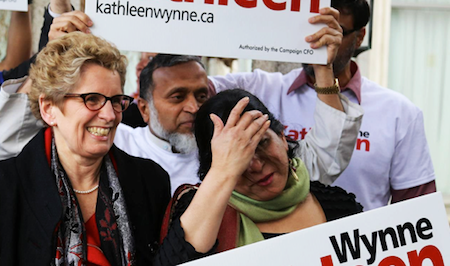
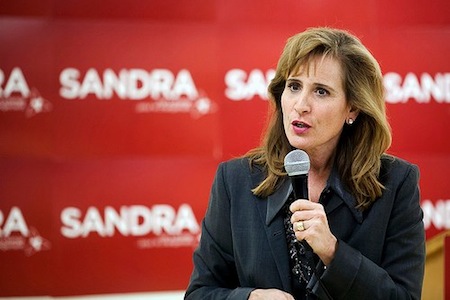
After delegates were selected over the weekend for the Ontario Liberal conference scheduled for January 25 to 27, two frontrunners have emerged — Sandra Pupatello (pictured above, bottom) and Kathleen Wynne (pictured above, top).

Pupatello won the greatest number of pledged delegates with 27%, followed closely by Wynne with 25%.  Kennedy fell far behind with just 14%, with Punjab-born MPP Harinder Takhar in a narrow fourth place with 13%.  Two remaining candidates — Charles Sousa (11%) and Eric Hoskins (6%) — followed far behind.

While there are independent and other ex officio delegates who will also be able to participate in the leadership vote, the pledged delegates clearly seem to indicate that the race will come down to Pupatello and Wynne who, like Kennedy, have all held the position of Ontario’s minister of education in the past decade.

Wynne, who would be Canada’s first openly-gay provincial premier, has been a member of the Ontario legislature since 2003, and she served as minister of education from 2006 to 2010; thereafter, she served as minister of transportation and then minister of municipal affairs and housing and aboriginal affairs.  Ideologically, she’s to the left of Pupatello, which could help her steal voters who might otherwise support the NDP in any future election.

Pupatello served in the Ontario legislature from 1995 to 2011, when she resigned to take a job as director of business and global markets at PricewaterhouseCoopers.  Aside from a stint as minister of education in 2006, she served as minister of economic development and innovation for much of the last five years of her legislative career.  She’s seen as more center-right than either Kennedy or Wynne, and she’s also perceived as the ‘establishment’ candidate as well.

Pupatello, 10 years younger than Wynne, is also seen as the more spirited campaigner, a quality that Liberal voters might like to see in a leader who will have to fight tooth-and-nail to retain power after the next provincial election.   Continue reading Kennedy falters as Pupatello and Wynne lead race to become Ontario premier

Mauritania warily eyes internationalized conflict in neighboring Mali

mauritania

If Mali had two decades of practice with democracy and rule of law and still couldn’t prevent a northern revolt that’s torn the country apart, leading to this week’s French military action to salvage the secular government in Bamako, it’s downright fortuitous that Mauritania, with virtually no experience of progressive, liberal democratic government, has so far avoided being dragged into the conflict. mauritania flag

Like Mali, Mauritania gained its independence from France in 1960.

Like Mali, which is 90% Muslim, Mauritania is nearly 100% Muslim, and it’s divided, ethnically, between a more Arabic north and a more sub-Saharan African south.

Like Mali, it’s a west African country that’s traditionally been at the bottom of an already-grim range of economic growth on the continent.

So there’s plenty of reason to believe that if the conflict in Mali spreads throughout the region, it will spread first to Mauritania,  a country with which Mali shares its largest border.  Although Mauritania has sealed its borders with Mali, and its current president Mohamed Ould Abdelaziz has been relatively aggressive against radical Islam, the relatively sparse Sahara country would seem to be an easy target for al-Qaeda in the Islamic Maghreb (AQIM).  In recent years, Abdelaziz has authorized raids against AQIM agitators across the border in northern Mali.

Let’s say that post-independence Mauritanian history doesn’t give us much optimism in the event that it does. Continue reading Mauritania warily eyes internationalized conflict in neighboring Mali

First Past the Post: January 16

ivansaak

East and South Asia

Pakistan’s Supreme Court, in its latest volley over corruption charges against the president, has ordered the arrest of prime minister Raja Pervez Ashraf.

The Supreme Court of Sri Lanka gets a controversial new chief justice.

A crackdown on bloggers in Vietnam.

India and Pakistan are still fighting over Kashmir.

South Korea is also dealing with extraordinary smog.

North America

U.S. president Barack Obama to back additional gun control measures in the United States.

Layoffs for Cirque de Soleil?

Latin America / Caribbean

Former vice president and failed chavista candidate for Miranda state governor Elías Jaua will be the new Venezuelan foreign minister.

Vice president Nicolás Maduro gives the Venezuelan state-of-the-nation speech.

The first outbreak of cholera in Cuba in decades.

Guatamalan president Otto Pérez Molina’s approval rating hits 70%.

Africa

Konna, that strategic town in Mali, may, uhhh, have been recaptured by Islamists?

Kenya’s three top coalitions are set to nominate on Thursday their presidential candidates for March 4 elections.

Europe

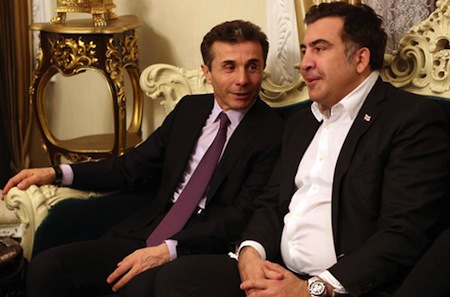
Georgia’s top two leaders had a conversation last night during the Orthodox New Year celebrations (pictured above).

Greece’s government stands firm in the face of anti-ND violence.

The governing Civic Democrats have endorsed Karel Schwarzenberg for Czech president. The Social Democrats are still pondering an endorsement.

Right-wing Tories are warning UK prime minister David Cameron not to buckle on the UK’s role in Europe.

Technocratic prime minister Mario Monti calls former prime minister Silvio Berlusconi the ‘pied piper’ of Italian politics.

Middle East

A new election law seems unlikely before Lebanon’s summer elections.

Jeffrey Goldberg breaks an Obama criticism of Israel, and Likud accuses the U.S. president of interference in Israeli elections.

Israeli forces killed a 17-year-0ld Palestinian youth in the West Bank.

Saudi Arabia jails Egyptian human rights lawyer.

Qatar prime minister Sheikh Hamad bin Jassim al-Thani says he won’t let Egypt go bankrupt.

On Egyptian water policy.

The link between Bahrain’s repression and U.S. arms.

An independent Iraqi Kurdish state?

Global

The World Elections blog looks to the 2013 elections.

M. Hollande’s little war — and what it means for French-African politics

malifabius Over the weekend, France found itself engaged in a new, if limited, war — and a new theater of Western intervention against radical Islam.Mali Flag IconFrance Flag Icon

French president François Hollande confirmed that French troops had assisted Mali’s army in liberating the city of Konna — in recent weeks, Islamist-backed rebels that control the northern two-thirds of the country had pushed forward toward the southern part of the country, threatening even Mali’s capital, Bamako.

On Tuesday, Hollande said the number of French troops would increase to 2,500, as he listed three key goals for the growing French forces:

“Our objectives are as follows,” Hollande said. “One, to stop terrorists seeking to control the country, including the capital Bamako. Two, we want to ensure that Bamako is secure, noting that several thousand French nationals live there. Three, enable Mali to retake its territory, a mission that has been entrusted to an African force that France will support.”

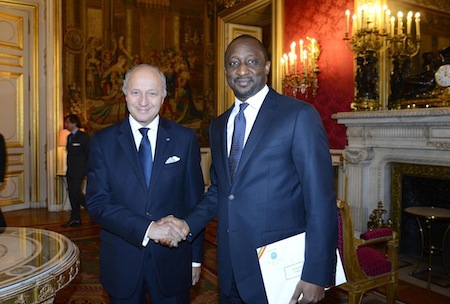
Hollande and his foreign minister, Laurent Fabius (pictured above with Malian foreign minister Tyeman Coulibaly), now face the first major foreign policy intervention of their administration, extending a trend that began under former president Nicolas Sarkozy, who spearheaded NATO intervention in support of rebels in Libya against longtime ruler Muammar Gaddafi and for the apprehension of strongman Laurent Gbagbo in Côte d’Ivoire in 2011.

Foreign Policy‘s Joshua Keating has already called the Malian operation the return of Françafrique. Françafrique refers to the post-colonial strategy pioneered largely by French African adviser Jacques Foccart in the 1960s whereby France’s Fifth Republic would look to building ties with its former African colonies to secure preferential deals with French companies and access to natural resources in sub-Saharan Africa, to secure continued French dominance in trade and banking in former colonies, to secure support in the United Nations for French priorities, to suppress the spread of communism throughout formerly French Africa and, all too often, source illegal funds for French national politics.  In exchange, French leaders would support often brutal and corrupt dictatorships that emerged in post-independence Africa.

But to slap the Françafrique label so blithely on the latest Malian action is, I believe, inaccurate — French policy on Africa has changed since the days of Charles de Gaulle and, really, even since the presidency of Jacques Chirac in the late 1990s.

After all, the British intervened just over a decade ago in Sierra Leone to end the decade-long civil war and restore peace for the purpose of stabilizing the entire West African region, and no one thought that then-prime minister Tony Blair was incredibly motivated by contracts for UK multinationals. Given the nature of the Malian effort, it’s quite logical that France — and Europe and the United States — has a keen security interest in ensuring that Bamako doesn’t fall and that Mali doesn’t become the world’s newest radical Islamic terrorist state in the heart of what used to be French West Africa.

Fabius, a longtime player in French politics, and currently a member of the leftist wing of the Parti socialiste (PS, Socialist Party), served as prime minister from 1984 to 1986 and as finance minister from 2000 to 2002, though his opposition — in contrast to most top PS leaders — to the European Union constitution in 2005 has left him with few friends in Europe.

Nonetheless, Fabius argued yesterday that it was not France’s intention for the action to remain unilateral — African forces from Nigeria and elsewhere are expected to join French and Malian troops shortly, UK foreign minister William Hague has backed France’s move, as has the administration of U.S. president Barack Obama — and today, the United Nations Security Council has also indicated its support for France’s efforts as well.

For now, Hollande has the support of over 75% of the French public as well as much of the political spectrum — and it’s hard not to see that the effort will help Hollande, who’s tumbled to lopsided disapproval ratings since his election in June 2012 amid France’s continued economic malaise, appear as a decisive leader. That doesn’t mean, however, that there won’t be trouble ahead for Hollande and Fabius. Continue reading M. Hollande’s little war — and what it means for French-African politics

A primer on the House of Schwarzenberg

houseofschwarzenbergWith the emergence of Czech foreign minister Karel Schwarzenberg as one of two finalists for the Czech presidency in a runoff to be held later this month, it’s worth taking a closer look at the House of Schwarzenberg and its role in European history throughout the centuries.austria flagczech

The house dates back to the Middle Ages, and perhaps its most illustrious member was once referred to as the ‘Austrian Bismarck’ for guiding the Austro-Hungarian empire during the tumultuous and revolutionary 1840s.

So if he wins the runoff on January 26, Karel Schwarzenberg will become an elected head of state with familial ties running throughout the remnants of European monarchy. Schwarzenberg’s mother belonged to another princely family, the Fürstenbergs, making him cousins with the late fashion designer Egon von Fürstenberg.  He was also second cousins with Ranier III, who was the prince of Monaco from 1949 until his death in 2005.

The family was initially based Franconia, in what is present-day Bavaria in Germany, and you can tour the ‘Schloss Schwarzenberg’ near Scheinfeld in Bavaria today.  Rebuilt in 1618 after its destruction by a fire, it was increasingly less important as the family’s base moved from Franconia to Bohemia in the heart of what is today the Czech Republic in the 17th century (though the castle was occupied by the Nazis during World War II, used as an American hospital on their march to Nuremberg, and it was transformed into a center for Czech literature in 1986).

One of the most influential of the earliest Schwarzenbergs was Johann, a close friend of Martin Luther, an episcopal judge who revised his court’s code of evidence and an influential member of the government of the Holy Roman Empire.

Adam, Count of Schwarzenberg, played a unique role as a top adviser of the Brandenburg Privy Council in the 1630s during the reign of elector George William, keeping Brandenburg neutral during the Thirty Years’ War, though he was ultimately forced to raise an army to expel invading Swedes and became the de facto ruler of Brandenburg from 1638 to 1640 when George William was forced into exile.

The Schwarzenberg coat of arms (pictured above) features a rather graphic tale about central Europe’s battles with the Ottoman Empire — a raven is pecking away at the head of a Turkish man, which was meant to symbolize the 1598 capture of a fortress, Raab (which translates to ‘raven’) in present-day Hungary.

Despite his family’s historical antipathy to the Ottomans in the 16th century, Karel Schwarzenberg, as the Czech foreign minister, has been relatively friendly to a possible Turkish accession to the European Union when the Czech Republic held the rotating six-month EU presidency in 2009, and he even used European history as a way to tweak France’s strident opposition to Turkey’s EU bid:

In the 17th century when central European countries all together fought fierce battles with Turkey, during the Ottoman offensive in Europe, France was practically an ally of Turkey.  In the 19th century, as you know, in the Crimean War, France was an ally of Turkey.  And now they are opposing it.  You see, alliances and attitudes come and go and change, and sometimes we see that even during our lifetime. Continue reading A primer on the House of Schwarzenberg

First Past the Post: January 15

aimask

East and South Asia

Understanding Tahir-ul Qadri’s march on Islamabad.

A guide to the seven candidates running for Bangkok governor.

South Korean president-elect Park Guen-hye’s transition team hits a snag.

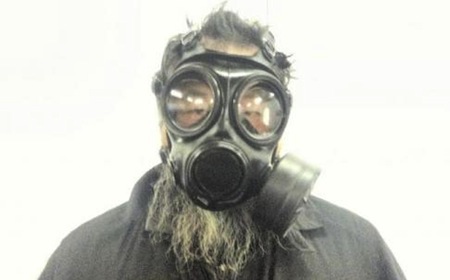
Ai Weiwei dons a gas mask (pictured above) to protest Beijing’s latest smog attack.

North America

Vice President Joe Biden is getting some serious credit these days.

Harvard law professor Lawrence Lessig on the prosecutorial bullying of Aaron Swartz.

The race for the leadership of the Ontario Liberal Party enters its final stretch with Sandra Pupatello in the lead for now.

Latin America / Caribbean

FARC’s ceasefire is set to end January 20 with talks ongoing with the Colombian government in Cuba.

Buenos Aires governor Daniel Scioli rebuffs Argentina president Cristina Fernández de Kirchner over foreign currency reserves.  [Spanish]

Africa

A permanent ceasefire in the Central African Republic.

Le Monde considers the divisions of Mali.

Mali’s Info Matin on the French intervention.  [French]

Europe

UK prime minister David Cameron tackles his country’s role in the European Union.

Iceland suspends talks to join the European Union in advance of elections in April.

Why Russia’s stirring doubts about a European bailout for Cyprus, and an interview with the Cypriot finance minister.

How France came to wage war in Mali.  Former prime minister Dominique de Villepin is pessimisticCharlemagne‘s take.

France’s government will proceed with a push for same-sex marriage despite protests over the weekend.

Germany’s SPD challenger for chancellor, Peer Steinbrück, is not doing so well.

A trial of former Italian prime minister Silvio Berlusconi on charges of paying for sex with an underage prostitute will proceed, notwithstanding the February 24-25 elections.

Middle East

A retrial for former Egyptian president Hosni Mubarak.

Three lessons from the Calatan experience for Scottish separatists

salmond

Artur Mas, the president of Catalunya, played the sovereignty card in calling early elections on November 25 and, thereupon, campaigned hard for Catalan sovereignty and against the federal Spanish government — it felt like, at times, he was running more against Spanish prime minister Mariano Rajoy than against any particular regional adversary.cataloniaSpain_Flag_IconUnited Kingdom Flag Iconscotland

His reward? Mas’s center-right party, Convergència i Unió (CiU, Convergence and Union), lost 12 seats.

That’s not the whole story, of course — sovereigntist parties hold an overwhelming majority with 87 seats in the 135-member Catalan parliament (the Parlament de Catalunya).  Catalan voters found a way to express their discontent with the austerity measures of Rajoy’s federal government and Mas’s regional government by shifting support to the more leftist, pro-independence Esquerra Republicana de Catalunya (ERC, Republican Left of Catalunya).

Furthermore, it’s not been an absolutely disastrous six weeks for Mas — the ERC truculently joined a governing coalition with the CiU, thereby stabilizing Mas’s government.  Just last week, the CiU and the ERC agreed upon a framework to push a vote for Catalan independence sometime in 2014, with or without the federal Spanish government’s acquiescence, setting him on a collision course with not only Mas, but much of the federal Spanish government and probably a majority of the other Spanish regions.

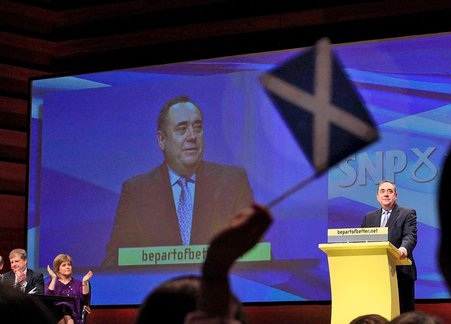
Meanwhile, in Scotland, the Scottish National Party, headed by first minister Alex Salmond (pictured above) has taken a vastly different course — United Kingdom prime minister David Cameron has agreed to the 2014 independence referendum in Scotland, and polls show independence trailing the status quo by about a 50% to 32% margin there.  Unlike in Catalunya, the Scottish aren’t coming out in waves of thousands in protest for independence, and despite the unpopularity of former Conservative UK prime minister Margaret Thatcher’s implementation of the poll tax in Scotland, the Scots can’t point to systemic — and recent — violations of civil liberties like the Catalans can, namely the suppression of Catalan language and culture under the regime of fascist Spanish strongman Francisco Franco from 1937 to 1975.

Catalan independence would likely be a greater disruption to Spain than Scottish independence would be to the United Kingdom — by the numbers at least.  With 7.5 million people, Catalunya comprises nearly 16% of the Spanish population.  Although Scotland comprises nearly a third of the United Kingdom by area, its population of 5.3 million people is just a little under 8.5% of the total UK population.

So what can the Catalan Sturm und Drang (or, tempesta i estrès, perhaps?) of the past few months, including the November regional elections, teach Scotland as it prepares for its own 2014 referendum?

Here are three lessons that pro-independence Scots should take to heart from the recent Catalan experience. Continue reading Three lessons from the Calatan experience for Scottish separatists

Zeman and Schwarzenberg to face off for Czech presidency


Human Rights Council, High-Level

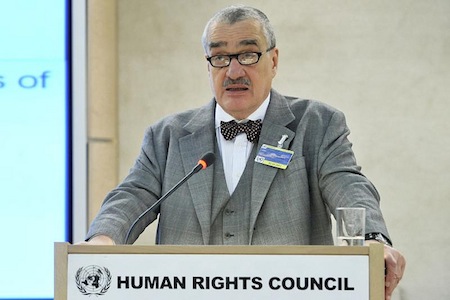
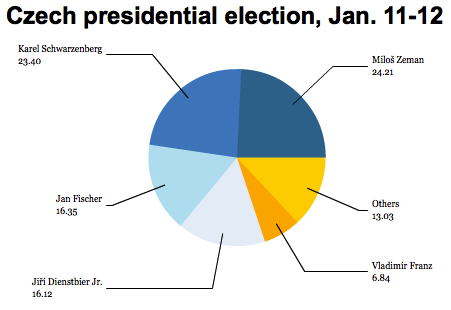
This weekend’s Czech presidential election resulted in something of a surprise, with center-right foreign minister Karel Schwarzenberg (pictured above) surging to a very close second place against front-running center-left candidate and former prime minister Miloš Zeman.czech

Zeman and Schwarzenberg will now compete in a runoff to be held on January 25 and 26 in the Czech Republic’s first direct presidential election in its post-Cold War history to succeed Václav Klaus, the Czech Republic’s president since 2003, an outspoken conservative and euroskeptic.

Schwarzenberg won a surprisingly high 23.40% of the vote, trailing less than 1% behind Zeman, edging out a statistician and former caretaker prime minister Jan Fischer, who won just 16.35% and nearly finished in fourth place behind another center-left candidate, Jiří Dienstbier Jr.  Fischer led polls as recently as a week or two ago, though his performance in a debate against Zeman in early January was seen as lackluster, fueling a boom for Zeman’s poll support heading into last weekend’s vote.

czechpres1st

Ominously for the current Czech government, the candidate of the governing Občanská demokratická strana (ODS, Civic Democratic Party), Přemysl Sobotka, a senator, finished in 8th place with just 2.46% of the vote, likely a result of his relatively obscurity in a field of longtime titans of Czech political life and of the brutal austerity measures that the current ODS-led government of Petr Nečas.

Schwarzenberg won throughout the center of the country in his native Bohemia and in Prague and other urban areas; Zeman dominated much of the rest of the country, including rural Moravia in the east and rural areas in the north.

So what should we expect in the final runoff?  Continue reading Zeman and Schwarzenberg to face off for Czech presidency

First Past the Post: January 11

130110_lebanon159162718

East and South Asia

What Burma can learn from Chile.

At least 93 Pakistanis have died in a bomb blast in Quetta.

More stimulus for Japan.

North America

The 2013 nominees for the Academy Awards.

California governor Jerry Brown proposes a state budget with a surplus.

Latin America / Caribbean

Grenada is headed for early elections.

Venezuela holds a presidential inauguration without its president.

Africa

More pressure on Zimbabwe from South African president Jacob Zuma?

Europe

Dutch finance minister Jeroen Dijsselbloem remains the favorite to head the Euro Group.

The Czech presidential campaign is winding down.

Artur Mas continues to agitate for Catalan independence.

Middle East

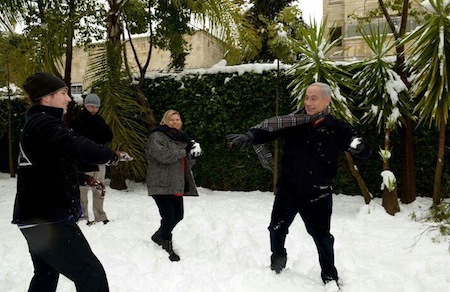
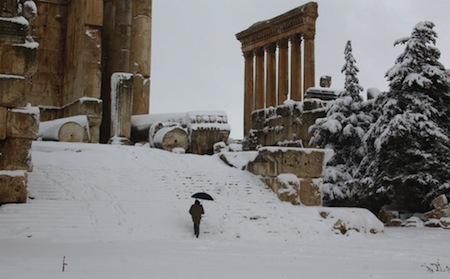
A rare snowstorm in the Levant in pictures (Baalbek in Lebanon pictured above).

Is Israeli politics necessarily shifting rightward?

The latest poll in Israel has good news for prime minister Benjamin Netanyahu.

Egypt also has a new central bank governor.

Photo credit to STR/AFP/Getty Images.

Lew to be nominated today for U.S. treasury secretary

lewobama

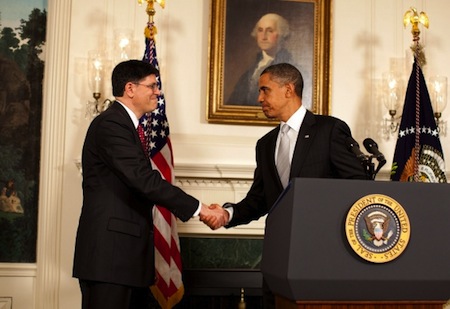
U.S. president Barack Obama is set to nominate his chief of staff, Jacob Lew (pictured above) as the next U.S. treasury secretary later today.USflag

Lew formerly served as the Obama budget director from 2010 to 2012 seems the likely frontrunner to succeed Geithner.

I wrote back in December that the next U.S. treasury secretary would play a greater role in setting foreign policy than the next U.S. secretary of state (U.S. senator John Kerry has been nominated for that job).

Here’s the Ezra Klein dossier on Lew.

First Past the Post: January 10

JackLew

East and South Asia

Tensions continue to heat up between India and Pakistan on the Kashmir border.

Hong Kong chief executive Leung Chun-ying has survived an impeachment hearing.

Trouble for Bangkok governor Sukhumbhand Paribatra with two months to go in his reelection bid.

The fight over rare earth metals.

North America

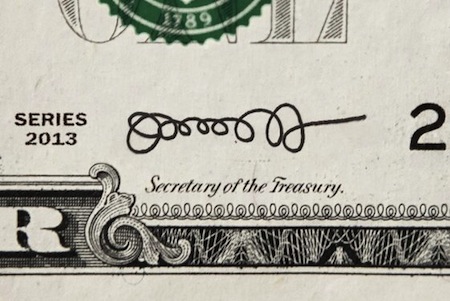
No one knows what will happen with the ominously looming debt ceiling fight in February, but some people are certainly anxious about the signature (pictured above) of likely U.S. treasury secretary nominee Jack Lew.

Remembering the 100th anniversary of former U.S. president Richard Nixon’s birth.

One Log Cabin Republican quits over the LGBT group’s attacks on U.S. defense secretary nominee Chuck Hagel.

Latin America / Caribbean

Venezuela’s Supreme Tribunal of Justice rules that president Hugo Chávez need not re-take the oath of office.

The three worst countries in which you could be born in Latin America. [Spanish]

Former Brazilian president Luiz Inácio Lula da Silva may be investigated in an ongoing vote-buying scandal.

Africa

Violence in Tana delta puts Kenya on edge.

Europe

John Sfakianakis shares reflections in Foreign Policy on the economic depression in Greece.

The Swiss Central Bank is engaged in an edgy strategy to maintain the Swiss franc’s value.

The United States tells the United Kingdom to stop edging toward a potential exit from the European Union.

The latest on the Lower Saxony state elections.

Klaus Wowereit’s days are numbered as Berlin mayorDer Spiegel argues.

Middle East

Egypt’s upcoming parliamentary elections will probably be in April.  Maybe.

Youssef Makhioun will lead the Salafist and incredibly conservative Al-Nour Party, which currently holds the second-largest number of seats in Egypt’s parliament, into those elections.

Global

Maplecroft charts political risk and hot spots in 2013.

The world’s population may decline in coming years.

The always-insightful World Elections gives us the top 10 elections of 2012.