Tag Archives: FDP

SPD party membership approves German grand coalition

grossekoalition

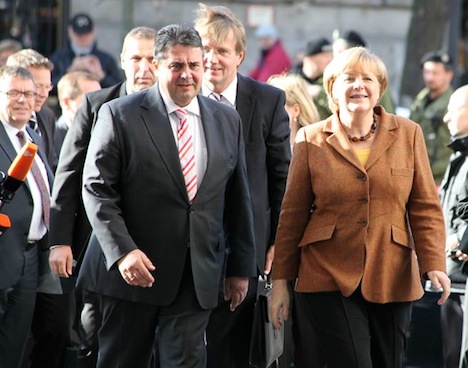
In an overwhelming endorsement of Germany’s new grand coalition, party members of the center-left Sozialdemokratische Partei Deutschlands (SPD, Social Democratic Party) have approved the governing agreement between the SPD and chancellor Angela Merkel’s center-right union.Germany Flag Icon

Nearly 370,000 German party members approved the agreement by the lopsided margin of 75.96% in a vote that was held over the past two weeks, the results of which were announced earlier today.  The vote followed the November 27 agreement struck among SPD leaders and leaders of Merkel’s Christlich Demokratische Union Deutschlands (CDU, Christian Democratic Party) and Merkel’s Bavarian allies, the  Christlich-Soziale Union (CSU, the Christian Social Union).

So what next?

Expect Merkel to name a new cabinet within the next 24 hours, and expect her formal reelection as chancellor to come early next week.

You can read more background about the coalition deal here and here, but here’s a short list of points to keep in mind: Continue reading SPD party membership approves German grand coalition

Merkel’s CDU-CSU, Gabriel’s SPD stumbling toward a not-so-grand coalition in Germany

gabriel

We’re less than two weeks from December.  That means that the Bundestag, the lower house of Germany’s parliament, has been sitting for about a month, and we’re weeks away from the self-imposed deadline that chancellor Angela Merkel placed on securing a new coalition government.Germany Flag Icon

In case you forgot, Merkel won a handsome victory in the September 22 federal election, when her center-right Christlich Demokratische Union Deutschlands (CDU, Christian Democratic Party) — together with the Christlich-Soziale Union in Bayern (CSU, the Christian Social Union in Bavaria) — won 311 seats in the Bundestag, just five seats short of an absolute majority.  It was the biggest victory for Merkel’s Christian Democrats in nearly two decades, harkening back to the wide margins that former CDU chancellor Helmut Kohl won in 1990 and in 1994 in the afterglow of the relatively successful reunification of West and East Germany.

But while the CDU-CSU savored a sweet victory, their coalition partners between 2009 and 2013, the Freie Demokratische Partei (FDP, Free Democratic Party) failed to win any seats in the Bundestag for the first time since 1945, leaving Merkel with two options — a minority government or a coalition government with more leftist partners.

Though Merkel flirted throughout early October with Die Grünen (the Greens), a tantalizingly novel coalition that would have remade the German political spectrum, the Greens pulled out of talks on October 16.  So for over a month, coalition negotiations have been exclusively among the CDU, the CSU and the center-left Sozialdemokratische Partei Deutschlands (SPD, Social Democratic Party).  Earlier in November, the coalition talks were going so well that CSU leader and Bavarian minister-president Hoorst Seehofer worried that the harmony would subsume the real policy differences between the German right and the German left.

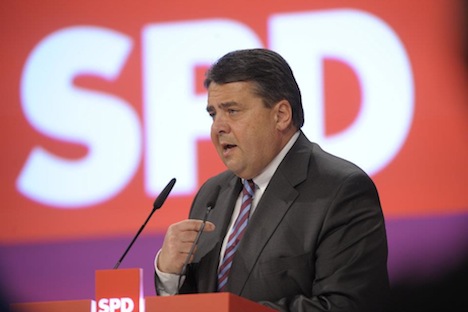
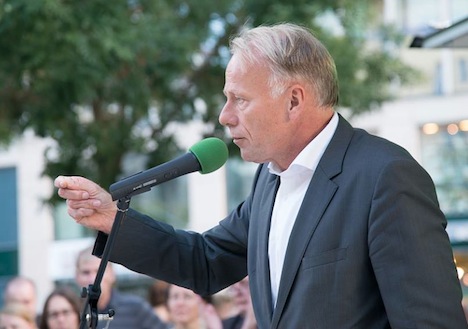
As Merkel quipped earlier this year, Christmas comes sooner than you think, and Merkel, Seehofer and the SPD’s leader, Sigmar Gabriel (pictured above), are under increasing pressure to agree on a coalition agenda — and given that the CDU-CSU’s 311 seats and the SPD’s 192 seats constitute 79.8% of the entire Bundestag, expectations are high that such a wide-ranging coalition will tackle long-term reform both in Germany and in the European Union.  Moreover, any coalition deal agreed among the three parties must also win subsequent confirmation from a vote of 470,000 SPD members in December.

So what’s holding up the deal?  Continue reading Merkel’s CDU-CSU, Gabriel’s SPD stumbling toward a not-so-grand coalition in Germany

Merkel’s coalition talks with Green Party leaders this week seem serious

kretschmann

German chancellor Angela Merkel, fresh off a victory at the end of last month in her country’s federal elections, turned this week to a once very-unlikely coalition partner — Germany’s Die Grünen (the Green Party). Germany Flag Icon

When news broke last week that Merkel would hold talks with the Greens, it was easy to blow it off as a formality.  After all, everyone assumed after the September 22 elections that Merkel’s center-right Christlich Demokratische Union Deutschlands (CDU, Christian Democratic Party) would form another ‘grand coalition’ with the center-left Sozialdemokratische Partei Deutschlands (SPD, Social Democratic Party).

But throughout the campaign, I listed all of the reasons why a ‘black-green’ coalition made a lot of sense — and those reasons still make as much sense now as they did before the election.  Merkel’s decision to phase out nuclear power in 2011 removed the key policy difference that most divided her from the Greens.  The leadership and the rank-and-file membership of the Greens is becoming older, wealthier and, in general, more like the CDU electorate.  Moreover, its younger members are less radical and more moderate, and don’t have the same antipathy to business as the (pardon the generalization) founding ‘1960s, hippie, flower child’ generation.

With the announcement that the Greens and Merkel’s CDU will explore a second round of talks over a potential coalition, however, everyone seems to be taking seriously the possibility of a ‘black-green’ coalition, which would be unprecedented in national German politics (though the Greens and the CDU joined forces in government recently, to mixed results, in Saarland and Hamburg).

There were always really compelling reasons why another CDU/SPD ‘grand coalition’ makes little sense.

After all, Merkel’s near-landslide victory left her CDU and the more Catholic, conservative, Bavaria-based Christlich-Soziale Union in Bayern (CSU, the Christian Social Union) just five seats short of an absolute majority.  She doesn’t need the SPD’s 192 seats, she needs five votes.  Moreover, the SPD’s collaboration with Merkel won it few votes, neither in Germany’s 2009 federal elections when the grand coalition’s foreign minister Frank-Walter Steinmeier led the party to its worst election result in postwar history nor in the most recent elections when the grand coalition’s finance minister Peer Steinbrück led the SPD to its second-worst result.  As such, the SPD is looking to draw a contrast with Merkel over the next hour years, not prop up Merkel’s government as her junior partner.

That means that the SPD will be looking for the first opportunity for snap elections — and it’s not exactly a foregone conclusion that Merkel will lead the CDU/CSU into a fourth consecutive campaign.  At first glance, a coalition with the Greens may seem more bold, but it might well be the more cautious option for Merkel.  They’ll be less likely to cause problems for Merkel and, with a smaller parliamentary caucus,

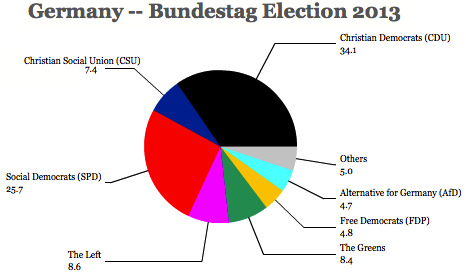
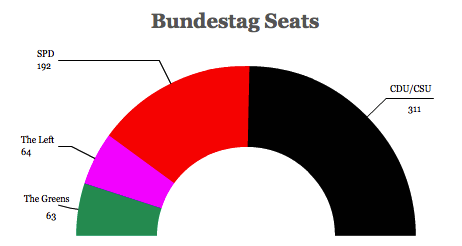
Here’s the breakdown of seats in the lower house of Germany’s parliament, the Bundestag, following the September 22 vote, which will have 630 seats — a ‘grand coalition’ would amount to about four-fifths of the entire Bundestag.
bundestag seats

Given that the CDU’s coalition partner between 2009 and 2013, the liberal Freie Demokratische Partei (FDP, Free Democratic Party), failed to surpass the 5% electoral threshold and lost all of its seats in the Bundestag in September, there’s only one other party to which Merkel can turn — the Greens.

Though Merkel’s coalition partners might both regret their cooperation (i.e., the SPD and the FDP both notched postwar nadirs in 2009 and 2013, respectively), there’s a strong case that a ‘black-green’ coalition could give the Greens a new identity at the very heart of Germany politics.  As a junior partner in Merkel’s third consecutive government, its supporters wouldn’t expect much, so to the extent that the Greens moderate Merkel’s agenda over the next four years (through policies that boost renewable energy or reduce CO2 emissions), their core voters should be fairly satisfied.  But the Greens stand to pick up many more centrist voters that might otherwise vote for the SPD or even for the CDU or the FDP.

The Greens ran an undeniably leftist campaign, pledging tax hikes and a 15% wealth tax to boot, along with the oft-ridiculed national ‘Veggie Day,’ and one of its four leaders, Jürgen Trittin, a former environmental minister from 1998 to 2005, faced ridicule over his approval of a pamphlet from 1981 that appeared to call for the legalization of sex between adults and minors.  Despite polls that in 2011 showed the Greens winning up to 25% or even 30% of the vote, they finished with just 8.4% of the vote — a swing of 2.3% less than their 2009 total.

Former Green Party leader and foreign minister Joschka Fischer, among others, took the Greens to task for their campaign within 48 hours of the election:

“It looks almost as though the current leadership of the Greens has gotten older but still hasn’t grown up,” Fischer told SPIEGEL following Sunday’s vote. “They followed a strategy that not only failed to win over new voters, but drove away many old ones.” Noting the party’s focus on tax hikes and social spending during the campaign, Fischer said that emphasizing a “leftist course” was a “fatal mistake.”

Former party head Reinhard Bütikofer has likewise not been complimentary of the current Green leadership. “The failure … to engage in a serious debate with Chancellor Merkel regarding … her policies for Europe granted her political hegemony” on the issue, he told SPIEGEL. He also criticized Trittin for being a mouthpiece of the party’s left wing.

Since the election, the Green leadership resigned en masse, and they elected two new leaders, including the centrist rising star Katrin Göring-Eckardt, who had served as one of two chancellor-candidates for the Greens during the election.  The Greens, who have long been divided between a more centrist realo (‘realist’) faction and a more radical fundi (‘fundamentalist’) faction, have long elected leaders in pairs (the new leftist Green leader is Anton Hofreiter, who, unlike Trittin, comes from the new generation of Greens parliamentarians).

But the clear exemplar of Greens success is Winfried Kretschmann (pictured above), the first and only minister-president of any of Germany’s 16 states — and in Baden-Württemberg, a wealthy (and relatively conservative) state in Germany’s southwest that’s a hub for commerce and industry.  Though Kretschmann came to power in 2011 on a wave of opposition to the Stuttgart 21′ rail development project, Kretschmann is now helping to implement the project after it won nearly 60% support in a subsequent referendum specifically on the project’s future.  Kretschmann, who’s firmly within the ‘realo,’ right wing of the Green Party, has won plaudits from business leaders as well, and he’s apparently playing a role in the CDU-Green negotiations.

Severe obstacles remain to a ‘black-green’ coalition. Continue reading Merkel’s coalition talks with Green Party leaders this week seem serious

Austrian NEOS may win seats in Nationalrat in resurrection of liberal politics

NEOs

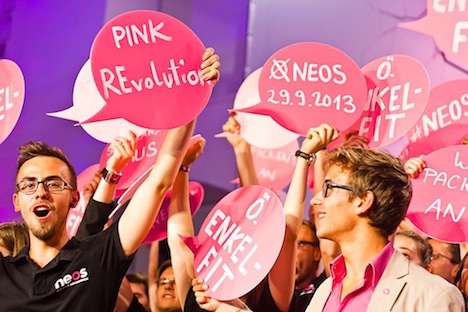
While Germany’s major liberal party suffered a historic defeat in last weekend’s parliamentary elections, a new Austrian party may win enough seats to return a liberal voice to Austria’s parliament for the first time in nearly 20 years in Austria’s national elections this weekend.austria flag

If it can win 4% of the vote on Sunday, the Das Neue Österreich (NEOS, The New Austria) could enter the Nationalrat, the key 183-member chamber of Austria’s parliament, which would mean that free-market and social liberals would have a voice in Austrian parliamentary politics for the first time since the Liberales Forum (Liberal Forum) lost all of its seats in the 1999 parliamentary elections.  Polls in the lead-up to Austria’s election show the NEOS gaining strength, but still hovering between 3% and the 4% electoral hurdle, and the NEOS continues to gain credibility and momentum in the final days of the campaign.

What’s more, if the NEOS enter the parliament, and the two current governing parties, the center-left Sozialdemokratische Partei Österreichs (SPÖ, Social Democratic Party of Austria) of chancellor Werner Faymann and the center-right Österreichische Volkspartei (ÖVP, Austrian People’s Party), fail to win an absolute majority of seats to continue a two-party grand coalition, the NEOS could conceivably enter government as well in Europe’s first ‘red-black-pink’ coalition.

Given the coziness of Austria’s political elite, and the fact that grand coalitions have dominated Austrian governance in the postwar era, there’s much to recommend the return of a fresh and liberal voice to Austrian politics — or even Austrian government.  Not too shabby for a party that didn’t exist one year ago.

The NEOS were founded as a political party in October 2012, mainly as an alliance of what remains of the Liberal Forum and the Young Liberals, another small party, under the leadership of Matthias Strolz.  Since September, the party’s lead parliamentary candidate has been Hans-Peter Haselsteiner, the CEO of Austrian construction company Strabag and a Liberal deputy in the Nationalrat in the 1990s — it was a stunning reversal for Haselsteiner, who had previously remained somewhat aloof from the NEOS earlier this year.  Not only does Haselsteiner have the deep pockets to finance a strong showing, he’s also one of the most well-known liberals in the country.  Austrians vote for parties through an open-list proportional representation system, so if the NEOS surpass the 4% threshold, the NEOS should count on at least seven seats in the Nationalrat.

Moreover, if the NEOS do enter the Nationalrat, they could lower the total number of seats that the SPÖ and ÖVP can hope to win, making it even more likely that the SPÖ and ÖVP will be forced to look for a third coalition partner to cobble together a governing majority.

In an ironic twist, the NEOS could well enter Austria’s parliament just days after Germany’s Freie Demokratische Partei (FDP, Free Democratic Party) narrowly failed to win 5% of the vote and, accordingly, Germany’s liberal party failed to win a single seat in the Bundestag, the lower house of Germany’s parliament, for the first time since 1949.  Continue reading Austrian NEOS may win seats in Nationalrat in resurrection of liberal politics

German election results — federal Bundestag and Hesse state results (in five charts)

Election officials released provisional results overnight in both the federal Germany election to determine the makeup of the lower house of Germany’s parliament, the Bundestag, and the Hessian state elections.Germany Flag Iconhesse flag

Here’s where things stand in the total national ‘party vote’:

bundestag2013

As predicted by exit polls earlier Sunday, neither the new eurosceptic party, the Alternative für Deutschland (AfD, Alternative for Germany) nor the longtime liberal Freie Demokratische Partei (FDP, Free Democratic Party) won more than 5% of the vote — meaning that they have not won any seats in the Bundestag.

The final total won by chancellor Angela Merkel’s Christlich Demokratische Union Deutschlands (CDU, Christian Democratic Party) — together with the Bavarian Christlich-Soziale Union in Bayern (CSU, the Christian Social Union) — comes to 41.5%.  That’s exactly the same percentage that the CDU/CSU and chancellor Helmut Kohl won in the 1994 German elections, and it’s just 2.3% less than Kohl’s total in the 1990 elections, which came in the aftermath of the largely successful reunification of West Germany with East Germany.  It’s an absolutely huge win for Merkel — but we already knew that as polls closed Sunday.

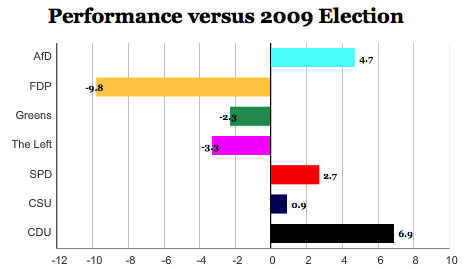
Here’s a look at how Sunday’s election result compared to the previous elections in September 2009:

versus2009

There are no absolutely clear winners except the CDU/CSU, which improved on its 2009 totals by a staggering 7.8% — including a nearly 1% improvement by the CSU (which is pretty incredible, given that the CSU seeks votes solely in Bavaria, home to just 12.5 million of Germany’s 80 million residents).

The FDP obviously had a disastrous result — the party’s worst result in Germany’s postwar history, which comes after its postwar high of 14.6% just four years ago.  Both leading FDP figure and economics and technology minister Rainer Brüderle, party leader and vice chancellor Philipp Rösler and former party leader (until 2011) and foreign minister Guido Westerwelle are all likely to step aside from their top leadership positions.

The center-left Sozialdemokratische Partei Deutschlands (SPD, Social Democratic Party) improved slightly on its 2009 result, which was a postwar low for the party under chancellor candidate Frank-Walter Steinmeier, who served as foreign minister in the 2005-09 CDU/SPD ‘grand coalition’ government.  But the SPD’s performance under its 2013 candidate Peer Steinbrück, who served as Merkel’s grand coalition finance minister, was its second-worst result in postwar German history.

Die Grünen (the Greens) also suffered a retreat from its 2009 totals and especially from polls in 2011 that showed them winning between 20% and 25% of the vote.  The poor result follows an unfocused campaign with at least four different leaders.  The Green platform swung from promoting ‘Veggie Day’ to advocating tax increases, despite the fact that its electorate is becoming more moderate, less radical, older and wealthier.

Die Linke (the Left) appears to have retained its traditional strength as the second-most popular party in the eastern states (second to Merkel’s CDU), but it has also lost support since 2009.  Though its leaders were crowing that it will be the third-largest party in the Bundestag for the first time since reunification, the CDU appears to have made significant inroads into the Left’s eastern heartland.

Though the AfD had a superb performance, it obviously fell 0.3% short of entering the Bundestag and, while it will work hard to retain relevance in next spring’s European elections, it’s difficult to tell if it can retain and grow its strength between now and 2017.

Here’s the breakdown of the seats in the Bundestag — due to so-called ‘overhang seats’ resulting from the way in which additional seats are allocated to bring seat totals in line with the ‘party vote,’ there are 630 seats:

bundestag seats

With 311 seats, Merkel is five seats short of an absolute majority.  Without the option of her previous coalition partner, the FDP, it means that she has three options: Continue reading German election results — federal Bundestag and Hesse state results (in five charts)

LIVE BLOG: Can Merkel win an absolute majority?

Screen Shot 2013-09-22 at 12.48.24 PM

With results yet to come in, the first exit polls show that German chancellor Angela Merkel winning a huge mandate.Germany Flag Icon

Here’s the ZDF exit poll:

  • Merkel’s center-right Christlich Demokratische Union Deutschlands (CDU, Christian Democratic Party) and its Bavarian sister party Christlich-Soziale Union in Bayern (CSU, the Christian Social Union): 42.5%.
  • The center-left Sozialdemokratische Partei Deutschlands (SPD, Social Democratic Party): 26.5%.
  • The democratic socialist Die Linke (the Left): 8.5%.
  • Die Grünen (the Greens): 8%.
  • Conservative, eurosceptic Alternative für Deutschland (AfD, Alternative for Germany): 4.8%.
  • Liberal Merkel coalition partner Freie Demokratische Partei (FDP, Free Democratic Party): 4.5%.

Let’s start with what we know.

How much of a victory is this for Merkel? It’s absolutely huge.

With 42.5% of the vote, Merkel’s CDU/CSU union would win just 1.3% less than Helmut Kohl won for the CDU/CSU in 1990 — and that was in the afterglow of reunification.

It looks like Peer Steinbrück will have led the SPD to a better result this year than Frank-Walter Steinmeier, the former foreign minister who led the SPD to win just 23% in the 2009 election.  It’s still not a great result for the SPD, and the exit polls show that the SPD didn’t actually narrow the gap in the final days as some pre-vote poll surveys had indicated.

Now let’s think about what’s still uncertain — it’s obvious that Merkel’s preferred coalition partner, the FDP, is struggling.  It would be the first time in Germany’s postwar period that the FDP fails to win enough seats to enter the Bundestag — their worst result was in 1969, when it won just 5.8% of the vote, and it follows their best-ever result from 2009 — 14.6%.  It’s been a spectacular collapse, and it’s hard to believe that Philipp Rösler’s leadership will survive very long.  There’s a lot of rebuilding ahead.

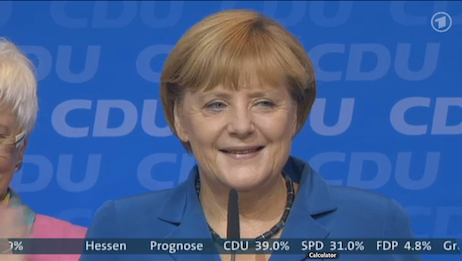
(Note that in Hesse, where state elections are being held, the FDP is falling short with just 4.8% as well.  While the CDU has won around 39%, the SPD is winning 31%, the Greens 10.5% and the Left 6% — and that means we could see another SPD-led attempt to govern with the support of the Left. Either way, it’s hard to see the current CDU/FDP coalition continuing to govern.  Here’s more on that race).

It’s still too soon to know whether the AfD or the FDP will win less than 5%.  But if they do, it’s conceivably possible for Merkel to win an absolute majority with just the seats of the CDU/CSU.  Thought 42.5% isn’t an absolute majority when the denominator is 100%, it comes very, very close when the denominator is 85.5% — the sum of the voter support of the four parties to clear the 5% hurdle.

If Merkel falls just a handful of seats short, and the FDP doesn’t enter the Bundestag, it may not be worth entering a coalition, but trying to govern with a very strong minority government.

Obviously, a ‘grand coalition’ with the SPD would be the most likely coalition, but as I’ve argued for weeks, a ‘black/green’ coalition between Merkel and the Greens has a lot of natural appeal.

* * * * *

Update, 13:51 ET.

So it seems pretty clear that the CDU/FDP coalition that governs Hesse will not be reelected.  But neither will the SPD/Green coalition have enough seats to control the Hessian Landtag.  That leaves the Left, which will win around eight seats, as the kingmaker — just as in 2008, when the SPD found itself in nearly the same situation.  When that happened in 2008, it led to a year of disorder that ultimately resulted in snap elections in 2009.  SPD leader Andrea Yspilanti faced an internal revolt when she tried to form a government with the support of the Left, and Hessian voters gave the SPD 13% less support in the 2009 elections.  This time around, we’ll have to see if Thorsten Schäfer-Gümbel, the new SPD leader in Hesse, can deliver a more graceful partnership with the Left.

Volker Bouffier, the CDU leader, will also likely try to determine if there’s space for a grand coalition or even a CDU-Green coalition in Hesse.

* * * * *

Update, 14:07 ET.

Even if Merkel wins an absolute majority of 300 seats in a 598-member Bundestag, there are a couple of good reasons why she might want to form a coalition with either the SPD or the Greens:

  • CSU hardliners.  With an ultra-thin majority, Merkel will not have a huge margin for victory.  That could risk pulling her further to the right.  Even if the AfD doesn’t make it into the Bundestag, Germany’s parliament already has a mildly eurosceptic party — the Bavarian CSU.  Top CSU leaders, including Bavarian finance minister Marcus Söder have called on Greece to leave the eurozone, which makes them about as eurosceptic as the AfD.  In a world where Merkel will want the flexibility to negotiate further bailouts for Greece, Portugal and other challenged European economies, and potentially a European banking union or greater fiscal control, she’ll want the support of a strong pro-European government.
  • Bundesrat considerations. With the likely loss in Hesse, the CDU/FDP will control just 10 seats in the Bundesrat, the upper house of the German parliament.  Leftists will control 41 seats, and CDU/SPD grand coalitions at the state level will control another 18 seats.  That means that Merkel will still have to look toward consensus in order to govern, and pulling either the SPD or the Greens into government could smooth the passage of legislation through the upper house.
  • Political calculation.  It may look like joining a coalition as Merkel’s junior partner is hazardous to your health as a political party.  The SPD, after four years in a grand coalition with Merkel, had a disastrous 2009 election and now the FDP, after four years in government, will leave the Bundestag altogether.  But a coalition with the Greens could make political sense for both the CDU and the Greens.  By separating the Greens from their traditional partners in government, Merkel could generate even more disunity on the German left.  But the Greens have had a difficult election — and there’s now evidence to show that they do better under a moderate, business-friendly platform (see the success of Winfried Kretschmann, the only Green minister-president, in the German state of Baden-Württemberg) than under the kind of leftist campaign — tax increases and advocating ‘veggie day’ — that the Greens ran in the federal 2013 campaign.  A turn to the center could really maximize the potential of the Greens in the 2017 election, and nothing could telescope that shift more than a partnership with Merkel that pulls Germany’s government ever so gently from the right to the center over the next four years.

Update, 15:58 ET.

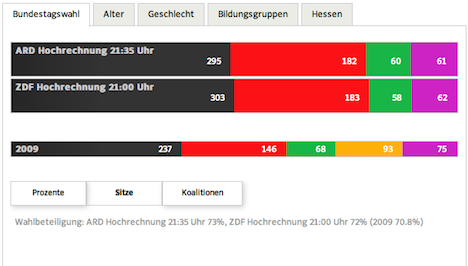
Projections are now divided between showing the CDU/CSU with 295 seats, just short of a majority, and with 303 seats, just barely a majority:

Screen Shot 2013-09-22 at 3.52.18 PM

We’re obviously going to have to wait to know the final numbers.  Keep in mind also that there’s still a chance that the eurosceptic AfD could still sneak into the Bundestag.


Germany (and Hesse) votes today!

What better way to kick off Germany’s election day — and the second full day of Oktoberfest in Munich — with Johannes Brahms’s ‘Academic Festival Overture,’ a loose assortment of what amounts to student drinking songs?Germany Flag Icon

Germany, with 80 million citizens, is the most populous member of the European Union, and it’s also the economic engine of Europe these days, for better or worse.

Angela Merkel, chancellor for the past eight years, is almost certainly likely to continue as chancellor, with her center-right Christlich Demokratische Union Deutschlands (CDU, Christian Democratic Party) and the CDU’s Bavarian sister party, the Christlich-Soziale Union in Bayern (CSU, the Christian Social Union), poised to win more than 10% to 15% more than the center-left Sozialdemokratische Partei Deutschlands (SPD, Social Democratic Party).

merkel2013

German voters will cast two ballots — for a local representative in each of 299 districts, plus the national ‘party vote’ for a political party to determine an additional 299 seats in the lower house of Germany’s parliament, the Bundestag.  The ‘party vote’ generally determines the proportion of seats that a party will hold in the Bundestag.

The drama comes down to whether Merkel will be able to continue her coalition with the liberal Freie Demokratische Partei (FDP, Free Democratic Party) — which is polling at around just 5%, the threshold to win seats in the Bundestag — or be forced back into a ‘grand coalition’ with the SPD.  Or, as I’ve argued at EurActiv, the third possibility is a historical ‘black-green’ coalition with Die Grünen (the Greens).

We’ll have a pretty good idea in about 10 hours of the universe of possibilities.

Between now and then, check out some of Suffragio‘s prior German election campaign coverage:

Photo credit to Alex Cole.

Close state election in Hesse could tilt federal Bundesrat further left

bouffier

While all of Germany goes to the polls on September 22 to elect a new national government, voters in the state of Hesse will also be choosing their own state government.hesse flagGermany Flag Icon

Although Hesse isn’t as large as Bavaria, which held its own state-level elections on September 15, exactly one week before the federal vote, the election in Hesse is as much a tossup as the national election is likely to be a certain win for German chancellor Angela Merkel.

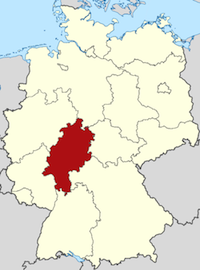
Hesse, a state in south-central Germany that borders both Bavaria and North Rhine-Westphalia, is home to Frankfurt, the financial center of Germany and in many ways the financial center of Europe.  With just over 6 million residents, Hesse is only the fifth-most populous state in Germany, but its role in the German economy means that the result on Sunday is important — its GDP per capita, on a regional basis, is Germany’s highest (except for the small city-states of Hamburg and Bremen). hessemap

It’s also important because the result of the Hessian election will determine five votes in the Bundesrat, the upper house of Germany’s parliament — a loss here on Sunday would leave the center-right with firm control of just 10 out of 69 votes in the upper house.  That would strengthen the parliamentary check that the center-left holds through its domination of the state governments that cumulatively determine the representatives to the Bundesrat.

It’s also a state where the two main center-right and center-left forces are balanced nearly equally in polls — the race is expected to be incredibly close.

Merkel’s Christlich Demokratische Union Deutschlands (CDU, Christian Democratic Party) has controlled Hesse’s government since the 1999 elections, when Roland Koch led the CDU into government alongside the liberal Freie Demokratische Partei (FDP, Free Democratic Party).

But things took a poor turn after a particularly brutal election in January 2008, after Koch and the CDU took a hard-right, anti-immigrant turn.  The CDU and the center-left Sozialdemokratische Partei Deutschlands (SPD, Social Democratic Party) essentially tied in that election — each won 42 seats in the 118-seat Landtag (state parliament).  With neither the CDU’s preferred coalition partner, the Free Democrats nor the SDP’s preferred partner, Die Grünen (the Greens), winning enough seats to form a stable majority, it left the democratic socialist Die Linke (the Left) holding the balance of power after it won 5.1% of the vote, enough to win (just barely) six seats, entering Hesse’s Landtag for the first time.

SPD leader Andrea Yspilanti ultimately decided to work with the Left — controversial for the party’s links to former communists in East Germany — but a revolt within the Social Democrats caused her attempts to fail and led to early elections in January 2009.  The Hessian electorate blamed the Social Democrats for the political crisis, and the SPD dropped 13% from its result just a year earlier, giving the CDU/FDP coalition a reprieve.

Koch stepped down as minister president in August 2010 to pursue business interests, handing over the reins to trusted acolyte Volker Bouffier (pictured above, left, campaigning with Merkel).  Bouffier previously served as Koch’s decade-long minister of the interior (and sport), embracing more robust surveillance and police techniques throughout the 2000s, which earned him the nickname, ‘Black Sheriff.’ Continue reading Close state election in Hesse could tilt federal Bundesrat further left

Your weekend cocktail-party glossary for the German election

Plakate zur Bundestagswahl

You’ve mastered the Syrian chemical weapons crisis, you’re ready for the showdown over the US government shutdown and the debt ceiling fight, and you’re ready to hit the party circuit this weekend, wit and pith at the ready.Germany Flag Icon

But wait! You’ve forgotten that Germany, the most populous and arguably the most important country in Europe, is going to the polls on Sunday to elect a new government.

You know that Angela Merkel, Germany’s chancellor for the past eight years, is likely to return for a third term chancellor, even though it’s less clear which governing parties will join her in coalition.

You know that her center-right Christlich Demokratische Union Deutschlands (CDU, Christian Democratic Party) holds a wide, double-digit lead over the center-left Sozialdemokratische Partei Deutschlands (SPD, Social Democratic Party).

And you know that, as far as elections go, it’s been a particularly boring one — even by the standards of Germany’s relatively muted consensus-driven politics.

But what else should you know about Sunday’s election?

Not to worry.  Here’s all the lingo you need to sound (and be) in the know about what’s likely to happen this weekend in Germany — and what might happen in its aftermath. Continue reading Your weekend cocktail-party glossary for the German election

Top German Green Party leader tagged with sensational sexual politics kerfuffle

tritten

The final weeks of the German election campaign have been marked by something less than substantive debate, what with the largest turn of events being center-left chancellor candidate Peer Steinbrück posing on the cover of a top news magazine giving German voters the bird.Germany Flag Icon

But with just six days to go until voting to determine the membership of the German Bundestag, the lower (and most important) house of its parliament, all eyes are on Jürgen Trittin and Die Grünen (the Greens) after a sensational story has put Trittin, a longtime Green leader, very much on the defensive.

The scandal involves a Green Party pamphlet from Göttingen in 1981 — just two years after the Greens formed as a political party — that Trittin approved and which called for the legalization of sex between minors and adults.  Trittin was a student at the time, one of five members of an editorial board that approved the manifesto, and claims not to have known the extent of the pamphlet.

Trittin, who served as the environmental minister in center-left chancellor Gerhard Schröder’s government between 1998 and 2005, today accepted full responsibility for the pamphlet and apologized for any minor role he played, which he claimed incorporated the stance of a radical gay rights group.

No one disputes the substantive content of the actual allegation, but it’s hard not to see the kerfuffle as a dirty trick against the Greens — family minister Kristina Schröder was quick to demand Trittin’s resignation, and other members of the center-right Christlich Demokratische Union Deutschlands (CDU, Christian Democratic Party) were also quick to attack Trittin and the Greens.  Alexander Dobrindt, the secretary-general of the CDU’s sister party in Bavaria, the Christlich-Soziale Union in Bayern (CSU, the Christian Social Union), called Trittin a front man for a ‘pedophilia cartel.’

Dobrindt himself is no stranger to controversy after calling on Greece to leave the eurozone last year during the heart of the eurozone’s financial crisis, and his CSU is the main force preventing the legislative adoption of marriage equality in Germany.

The CDU/CSU’s sanctimonious tone against Trittin is akin to demanding that Merkel to resign because of her now documented, minor involvement with the communist Sozialistische Einheitspartei Deutschlands (SED, Socialist Unity Party) as a young scientist in East Germany.  Even though Merkel had ties in her student days to the SED, so did most prominent East Germans, due to the nature of living in an authoritarian dictatorship in the 1970s and 1980s.  No one credibly believes that any minor collaboration should outweigh the role she played as a democratic activist in the late 1980s or doubt her legitimacy over two decades as a top policymaker in the reunified Germany.

But the Greens, which got their start as a radical leftist group and emerged from the new political movements of the 1970s, including the environmental movement, the pacifist movement and the sexual revolution, formally endorsed Germany’s anti-pedophilia laws in 1989.  The Green Party has been hit with charges of supporting pedophilia in the past, and it was Franz Walter, a political scientist investigation the party’s past affiliations with pedophile activists, who discovered to link to Trittin.

It’s also not difficult to understand why the CDU/CSU is brimming with such stern disapproval — the profile of the Green Party’s electorate has become older and wealthier over the past decade.  So if the latest scandal causes Green voters to think twice about their support (especially soft Green supporters), many of them will consider voting for the CDU or the CDU’s liberal junior coalition partner, the Freie Demokratische Partei (FDP, Free Democratic Party) instead of the center-left Sozialdemokratische Partei Deutschlands (SPD, Social Democratic Party).  That’s important — while the CDU/CSU leads the SPD by between 12 and 16 points in most opinion polls, the FDP is winning around 5% in polls, which is the threshold for winning seats in the Bundestag on the basis of proportional representation.

So in a world where the Green vote collapses, it would be much better for Merkel if the SPD gains a few more votes, so long as the FDP gains a few more votes (at least enough to win 5% of the electorate).

Given the state of the campaign, the Greens have already been doing a pretty good job of confirming their own irrelevance.  If it’s been a horrible campaign season for the SPD and the FDP, it’s not been an easy one for the Greens.  Polls show the Greens winning between 9% and 11% of the vote, and markedly less than the 20% to 25% that polls showed the Greens winning in much of 2011 — after the Fukushima nuclear meltdown in Japan but before Merkel announced her support for phasing out Germany’s nuclear energy. Continue reading Top German Green Party leader tagged with sensational sexual politics kerfuffle

FDP shut out of Bavarian parliament, CSU wins absolute majority

horst

The result of today’s state elections in Bavaria has both good news and bad news in terms of Angela Merkel’s hopes to win a third term as chancellor in exactly one week.bavarian_flag_iconGermany Flag Icon

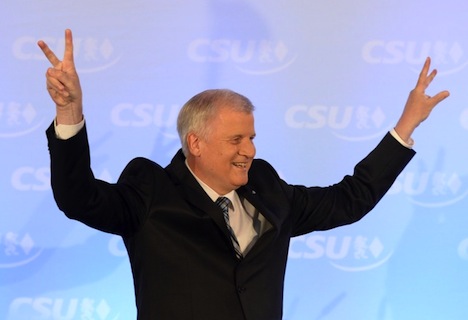
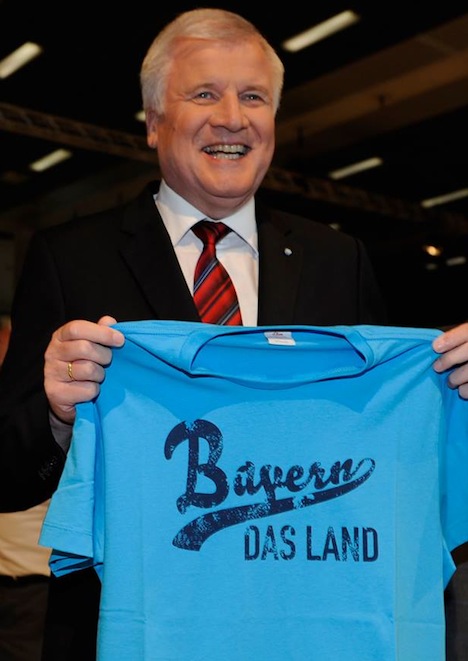
With results still coming in, the center-right Christlich-Soziale Union in Bayern (CSU, the Christian Social Union) will improve vastly upon its historically poor result in the prior September 2008 election, giving Bavaria’s minister president Horst Seehofer (pictured above) an absolute majority in the 187-member Landtag, Bavaria’s unicameral state parliament.

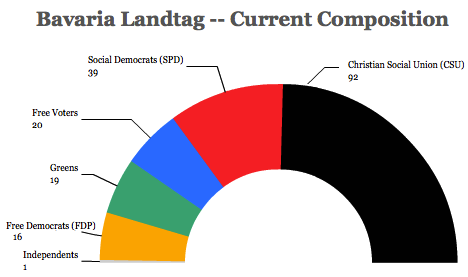
The current projection gives the CSU 101 seats, with just 43 seats for the center-left Sozialdemokratische Partei Deutschlands (SPD, Social Democratic Party) and 18 seats each for Die Grünen (the Greens) and the center-right group of independents, the Freie Wähler (FW, Free Voters).

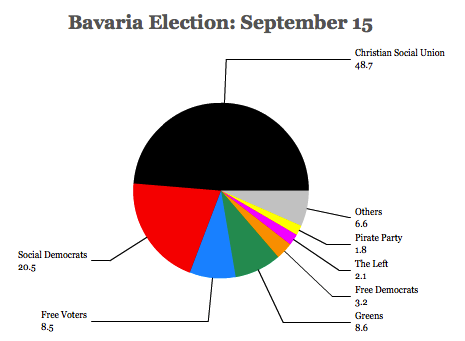
Here’s the latest snapshot of the result:

bavaria2013

That’s great news for the CSU, which has controlled Bavaria’s state government consecutively since 1947.  The Bavarian-based CSU is the sister party of Merkel’s Christlich Demokratische Union Deutschlands (CDU, Christian Democratic Party), which competes everywhere else in Germany, and the two parties work together as a union for federal political purposes.  So the fact that the CSU increased its support by over 5% in what was already a center-right heartland is a sign that Merkel will be able to drive up the number of seats that the CDU/CSU will win in next week’s federal elections.

It’s an amazing turnaround for the CSU, which won less than 44% five years ago and was polling just 40% as recently as 2010.  It’s a huge win for Seehofer personally as well, given that his personality dominated the CSU’s presidential-style campaign, the same tactic that Merkel and the CDU have deployed for next week’s federal elections.  It puts Seehofer alongside recent CSU leaders who have dominated Bavaria’s recent past, such as Franz Josef Strauß in the 1970s and 1980s and Edmund Stoiber in the 1990s and 2000s.  Given the relative strength of the Bavarian economy vis-à-vis Germany and, especially vis-à-vis Europe, the CSU’s win is not surprising — Bavaria’s reputation long ago solidified its image as the land of laptops und Lederhose.

But it’s horrible news for the liberal Freie Demokratische Partei (FDP, Free Democratic Party), which won just 3.2% today, falling far short of the 5% threshold required to win seats in the Landtag.

Seehofer and the CSU depended on a governing coalition with the Free Democrats for the fast five years, and Merkel and the CDU/CSU govern in coalition with the Free Democrats at the federal level as well.  Since riding a wave of popularity in the late 2000s (the Free Democrats won nearly 15% of the vote in the 2009 federal elections), its public support collapsed shortly thereafter.  After a series of poor performances in state elections, foreign minister Guido Westerwelle stepped down as the party’s leader.  But its new leader Philipp Rösler, Germany’s first Vietnamese-born party leader, has hardly done much better.  Under his leadership, though, the Free Democrats actually gained support in two key state-level votes — in the May 2012 North Rhine-Westphalia election and the January 2013 Lower Saxony state elections.

The FDP’s loss in Bavaria comes at a devastating time, however.  Seehofer and the CSU in Bavaria will no longer need a coalition partner, but that’s not likely to be the case for Merkel next week, so Merkel needs the Free Democrats to perform much better nationwide in seven days.  While Merkel’s CDU/CSU widely leads in the polls in advance of next week’s federal election, Merkel is unlikely to win the kind of outright majority that Seehofer won today (because the rest of Germany tilts further to the center and to the left than the Catholic, socially conservative Bavaria).  Just as for Bavaria’s state elections, there’s a 5% threshold for winning seats on the basis of proportional representation in the Bundestag, the lower house of Germany’s national parliament, and polls show the Free Democrats treading at about 5% support nationally.

So if the Free Democrats win less than 5% next week, Merkel will be forced to look to other alternatives: an unstable minority government, return to a ‘grand coalition’ with the rival Social Democrats or a more creative solution, such as a ‘black-green’ coalition with the Greens.  Even if the Free Democrats win more than 5%, their ranks are likely to be so decimated that Merkel may be forced into an alternative anyway.  Continue reading FDP shut out of Bavarian parliament, CSU wins absolute majority

What is Helmut Kohl thinking by endorsing the FDP in Germany’s elections?

kohl

In an election campaign with few twists and even fewer turns, leave it to a blast from Germany’s past to shake up politics just 12 days before Germans head to the polls.Germany Flag Icon

In a move that seems baffling at first glance, former chancellor Helmut Kohl spent the weekend welcoming Rainer Brüderle, a former economics and technology minister, and Philipp Rösler, the vice minister for economics and vice chancellor, and the leader of the Freie Demokratische Partei (FDP, Free Democratic Party), to his home — and indicating that he was all but endorsing the FDP in elections later this month.

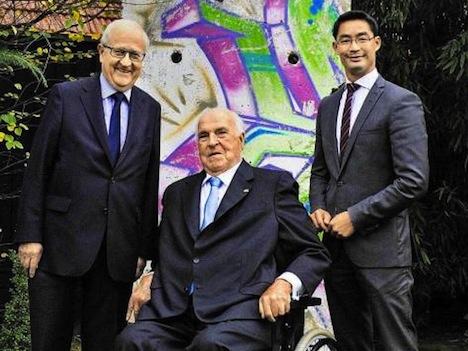
It’s odd for many reasons, not least of which because Kohl (pictured above, center, with Brüderle left and Rösler right), the longest-serving chancellor since Otto von Bismark, was the longtime leader of the center-right Christlich Demokratische Union (CDU, Christian Democratic Union) that chancellor Angela Merkel now leads.  Kohl, now age 83, has been out of frontline politics since 1998, when he lost his bid for reelection.  Among Kohl’s top accomplishments are vital roles in engineering both the reunification of West and East Germany and the development of the European single currency.

So what is Kohl up to?

There are a handful of reasons why Kohl might be campaigning so openly for the Free Democrats in the last stretch of the campaign, but none are as compelling as the explanation that Kohl is actually doing Merkel and the CDU a huge favor by boosting their coalition partners.

The Free Democrats are the junior partners in Merkel’s governing ‘black-yellow’ coalition, and though Merkel would prefer to continue governing alongside the Free Democrats, their support has dropped so low that it risks missing the 5% threshold necessary to win seats in the Bundestag, the lower house of the German parliament.  With the Christian Democrats holding a consistent double-digit lead over the center-left Sozialdemokratische Partei Deutschlands (SPD, the Social Democratic Party), and with voters preferring Merkel with a two-to-one margin over Social Democratic chancellor candidate Peer Steinbrück, there’s not much risk that the CDU will lose on September 22 — together with its Bavaria sister party, the Christlich-Soziale Union in Bayern (CSU, the Christian Social Union).

So if Kohl can bring a few crossover voters from the CDU to support the FDP, he can help guarantee that the Free Democrats make it back into the Bundestag with at least a minimum of seats, therefore facilitating the possibility that Merkel can continue her preferred coalition in a third term without resorting to a grand coalition with the Social Democrats (as she did from 2005 to 2009).  Crazy like a fox.

It’s a dangerous game, though, because there is some risk in that strategy.  Steinbrück delivered a strong performance in last week’s debate with Merkel and while it hasn’t helped him in the polls so far, the race could tighten in the closing days.  Moreover, the newly formed Alternative für Deutschland (AfD, Alternative for Germany), the country’s first eurosceptic party could steal votes from Merkel on the right, and it’s the one party that’s gaining in polls over the past week — it could even hit the 5% threshold to enter the Bundestag.  But at this point, with less than two weeks to go, a massive change would require a year’s worth of stubborn German public opinion to transform virtually overnight.  So it’s a risk that Kohl — and likely even the cautious Merkel — are probably happy to take.  Continue reading What is Helmut Kohl thinking by endorsing the FDP in Germany’s elections?

Green is the new black: making the case for a Merkel-led CDU-Green coalition

greenmerkel

I argue in EurActiv this morning that the most stable possible coalition for chancellor Angela Merkel after Germany’s September 22 federal elections might be a coalition between Merkel’s Christlich Demokratische Union (CDU, Christian Democratic Union) and the increasingly centrist Die Grünen (the Greens):

The possibility, long been referred to as a ‘Jamaica’ coalition because the colors of the three parties are those of the Jamaican flag — black (CDU), yellow (FDP) and green, has never happened in the Bundestag.  State-level examples aren’t promising – Germany’s first ‘Jamaica’ coalition in Saarland collapsed after just 26 months later, and a purely ‘black-green’ coalition in Hamburg didn’t fare much better between 2008 and 2010, ending after difficulties enacting education reforms.

While it’s still more likely that Merkel will try to continue her current coalition with the liberal Freie Demokratische Partei (FDP, Free Democrats), the FDP is polling so poorly that it may not even return to the Bundestag — if it does, it will be with far fewer seats than the 93 seats it won in the previous election.  The likeliest alternative is another ‘grand coalition’ with the center-left Sozialdemokratische Partei Deutschlands (SPD, the Social Democratic Party), but given the difficulty that the SPD has had in drawing contrasts with Merkel since the 2005-09 coalition, there’s reason to believe another ‘grand coalition’ would be tumultuous and likely to end with early elections.

A CDU-Green union could give Merkel the best of both worlds — a more stable majority than the FDP and a more reliable coalition partner than the SPD….

Merkel’s 2011 decision to phase out nuclear energy and to boost solar, wind and other forms of renewable energy made her an immediate ally of the Greens on their top policy priority, clearing what had been the chief obstacle to a CDU-Green partnership.  Otherwise, the Greens have long been among the most pro-European of Germany’s political parties, and former Green leader and foreign minister Joschka Fischer championed greater European federalism.

It’s not to say there aren’t problems with the idea, and there’s still a leftist contingent that would be appalled by a partnership with Merkel.  During the campaign, the Greens have called for a tax increase of up to 49% for the top rate and for an additional 15% wealth tax, and it’s unlikely Merkel’s CDU would agree to anything like that.

The Greens have always been split between fundi (fundamentalist / leftists) and realo (realistic / moderate) wings.  But the radical 1960s-era Green leadership has given way to a more moderate leadership, personified by Katrin Göring-Eckardt, one of two Green chancellor-candidates and Cem Özdemir, a son of Turkish immigrants.

Even the more leftist Jürgen Trittin, the other Green chancellor-candidate, has espoused relatively centrist views.  Meanwhile, Claudia Roth, the most stridently leftist Green leader, placed last in the race to determine who should represent the Greens in this year’s election.

Perhaps the most promising sign for a ‘black-green’ coalition is the level to which Greens have governed pragmatically at the state level.  Although the Greens came to power in the southwestern state of Baden-Württemberg two years ago largely on the basis of opposition to the ‘Stuttgart 21’ underground train station project, it is now Green minister-president Winfried Kretschmann working with SPD allies and business interests to develop it.

Demographic data also favors a ‘black-green’ coalition:

Polling data shows that the Green electorate isn’t incredibly dissimilar to the upper-class, middle-aged CDU electorate — and nearly half of them already prefer Merkel for chancellor.

It’s not that it’s the likeliest coalition to emerge on September 23, but the chances of a ‘black-green’ government are currently underreported.

Here’s more on Germany’s upcoming elections from Suffragio, including:

Bavarian elections provides Merkel, CSU a dress rehearsal for federal German vote

seehofer Exactly one week before Germans go to the polls to choose between center-right chancellor Angela Merkel and her center-left challenger Peer Steinbrück, Bavarian voters will elect its local state government in a key test for Merkel’s regional allies.Germany Flag Iconbavarian_flag_icon

The outcome isn’t incredibly doubtful because since 1947, Bavaria’s staunchly Catholic, business-friendly, socially conservative Christlich-Soziale Union in Bayern (CSU, the Christian Social Union) has controlled the 187-seat Landtag, the state legislature of Germany’s second-most populous state.

Given that the state has one of Germany’s — and Europe’s — best economies, the CSU looks set to strengthen its hold on Bavarian government in what amounts to a test run of many of the arguments that Merkel hopes will power her Christlich Demokratische Union Deutschlands (CDU, Christian Democratic Party) to victory on September 22 alongside the CSU, which has been united with the CDU in federal politics for decades.  Merkel, who currently governs in an alliance with the liberal Freie Demokratische Partei (FDP, Free Democratic Party), hopes that voters will give her credit for steering Germany — and the entire eurozone — through the worst of a sovereign debt crisis that began in 2010 and an economic recession from which Europe may already be recovering.

But the CSU and Bavaria’s minister president Horst Seehofer (pictured above) can make an even more sanguine case on the basis of the Bavarian economy, which showcases several star multinational corporations, such as BMW, Siemens, and adidas.  Whereas the European Union had an average unemployment rate of 10.4% in 2012 and Germany had an unemployment rate of 5.5%, Bavaria’s was just 3.2%.  To consider just how staggering that is, consider that United States last had an unemployment rate that low in October 1953. It’s an economy that, at around  €465 billion ($610 billion), is about as large as the economy of the US state of Pennsylvania and even larger than the entire economy of Saudi Arabia, and nearly 1.5 times the size of the economy of neighboring Austria.

If the CSU is successful on September 15, it will mark a rebound from the previous September 2008 election, the CSU’s worst performance since 1954.  Five years ago, Bavarian voters went to the polls in the middle of an uncertain future, with the collapse of US financial firm Lehman Brothers and a global financial panic topping world headlines.  It was also a period of uncertain leadership within the CSU, Bavarian minister-president Edmund Stoiber resigned after 14 years in office following the resignation of his chief of staff, Michael Höhenberger, which itself followed accusations that Höhenberger snooped on the private life of one of Stoiber’s critics.  Günther Beckstein, Stoiber’s longtime interior minister, succeeded Stoiber and led the CSU through the 2008 election, but stepped down following the CSU’s historic loss.

Even though the CSU won just 43.4% of the vote (a drop of over 17% from its prior performance) and lost its absolute majority in the Landtag, it remained the largest party in Bavaria by far, outpacing the second-place Sozialdemokratische Partei Deutschlands (SPD, Social Democratic Party) by nearly 25% of the vote and Seehofer, a former health and food minister, easily won election as Bavaria’s minister-president in October 2008.

As the CSU and the SPD both suffered historic losses, two additional groups on the Bavarian right made extraordinary gains.  The first is the Freie Wähler (FW, Free Voters), a bloc of independent, unaffiliated center-right deputies, which won 10% of the vote, largely from disappointed CSU supporters, and entered the Bavarian Landtag for the first time.  The second is the FDP, which won 8% and 16 seats, returning to the Bavarian legislature for the first time in 14 years and providing the CSU with a stable coalition partner in Munich.  Even the socialist Die Linke (The Left) competed for the first time and won 4.3%, impressive in a state as conservative as Bavariabavaria Five years later, although polling data isn’t as ubiquitous for Bavaria’s state election as for the wider federal German elections, the CSU is polling higher than in 2008, and it may win over 50% of the vote, restoring the absolute majority that it enjoyed in the Landtag without interruption from 1962 to 2008. That’s good news for Seehofer, because the FDP is faring as poorly in Bavaria as it is in federal polling — the Free Democrats are in danger of missing the 5% threshold required to win seats in the Bavarian Landtag (and in the federal Bundestag as well).  Meanwhile, the Social Democrats are in danger of setting a new postwar low in Bavaria on September 15 and in federal elections a week later — it’s polling at around 18% in Bavaria, which is even worse than its 2008 result (18.6%).  Continue reading Bavarian elections provides Merkel, CSU a dress rehearsal for federal German vote

Assessing the potential coalitions that might emerge after Germany’s federal elections

roslerFDP

With now less than 40 days to go until Germany’s federal elections, polls show that chancellor Angela Merkel is by far the most popular candidate to return as chancellor and her party, the Christlich Demokratische Union (CDU, Christian Democratic Union), will clearly be the largest bloc in Germany’s Bundestag after the election. Germany Flag Icon

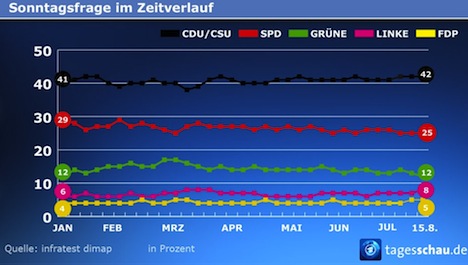
Polls have been remarkably consistent throughout much of the year leading up to the September 22 vote.  The center-right CDU, together with its Bavarian sister party, the Christlich-Soziale Union in Bayern (CSU, the Christian Social Union), overwhelmingly leads Germany’s largest center-left party, the Sozialdemokratische Partei Deutschlands (SPD, the Social Democratic Party), and voters overwhelmingly prefer Merkel to the SPD’s candidate for chancellor, Peer Steinbrück — by a nearly two-to-one margin.  Here’s the trendline from Infratest dimap, which released its latest poll this week:

chancellorgraph

This week’s news that Germany leads GDP growth in the eurozone, which itself pulled out of recession in the second quarter of 2013, will only buoy Merkel’s chances.  Barring a huge shift in public opinion that has only calcified over the past year, Steinbrück, a bland technocrat who comes from the right wing of the SPD and who served as finance minister in the ‘grand coalition’ government of 2005 to 2009, will lead the SPD to a loss of nearly historic proportions.  But while that means Merkel is very likely to return as chancellor, the composition of Merkel’s third government is less certain.

That’s because support for Merkel’s current coalition partners, the free-market liberal Freie Demokratische Partei (FDP, Free Democratic Party), has collapsed since the previous September 2009 election, when it won 14.6% of the vote and 93 seats in the Bundestag, a record-high electoral performance for the party.  But since 2009, the FDP has struggled to maintain a presence in local Germany elections, losing support in state after state.  Its decade-long leader Guido Westerwelle, the first openly gay party leader in German history, stepped down in April 2011 as party leader and vice chancellor (though he remains foreign minister) after the FDP won barely 5% in the state elections of Baden-Württemberg.  His successor as FDP leader is the Vietnamese-born Phillip Rösler (pictured above), who began his career in Lower Saxony (Niedersachsen) and who had served previously as health minister in the CDU/FDP coalition government from 2009 to 2011.

Although Rösler has not lifted the FDP back up to its 2009-level heights, he has managed to staunch the party’s decline.  In the May 2012 elections in North Rhine-Westphalia, Germany’s most populous state, the FDP managed to win 8.6% of the vote, an increase of nearly 2% from the previous election, though that’s largely due to the popularity of Christian Lindner, who led the FDP’s 2012 campaign.  More recently, though, in Lower Saxony’s state election in January 2013, the FDP won 9.9% of the vote, a gain of 1.7%.

It’s also because Germany’s electoral system is notoriously complex.  Germans will actually cast two votes in September — the first is for a candidate to represent one of 299 electoral districts in Germany, the second is for a German political party.  The second ‘party vote’ is meant to determine the party’s ultimate total share of seats in the Bundestag, and so a party will receive additional seats on the basis of the party vote sufficient to provide that its percentage of seats in the Bundestag is roughly equal to the percentage of votes it received pursuant to the party vote (so long as the party receives at least 5% of party vote support).  That means that the number of seats in the Bundestag changes from election to election — although it must have a minimum of 598 seats, it has had as few as 603 and as many as 672 since German reunification.

The FDP has struggled all year long to achieve merely 5% support in opinion polls and, while it’s doing better in polls than it was at the beginning of the year, there’s no guarantee that it will meet that threshold:

trendline2013germany

That means that, more than anything else, the composition of Germany’s next government turns on the FDP’s performance.  If it wins less than 5%, Merkel will not have the option of continuing a coalition with the FDP.  Moreover, even if the FDP wins more than 5%, it may still not win enough seats to cobble together a CDU/FDP majority in the 598-member Bundestag.

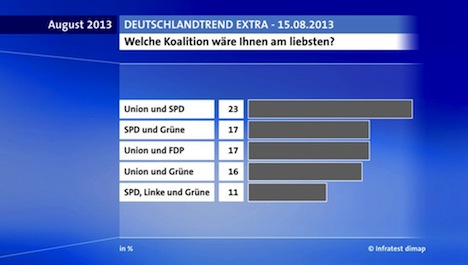
Furthermore, polls show that while German voters overwhelmingly prefer Merkel as chancellor, they actually favor a return to the CDU/SPD grand coalition, more than the current CDU-led government or a potential SPD-led government:

preferredcoalitions

Two additional coalitions — a CDU/Green government and a united left coalition among the SPD, Green and Die Linke (the Left Party) — also win significant support.

But what are the chances that any of these five coalitions will actually emerge after September 22?  Here’s a look at each potential coalition and the chances that it could form Germany’s next government.

CDUpreferredcoalitionThe current government: CDU/FDP.

Merkel prefers to continue her current coalition over any alternative because her political agenda matches well with the FDP’s political agenda.  Any negotiations between Merkel and the SPD or the Greens would entail huge concessions from Merkel that she would not otherwise have to make in coalition with the FDP.  But, as noted above (and as represented in the graph to the right, on the basis of current polls), it’s unclear if that coalition can win a majority.

Under Rösler’s leadership, the FDP is running on a campaign of lower taxes and liberalizing Germany’s economy, which is standard Free Democratic fare, and both the FDP and Merkel’s CDU oppose new tax increases.  Their largest policy difference might be same-sex marriage — the FDP supports it and the CDU (and especially the Catholic-influenced CSU) oppose it, although the FDP has taken a much stronger stand on privacy rights than Merkel’s CDU.

Even if they win enough seats to form a majority, no one expects the margin to be larger than the government’s current 21-seat margin.  So even a single-digit majority could turn out to be a Pyrrhic victory if Merkel finds herself forced to look outside her own government to enact her legislative agenda on an ad hoc basis, especially with respect to European Union matters, given the sometimes eurosceptic nature of many CSU deputies.  That’s hardly a recipe for stable government.

Polls in August show that together, the current government will win between 44% and 47% of the vote if the election were held today.  Unfortunately, that doesn’t give us much of an idea about whether they’ll have enough support in the Bundestag to form a majority.  Since reunification, Germany has held only six federal elections — they’ve resulted in three CDU-led governments, two SPD-led governments and a single CDU-SPD grand coalition. Continue reading Assessing the potential coalitions that might emerge after Germany’s federal elections