Category Archives: European Union

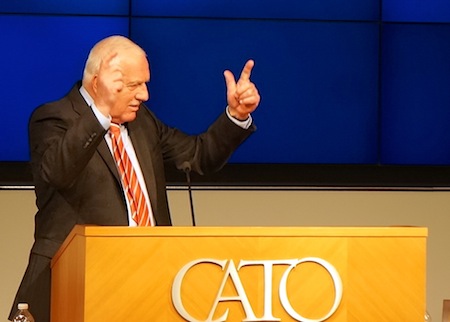
Václav Klaus, fresh from Czech presidency, discusses eurozone in Washington

klauscato

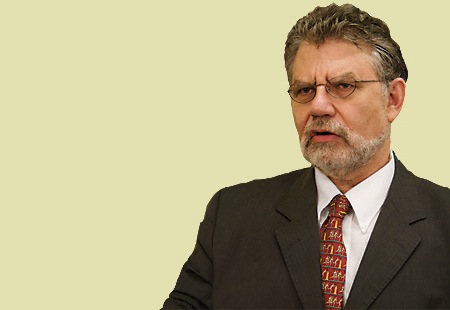
Just three days after leaving the Czech presidency, Václav Klaus spoke at the Cato Institute in Washington earlier today — Klaus is joining Cato as a senior distinguished fellow this spring.czechEuropean_Union

Klaus, who stepped down after a decade in office, didn’t break much new ground — his remarks were essentially everything you’d expect from the famously euroskpetic former president, who was the last European Union head of state to sign the Treaty of Lisbon (and quite reluctantly, at that).

The great eurozone fight

In brief, Klaus has long argued that the eurozone is not an optimal currency zone, it’s a project that was implemented without sufficient democratic input from everyday Europeans, and the economic costs of monetary integration and centralization far outweigh the benefits, and those costs have become increasingly evident from the economic pain suffered today in Greece, Spain, Italy and throughout Europe.

Klaus’s diagnosis has become fairly uncontroversial — both on the left and the right, and for both intergovernmentalists and neo-functionalists alike.  A lot of European federalists would agree that the European Union needs more robust democratic institutions at the supranational level.  Many economists agree that the one-size-fits-all monetary policy has been incredibly harmful to many countries in southern Europe since 2008, and the painful internal devaluation forced upon many countries in the European periphery, from Latvia to Greece, has been a needless exercise in poor economic policymaking.

But whereas many economists would argue that the solution lies in greater fiscal harmony (especially through fiscal transfers from wealthier regions to poorer regions), looser monetary policy, a eurozone-wide borrowing capacity, debt forgiveness and a doubling-down on the more long-standing commitment to the free movement of goods, services and people throughout the European Union, Klaus’s solution is to unwind the eurozone.

Klaus would rather see a way for Greece — and other troubled economies — to simply exit from a eurozone that’s delivered now nearly half a decade of GDP contraction, painful downward pressure on income, and widespread unemployment and social rupture.

That’s not a crazy idea economically — if Greece could leave the eurozone tomorrow (or if Greece simply went bankrupt, thereby essentially forcing Greece out of the eurozone), it could conceivably pursue a much more aggressive monetary policy, devalue its currency, and take other steps to make its exports more competitive in global markets once it’s no longer yoked to a monetary policy that’s better suited for, say, the German economy.

But that’s not the entire story.  Greece might also suffer extraordinarily in the short-run while it makes that transition — starting with how it would reintroduce the drachma and how it would even finance basic governance outside the current eurozone regime, forcing perhaps even more austere budget-cutting in a country where the social safety net is already tattered.

And those are just the problems inside Greece — though the Greek economy is just a fraction of the European economy, it could set off a chain reaction of fear, bank runs and deep recession throughout the eurozone as investors pull out of not only the peripheral economies, but also out of the entire eurozone.  How would a massive Greek devaluation affect Cyprus? Would Spain and Italy withstand the inevitable bank runs and currency flight? The chain reaction of unraveling one of the world’s foremost reserve currencies could well be catastrophic.

Looking to national parallels: the Czechoslovak breakup and German reunification

Klaus related the current monetary union to the breakup 20 years ago of Czechoslovakia into two separate nations — a process that Klaus said was painful though necessary (though the Slovak economy is doing much better these days than the Czech economy).  But Greeks might be troubled by the more painful example of the breakup of the Yugoslav federation and the Soviet Union, both of which were also monetary unions as well as political unions.  The breakup of the ‘ruble zone’ led to massive hyperinflation throughout the Soviet Union and an economic shock that cut standard of living in half.  There’s simply no way to know what forces could be unleashed by the process — no matter what anyone says, there’s not a precedent for unraveling even a tiny part of the world’s largest currency union in an orderly fashion.

I would have liked to hear, in particular, Klaus’s thoughts on another contemporary experiment in currency union: German reunification.

Continue reading Václav Klaus, fresh from Czech presidency, discusses eurozone in Washington
‘La bataille des chiffres’: EU leaders agree new budget deal

EUbudget

Guest post by Michael J. Geary

European Union leaders reached agreement Friday on the EU budget (the multi-annual financial framework or ‘MFF’) for the period from 2014 to 2020.European_Union  After months of bickering, the 27 member states signed off on a deal totaling €908.4 billion, and the European Parliament will vote on the budget in March.

The budget is geared towards two — some would say conflicting — goals and political constituencies.

On the one hand, politicians argued that spending should be mobilised to support growth, employment, competitiveness and convergence, in line with the Europe 2020 Strategy. At the same time, some EU leaders in the United Kingdom, Germany and in the Netherlands, made clear that ‘as fiscal discipline is reinforced in Europe, it is essential that the future MFF reflects the consolidation efforts being made by Member States to bring deficit and debt onto a more sustainable path.’  The result is a smaller budget than was agreed for the previous budgetary period (2007 to 2013), yet one that is expected to achieve greater results to help pull the EU out of its economic malaise. A ‘spend less, achieve more policy’ strategy in an era when one in four Spaniards are unemployed seems doomed to fail.

The result, however, is not wholly surprising. Over the last four years, austerity and cuts in public spending have become commonplace throughout the EU, so it should come as no shock that the EU institutions should also tighten their belts.

Speaking after the negotiations concluded, German chancellor Angela Merkel said, ‘The agreement is a good agreement as it gives predictability for investors to create growth and jobs.’  José Manuel Barroso, the European Commission president, no doubt privately disappointed with the outcome, publicly voiced support for the deal saying the budget was ‘an important catalyst for growth and jobs.’

UK prime minister David Cameron can also be very pleased with the result, given that the agreement marks the first time in the history of the EU that its budget has been scaled back.  Cameron had gone to Brussels threatening to use the veto if leaders failed to make savings in real terms. He singled out the exorbitant salaries paid to some of the EU’s top officials, some of whom earn close to €15,000 per month and are taxed at just 8%. During the last five years, national-level tax increases have been imposed in addition to freezes on public and private sector pay, while officials working in the EU institutions have escaped austerity.  Cameron was determined, during the talks on the budget, to cut administrative costs despite opposition from French and Polish leaders who feared any cuts to the EU budget would affect generous subsidies to farmers and structural and cohesion funds.

Cameron was clearly relieved that his call for budgetary reductions met with friendly ears at least among some EU colleagues.  Over the past twelve months, he had been busy building a coalition among the Dutch, German and Scandinavian member states (the EU’s main paymasters) to reduce the budget in real terms.

Although Cameron and Merkel may well find themselves at odds over the UK’s role in the EU over the next five years, with Cameron determined to ‘renegotiate’ its role and Merkel equally determined to forge ever closer fiscal and political union, budget politics may have been a useful vector to find common ground.  Indeed, Merkel and Dutch prime minister Mark Rutte ultimately became strong supporters of London’s push to force austerity on the EU itself.  The unlikely emergence of the Anglo-German alliance was perhaps the most intriguing element of the negotiations. Continue reading ‘La bataille des chiffres’: EU leaders agree new budget deal

Clarke’s pro-Europe tone highlights referendum risk to UK Tories from the center

kenclarke

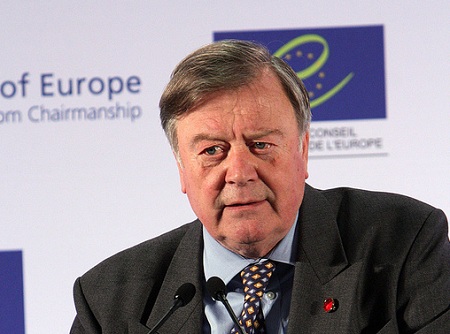
Longtime senior Conservative Party grandee — and former chancellor of the exchequer — Kenneth Clarke (pictured above) in no uncertain terms yesterday said that a British exit from the European Union would be a disaster.United Kingdom Flag IconEuropean_Union

That Clarke is pro-Europe is certainly not a surprise.

As former prime minister John Major’s chancellor from 1993 until the fall of the Tory government in the 1997 Labour electoral landslide, Clarke was the most prominent pro-European in Major’s government — at one point, Clarke was even in favor of the United Kingdom joining the eurozone.  When Major’s government irreparably fractured over divisons on the UK’s role with respect to Europe, Clarke was most certainly the top general of the pro-European faction.

So it’s not a shock to see Clarke joining forces with Peter Mandelson, the former Labour veteran, and others for a cross-party effort to boost the United Kingdom’s continued presence in the European Union:

“There’s a broad range of opinion inside the [Conservative] party. The number of people who actually want to leave the European Union; it’s quite tiny. They get a disproportionate amount of attention. My guess is that there are about 30 who want to leave and when we first joined the European Community I think there was slightly more than that.”

He warned that it would be “pretty catastrophic” if Britain left the EU and said he was now resigned to fighting a referendum on the issue if the Conservatives win the next election.

“The background climate in this county has become … unremittingly hostile. I think somebody has got to make the positive case again. The climate of public opinion just needs to be reminded how essential it is if we really want the UK to play a part in the modern world,” he said.

But it’s another headache for UK prime minister David Cameron, who announced in a widely anticipated speech last week that he would seek to renegotiate the United Kingdom’s role in the EU and, thereupon, call a referendum on the UK’s continued membership by 2017 (obviously depending on the reelection of the Tories in the 2015 general election).

Clarke’s outspoken support shows just how difficult Cameron’s balancing act on Europe has become — and it will only be more difficult as a potential referendum approaches. Continue reading Clarke’s pro-Europe tone highlights referendum risk to UK Tories from the center

From Heath to Wilson to Thatcher to Cameron: continuity in EU-UK relations

heathmaggy

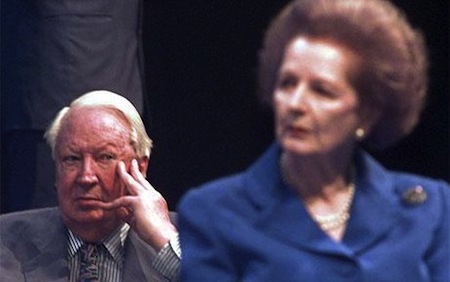
My friend and colleague, Dr. Michael J. Geary, and I, are in The National Interest today with a even-further revised piece on the history of relations between the United Kingdom and the European Union (pictured above are former prime ministers Edward Heath and Margaret Thatcher).United Kingdom Flag IconEuropean_Union

In particular, we continue to argue that British participation in the EU — including UK prime minister David Cameron’s latest speech demanding a renegotiation of the UK’s position in the EU and a straightforward in/out referendum by 2017 — must be viewed within the long context of the tumultuous 40-year history of UK-EU relations:

But even as the Eurozone accepts that deeper union is necessary to make the single currency workable, it’s unclear that in the reality of today’s “multi-speed Europe,” Cameron would need to renegotiate anything in order to retain the fiscal prerogative at home—just 22 days ago, the “fiscal compact” took effect through much of the rest of the EU, despite Cameron’s refusal to ratify it.

That’s why Europe should view Cameron’s speech not only in the narrow context of right-wing domestic politics or fiscal sovereignty, but within the wider scope of Britain’s troubled relationship with European integration. Ideally, Britain wants a European-wide free-trade area without the supranational institutional apparatus, something it proposed during the 1950s. Yet unless the euro implodes, that’s not the future of the EU.

Photo credit to Paul Grover.

Europe concedes Cyprus default less than a month before presidential election

bankofcyprus

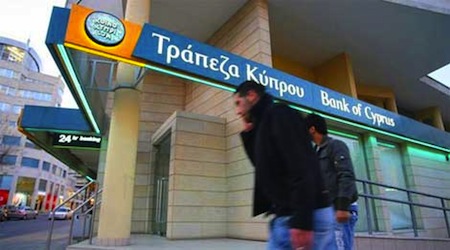
Felix Salmon has a tantalizing tidbit about Olli Rehn, European commissioner for economic and monetary affairs, apparently conceding that a Cypriot default is now virtually inevitable, less than a month before the Cypriot presidential election:European_UnionGreece Flag Iconcyprus_world_flag

EU economics commissioner Olli Rehn went on the record telling him that Cyprus is going to have to restructure its debt — just two weeks after ruling such a thing out.

That might come as little surprise, given that Cypriot banks were loaded up to the gills with Greek debt, and Greek debt suffered a 70% haircut. Cyprus is tiny, and could never afford the €17 billion needed to bail out the banks and the government — especially since that would bring the country’s debt load up to more than 140% of GDP.

Salmon cites a report from The Wall Street Journal‘s Stephen Fidler reporting from Davos.

The Republic of Cyprus, with just over 800,000 people, is the third-smallest member of the eurozone (after Malta and Luxembourg), and it’s a relative newcomer to the single currency, having replaced the Cypriot pound for the euro only in January 2008, although the Turkish-controlled northern part of the island still uses the Turkish lira.

The country accounts for just 0.2% of the eurozone economy, though its GDP per capita is a relatively wealthy $29,000, and it’s been in negotiations for a bailout for some time now.  That hasn’t yet been successful, in part because of the unique legal, political and financial complexity of the negotiations.

Rehn’s statement, if true, is essentially a declaration that time has run out — Moody’s downgraded Cypriot debt in July 2011 to junk status.

Nonetheless, a €17 billion bailout would be dwarfed by the Greek bailout (€245.6 billion), the Spanish bailout in July 2012 to provide liquidity to Bankia (€41 billion), and even the bailout provided by the ‘troika’ of the European Commission, the European Central Bank and the International Monetary Fund of Romania that began in 2009 (around €20 billion).

In many ways, a Cypriot default will be a key test for the European Union, given that it would be the first default since the treaty establishing the European Stability Mechanism formally came into effect at the end of September 2012.

Unlike in Greece, where much of its debt is governed by Greek law, much of Cypriot debt is governed under various international law, which will make it a messier restructuring.

Keep in mind, also, that the island of Cyprus remains split between the Republic of Cyprus (largely populated by Greek Cypriots) and the Turkish-occupied northern half of the island, the Turkish Republic of Northern Cyprus (largely populated by Turkish Cypriots).  The island has been divided since a 1974 coup, Greece’s attempt to annex the entire island, and Turkey’s subsequent invasion, and the formal declaration of Northern Cyprus’s independence in 1983.

Add to that the fact that Cyprus is seen as a hub for worldwide money laundering, especially with respect to illicit funds from Russia, despite the protestations of Panicos Demetriades, president of the Central Bank of Cyprus, earlier this week.

That means bailout proceeds could go directly into the pockets of some of Russia’s wealthiest oligarchs, a position that’s unlikely to go down well politically throughout the rest of the eurozone, especially as Germany gears up for federal elections later this year — German officials have even demanded that Russia contribute to any Cypriot bailout.

Meanwhile, Cyprus will go to the polls in less than a month to replace Demetris Christofias, the country’s left-wing president since 2008.  Unlike in many European countries with parliamentary systems, Cyprus’s president is both head of state and head of government.

With a default (orderly or otherwise) on the horizon, Cyprus now faces a presidential election on February 17 — with a runoff, if necessary, a week later on February 24 — in the midst of a financial crisis and perhaps in the midst of bank runs.

Christofias, who has presided over economic turmoil and an unemployment rate that’s now at 14%, has so far refused to engage in massive privatizations of state-run industries as a condition for a potential bailout.

Add all of those factors together — the size of the Cypriot banking sector’s debt, the legal complexity of the debt, the Russian laundering issue, the complexity of the Turkish political reality with Northern Cyprus, and the leftism of the Christofias administration — and you start to understand why Cyprus is now allegedly headed to a default.

Continue reading Europe concedes Cyprus default less than a month before presidential election

Taking a deeper look at Cameron’s EU speech and UK relations with Europe

Over at EurActiv, Dr. Michael J. Geary, a friend and colleague at the Woodrow Wilson International Center for Scholars, and I have written a piece placing UK prime minister David Cameron’s speech from Wednesday in greater context in respect of existing European Union structures and the longstanding 40-year history of the United Kingdom’s tumultuous relationship with the EU and its predecessor, the European Economic Community.
United Kingdom Flag Icon
European_Union

You can read it here.

We note, among other things, that Cameron’s latest gambit is well-placed within the UK’s long-standing discomfort as a member of Europe:

In fact, if Cameron’s latest gambit has a sense of déjà vu to it, it’s because it comes almost directly out of the political playbook of former Labour prime minister Harold Wilson.

Just one year after [Edward] Heath secured British membership in the EU’s predecessor, the European Economic Community, Wilson sought to renegotiate the original deal and, in 1975 held a referendum on whether Britain would remain in the Community.

But British-EU relations have always been troubled, and even the British accession to the EEC is poised with original sin. Denied membership to the EEC twice during the 1960s by French president Charles de Gaulle, Britain finally gained entry in 1973 after months of protracted negotiations between pro-European Conservative prime minister Edward Heath and de Gaulle’s successor, Georges Pompidou….

In some ways, British truculence goes back well beyond the era of European Union – in 1931, the United Kingdom was the first major European power to ditch the gold standard, goosing its own economic recovery while leaving the economies of Germany and France clamped to 24-carat chains.

We also place the speech in the context of what are likely to be negotiations, initiated by German chancellor Angela Merkel, for a new EU treaty that attempts to locate greater fiscal policymaker power with Brussels, at least among the eurozone nations:

[Merkel], who wants a new EU treaty granting greater fiscal control to Brussels (and to Berlin, in no small part), may be willing to trade more opt-outs to Cameron in exchange for green-lighting further integration for the core eurozone countries.

Cameron may also be hoping that he can use negotiations on the still uncertain EU budget for 2014 to 2020 as a bargaining chip.

Negotiations wouldn’t begin in earnest until after Cameron’s reelection in 2015 (still a questionable proposition) and after German federal elections expected in September 2013, so it’s impossible to know whether the 2014 budget or a new Merkel-led treaty effort would even come into play.

After all, it’s not clear if the eurozone will exist in its current form through the next five months, let alone five years. But if Merkel and French president François Hollande balk at Cameron’s push, will it be enough for him if he manages to, say, renegotiate an opt-out from the EU’s working time directive, or perhaps repatriate additional justice policymaker powers from Brussels?

Cameron pledges 2017 EU referendum: ‘It is time for the British people to have their say’

Screen Shot 2013-01-23 at 3.32.55 AM

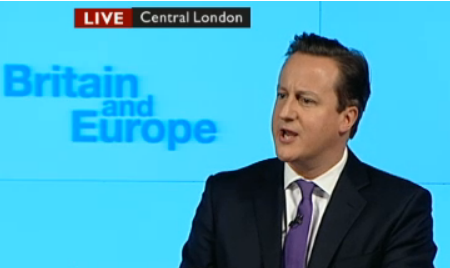
UK prime minister David Cameron, calling the democratic legitimacy of the European Union ‘wafer thin,’ has this morning pledged to renegotiate a new settlement with the European Union for the United Kingdom, and then a straight in-or-out referendum within the United Kingdom by 2017.European_UnionUnited Kingdom Flag Icon

Well, then.  Today’s address was probably the most important speech of Cameron’s career and perhaps the most important turning point on UK-EU relations since Britain’s hard-fought entry 40 years ago into what was then the European Economic Community.

Less than a month after the EU fiscal compact treaty goes into effect, and on the day that France and Germany are celebrating 50 years of friendship –as cemented by the Élysée Treaty — no less, Cameron is pledging the referendum that neither his Conservative predecessors as prime minister, Margaret Thatcher nor John Major dared to hold.

Given that the United Kingdom is not (and will not anytime soon) be a member of the eurozone, there’s a rationale for the UK to negotiate a role where it is not subject to the ever-closer political union that the eurozone crisis has required, and it should be clear that the UK won’t cede fiscal and banking policymaking to Brussels when it hasn’t ceded monetary policymaking.  But it doesn’t follow that the UK needs to renegotiate those issues; after all, given the ‘Europe at multiple speeds’ approach that’s now reality, the UK has opted out of many EU initiatives — not only the single currency, but also the Schengen Agreement that eliminates internal border controls within the EU.

I’ll have plenty of longer thoughts on Cameron’s gambit later this week.

But for now, as I listen to his speech in real time, here are some initial reactions.

Cameron has ended his speech with a note of caution that the United Kingdom is not Norway and it is not Switzerland, and he’s discussing the benefits of membership in the EU — ‘more powerful in Washington, Beijing, Delhi’ by remaining in the EU — not to mention the free trade benefits of the single market.

By 2017, if there’s actually a referendum, and Cameron’s Tories have won the 2015 general election, I predict that Cameron will be arguing for a ‘yes’ vote on such a referendum.

It’s worth noting that no member-state has ever left the European Union (although Greenland, part of the Danish realm, voted to pull out of the EU in 1985 in order to protect its fishing rights — an issue that’s snagged Icelandic and Norwegian membership in the EU as well).

In the meanwhile, this seems like a political masterstroke — Cameron has pulled a play directly from the political playbook of Labour prime minister Harold Wilson, who held his own referendum on the United Kingdom’s EU membership in 1975 (it won 67,2%).

Consider:

  • In giving the euroskeptics a clear referendum on Europe, Cameron has now given them a reason to work hard for a Tory victory in 2015.
  • Given the relatively anti-Tory and pro-Europe view of the Scottish, the referendum, scheduled for 2017, need not spook the Scottish toward independence, given the scheduled 2014 referendum within Scotland on Scottish independence.
  • He will have quieted the euroskeptic right within his own caucus, notably his former defense minister Liam Fox and other anti-Europe Tories.
  • He will have managed to draw some daylight between his party and his coalition partner, the Liberal Democrats, who are incredibly pro-Europe, thereby giving the Lib Dems something with which to distance themselves from the Tories.  That will only help win votes away from Labour in 2015.
  • He will have taken the steam out of the rising United Kingdom Independence Party, not only for 2015, but for next year’s elections to the European Parliament.
  • By keeping the terms of renegotiation vague, Cameron can take any concessions from Europeans and declare victory (say, an opt-out from the working time directive), and push for a ‘yes’ vote in 2017.

Who is Jeroen Dijsselbloem?

jeroen

Most indications are that the next Euro Group head will be a relative newcomer to the group of eurozone finance ministers — Dutch minister Jeroen Dijsselbloem, who declared his formal candidacy for the job today.European_UnionNetherlands Flag Icon

As I noted at the beginning of the year in my piece on 13 up-and-coming politicians to watch in 2013, the current head of the Euro Group since 2005, Jean-Claude Juncker, also prime minister of tiny Luxembourg since 1995 and the Luxembourgian finance minister from 1989 to 2009, is stepping down from the role.

Dijsselbloem belongs to the anti-austerity social democratic Partij van de Arbeid (PvdA, Labour Party) — that has joined a coalition that’s headed by the decidedly more budget-obsessed Volkspartij voor Vrijheid en Democratie (VVD, the People’s Party for Freedom and Democracy) and prime minister Mark Rutte.

The second Rutte cabinet took office as a ‘purple’ Lib-Lab coalition in November 2012 after a closely fought election in September 2012, during which Labour leader Diederik Samsom fought for a more gradual process of budget cuts to bring the Dutch budget within 3% of GDP.

The Euro Group came into being in the late 1990s in advance of the introduction of the single currency as an informal group.  In 2005, Juncker became the group’s first president amid a push to formalize the group’s role in 2009 though a protocol to the Treaty of Lisbon:

The Ministers of the Member States whose currency is the euro shall meet informally. Such meetings shall take place, when necessary, to discuss questions related to the specific responsibilities they share with regard to the single currency. The Commission shall take part in the meetings. The European Central Bank shall be invited to take part in such meetings, which shall be prepared by the representatives of the Ministers with responsibility for finance of the Member States whose currency is the euro and of the Commission.

The Euro Group typically meets a day before the Economic and Financial Affairs Council of the Council (Ecofin) of the European Union — Ecofin is comprised of the wider group of all 26 EU member state finance/economics ministers.  Accordingly, the Euro Group typically dominates economic policymaking at the Council level.  At the Council, policies related to fiscal matters must be adopted unanimously, though other policies can be adopted by the EU’s qualified majority voting mechanism (i.e., essentially a supermajority formula that requires both a majority of the 27 member states and a majority of the EU population).

The Euro Group president is appointed for a term of 2.5 years, by majority vote of the Euro Group, and the next president could be appointed as early as Monday, though French finance minister Pierre Moscovici has called for a more formal and transparent process of selecting the next president.  Moscovici has also called on Dijsselbloem to outline his views on the future direction of the Euro Group, and Dijsselbloem is set to discuss goals at Monday’s meeting, though Juncker has been dropping all sorts of hints that Dijsselbloem’s selection is all but assured.

Dijsselbloem has been a member of the Tweede Kamer (the lower house of the Dutch parliament) since 2000, after spending four years as an assistant at the ministry of agriculture, nature management and fisheries.

In parliament, Dijsselbloem has been a moderating voice on highly charged issues like the role of Muslims in Dutch society.  In 2007, he spearheaded a commission on educational reform.  Earlier in 2012, when former Amsterdam mayor Job Cohen resigned as Labour leader, Dijsselbloem was chosen to serve as the party’s interim leader until Samsom was elected as the permanent Labour leader, and he was the fifth candidate on Labour’s list in the 2012 elections.

As early as the 2003 election, Dijsselbloem was seen as a Samsom confidante — they campaigned together in that year as the ‘rode ingenieurs‘ — the ‘Red Engineers’ — due to their red overalls and scientific backgrounds, Samsom in nuclear energy and Dijsselbloem in agricultural economics.

Despite just two months on the job as a pro-growth minister in a government that will seek to reduce the Dutch budget to within 3% of GDP in 2013, Dijsselbloem literally personifies the current fiscal debate in Europe.  It helps that the Netherlands was one of the original six countries that formed the predecessor to the European Union and that it retains one of Europe’s last remaining ‘AAA’ credit ratings.

On one side, as personified by Moscovici and French president François Hollande of the center-left Parti socialiste, only aggressive government policies to boost aggregate demand can reduce unemployment and jumpstart Europe’s economic engine.  Although even Hollande admits the need to bring France’s budget in line with the European Union standard, generally, of within 3% of GDP, Hollande’s government has preferred to implement tax increases rather than cut spending too deeply.

On the other side, as personified by German finance minister Wolfgang Schäuble and German chancellor Angela Merkel of the center-right Christlich Demokratische Union Deutschlands (CDU, Christian Democratic Union), the key to prosperity — even in the face of recession — is to cut spending and narrow the budget deficit, thereby bringing more investment and business confidence by shoring up public finances. Continue reading Who is Jeroen Dijsselbloem?

13 in ’13: Thirteen up-and-coming world politicians to watch in 2013

2013red

Earlier today, Suffragio kicked off its 2013 coverage of world politics with a look at 13 key elections to watch in 2013.

While we’ll watch as new leaders, from Egyptian president Mohammed Morsi to French president François Hollande to South Korean president Park Geun-hye begin their first full years of power, we’ll also watch for comebacks by former presidents — former Brazilian president Luiz Inácio Lula da Silva will make a decision about running for a third term in the 2014 Brazilian presidential election and former Chilean president Michelle Bachelet is the odds-on frontrunner to win a new term in Chile’s December 2013 election.

In addition, however, here are 13 up-and-coming politicians and other public figures who will figure prominently in the next 12 months — either because they are likely to come to power themselves in 2013 or because this year will will likely be a make-or-break year for them to achieve power beyond 2013. Continue reading 13 in ’13: Thirteen up-and-coming world politicians to watch in 2013

Joseph Weiler is the new president of the European University Institute

It’s with some delight that I congratulate Joseph H.H. Weiler, Joseph Straus Professor of Law at New York University, who has been selected as the next president of the European University Institute, where he received his doctorate and where he taught law from 1978 to 1985. 

Weiler was my international trade professor in law school at NYU, and although I studied under an impressive roster of legal scholars at NYU — including former Stanford Law dean Larry Kramer, Chicago Law dean Michael Schill and Middle East / constitutional academic rockstar Noah Feldman — Weiler’s course on the law of the World Trade Organization and the North America Free Trade Agreement (and really, the European Union as well) opened quite a new world of international law to me, and his relationship with the EUI gave me the chance, as a law student, to study there for a semester with any number of other top legal and political science scholars.

The EUI, situated in the hills just above Florence and just below Fiesole in Tuscany, is an international, pan-European postgraduate and research institute established by the European Union’s member states in the 1970s.

Andrew Moravcsik, Brookings panel explore US-EU relations in Obama’s second term

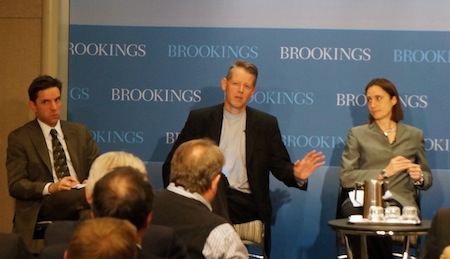
I had the opportunity to catch Princeton University’s Andrew Moravcsik (pictured above, middle) at the Brookings Institution yesterday for a brief panel discussion on relations between the United States and the European Union following the reelection of U.S. president Barack Obama.  Moravcsik engaged with Atlantic columnist Clive Crook and other panelists on not only the direction of US-EU relations in Obama’s second term, but also whether US-EU relations are even incredibly relevant at all for an administration likely to have higher priorities. 

It takes a special kind of brass for an American to become one of the fundamental scholars of European integration, but Moravcsik is the father of the liberal intergovernmentalism theory of European integration, which purports that European institutions are essentially the creations of nation-states, and that supranational entities such as the European Union only have as much power as those states unanimously agree to provide them.  It stands in contrast to the competing neofunctionalism theory that purports that institutions like the European Union gather more power through the spillover effects of integration, allowing them to grow and gain additional power as integration deepens, notwithstanding the wishes of nation-states.  It’s a fascinating debate, and it’s especially fascinating to consider the consequences of both theories for the ongoing European response to the eurozone’s sovereign debt crisis.

Needless to say, few political scientists — European, American or otherwise — have had as much influence on European integration theory as Moravcsik.  As such, he’s long been one of my favorite scholars since I first studied European integration theory at the European University Institute, so it was somewhat of a pleasure to see him discuss US-EU relations in person — and not less than a 10-minute walk from home at that.

The discussion featured much of the standard debate between intergovernmentalism and functionalism, with Crook arguing in particular that the United Kingdom under prime minister David Cameron was perhaps irretrievably isolating itself from Europe and that it risked geopolitical irrelevance if it did so.  He worried that the European Union, more generally, has failed to adequately provide ‘variable geometry’ for European countries — a so-called ‘multi-speed Europe.’

Moravcsik, however, largely shrugged off those concerns and noted that a multi-speed Europe emerged two decades ago, with some countries participating more fully and others, like the United Kingdom, choosing to participate in some core functions but not others:

There’s a lot of people in Brussels who say a lot of things, but what happens is what member states say.

He pointed to the limited nature of participation in the eurozone — many members, including the United Kingdom, have not acceded to the single currency.  He also pointed to the voluntary nature of opting into any unified European foreign policy (e.g., the ‘coalition of the willing’ that included the United Kingdom, Italy and Poland, but few others, in support of the U.S. invasion of Iraq in 2003), the flexibility of European competition policy, and the opt-out nature of the Schengen Agreement that establishes the free crossing of borders throughout Europe, to which even some non-EU countries are party.  He added that Turkey and, increasingly, Morocco are both, to some degree, integrated into the European Union, if not in quite a de jure capacity.

I found Moravcsik’s thoughts on US-EU relations more intriguing, however — especially his thoughts on the Obama administration’s much-trumpeted ‘pivot to Asia.’

Moravcsik argued that US-EU relations are far more sanguine than, perhaps, has been reported, and noted the role that German chancellor Angela Merkel and European Central Bank president Mario Draghi played in preventing — or at least delaying — the kind of eurozone crisis that could have endangered Obama’s election.  He added that U.S. and European interests are largely aligned and that when the Obama administration needs to call someone in the world with the will and means to support its goals, it’s still likely to call on Europe.  He noted that the United States and Europe agree more consistently today than they did during the Cold War on issues as wide-ranging as nuclear proliferation, Israeli-Palestinian peace, consequences of the ‘Arab Spring,’ and environmental and climate change policy.

As such, he dismissed the idea of a ‘pivot to Asia’ as nothing so much as overheated rhetoric, comparing it to the talk of the United States as a unilateral ‘hyperpower’ in 2003.  In both cases, he argued that Europeans have (wrongly) taken American rhetoric at far more than face value.  To the contrary, Moravcsik claimed that the ‘pivot to Asia’ talk was ‘drummed up’ as a strategic justification for the United States pulling out of Iraq and Afghanistan.

That was perhaps a bit starker than I’d imagined.  After all, Obama is headed, of all places, to southeast Asia for his first post-reeelction trip — to Myanmar/Burma, the first trip by a sitting U.S. president to that country in U.S. history.

Broadly speaking, Moravcsik argued that large strategic shifts, like any ‘pivot’ to Asia, are accomplished only gradually over long periods of time.  That strikes me as largely correct, but it nonetheless will be interesting to see what happens between now and 2017 on U.S. Asia/Pacific policy.

Notably, we have a handful of measuring sticks to guide us: Continue reading Andrew Moravcsik, Brookings panel explore US-EU relations in Obama’s second term

Some thoughts on the Nobel Peace Prize

The Nobel Peace Prize this morning was awarded to the European Union ‘for over six decades contributed to the advancement of peace and reconciliation, democracy and human rights in Europe’:

Thorbjorn Jagland, the chairman of the panel awarding the prize, said it was a signal focusing on the union’s historical role binding France and Germany together after World War II and its perceived impact in spreading reconciliation and democracy beyond the Iron Curtain that once divided Europe and on to the Balkans. “The stabilizing part played by the E. U. has helped to transform most of Europe from a continent of war to a continent of peace,” he said.

I’ve got a busy morning, but I wanted to share three initial observations:

First, this is obviously a not-so-subtle attempt by the Nobel Committee to provide some encouragement at a time when the EU is in a bit of a crisis — not just in the sense of lurching to save the eurozone, but a more existential political crisis.  In many ways, the EU is right now a sort of halfway house that resembles something like the pre-constitutional United States, when it was governed by the ineffective Articles of Confederation.

The EU today has a monetary union, but no fiscal or political union to match, despite the failure of the much-derided “EU constitution” effort in 2004 and 2005 that ended with a resounding failure in referenda in France and the Netherlands.  With German chancellor Angela Merkel this week on a trip in Greece to discuss that country’s finances after four years of recession and biting austerity designed to keep Greece in the eurozone, the Nobel Prize will be a reminder that the stakes of the eurozone’s success really are more than just determining the  outcome of an experiment in monetary policy, but the future of the entire ‘European project’ — and I think that’s a point upon which both the pro-federalist ‘neo-functionalism’ and the more skeptical ‘intergovernmentalism’ schools of EU integration would agree.

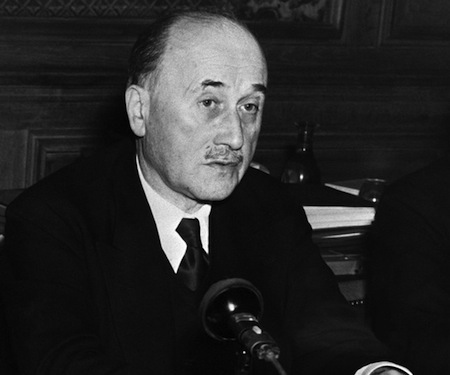
Secondly, it feels like a posthumous Nobel award to Jean Monnet (pictured above) and Robert Schuman, a former prime minister and foreign minister of France.  The two were as responsible as anyone for the establishment of the EU’s predecessor, the European Coal and Steel Community in 1951 among France, Germany, Italy, the Netherlands, Belgium and Luxembourg.  Monnet’s plan for coal and steel cooperation and the 1950 Schuman Declaration largely became the blueprints for the creation of the ECSC.

If it seems shocking that the EU has been awarded the Nobel Peace Prize, it’s only because it has been so successful.  From cooperation over coal in the Saar, the European project expanded into a means for creating a common market to tear down tariffs among European nations, a vehicle for unity against the Soviet Union, a mechanism for boosting fledgling democracy in Greece, Portugal and Spain in the 1980s, a salve to soothe Europeans worried about the reunification of Germany in the early 1990s, and the easiest way for “western Europe” to reach out to the newly liberated eastern European states following the collapse of the Soviet Union.  Today, the EU remains a stabilizing force in the Balkans — with Serbia, the last bastion of ethnic-based warfare on the European continent in the 1990s, now a fledgling democracy that itself is in EU accession talks.

Finally, if you think of the Prize as both a boost to EU at a time of institutional stress and an acknowledgement of Monnet’s efforts, I also see it as an acknowledgement of the leadership of Jacques Delors — the eighth president of the European Commission, he more or less railroaded the Maastricht treaty through what was then the European Economic Community in 1992 (despite some fireworks with UK prime minister Margaret Thatcher).  Although I think it’s still too early to tell whether the euro as a single currency is a success or a failure, if the EU pulls through this crisis by developing a fiscal union and a political union commensurate with its monetary union, Delors will rightly be seen as just as important as Monnet and Schuman for his role in bringing about a real supranational union of European states.

Is the European ‘Christian democracy’ party model dead?

When Dutch voters go to the polls on September 12, we don’t know whether they’ll favor prime minister Mark Rutte’s Volkspartij voor Vrijheid en Democratie (VVD, the People’s Party for Freedom and Democracy) or Emile Roemer’s Socialistische Partij (SP, the Socialist Party) or even Diederik Samsom’s Partij van de Arbeid (PvdA, the Labour Party) as their top choice.

What we do know is that the election could well be the worst post-war finish for the traditional Christian Democratic party in the Netherlands, the Christen-Democratisch Appèl (CDA, Christian Democratic Appeal).  It’s currently on track to finish in fifth place (or even sixth place) in a country that it had a hand in governing virtually without break in Dutch post-war politics until 2010.

In 2010, the CDA won just 21 seats in the lower house of the Dutch parliament, and it could win just 15 seats or less this time around.

So it goes all across Europe:

  • In Italy, the Democrazia Cristiana controlled the government (or participated in governing coalitions) for nearly 50 years of post-war Italian politics.  The Tangentopoli (‘Bribesville’) scandal led to its demise under the weight of massive corruption allegations in 1992, and the remaining core of that party, the Unione dei Democratici Cristiani e di Centro (UDC, the Union of Christian and Centre Democrats), led by Pier Ferdinando Casini, plays a significant, but minor role in Italian politics today.
  • Norway’s Christian Democratic Party, the Kristelig Folkeparti (KrF) once dominated Norwegian politics as well, but now holds just 10 out of 169 seats in the Norwegian parliament.
  • In Bavaria, the Christlich-Soziale Union (CSU, Christian Social Union) has controlled Bavaria’s state government since 1957.  It’s still the overwhelmingly largest party in Bavarian politics, but it lost 32 seats in the Landtag in 2008 and now holds just 92, and it looks likely to lose even more seats in the Bavarian state elections that must be held in 2013.
  • In Switzerland, the Christlichdemokratische Volkspartei der Schweiz (CVP, Christian Democratic People’s Party of Switzerland) has steadily declined since the 1970s.

Only in German federal politics does Christian democracy seem to be holding on — in the form of Angel Merkel’s Christlich Demokratische Union (CDU, Christian Democratic Union), which is allied at the federal level with Bavaria’s CSU.

So what’s happened to Christian democracy? And is it a concept whose time is up?

Christian democracy emerged as a political movement in the 19th century, as much as anything a reaction of the Catholic Church to the Industrial Revolution — and to the Marxist ideas that had so effectively challenged industrial capitalism in the mid-19th century, in the same way that the social democratic movement that gave voice to (and moderated) the growing labor movement.  (Some political scientists see a parallel in the “justice and development” strand of moderate Islamist parties that have emerged in Turkey and through vehicles like the Muslim Brotherhood in Egypt and Jordan).

It reached its heyday during the Cold War as a bulwark against the communist influences of Soviet Russia, but today seems increasingly an anachronism as the European right divides into, on the one hand, a free-market liberal ideology untroubled with cultural issues and, on the other hand, a nationalist ideology that is increasingly both anti-Europe and anti-immigrant.  That fragmentation provides yet another complication in navigating the European Union out of its current debt and currency crisis — the European Union was formed and the eurozone conceived in a world where Christian democracy largely controlled the initial EU member states. Continue reading Is the European ‘Christian democracy’ party model dead?

Is Bavarian finance minister Markus Söder really the most dangerous politician in Europe?

Der Spiegel ranks the top 10 most dangerous politicians in Europe, and you might be surprised at who comes out on top.

The piece targets Markus Söder, the finance minister of Bavaria since November 2011:

The politician from the [Christlich-Soziale Union in Bayern (CSU, the Christian Social Union)], the conservative sister party to Chancellor Angela Merkel’s Christian Democratic Union, is known for his tub-thumping rhetoric and has stepped up a gear in the euro crisis with vitriolic comments about Greece. “An example must be made of Athens, that this euro zone can show teeth,” he told the Bild am Sonntag tabloid newspaper this week. “Everyone has to leave Mom at some point and that time has come for the Greeks.”

It also points the finger at Alexander Dobrindt, general secretary of the CSU to which Söder also belongs — Dobrindt has also called on Greece to exit the eurozone by paying its debts in drachmas instead of euros.

Söder, an up-and-coming politician in the CSU, has previously served as minister for environment and health from 2008 to 2011 and from 2007 to 2008, as minister for federal and European affairs.  He’s a solid populist, to be sure — for example, he’s in favor of Bavaria’s ban on the wearing of Muslim head scarves (but not nun’s habits).

But it’s easy enough to explain away the relatively strident tone from Söder and the CSU as political posturing in advance of Bavarian state elections that must take place sometime in 2013.  The CSU will be struggling to maintain the grip that its held on Bavarian state politics since the 1950s.  At the federal level, although the CSU-backed Angel Merkel has walked a tight line when it comes to balancing national and federalist European interests, but her leftist opponents are even more federalist when it comes to Europe and the eurozone.

The Spiegel list is dominated by some of the nationalist right’s usual suspects: Nigel Farage, leader of the UK Independence Party (UKIP) and a member of the European Parliament; Marine Le Pen, leader of the Front national in France; Timo Soini, leader of the Perussuomalaiset (PS, True Finns) party, also a member of the European Parliament; Geert Wilders, head of the Dutch Partij voor de Vrijheid (PVV, Party for Freedom); and Heinz-Christian Strache, head of the Freiheitliche Partei Österreichs (FPÖ, Austrian Freedom Party).

They seem like odd choices, though, because none of them (except perhaps Strache) seem to be on the upswing.  Wilders is polling quite dreadfully in advance of the Dutch elections on Sept. 4.  Farage and Soini are sideshows at best.  Despite her strong showing in the French presidential election in April and the shadow she casts over the French center-right, Le Pen failed to win a seat in France’s national assembly in the June elections — and her party won just two seats in total.

To me, the following politicians are far more “dangerous” — by “dangerous,” I mean the ability to win real power or to be more effective in making mischief: Continue reading Is Bavarian finance minister Markus Söder really the most dangerous politician in Europe?

Worries about Greece’s immediate eurozone exit are extremely overblown

Earlier this week, as the chances of a pro-bailout Greek coalition fell apart, you would think that the failure to cobble together a coalition was tantamount to Greece withdrawing from the euro and reintroducing the drachma.

Sure enough, signs of a “bank jog” emerged this week, as Greeks pulled out over €1.2 billion in deposits from Greek banks on Monday and Tuesday amid the political tumult.  An article in Der Spiegel declared that it is time for Greece to leave the euro and even Christine Lagarde, managing director of the International Monetary Fund said that, although it would be “quite messy,” it is time to start thinking about how to engineer a Greek exit from the euro.

But with an interim caretaker prime minister, Panagiotis Pikrammenos, being sworn in today, and new elections scheduled for just over a month from today, the warnings of Greece’s immediate exit from the eurozone are extremely overblown. Continue reading Worries about Greece’s immediate eurozone exit are extremely overblown