A state-by-state overview of India’s election results

modiwins

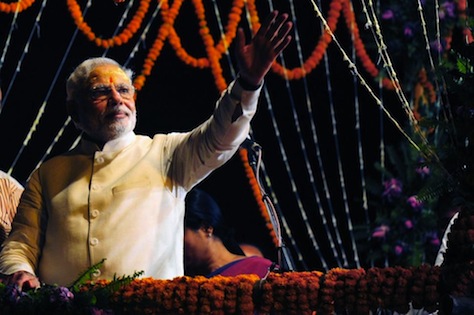
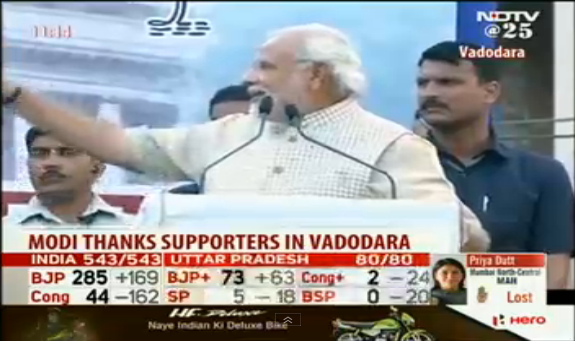
It quickly became clear early on Friday morning across India that Narendra Modi and his Hindu nationalist Bharatiya Janata Party (the BJP, भारतीय जनता पार्टी) were headed for a historical victory in India’s national elections, which took place across nine separate phases between April 7 and May 12. India Flag Icon

But to really understand the impact of the victory, it’s important to delve into the results on a state-by-state level. Where did the BJP massively exceed expectations? Where did it fall short? Where did regional leaders keep the ‘Modi wave’ at bay? Where did regional leaders fail? Each state tells us something about the future shape of India’s new political reality in New Delhi and about the future of state governance, which, after all, represents the most important level of government for most Indians, even in the Modi era.

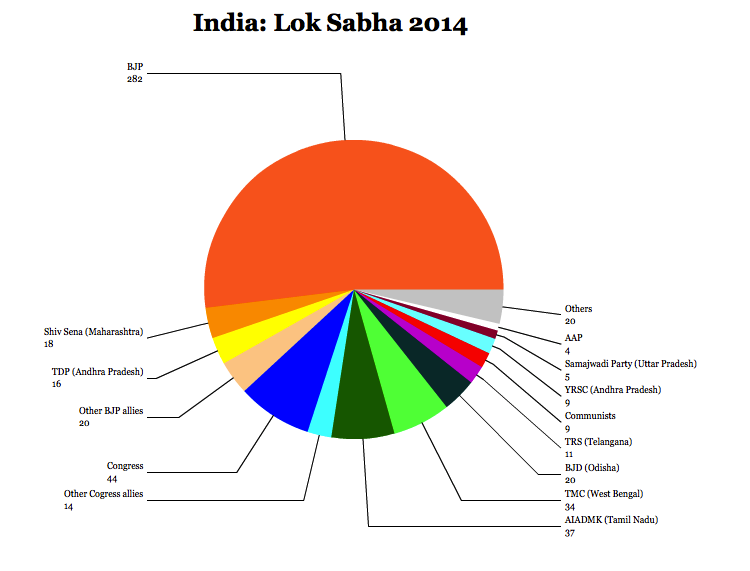
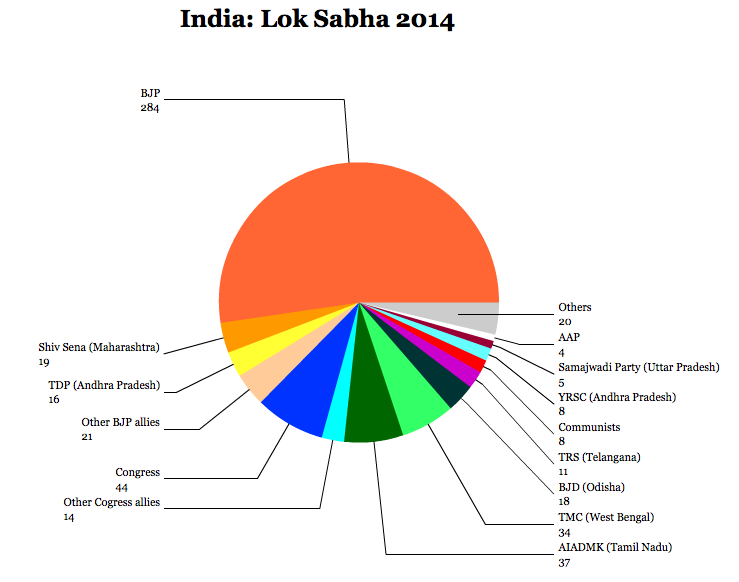
For the record, here are the final results:

loksabha14

The BJP, together with its allies in the National Democratic Alliance (NDA) won 336 seats in the Lok Sabha (लोक सभा), the House of the People, the lower house of India’s parliament. It’s the largest mandate that any Indian party/coalition has won since 1984.

The ruling Indian National Congress (Congress, भारतीय राष्ट्रीय कांग्रेस) and its allies in the United Progressive Alliance (UPA) won just 58 seats. Not only did the Congress suffer the worst defeat of its history under the leadership of Rahul Gandhi, the great-grandson of India’s first post-independence prime minister Jawaharlal Nehru, it’s the first time that a non-Congress party has won an absolute majority in the Lok Sabha.

Regional parties and other third groups won an additional 149 seats. Continue reading A state-by-state overview of India’s election results

The European parliamentary elections are really four contests

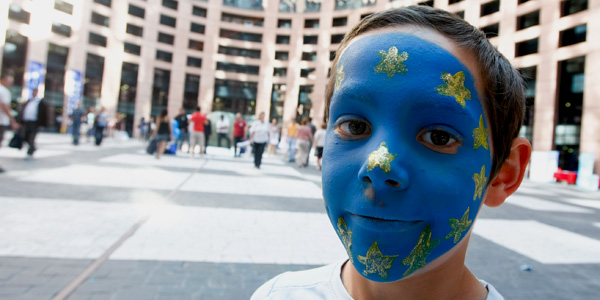
Festival of Europe Open day 2012 in Strasbourg

It’s hard to know exactly how to place the European parliamentary elections in the constellation of world politics. European_Union

From one perspective, they’re relatively unimportant — a largely apathetic electorate is choosing a body of 751 MEPs in a parliament that has less power within the European Union than most parliamentary bodies have within national governments. The Council of the European Union gives member-states veto power over EU legislation and the European Commission, the regulatory executive of the European Union, has the power to introduce legislation. Voters, since the first direct elections in 1979, have turned out in ever lower proportions with each election cycle. To the extent you talk to European voters who actually care about the elections, they mostly view them as an opportunity for a protest vote.

From another perspective, they’re incredibly important. They represent the one point of genuine democratic participation within the European Union and, given the tumult of the past five years with respect to the eurozone, the European economy and the power of relatively wealthier states to dictate the monetary policy and, increasingly, the fiscal policy of weaker states, the current elections  represent a major conversation about the future of EU policy. That’s especially true in the context of the weighty matters that the next European Parliament will face, including a new data privacy directive and the Transatlantic Trade and Investment Partnership, a potentially game-changing free-trade agreement with the United States.

* * * * *

RELATED: In Depth: European parliamentary elections

* * * * *

So which is the right interpretation?

It can be both — and many things besides — depending on your view. That’s because the European parliamentary elections are really four separate political contests, wrapped up and presented as one set of elections. The relative importance or unimportance that a particular actor places on the ‘European elections’ depends upon which of the four ‘contests’ most resonates.

So what are the four contests simultaneously raging across Europe? Continue reading The European parliamentary elections are really four contests

India’s election results: Modi wave largest mandate since 1984

Screen Shot 2014-05-16 at 1.44.49 PM

The results are now (largely) in for what will certainly be one of the biggest election dramas of the decade.India Flag Icon

Narendra Modi, Gujarat’s chief minister, has led the Hindu nationalist Bharatiya Janata Party (the BJP, भारतीय जनता पार्टी) to its best-ever victory. In India’s post-independence history, it’s the first time that the BJP — or any party — has won an absolute majority other than the  Indian National Congress (Congress, भारतीय राष्ट्रीय कांग्रेस).

* * * * *

RELATED: In-Depth: India’s elections

* * * * *

Conversely, the Congress, the party of Indian independence and the party of Mahatma Gandhi and Jawaharlal Nehru, has suffered its worst defeat in the history of independent India. After a decade of rule, party president Sonia Gandhi and her son, party vice president Rahul Gandhi, face a long wilderness in the Modi era.

Here’s the latest on results, via NDTV:

loksabha14

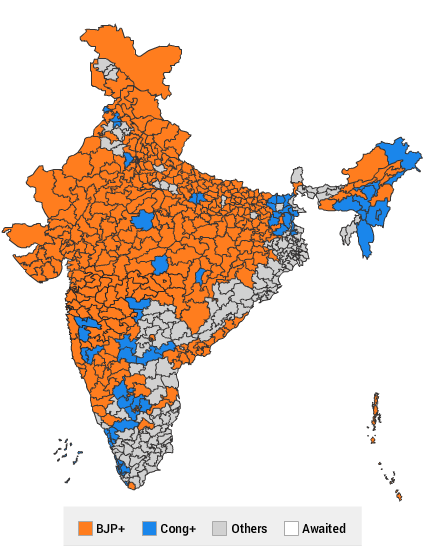
The BJP, by itself, will hold 284 seats, which gives it an absolute majority in the Lok Sabha (लोक सभा). Together with its allies in the National Democratic Alliance (NDA), it will hold 340 seats. That represents the largest mandate that any governing coalition has won since 1984, when Congress won over 400 seats under Rajiv Gandhi, who was waging the fight after his mother, Indira Gandhi, was assassinated by her SIkh bodyguards in the wake of Sikh riots.

It’s hard to describe just what a massive landslide this was, but this NDTV map of all 543 constituencies give you a good idea:

Screen Shot 2014-05-16 at 2.04.09 PM

Continue reading India’s election results: Modi wave largest mandate since 1984

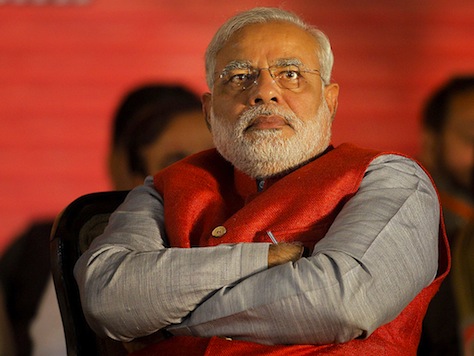
The phenomenon of Narendra Modi, 56-inch chest and all

modichest

It’s not hard to understand why Gujarat chief minister Narendra Modi is leading his Bharatiya Janata Party (the BJP, भारतीय जनता पार्टी) and its allies to a victory that will be the most resounding in Indian history since 1984.India Flag Icon

The truth has been there all along, as Narendra Modi became more than just a potential prime minister. Somewhere along the course of the election campaign and the nine phases of voting that began way back on April 7, Modi became a phenomenon.

* * * * *

RELATED: In-Depth: India’s elections

* * * * *

Even before he leapt to the national stage, Modi perfected the art of campaigning by hologram, whereby a life-size avatar of Modi could address election rallies in multiple cities simultaneously:

modihologram

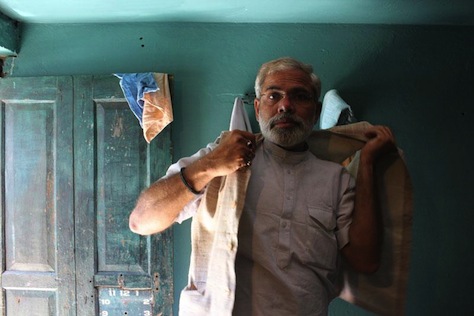
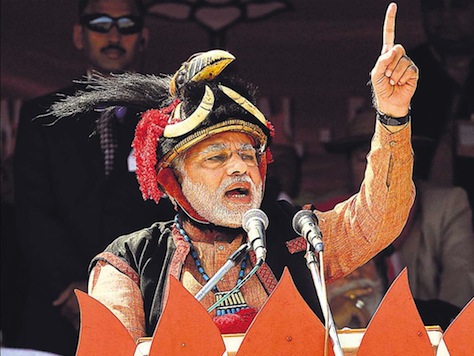
His colorful kurtas — traditional body-length garments for men that Modi often wears with short sleeves — have become a downright fashion statement and have already attracted international attention. Here he is in a great photo from Sonia Paul of The Caravan:

kurta

Modi himself has admitted to a bit of cockiness about his fashion:

[Modi] confesses he likes to dress up well, is “god-gifted” in the way of mixing and matching colours and is happy at compliments on his dressing sense…. “Yes, I like to dress up well and stay clean. God has gifted me the sense of mixing and matching colors. So I manage everything on my own. Since I’m god-gifted, I fit well in everything. I have no fashion designer but I’m happy to hear that I dress well.”

Implausibly, as he brags about his 56-inch chest (critics joked it was more like a 56-inch belly), he’s also become something of a sex symbol among a certain segment of India’s population.

But when, as now seems inevitable, he becomes India’s next prime minister, the entire world will turn its attention to one of the oddest — and compelling — characters in international politics today.

So who is the personal Narendra Modi? And what have we learned about him on the campaign trail?  Continue reading The phenomenon of Narendra Modi, 56-inch chest and all

Who’s who in Modi-world: A guide to the next Indian government

gangsallhere

In just a few hours, India’s national election results will be released.India Flag Icon

If exit polls (and virtually all polls, leading up to India’s six-week elections) are correct, Gujarat’s chief minister Narendra Modi will have delivered his conservative, Hindu nationalist Bharatiya Janata Party (the BJP, भारतीय जनता पार्टी) and its allies to a potentially historic victory — and an equally historic defeat for the ruling Indian National Congress (Congress, भारतीय राष्ट्रीय कांग्रेस).

Whatever happens when election results are announced, there’s no doubt that Modi led one of the most ‘presidential’ campaigns in Indian history. If the BJP emerges victorious, as expected, it will be a mandate for Modi as much as for the BJP.

The magic number is 272 — if the BJP-led National Democratic Alliance (NDA) can win an absolute majority in the Lok Sabha (लोक सभा), the lower house of the Indian parliament, Modi will certainly be India’s next prime minister, and he’ll likely steer a relatively stable government that should last for its full five-year term.

If the BJP and its allies fall short of 272 seats, while still emerging as the largest bloc in the Lok Sabha, they will also likely form the next government by forging a series of alliances with regional parties, including any of the following:

  • the ruling, Dravidian AIADMK of Tamil Nadu’s chief minister Jayalalithaa;
  • the Uttar Pradesh-based Bahujan Samaj Party (BSP) of former chief minister Mayawati; or
  • the Biju Janata Dal (BJD), which is a former member of the NDA, and is forecast to win both state and Lok Sabha elections in the state of Odisha.

While regional allies might temper the Hindutva tendencies of a stronger BJP government, they might also prevent Modi from enacting the kind of economic reforms that he has promised to unleash greater GDP growth and development and to stymie bureaucratic waste and massive corruption.

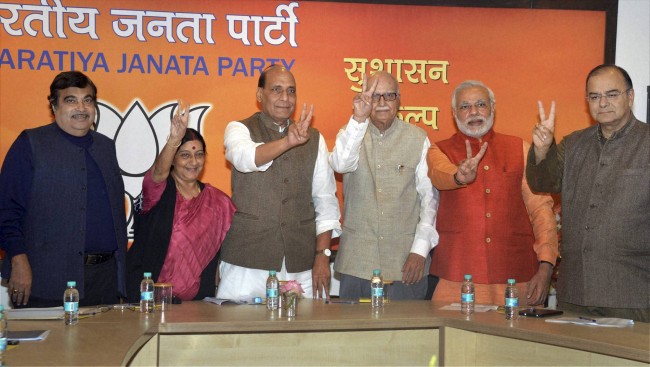
In any event, almost every sign indicates that Modi will become India’s next prime minister, and he was already gathering with top BJP officials in Gujarat yesterday planning his new government (pictured below in a photo that Modi tweeted):

bjpmeeting

So who are the individuals that could become the most important officials in a Modi administration?

Here is Suffragio‘s guide to Modi-world — a list of 25 Indian politicians and leaders who are most expected to play a role in a government that promises to be very different than the current government.

The officials are divided into four categories:

  • the BJP’s ‘old guard,’ which controlled the party in the its first major stint in government between 1998 and 2004;
  • the BJP’s ‘new guard,’ the new generation of leadership with whom Modi is more comfortable;
  • the Gujaratis, the members of Modi’s own inner circle after 13 years of state government; and
  • the allies, those non-BJP party leaders who might be expected to take key roles within the NDA and otherwise in the next government.

Continue reading Who’s who in Modi-world: A guide to the next Indian government

Pivoting to Modi: US-India relations in the Modi era

modiUS

I write tomorrow in The National Interest about US-India relations — why they’re at such a nadir and how they could become even worse under the person that exit polls (and every other piece of evidence) say will become the next prime minister of India, Gujarat’s chief minister Narendra Modi.India Flag IconUSflag

Just six years ago, US president George W. Bush stood beside Indian prime minister Manmohan Singh to hail a landmark nuclear deal that welcomed India into the global nuclear club. Though it foresaw greater technological cooperation between the United States and India, its real power was in demonstrating US respect for the world’s largest democracy — and the world’s second-most populous nation-state.

* * * * *

RELATED: In Depth: India’s elections

* * * * *

Much of that goodwill today is gone, unfortunately, and US-India relations could take an even more ominous tumble during a Modi-led government dominated by his conservative, Hindu nationalist Bharatiya Janata Party (the BJP, भारतीय जनता पार्टी).

In brief, Modi (pictured above) will be a much different kind of Indian leader, who isn’t nearly as friendly to Westernization as the English-speaking elites in the ruling Indian National Congress (Congress, भारतीय राष्ट्रीय कांग्रेस). It doesn’t help that Modi was essentially banned from US and European travel for much of the past decade, though US and European officials may have had good cause for shunning Modi on the basis of his role in the 2002 communal riots in Gujarat.

Amid a dizzying amount of political change across Asia, India might prove to be the most difficult challenge for the Obama administration in its final 2.5 years:

But from the U.S. perspective, Modi’s rise could be the most challenging of all. Even though the bilateral relationship is now at its lowest point since Obama took office, its current state could feel warm and fuzzy compared to what lies ahead. Among the priorities of the Obama administration in its final two-and-a-half years, the challenge of restoring strong ties with India should lie at the top of the Asia agenda. No amount of pivoting will matter much if U.S. ties to the world’s largest democracy—and, despite its current stumbles, one of the world’s largest emerging economies—lie in tatters in January 2017.

I argue that the Obama administration needs to find a way to move past the diplomatic kerkuffle of the Khobragade affair that added so much needless tension to the US-Indian relationship, appoint a much stronger ambassador to India than the outgoing envoy Nancy Powell and work to encourage Modi’s instinct for greater economic freedom while discouraging Modi’s possible instinct to restrict India’s religion freedom.

The truth, however, is that no one knows exactly how Modi will deal with US relations: Continue reading Pivoting to Modi: US-India relations in the Modi era

Photo of the day: Guy Verhofstadt’s tie

guy

The five major candidates elected by their respective European parties to become the next president of the European Commission are debating today in a (mostly) English-language debate on the future of the European Union.European_UnionBelgium Flag

It’s jarring enough that a debate among two Germans, a Greek, a Luxembourger and a Belgian on the future of Europe is taking place officially in English. I’ll have some more thoughts in the coming days on the contest among the European Commission presidential contest.

* * * * *

RELATED: In Depth: European parliamentary elections

* * * * *

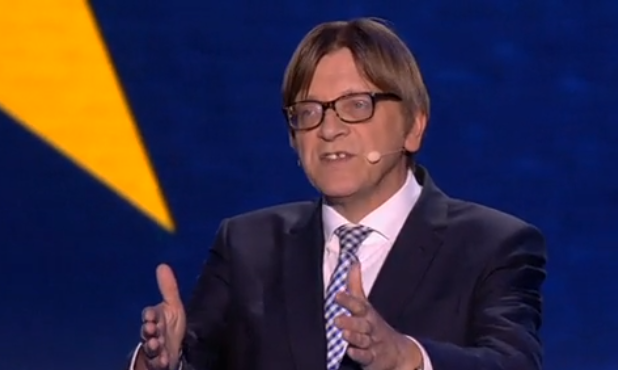
For now, as I watch the debate, the candidate with the most energy is former almost certainly former Belgian prime minister Guy Verhofstadt. He’s the candidate of the Alliance of Liberals and Democrats for Europe Party (ALDE), currently the third-largest bloc in the European Parliament, and comprised of many of Europe’s economically and socially liberal parties.

Verhofstadt, who belongs to the Open Flemish Liberals and Democrats (Open VLD, Open Vlaamse Liberalen en Democraten), served as Belgium’s prime minister from 1999 to 2008, and he’s more responsible for orienting Belgium toward a Thatcherite economic orientation than just about anyone else in the past four decades in that country (Belgium will also hold its national elections on May 25, the same day as most countries will vote in the European parliamentary elections).

He’s also the candidate with the best tie, hands-down. Can you imagine a US presidential candidate wearing such a fashion-forward tie on the campaign trail, let alone a presidential debate? Continue reading Photo of the day: Guy Verhofstadt’s tie

In Depth: European Parliament

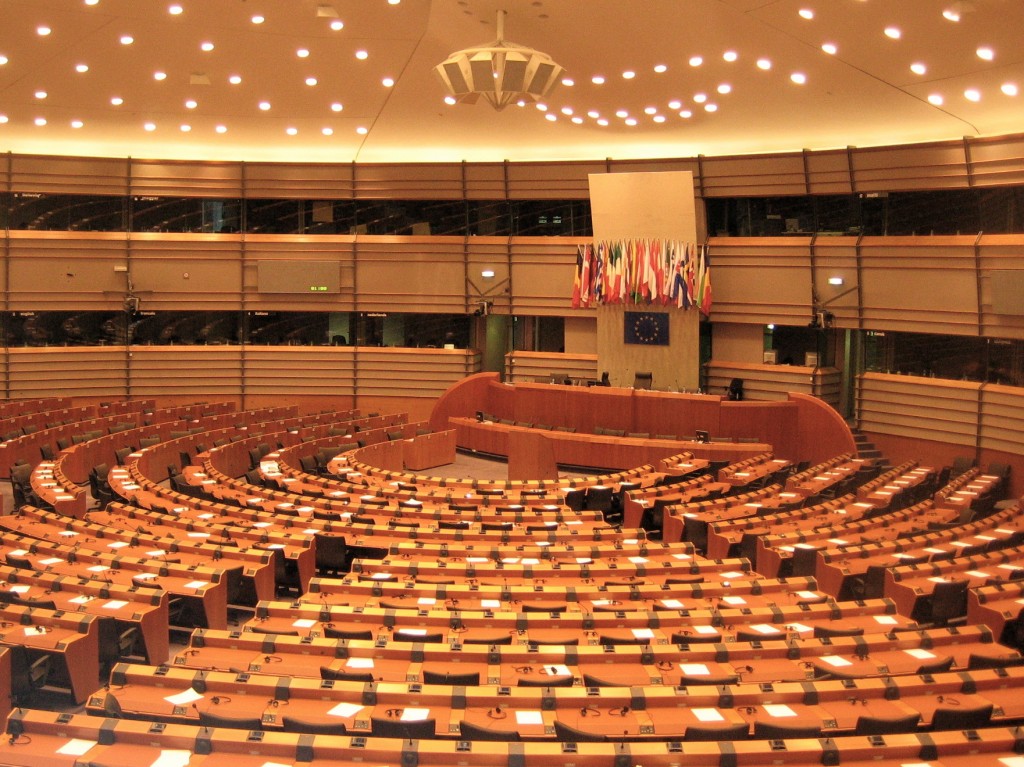
(43) EU parliamentary chamber

On the last full weekend of May, European voters in 28 member-states with a population of over 500 million will determine all 751 members of the European Parliament.European_Union

The political context of the 2014 parliamentary elections

Since the last elections in June 2009, the European Union has been through a lot of ups and downs, though mostly just downs. After the 2008-09 financial crisis, the eurozone went through its own financial crisis, as bond yields spiked in troubled Mediterranean countries like Greece, Spain, Italy and Portugal with outsized public debt, sclerotic government sectors and economies operating near zero-growth. Eastern European countries, facing sharp downturns themselves, and a corresponding drop in revenues, implemented tough budget cuts and tax increases to mollify bond markets. Ireland, which nationalized its banking sector, faced similar austerity measures. European Central Bank president Mario Draghi’s promise in the summer of 2012 to do ‘whatever it takes’ to maintain the eurozone marked the turning point, ending over two years of speculation that Greece and other countries might have to exit the eurozone. Many countries, however, are still mired in high unemployment and sluggish growth prospects.

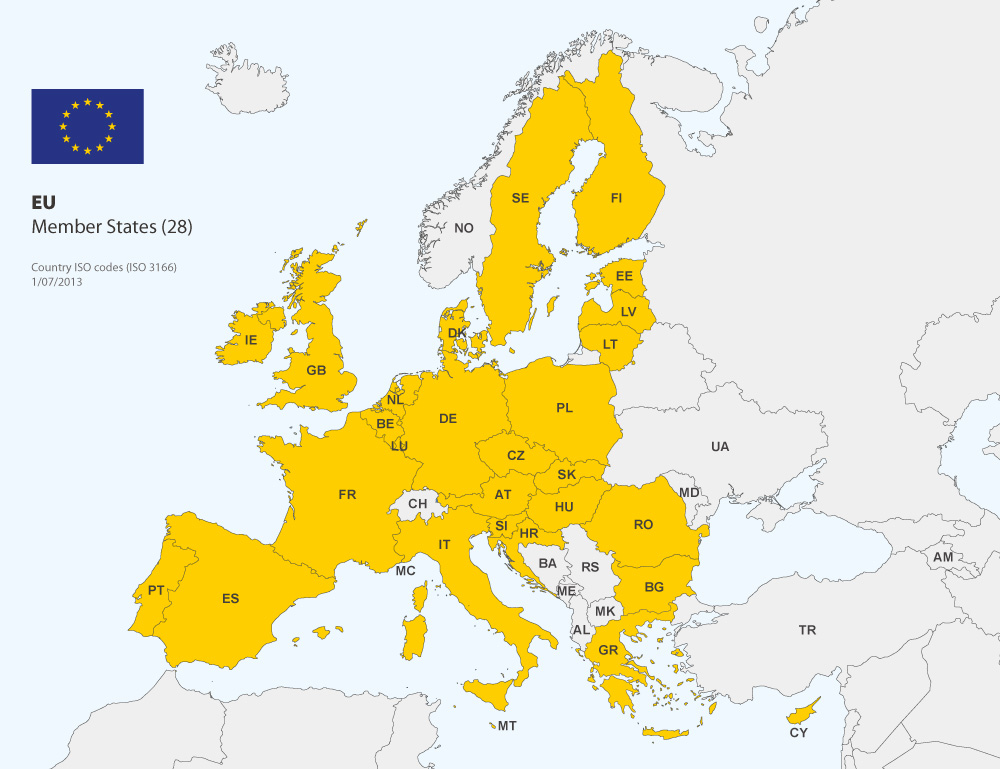
One new member-state joined the European Union, Croatia, in July 2013, bringing the total number to 28, though Iceland, Serbia and Montenegro all became official candidates for future EU membership:

eu-members-2013

Politically speaking, since the 2009 elections, only two of the leaders in the six largest EU countries are still in power (Polish prime minister Donald Tusk, a centrist, and German chancellor Angela Merkel, a Christian democrat) reflecting a climate that’s been tough on incumbent governments. Spain and the United Kingdom took turns to the political right, and France and Italy took turns to the political left, but none of those governments seems especially popular today — and each of them will face a tough battle in the voting later this month.

Of course, that’s only if voters even bother to turn out. Since the European Parliament’s first elections in 1979, turnout has declined in each subsequent election — to just 43.23% in the latest 2009 elections:

EU turnoutAt the European level, the Treaty of Lisbon, a successor to the ill-fated attempt to legislate a European constitution in the mid-2000s, took effect in December 2009, scrambling the relationships among the seven institutions.

 The elections, which will unfold over four days between May 22 and May 25, are actually about much, much more than just electing the legislators of the European Union’s parliamentary body, which comprises just one of three lawmaking bodies within the European Union. Continue reading In Depth: European Parliament

Who is Federica Mogherini?

mogerhini

When Matteo Renzi, the 39-year-old former Florence mayor, pushed Enrico Letta out of power in February, I questioned the timing of his decision and noted that it was an arguably anti-democratic electoral coup against a prime minister of his own party that could easily backfire on Renzi.Italy Flag Icon

But among the most eyebrow-raising choices was Renzi’s decision not to reappoint the internationally acclaimed Emma Bonino as foreign minister, allegedly against the wishes of Italian president Giorgio Napolitano.

A longtime leader of the Radicali Italiani (Italian Radicals), a group of reform-minded, good-government economic and social liberals, Bonino had a long career in Italian and international politics as an inaugural (and subsequent) member of the European Parliament,  international trade minister under center-left prime minister Romano Prodi, and European commissioner for health and consumer protection in the late 1990s. A longtime  international activist for human rights, Bonino surfaced briefly as a potential Italian presidential contender in May 2013, though the electors  ultimately decided to reappoint Napolitano.

Instead, Renzi appointed Federica Mogherini, a previously little-known international affairs expert and legislator in Renzi’s Partido Democratico (PD, Democratic Party).

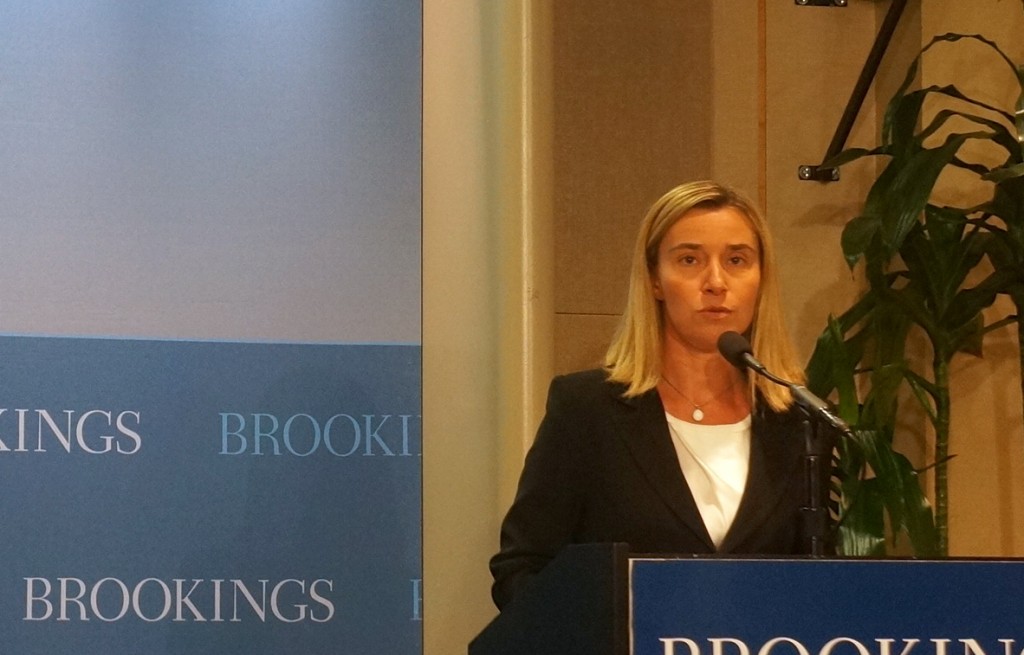
Of course, youth need not prevent an official from becoming foreign minister (it hasn’t stopped Austria’s 27-year old foreign minister Sebastian Kurz). Nonetheless, it was a risk to replace such a renowned official like Bonino with an untested foreign minister like Mogherini (pictured above). Even before Bonino, the foreign ministry is a role that’s been held by some of Italy’s most senior politicians — Gianfranco Fini and Franco Frattini on the right, and Massimo D’Alema and Lamberto Dini on the left.

Mogherini, in her first trip abroad, was received by US secretary of state John Kerry yesterday, and she appeared briefly at the Brookings Institution today to share thoughts about European relations with Russia, Ukraine, North Africa and the Middle East.

Mogherini is impressive, even to those of us who regret that Bonino’s time as foreign minister was truncated to just 10 months. At her discussion at Brookings, she was more forthright and authoritative than one might expect from such an untested foreign minister.   Continue reading Who is Federica Mogherini?

Did Abdullah just win the Afghan presidency?

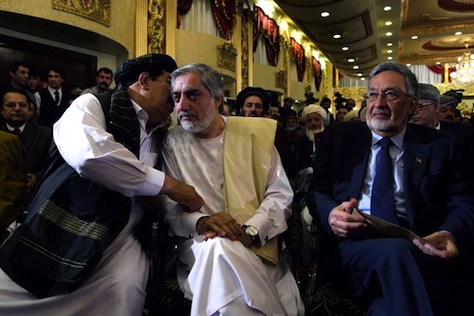
abdullahrassoul

Earlier this week, leading Afghan presidential candidate Abdullah Abdullah secured the endorsement of Zalmai Rassoul, the third-place finisher in the April 5 first-round election. That brings Abdullah, a former foreign minister and the runner-up to outgoing president Hamid Karzai in the flawed 2009 presidential election, the strong frontrunner in an anticipated runoff likely to be held on June 14. afghanistan flag

Although results are due to be finalized Thursday (delayed for a day due to the high volume of serious complaints about the voting), Abdullah leads in the preliminary results with 44.94% of the vote, and if he wins the presidency, it will give the country’s Tajik ethnic minority a key role in policymaking in the years ahead.

Abdullah (pictured above, center, with Rassoul, right), who is half-Pashtun and half-Tajik, served as a chief aide to the late Ahmad Shah Massoud, a top Tajik commander of the Northern Alliance, which helped sweep the Taliban out of power in 2001-02. That gives Abdullah credibility among Afghanistan’s two most important ethnic groups. His running mate, Mohammad Khan, is a former leader of Hezb-i-Islami, a Pashtun insurgent group not incredibly unlike today’s Taliban insurgency.

His nearest challenger is Ashraf Ghani Ahmadzai, a former World Bank official and former Afghan finance minister. Ghani was trailing with 31.47% in the latest count, enough to power him to a runoff against Abdullah — but perhaps too deep a deficit to defeat Abdullah in the second round, given that Abdullah’s first-round total suggests he’s only 5.06% away from securing an outright majority.

* * * * * 

RELATED: Afghanistan hopes for calm as key presidential election approaches

* * * * *

Rassoul, who won just 11.48% of the vote served until very recently as Afghanistan’s foreign minister, and he ran with the support of  Karzai’s brother, Quayum Karzai, who dropped out of the presidential race earlier this spring. Though Rassoul didn’t win Karzai’s official endorsement, he’s widely seen as the candidate of the outgoing administration, and his support drew mainly from Pashtun tribes loyal to Karzai in southern Afghanistan.

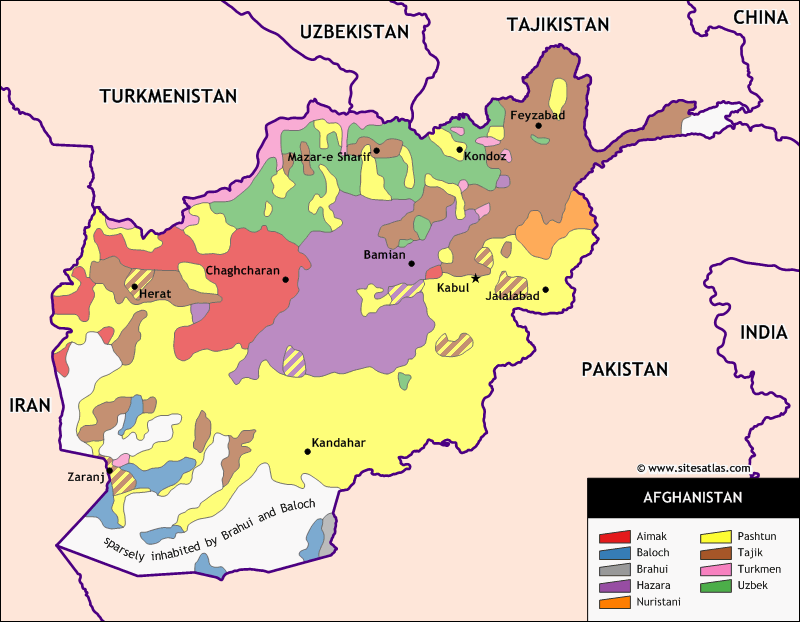
In the country’s politics, building a presidential majority is less about winning over individual voters on the basis of ideology, but about cobbling together a majority from among the country’s ethnic groups. Pashtuns, largely dominating the south and east of the country, constitute around 42% of the population, and as the most populous group, have typically dominated politics — in the royal era, the Soviet era, the Taliban era and the Karzai era since 2001.
afghanethnicity

Tajiks, however, are the most dominant group in Kabul and throughout Afghanistan’s northeast, constituting 27% of the population. Uzbeks, 9% of the population, predominate in the north-central part of the country and Hazaras, which constitute another 9% of the population, live in the central highlands of Afghanistan.

Ghani’s running mate, Abdul Rashid Dostum, is a leading Uzbek warlord, and Ghani had hoped to build a coalition based on winning the largest share of the Pashtun vote and bringing along the Uzbek vote as well.

You can see how ethnic ties play a role in the preliminary election results in this map from the indispensable website Electoral GeographyGhani was the top candidate in much of the Pashtun and Uzbek heartlands. Rassoul was the top candidate in the southern province of Kandahar, the home of the Karzais. Abdullah dominated the rest of the country, including the Hazara highlands, Kabul and the Tajik northeast.

afghanresults

Continue reading Did Abdullah just win the Afghan presidency?

Indian court ruling highlights women’s issues in election campaign

3491848697_b227df400d_b

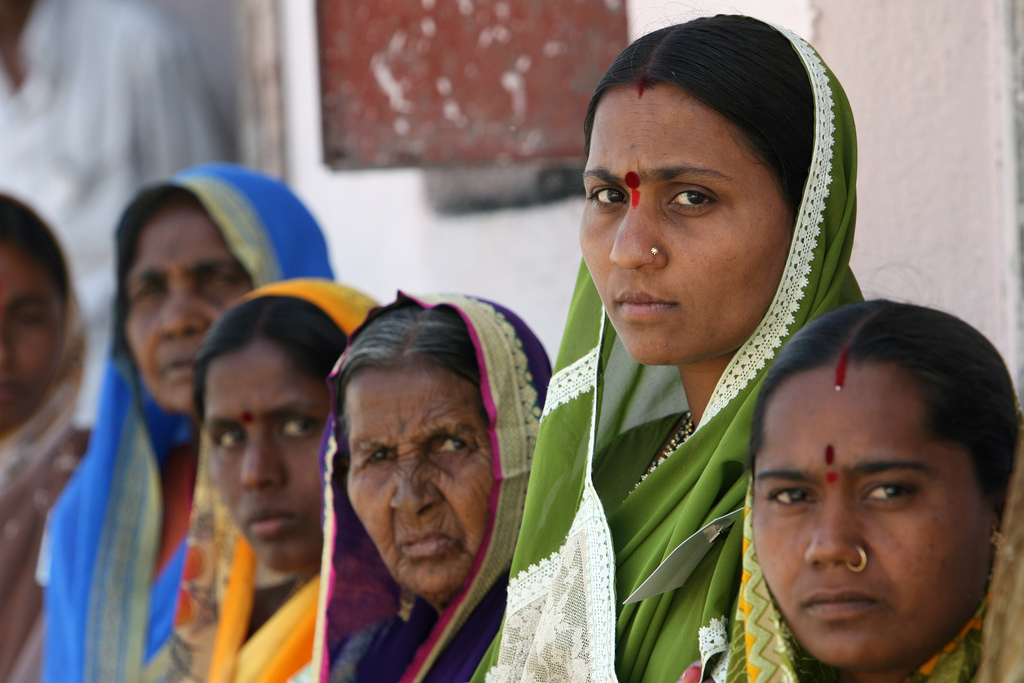
A decision earlier this week by a Delhi court that forcible sex between a husband and wife doesn’t constitute rape highlights an issue that has been increasingly part of India’s policy conversation during this campaign season — violence against women, in particular, and gender equality, more generally. India Flag Icon

The brutal rape and murder of a 23-year old in Delhi in December 2012 caused a national sensation and an outpouring of  sympathy and anger. The governing Indian National Congress (Congress, भारतीय राष्ट्रीय कांग्रेस) was immediately met with calls for legislation designed to increase urban safety for women and to institute stricter criminal penalties for rape. The girl, whose name was initially withheld from media reports, has come to be known by many pseudonyms, the most common of which is ‘Nirbhaya,’ which means ‘fearless one’ in Hindi.

In March 2013, following the conclusions of a panel committee established to consider legal reforms, India’s parliament enacted new, stronger anti-rape laws. Although the laws lengthened jail sentences for rape and related crimes and introduced the death penalty for repeat offenses, they also created new offenses, such as stalking and voyeurism, which weren’t previously illegal. The laws also expand the definition of rape, and they relax some of the burdens required for a conviction — for instance, a victim no longer has to prove physical struggle to show lack of consent.

Critics of the new laws argue that they still aren’t strong enough. For example, marital rape is still not illegal. Moreover, the legal reforms did nothing to address Section 377 of the Indian penal code, which criminalizes same-sex conduct, a statute that the Indian supreme court upheld last December, nor do they particularly address the challenges of transgendered Indians. (Though the Indian supreme court a month ago recognized transgender as a third gender category in a ruling that LGBT advocates hailed as a landmark decision.)

* * * * *

RELATED: Is there a potential parliamentary path to amending Section 377 in India?

* * * * *

Even as activists worry that the current government’s steps don’t go far enough, they also worry that a government led by Narendra Modi and the conservative, Hindu nationalist Bharatiya Janata Party (the BJP, भारतीय जनता पार्टी) could be even worse. Exit polls, though not incredibly accurate in the past, forecast a strong Modi victory when election results are announced on May 16.

* * * * *

RELATED: In-Depth: India’s Elections

* * * * *

Both Modi and Rahul Gandhi, who is leading the Congress election effort, have railed against sexual violence and invoked the memory of Nirbhaya in their campaign rallies. But whether you prefer Modi or Congress depends on your perspective about the roots and causes of sexual violence in India.  Continue reading Indian court ruling highlights women’s issues in election campaign

Veepstakes, Indonesia-style: Will Kalla return as vice president?

kalla

More than a month after Indonesia’s parliamentary elections, and with just less than two months until its presidential election, all eyes are on Jakarta governor Joko Widodo (most Indonesians refer to him simply as ‘Jokowi’), the frontrunner to become Indonesia’s next president. In particular, many Indonesians are watching to see who  he will choose as his running mate in the July 9 vote. Indonesia Flag

Under Indonesia’s somewhat arcane system, a party (or a coalition of parties) must win either 25% of the national vote in the April parliamentary elections or hold 20% of the seats in the Dewan Perwakilan Rakyat (DPR, People’s Representative Council) in order to nominate a presidential candidate.

No single party — not even Jokowi’s — managed to surpass that hurdle. That’s led to a series of behind-the-scenes negotiations among Indonesia’s major parties to sort alliances for the July election. It makes for a uniquely Indonesian version of ‘veepstakes,’ a term normally applied to the drawn-out process whereby US presidential nominees painstakingly select a running mate. Just as in the United States, the Indonesian media is watching Jokowi’s every move this week to divine clues as to his choice.

* * * * *

RELATED: ‘Jokowi effect’ falls flat for PDI-P in Indonesia
RELATED: Who is Joko Widodo?

* * * * *

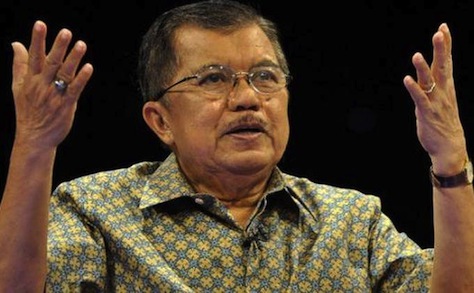
Among the more tantalizing names being floated is Jusuf Kalla (pictured above), who served as vice president in the first term of the outgoing incumbent, Susilo Bambang Yudhoyono, and who currently serves as president of the Indonesian Red Cross Society.

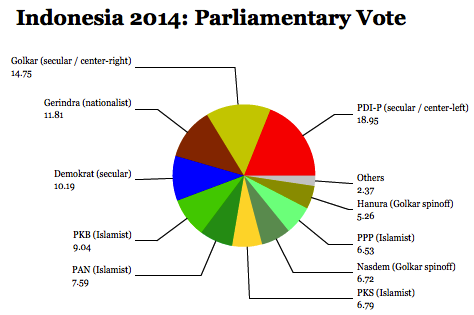
indonesia14

Final results from the election were announced late last week, and the presidential candidates have until May 18 to name their running mates, a decision that usually bridges two or more parties in alliance for the presidential elections. Jokowi is set to announce his own running mate on Friday. Continue reading Veepstakes, Indonesia-style: Will Kalla return as vice president?

Grybauskaitė headed for easy reelection as Lithuania’s president

grybauskaite

Though the disputed independence referenda in Ukraine’s troubled eastern oblasts attracted considerably more international attention, Lithuania also went to the polls on May 11 to elect a president.Lithuania Flag Icon

Dalia Grybauskaitė, the incumbent since 2009, easily led the first round with 46.61% of the vote, just shy of an outright victory, and she is almost certain to win reelection in the May 25 runoff against Zigmantas Balčytis, a member of the European Parliament, a former finance minister and, briefly for a month in 2006, acting prime minster. Balčytis is the candidate of the governing center-left Lietuvos socialdemokratų partija (LSDP, Social Democratic Party of Lithuania).

The runoff will coincide with elections for the European Parliament, where Lithuania holds 11 of its 751 seats.

Balčytis, a relatively uncharismatic candidate, won just 13.84% of the vote, however, only narrowly edging out Artūras Paulauskas, the candidate of the Darbo Partija (DP, Labour Party), who 12.20%.

Grybauskaitė, who lists the late British prime minister Margaret Thatcher among her political heroes, has been dubbed, somewhat unimaginatively, as Lithuania’s ‘Iron Lady,’ after amassing one of the most prolific political careers of any figure in post-Soviet Lithuania. A former finance official, Grybauskaitė served as Lithuania’s representative to the European Commission between 2004 and 2009, for much of that time as the commissioner for financial planning and the budget. As commissioner, Grybauskaitė worked to reduce agricultural subsidies from the European budget and she was responsible for passing the first such budget that held funding for the Common Agricultural Policy to below 50% of European funds for the first time in European Union history.

Upon returning to Lithuania, she easily won a first-round election running as a conservative independent against token opposition. Though Lithuania’s parliamentary government means that the prime minister is responsible for most of Lithuanian domestic policy,  Grybauskaitė holds a key role in setting foreign policy. She has championed Lithuania’s place in the heart of the European Union, the eurozone and in NATO, and she has fiercely resisted Russian designs on influencing its ‘near-abroad,’ especially during the most recent security crisis over the Russian annexation of Crimea and possible designs to influence eastern Ukraine.   Continue reading Grybauskaitė headed for easy reelection as Lithuania’s president

How the eastern Ukraine referenda relate to the May 25 election

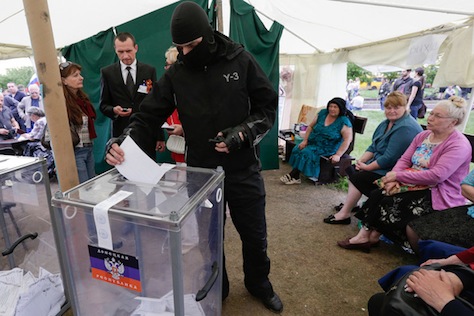
donetsk

It’s hard to know, especially from afar, how to interpret the weekend’s referenda in Donetsk and Luhansk oblasts in eastern Ukraine.Ukraine Flag Icon

According to the pro-Russian organizers, 89.07% of voters in Donetsk voted for ‘self-rule,’ on the basis of 74.87% turnout. In Luhansk, fully 96% of the electorate voted for ‘the declaration of state independence’ on the basis of a reorted 75% turnout. Those numbers are all disputed by Ukraine’s central government. 

Adding to the lack of clarity, the referendum questions themselves are vaguely worded, so no one knows exactly what the region’s voters elected to do.

In Donetsk, voters were asked, “Do you support the declaration of state independence of the Donetsk People’s Republic?” In Luhansk, voters were asked, “Do you support the declaration of state independence of the Luhansk People’s Republic?” The Russian word used for ‘state independence,’ samostoyatel’nost‘, means ‘standing by oneself,’ so no one really knows what the voters were actually asked to choose — it could mean anything from greater autonomy to full independence to, possibly, Russian annexation.

Interim Ukrainian president Oleksandr Turchynov declared the votes a ‘farce,’ and Western observers, including European leaders, have dismissed the referendum as illegitimate in its conception and fraudulent in its execution. Continue reading How the eastern Ukraine referenda relate to the May 25 election

India Lok Sabha elections: Phase 9

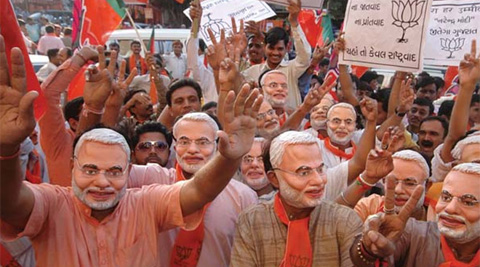
modisupportersm

Today marks the final phase of India’s election marathon.India Flag Icon

Voters in 41 constituencies will elect their members of the Lok Sabha (लोक सभा), the 545-seat lower house of the Indian parliament. After today’s voting, exit polls should give Indians (and the rest of us) the first indications of what the results might be, though they have been vastly wrong in the past. The official final results will be announced on Friday, May 16.

In particular, it’s the biggest day of voting in two of India’s most populous states. Uttar Pradesh will elect 18 of its 80 seats today, and West Bengal will elect 17 of its 42 seats. In addition, Bihar will elect its final six legislators.

In West Bengal, a state of 91 million Indians, chief minister Mamata Banerjee’s local All India Trinamool Congess (TMC, সর্বভারতীয় তৃণমূল কংগ্রেস) is set to win the biggest share of the vote after sweeping to power in the state’s 2011 elections and, in so doing, sweeping a 34-year communist government out of office in West Bengal.

* * * * *

RELATED: Mamata-Modi spat takes center stage in West Bengal

* * * * *

Nonetheless, the Communist Party of India (Marxist) (CP-I(M)) and the Left Front (বাম ফ্রন্ট) are expected to win a large share of the vote as well.

That leaves India’s two national parties, the governing, secular Indian National Congress (Congress, भारतीय राष्ट्रीय कांग्रेस) of Rahul Gandhi and outgoing prime minister Manmohan Singh, and the conservative, Hindu nationalist Bharatiya Janata Party (the BJP, भारतीय जनता पार्टी)  of chief minister Narendra Modi, both unlikely to make many gains in West Bengal.

Both Uttar Pradesh and Bihar will provide more fertile territory, especially for the BJP, which needs to win most of the 122 seats in those two states to have a chance at winning a majority government in the Lok Sabha.

In what might be the most watched constituency in India, Modi is battling Arvind Kejriwal, the former chief minister of Delhi, in the city of Varanasi (formerly Benares). Lying on the shores of the Ganges River, the city is known as India’s holiest, and it’s in the heart of Uttar Pradesh.

* * * * *

RELATED: Did Kejriwal err in resigning position as Delhi’s chief minister?

* * * * *

Kejriwal emerged as one of the most popular politicians in the country after his showing in the December 2013 elections in the National Capital territory. His newly formed Aam Aadmi Party (AAP, आम आदमी की पार्टी, Common Man Party) took power for 49 days, instituting popular policies from water and power subsidies to hotlines for reporting bribery. Kejriwal resigned, however, in February, when the territorial legislature refused to enact his jan lokpal bill that would have instituted mechanisms for reducing corruption.

Since leaving office, Kejriwal has led a national campaign for the AAP, hoping that he can recreate the same electoral magic nationally that he did six months ago. But there’s a general sense that Kejriwal made a mistake by resigning, and that his national campaign attempts to do too much in too little time. There’s a chance that it will backfire so much that the AAP might not even win a majority of Delhi’s seats to the Lok Sabha.

But in Varanasi, Kejriwal has waged an electrifying fight against Modi, who chose to contest  both the Varanasi constituency and in the Vadodara constituency in his home state of Gujarat. Continue reading India Lok Sabha elections: Phase 9