Tag Archives: liberal

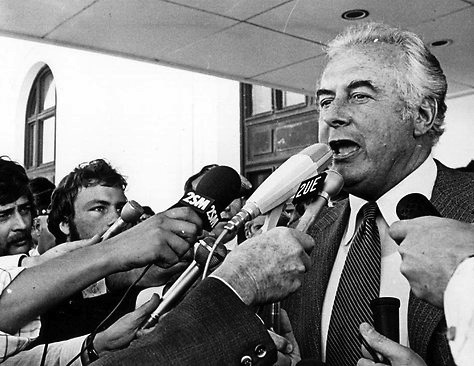
Remembering Gough Whitlam, Australia’s progressive martyr

whitlamPhoto credit to UPI/Bettman Newsphotos.

Gough Whitlam served as Australia’s prime minister for just three years, but the tumultuous Whitlam era gave the country its most severe constitutional crisis, a universal health care program,  diplomatic ties with the People’s Republic of China and a progressive statesman whose spirit continues to guide the Australian left today. Notably, his short-lived government was the only one headed by the center-left Australian Labor Party between 1949 and 1983.australia new

Whitlam, who died today at age 98, left office in 1975 after Australia’s governor-general, Sir John Kerr, controversially dismissed him as prime minister, transforming Whitlam into something of a martyr. Whitlam lived for nearly four decades to watch seven more prime ministers come and go, including the internecine battles between the two prime ministers from within his own Labor Party between 2007 and 2013, Kevin Rudd and Julia Gillard.

Whitlam personified the hope of the new post-war generation when he came to power in 1972, the first center-left prime minister in over two decades. Despite the opposition of the newly dethroned center-right Coalition of the Liberal Party and the Country National Party, Whitlam introduced a whirlwind of legislation. He  created a national healthcare system, Medicare (initially ‘Medibank’), abolished student university fees, eliminated the federal death penalty, withdrew Australian troops from Vietnam and, most controversially at the time, recognized Beijing over  Taipei. Within Australia, Whitlam delivered to the Northern Territory and the Australian Capital Territory representation in the Australian parliament’s upper house, the Senate, fought for environmental protections for the Great Barrier Reef (including a ban on offshore oil drilling) and delivered greater control over tribal lands in the Northern Territory for Australia’s indigenous population.

He introduced Australian, rather than British, passports and he replaced ‘God Save the Queen’ with an Australian national anthem. Decades later, he would team up with his former Liberal rivals to support an Australian republic in an unsuccessful 1999 referendum.

There’s no real direct analog to Whitlam in the United States, but you might think of him as Australia’s combination of John Kennedy, Lyndon Johnson and Jimmy Carter — all in one person and packed into three very tumultuous and very active years in office.  Continue reading Remembering Gough Whitlam, Australia’s progressive martyr

Liberals dominate New Brunswick vote

gallant

The cardinal rule of political prognostication in Canada is that provincial results can provide no guarantee of future performance.newbrunswickCanada Flag Icon

Nevertheless, Justin Trudeau must be feeling pretty good this week about the Liberal brand throughout Canada, after a strong Liberal victory in New Brunswick, the fourth consecutive Liberal triumph in provincial elections since Trudeau won the federal leadership in April 2013.

The New Brunswick victory follows a rout in Québec, where the Parti libéral du Québec (Liberal Party, or PLQ) won April elections under the leadership of former health minister Philippe Couillard, after just 18 months in opposition. It also follows elections in Ontario, where the provincial Liberal Party won a fourth consecutive term and a majority government under premier Kathleen Wynne in June.

Those follow a landslide victory last October in Nova Scotia and a come-from-behind win by the incumbent Liberals under premier Christy Clark in British Columbia last  May.

The Liberal Party last came to power in New Brunswick in 2006 when voters narrowly ousted two-term premier Bernard Lord, oft-mentioned in the early 2000s as a potential Conservative prime minister. But in 2010, voters turned against the Liberals and premier Shawn Graham after an ambitious four-year program designed to improve energy, education and health care.

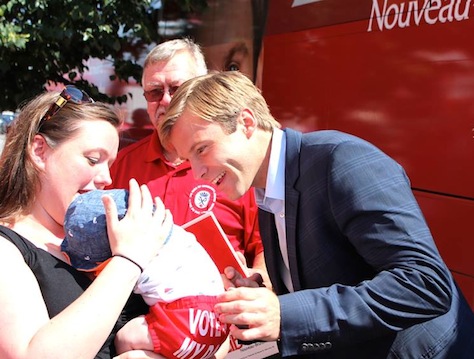
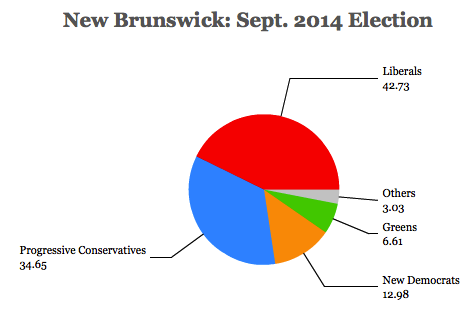
On Monday, however, New Brunswick’s voters rejected the Progressive Conservatives and premier David Alward. Under the leadership of the 32-year-old Brian Gallant (pictured above), who was just two years old when Trudeau’s father, Liberal premier Pierre Trudeau, left office in 1984, the Liberals have now returned to power. Liberals gained 14 seats to hold a total of 27 in the province’s legislative assembly, to just 21 for the center-right Progressive Conservatives and one for the Green Party’s leader David Coon, a historic breakthrough for a party whose two members of the Canadian House of Commons come from British Columbia.

newbrunswick2014

Gallant, who was predicted to win the September 22 election, despite polls showing a narrowing race in the days leading to the vote, promised to deliver more jobs and better roads and other provincial infrastructure.

All major parties, including the Liberals, supported the Energy East oil pipeline, which would link Albertan and Saskatchewan oil fields to Saint John, New Brunswick’s largest city on the southern coast along the Bay of Fundy. But while Alward vocally championed the development of shale gas exploration and ‘fracking’ within New Brunswick during the campaign, Gallant opposed fracking and, along with the Greens, supports a moratorium on fracking — for now.  Continue reading Liberals dominate New Brunswick vote

Revoking mining tax, Abbott dismantles Labor achievements

tonygoesmining

If the carbon trading scheme was the signature accomplishment of six years of Labor government, perhaps its second-most important policy achievement was the promulgation of a mining profits tax that came into effect in 2012.australia new

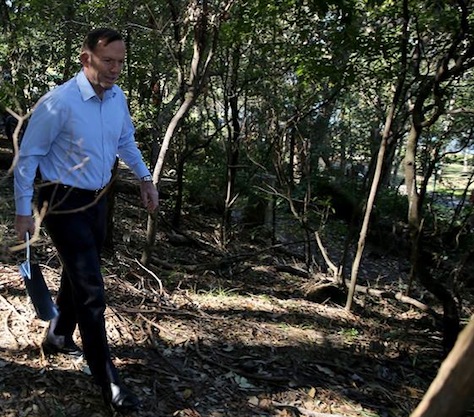
But a month after Australian prime minister Tony Abbott successfully scrapped the carbon scheme, he’s now also managed to repeal the mining tax as well, which levied a 30% tax on mining profits. Ironically, the tax failed to raise anything close to the projections that the Australian Labor Party hoped, due in part a slowdown in demand for Australian commodities as China’s economy decelerates. Eliminating the tax was one of the chief campaign pledges that Abbott made in his campaign to defeat Labor last September.

Nevertheless, with the decision by Australia’s Senate to scrap the tax by a margin of 36 to 33, Abbott will easily pass the repeal through Australia’s lower house, the House of Representatives, where Abbott’s Liberal Party / National Party coalition holds a more solid majority.

As with the carbon scheme, Abbott secured the legislative victory with the support of Clive Palmer, a former mining magnate, and his new Palmer United Party, an alternative to the center-left Labor and to the center-right Coalition. Palmer holds the party’s sole seat in the House of Representatives, but the PUP holds three seats in the Senate, making it a key power broker in enacting Abbott’s policy agenda.  Palmer himself is an often beguiling mix of ideologies, but he seems more at home on the right than on the left.

Palmer, who made millions as the owner of several coal and nickel interests, agreed to the repeal after securing the government’s support for several family-based initiatives. He also received a promise to freeze government contributions to Australia’s superannuation plan for nine years, forcing Abbott to rescind a campaign pledge, thereby halting a planned rise from 9% to 12% — employer contributions  are now capped at 9.5%.

* * * * *

RELATED: How Tony Abbott killed Australia’s carbon scheme

* * * * *

Under a policy introduced by former prime minister Paul Keating in the 1990s, agreed with business and labor unions, employers are required to make annual contributions to each employee’s ‘superannuation’ fund. The contribution level began at 3%, rose to 9.5% and was set to climb to 12% before the Abbott government’s latest decision, which would freeze contributions at 9.5% through 2025. That, in turn, has caused Keating and other Labor leaders to denounce the mining tax deal, arguing that it could derail the full potential of the superannuation program, which itself was designed to meet the rise of retirement-age Australians set to expand in the current decade and beyond.

Nevertheless, the deal leaves Labor in somewhat of a quandary under the leadership of former education minister Bill Shorten.

Australian voters aren’t exactly keen on Abbott’s government, which hasn’t had an incredibly easy first year in office — it’s been captive to small parties like Palmer’s in the Australian Senate and Abbott was also forced to shelve his plan to expand paid parental leave, one of his top campaign pledges last summer. 

But it makes the drama of the last Labor government even more pointless. It now seems less relevant than ever if Kevin Rudd or Julia Gillard was prime minister in 2010, because Abbott has, in about one month’s time, dismantled Labor’s two policy cornerstones. To have spent his first months as opposition leader railing impotently on the sidelines doesn’t make Shorten look like a prime minister in waiting, even as Abbott’s government suffers from its decisions on superannuation and paid parental leave.

How a bottle of wine brought down one of Australia’s top politicians

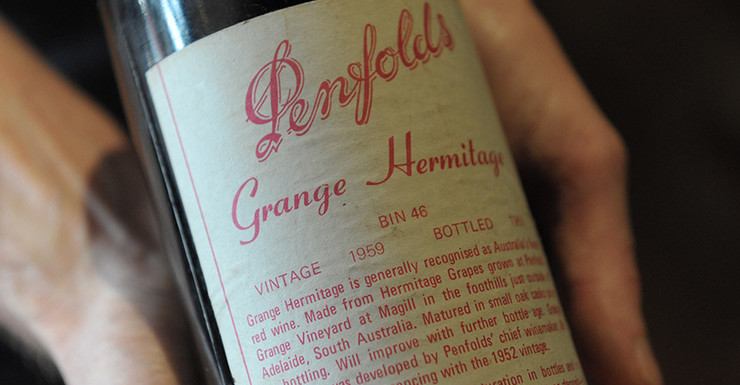
newdaily_170414_grange

In the end, all it took for Barry O’Farrell to lose his job as the premier of New South Wales, Australia’s most-populous state, was a $3,000 bottle of wine.australia newnew south wales flag

Though he came to power in 2011 in a landslide victory over the Australian Labor Party, O’Farrell resigned last week as premier after just three years in office and seven years leading the NSW division of Australia’s center-right Liberal Party.

O’Farrell, who appeared before the Independent Commission Against Corruption (ICAC), denied having received a gift bottle of 1959 Grange Meritage from  from an executive at Australian Water Holdings. Unfortunately for him, the commission had found a handwritten thank-you note to AWH’s CEO Nick Di Girolamo, which read:

Dear Nick & Jodie, We wanted to thank you for your kind note & the wonderful wine. 1959 was a very good year, even if it is getting even further away! Thanks for all your support. Kind regards, Baz & Rosemary.

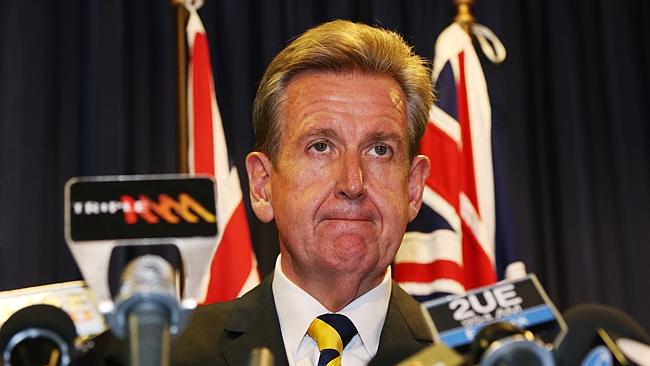
ofarrell

A day after the thank-you note came to light, O’Farrell (pictured above) claimed that, in a ‘massive memory fail,’ he had no recollection of the gift, but nevertheless announced his resignation.  He stepped down officially on Thursday, and the New South Wales treasurer Mike Baird became the state’s new premier the same day.

It’s a fairly well-trodden path for a politician caught in a bind like this — if you believe your position untenable, better to resign as early as possible, take credit for ‘falling on your own sword,’ and hope for future rehabilitation via the private sector or, in time, a political sinecure. Sure enough, at the end of the week, Liberal prime minister Tony Abbott was praising O’Farrell for having ‘taken the honorable step’ of resigning.

O’Farrell’s resignation came so fast that some commentators wondered whether he did so because he realized more revelations would come out through the commission’s investigation.

In political terms, his resignation is unlikely to dent Abbott’s Liberal/National Coalition government. But it turns state politics upside down in New South Wales, home to 7.3 million Australians — nearly one-third of the country’s entire population. Continue reading How a bottle of wine brought down one of Australia’s top politicians

Despite CETA signing, Harper’s 2014 agenda remains unambitious

barrosoharper

Canadian prime minister Stephen Harper today celebrated the signing of a landmark free-trade deal between Canada and the European Union, bringing to fruition one of the top accomplishments that Harper can claim since taking office with a minority government in 2006 and a majority government in 2011. Canada Flag Icon

Although the pact won’t be ratified until 2015, the Comprehensive Economic and Trade Agreement (CETA) removes tariffs between Canada’s economy and the $17 trillion economy of the European Union, which comprises 28 countries and over 500 million people.  Together with the North American Free Trade Agreement (NAFTA), it will give Canada exclusive access to more than half of the global economy.  CETA will allow Canadian automakers to export 12 times as many automobiles to Europe, and it will fully open the EU market to Canadian fruits, vegetables, wheat, grains and dairy, while removing tariffs on European wine and spirits, all seafood, metals and minerals (including steel and iron) and up to 29,000 tonnes of European cheese.  Furthermore, Harper is considering granting compensation to Canada’s dairy producers, especially in Québec, if they lose revenue in the wake of the agreement.

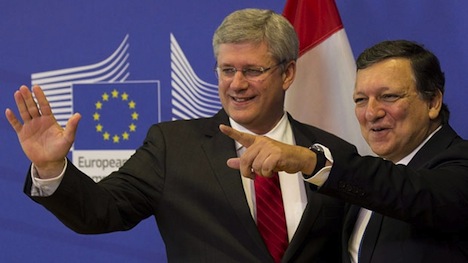
What’s more, Harper (pictured above with European Commission president José Manuel Barroso) will be able to brag that his vision for a Canadian-European free trade agreement served as a precedent for the Transatlantic Trade and Investment Partnership (TTIP) still being negotiated between the United States and the European Union.

At a time when the Liberal Party has emerged from the brink of political oblivion with the selection of its popular, telegenic leader Justin Trudeau, to lead polls in advance of the 2015 election — an iPolitics/EKOS poll earlier this week gave the Liberals 36% support to just 26% support for Harper’s Conservative Party and 25% for the social progressive New Democratic Party — the completion of CETA and its ratification gives Harper three domestic policy wins.

First, it’s perhaps his most significant policy accomplishment in seven years.  Second, not only does it give him a substantive accomplishment, it gives him one that bolsters the case that he’s dedicated to creating jobs and strengthening Canada’s economy, and it provides a contrast to Trudeau’s often wishy-washy blather.  Third, it hoists a difficult choice on the NDP — support the CETA and anger labor unions, especially within its new Québécois stronghold; or oppose to CETA to draw a stronger contrast to Trudeau’s newly invigorated Liberals.

But don’t expect much more in the way of ambition from Harper’s government this year.

The agreement comes after the reading of Harper’s 2013 Throne Speech, much of which constituted a victory lap detailing Canada’s superior employment and economic record compared to its developed-world peers, such as the United States and the European Union, where political instability, stagnant GDP growth and joblessness have been more acute.  While Harper hopes to pass a law requiring balanced budgets in the future, it’s unclear whether he can actually pass a bill through Canada’s parliament or that future governments would keep it in place.

The rest of Harper’s agenda amounted to an odd mix of populist consumer protection schemes:

The government promised to “take steps to reduce roaming costs” for cellphone users. It says it will take action so that cable and satellite customers can “choose the combination of television channels they want” by “unbundling” channel packages. And it promised to move on “hidden fees,” including making it so that “customers won’t pay extra to receive paper bills.” If this part of the agenda reads like it was pilfered from the NDP, that’s because to some extent it was.

It’s puzzling for a market-oriented party like the Tories to prioritize these kind of measures — services like Netflix and Hulu are already, in part, helped to unbundle television packages through market forces.  Roaming costs for Canadian users are already coming down due to market pressures.  So many of the consumer goals Harper listed are likely to come about through the market without the need for government interference.

It’s equally baffling to know how Harper will reduce ‘geographic price discrimination,’ his term for the price differential between consumer goods sold in Canada and the United States. Presumably, if the price difference is enough, Canadians (90% of whom live within 100 miles of the US border) will make a trip down south to buy them at cheaper prices, or enterprising entrepreneurs will find a way to undercut them — especially in the world of e-commerce.

But even more, it’s small ball.  It’s the Canadian equivalent of former US president Bill Clinton’s much-derided 1995 agenda of school uniforms and ‘v-chips.’  Though consumer protection initiatives aren’t nothing, it’s hardly the kind of bold, conservative agenda that you might have expected Harper to champion upon coming to power seven years ago, and surely not what you’d expect from a government just two years after finally capturing a majority government.

John Ivison, writing in The National Post, likened the Throne Speech to ‘a botox treatment gone bad’:

The Throne Speech is littered with examples of the government wading into sectors of the economy to “fix” problems that should be left to either the market or the existing regulators — all to the detriment of millions of Canadian shareholders.  It’s all so transparent and light as tinsel.

But it’s not just this year’s Throne Speech.

Aside from CETA, it’s hard to point to any truly groundbreaking, signature legislative acts in the Harper era.  Sure, the government reduced the rate of the Goods and Services Tax from 7% to 5% by January 2008, and it will likely balance Canada’s budget by 2015.  But those accomplishments, significant as they are, won’t be remembered in 50 or 100 years in the same way that CETA could be remembered.  Continue reading Despite CETA signing, Harper’s 2014 agenda remains unambitious

Shorten set to lead Australian Labor through its wilderness period

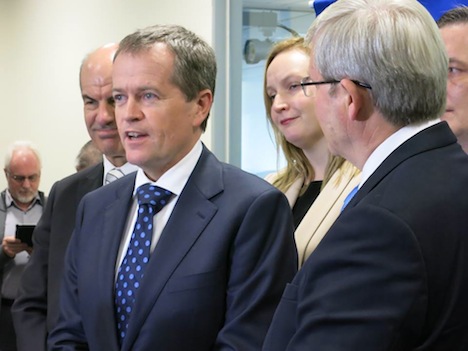
shorten

Hardly a month after the Australian Labor Party lost its bid for a third consecutive term in power under former prime minister Kevin Rudd, Australia’s chief center-left party has a new leader — Bill Shorten.Australia Flag Icon

But Shorten, who won the leadership without the support of the party’s rank-and-file membership, will face an immediate showdown with prime minister Tony Abbott over scrapping Australia’s carbon pricing scheme, which in turn could lead to early ‘double dissolution’ elections within months that would favor Abbott’s Liberal Party (which governs in coalition with the National Party) — and that could see Labor switch leaders just as easily.

Shorten has his work cut out for him.

For now, however, the leadership victory caps a meteoric rise for Shorten (pictured above), who came to national prominence as the head of the Australian Worker’s Union between 2001 and 2007, when he was first elected to the House of Representatives on the wave that brought Rudd and Labor to power.  As the AWU’s national secretary, Shorten attained national prominence for his role during the Beaconsfield mine collapse in Tasmania in 2006.  Reelected in 2010, he was appointed minister for financial services and superannuation under prime minister Julia Gillard, and he took on the workplace relations portfolio in 2011.  Shorten, who supported Gillard when Labor kicked Rudd out of office in June 2010, played a key role in backing Rudd in June 2013 when an increasingly desperate Labor Party caucus believed Gillard would lead them to an electoral disaster, and Shorten served for two and a half months under Rudd in 2013 as education minister.

But even under the more popular Rudd, Labor still lost the September 2013 elections, and the Coalition won a solid (if not quite landslide) victory, Gillard left parliament last June, and though Rudd was narrowly reelected in his Queensland district, no one expects him to play much of a role going forward — and if he follows the well-trod path of former prime ministers, Rudd will step down from parliament sometime within the next year.

Picking up the pieces of a defeated Labor Party — and facing down the conservative Abbott government — now falls to Shorten, who will benefit from a fairly united Labor Party supporting him.  He certainly won’t face the toxic interpersonal, intraparty Rudd-Gillard schism that plagued Labor when it was in government, and new party rules adopted when Rudd most recently returned to the leadership mean that it will be especially difficult to remove Shorten from power.

In addition to the new rules for the leadership contest (described below), a 60% supermajority of the Labor parliamentary caucus (or 75% in government) is now required to remove a leader.  That should slow Labor’s propensity to change leaders with such frequency — at least, unless Labor decides to change the rules to lower the threshold.  The rules change dates not only from the poisonous Rudd-Gillard rivalry that so damaged Labor’s last stint in government — Labor went through five leadership changes the last time it was in opposition: former deputy prime minister Kim Beazley from 1996 to 2001, Simon Crean from 2001 to 2003, Mark Latham from 2003 to 2005, Beazley (again) from 2005 to 2006, and finally, Rudd until the successful 2007 election.

In the most recent leadership race, Shorten faced former deputy prime minister Anthony Albanese in Australia’s first dual leadership ballot — unlike prior leadership spills determined solely by the parliamentary caucus, the new rules require that the Labor caucus and the rank-and-file party membership hold dual votes — each vote has 50% weight in determining the final result.

That means that a leader can be elected despite losing a majority of the Labor caucus or of the Labor party membership and, sure enough, that’s what happened in the first contest under the new rules.  While Shorten, traditionally Labor’s right wing, won 55 of the 86 Labor MPs (62.95% of the Labor caucus), Albanese, from Labor’s left wing, won 59.92% of the rank-and-file vote.  So although Shorten lost the party membership by a wide margin, he won the combined vote with 52.02% due to his superior strength among Labor’s MPs.  Continue reading Shorten set to lead Australian Labor through its wilderness period

Nova Scotia Liberal landslide an omen for federal Canadian politics?

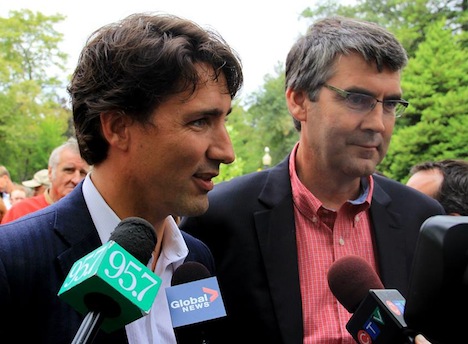
trudeaumcneil

No one will say it’s exactly the blockbuster story of the year, but it’s worth taking note of the landslide victory of the Nova Scotia Liberal Party last night in Atlantic Canada’s most populous province.

Canada Flag Iconnova scotia

Take all the usual caveats — provincial politics is very different from federal politics, and the federal Liberal Party is not the same as the Nova Scotia Liberal Party.  The federal Conservative Party is certainly not the same as the Nova Scotia Progressive Conservative Party.  And the federal New Democratic Party remains in the opposition, while the NDP in Nova Scotia was defending a provincial government.

But the general landscape still mirrors the federal political scene in a way that makes Nova Scotia a better bellwether than other provinces, unlike in Québec, where provincial politics really does revolve around a different axis of policy issues.  Or in the Canadian west, where the Progressive Conservative party in Alberta is the more center-left of the province’s two main parties, the Liberal Party in British Columbia is the center-right option, and where the conservative provincial party is simply the Saskatchewan Party.  The NDP’s 2009 landslide in Nova Scotia in many ways presaged the ‘orange wave’ in the federal 2011 election, wherein the federal NDP far surpassed the Liberals to become Canada’s second-largest political party and the official opposition.

Under leader Stephen McNeil, the Liberals won more support (45.52%) than any party in a Nova Scotian provincial election since 1993, and the Liberals will hold 33 seats in the 51-member Nova Scotia House of Assembly.  That’s even more than the New Democrats, under outgoing premier Darrell Dexter, won (31) in the 2009 election.

Dexter lost his own seat by a slim margin, and the NDP’s caucus will be reduced to just seven seats on 26.90% of the vote.  The Progressive Conservatives, who controlled the provincial government between 1999 and 2009, won just 11 seats on 26.39% of the vote.

But it’s really hard not to see Stephen McNeil’s win as the first electoral evidence that the Liberals are back — and running strong.

McNeil and the Liberals were leading polls to return to government in Nova Scotia long before Justin Trudeau was anointed as the federal Liberal leader and all but prime minister-in-waiting.  But McNeil (pictured above, right, with Trudeau, left) looks like he could be Trudeau’s older brother.

There were other lessons from Halifax for federal Canadian politics, too.  It was somewhat of a relief for pollsters to have forecasted the results more or less accurately after virtually no one foresaw two high-profile recent upset victories — in Alberta in April 2012 and in British Columbia in May 2013.

It’s also a harbinger for Conservative prime minister Stephen Harper.  In Alberta, where voters gave the benefit of the doubt to the Progressive Conservatives and reelected premier Alison Redford, the unemployment rate is 5%.  In British Columbia, voters reelected premier Christy Clark and gave the Liberals a fourth consecutive term of government, the unemployment rate is 6.7%.  Nova Scotia, without the rich mineral wealth that has resulted in a boom for western Canada, unemployment is running at 9%.  That’s not a fact that will be lost on Harper, whose Tories have now fallen behind the Trudeau-era Grits in national polls.

The national unemployment rate (7.2%) lies somewhere in between the two extremes.  The Canadian economy is marking equivalent or slightly higher GDP growth than the United States and in 2011, Canadian voters rewarded Stephen Harper for steering Canada through the global financial crisis without the staggering bank failures, the ragged political strife or the soaring unemployment that the United States suffered.  For Harper to win in 2015, he’ll need more voters who feel like Albertans and British Columbians than Nova Scotians.

Three lessons that Nova Scotia’s provincial election can teach us about Canadian politics

CIMG0662

Voters in the heart of Atlantic Canada will go to the polls tomorrow to determine the fate of the first New Democratic provincial government in the history of the Maritimes. nova scotiaCanada Flag Icon

Polls show that, under the weight of a patchy economy and low job creation, Nova Scotians will reject premier Darrell Dexter’s historic NDP government in favor of a Liberal Party government under Stephen McNeil — the Liberals hold a lead of between 15% and 20% in advance of the October 8 election, and voters prefer McNeil as Nova Scotia’s next premier by a slightly smaller margin.

While it may not be as populous as Ontario, Québec or British Columbia, Nova Scotia — with just under 3% of Canada’s population — is still the largest province in Atlantic Canada, which historically has a different cultural, political and economic orientation from the rest of Canada.  With an economy that once roared in the 19th century (on the basis of shipbuilding and transatlantic trade), Atlantic Canada now features some of the most stagnant economies within Canada, and regional unemployment runs highest in the Maritimes.  Despite some economic growth in Halifax, Nova Scotia’s capital and the largest metropolitan area in Atlantic Canada, the province’s 8.7% unemployment rate is still higher than Canada’s national 7.1% average.

Atlantic Canada, notably New Brunswick, was the last refuge of the old Progressive Conservative Party before it merged with Stephen Harper’s western-based Canadian Alliance in 2003 to form the Conservative Party that governs Canada today.  In the 2001 federal Canadian election, the PCs won nine of their 12 seats in the House of Commons from within Atlantic Canada.  Even today, Atlantic Canada remains home to a certain kind of Conservative politics — more moderate and less ideological — and the local center-right provincial party still calls itself the Progressive Conservative Party (remember that in Canada, there’s a brighter line between national and provincial political parties).  Before Harper came to power in 2005, Tories placed their hope to retake national power in former New Brunswick premier Bernard Lord; Nova Scotia MP Peter MacKay led the PCs into their merger with the Alliance a decade ago, and he served as Harper’s defense minister for six years before a promotion this summer to justice minister.

The fate of the old Progressive Conservatives might have been foreboding to the national Liberal Party as well.  In the most recent 2011 Canadian election, in which the once-mighty Liberals lost all but 34 of their seats in the House of Commons, the Liberals won 12 of them from Atlantic Canada — again, a party struggling for relevance nationally found refuge in the Maritimes.  But while the Progressive Conservatives ultimately faded into Harper’s wider conservative movement, the election of Justin Trudeau as the party’s national leader earlier this transformed the Liberals from a spent, third-place political force into something like a government-in-waiting.

So even though Nova Scotia is small, it can also be a bellwether for larger trends.

While Trudeau’s leadership has breathed new life into the Liberal brand (even at the provincial level), McNeil and the Nova Scotia Liberals held a wide lead over the NDP in the province long before Trudeau’s national ascent.  It’s a remarkable turnaround from the June 2009 provincial elections when the NDP swept to power with 45.24% of the vote, winning 31 out of the 52 seats in the Nova Scotia House of Assembly and ending a decade of Tory rule in the province — a victory that presaged the NDP’s 2011 federal breakthrough under its late leader Jack Layton.

Keeping all of that in mind, here are three areas to keep an eye on in the wake of tomorrow’s election that could presage trends over the next two years of Canadian politics more generally: Continue reading Three lessons that Nova Scotia’s provincial election can teach us about Canadian politics

Austrian NEOS may win seats in Nationalrat in resurrection of liberal politics

NEOs

While Germany’s major liberal party suffered a historic defeat in last weekend’s parliamentary elections, a new Austrian party may win enough seats to return a liberal voice to Austria’s parliament for the first time in nearly 20 years in Austria’s national elections this weekend.austria flag

If it can win 4% of the vote on Sunday, the Das Neue Österreich (NEOS, The New Austria) could enter the Nationalrat, the key 183-member chamber of Austria’s parliament, which would mean that free-market and social liberals would have a voice in Austrian parliamentary politics for the first time since the Liberales Forum (Liberal Forum) lost all of its seats in the 1999 parliamentary elections.  Polls in the lead-up to Austria’s election show the NEOS gaining strength, but still hovering between 3% and the 4% electoral hurdle, and the NEOS continues to gain credibility and momentum in the final days of the campaign.

What’s more, if the NEOS enter the parliament, and the two current governing parties, the center-left Sozialdemokratische Partei Österreichs (SPÖ, Social Democratic Party of Austria) of chancellor Werner Faymann and the center-right Österreichische Volkspartei (ÖVP, Austrian People’s Party), fail to win an absolute majority of seats to continue a two-party grand coalition, the NEOS could conceivably enter government as well in Europe’s first ‘red-black-pink’ coalition.

Given the coziness of Austria’s political elite, and the fact that grand coalitions have dominated Austrian governance in the postwar era, there’s much to recommend the return of a fresh and liberal voice to Austrian politics — or even Austrian government.  Not too shabby for a party that didn’t exist one year ago.

The NEOS were founded as a political party in October 2012, mainly as an alliance of what remains of the Liberal Forum and the Young Liberals, another small party, under the leadership of Matthias Strolz.  Since September, the party’s lead parliamentary candidate has been Hans-Peter Haselsteiner, the CEO of Austrian construction company Strabag and a Liberal deputy in the Nationalrat in the 1990s — it was a stunning reversal for Haselsteiner, who had previously remained somewhat aloof from the NEOS earlier this year.  Not only does Haselsteiner have the deep pockets to finance a strong showing, he’s also one of the most well-known liberals in the country.  Austrians vote for parties through an open-list proportional representation system, so if the NEOS surpass the 4% threshold, the NEOS should count on at least seven seats in the Nationalrat.

Moreover, if the NEOS do enter the Nationalrat, they could lower the total number of seats that the SPÖ and ÖVP can hope to win, making it even more likely that the SPÖ and ÖVP will be forced to look for a third coalition partner to cobble together a governing majority.

In an ironic twist, the NEOS could well enter Austria’s parliament just days after Germany’s Freie Demokratische Partei (FDP, Free Democratic Party) narrowly failed to win 5% of the vote and, accordingly, Germany’s liberal party failed to win a single seat in the Bundestag, the lower house of Germany’s parliament, for the first time since 1949.  Continue reading Austrian NEOS may win seats in Nationalrat in resurrection of liberal politics

At the dawn of the Abbott era of Australian politics, what comes next?

abbotthockey

You’d be excused if you thought that Australian prime minister Kevin Rudd’s concession speech earlier today sounded more like the victory speech of a man who had just won the election.Australia Flag Icon

In a sense, Rudd did win the battle against expectations — just barely.  Even though Rudd will soon become a former prime minister and has already announced he will step down as the leader of the center-left Australian Labor Party, he can breathe a sigh of relief that Labor did not fare as poorly as some worst-case scenarios projected — either under Rudd’s return to the leadership or under former prime minister Julia Gillard.  So Rudd was probably right to gloat in his speech that he preserved Labor as a ‘viable fighting force for the future.’  What Rudd didn’t have to say was his belief that Gillard would have led Labor to an absolute collapse.

With three seats left to be determined, the center-right Coalition government led by Liberal Party leader Tony Abbott has 91 seats in Australia’s  150-member House of Representatives to just 54 seats for Labor and two independents, with Adam Bandt, the sole MP of the Australian Greens, holding onto his Melbourne seat despite a strong Labor push.  That’s a very strong victory for Abbott, who has picked up 18 seats, but it’s not a historic landslide — four of those gains come from seats formerly held by independents.

Rudd, on the other hand, can claim that his three-month leadership of the party helped avert a catastrophe, though we’ll never know whether Gillard would have done better or worse (and there are some reasons to believe that Labor should have simply stuck with Gillard through September).

You can get all of the seat-by-seat results here, and you can read the pre-election analysis of the marginal seats here.

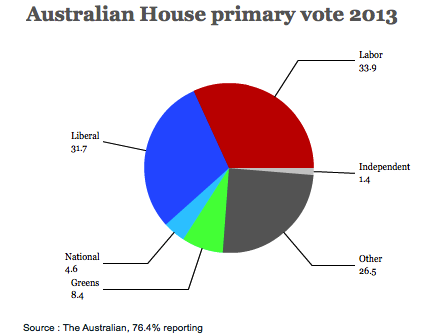
Here’s the result of the primary vote count:

primaryvote

The most striking piece is that more than one of every four voters chose as their first preference someone other than a Labor, Coalition or Green candidate, and it corroborates that the election was more a statement of disapproval of the Rudd-Gillard governments than an embrace of Tony Abbott.

So what comes next?  Within a week, Abbott will likely become Australia’s new prime minister.  What does that mean for Australian politics?  Continue reading At the dawn of the Abbott era of Australian politics, what comes next?

What should Australia expect from prime minister Tony Abbott?

abbott

Before the Kevin and Julia show, there was the Tony and Malcolm show.Australia Flag Icon

The rivalry between the dueling camps of Labor prime minister Kevin Rudd and former Labor prime minister Julia Gillard is now legendary — Rudd came to power in November 2007 after waging a near-perfect campaign (‘Kevin 07’) that brought the Australian Labor Party back to power after over a decade in opposition.  But his deputy prime minister Julia Gillard became prime minister in June 2010 after Rudd’s parliamentary colleagues wearied of his leadership style.  Gillard led Labor to the narrowest of reelections in August 2010 in what remains a hung parliament.  Rudd, who returned to government as Gillard’s foreign minister shortly after the election, challenged Gillard for the Labor leadership in February 2012 — and lost.  But as Gillard’s poll standing deteriorated throughout 2013, Rudd’s supporters engineered another vote in June 2013, and so Rudd (not Gillard) is leading Labor into Australia’s election on Saturday.

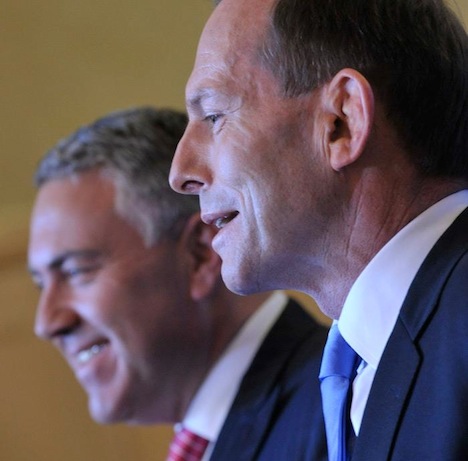
What’s less well-known is that opposition leader Tony Abbott (pictured above) emerged as the leader of the Liberal Party (and the center-right Liberal/National Coalition) after engineering a leadership spill of his own in December 2009.  After former prime minister John Howard lost his seat in the 2007 election, the Liberals turned initially to Brendan Nelson, but finally to Malcolm Turnbull as its leader in 2008.  But when Turnbull pushed his party to support the Labor government’s carbon reduction scheme, Abbott challenged Turnbull and improbably won a 42-41 victory on the second ballot, giving the Liberals their fourth leader in three years.

It’s an understatement to say that Abbott has proven a hard sell to the Australian public — in some ways, Abbott is akin to the Barry Goldwater or even the Ronald Reagan of Australian governance, a conviction politician and a conservative’s conservative who will undoubtedly pull Australia to the right.

A staunch Catholic who once studied in seminary for a career in the church (nicknamed early in his career by the press as the ‘Mad Monk’), a boxer with plenty of appetite for aggression in Australia’s House of Representatives, and a conservative who once studied at Oxford on a Rhodes scholarship, Abbott is multifaceted and talented.  But there’s no doubt that he’s socially and economically more conservative than Turnbull, Howard or Malcolm Fraser (prime minister from 1975 to 1983).  Abbott also had more ties to the recently rejected Howard government than Turnbull, having served as employment minister from 1998 to 2003 and health minister from 2003 to 2007.  Australian voters remained too hesitant about Abbott to hand the government back to the Coalition in 2010, but just barely.  Today, the Coalition holds one more (72 to 71) seat than Labor in the  House of Representatives, but independents and the Australian Greens have provided the Gillard/Rudd government a 76-74 majority since 2010.  It’s a similar story in the Senate, where the Coalition already holds a 74 to 71 advantage over Labor, which governs with the support of nine Green senators.

Just as Rudd routinely garnered higher approval ratings than Gillard between 2010 and 2013, Turnbull posted higher ratings as well.  Commentators in early 2013 daydreamed over the possibility that both of Australia’s major parties would dump their unpopular leaders in favor of their more charismatic alternatives.

But while Rudd and Gillard plotted and schemed over leadership, dragging Labor’s government and Australia into what amounted to a personality contest, Turnbull refrained from challenging Abbott for the Liberal leadership.  The difference between the Labor approach and the Liberal approach is one reason why Abbott is a certain favorite to become Australia’s next prime minister.

Since returning as prime minister in June, Rudd has spent most of his time flailing — although a Newspoll survey showed Rudd’s Labor tied with Abbott’s Coalition as recently as July 8, Labor now trails the Coalition in the two-party preferred vote (i.e., after all third-party voter preferences have been distributed to Labor and the Coalition) by a 54% to 46% margin, according to the latest September 1 Newspoll survey.

But Rudd’s campaign has managed to do what even Gillard’s government could not — turn Abbott into a plausible prime minister.  For the first time in the campaign, more voters prefer Abbott as prime minister (43%) than prefer Rudd as prime minister (41%) — that’s an astounding turnaround, given that an early August poll showed that voters widely preferred Rudd to Abbott by a 47% to 33% margin.  Ironically, though Rudd was supposed to be Labor’s secret weapon in winning a third term in power, Abbott has so completely transformed his image through the course of the campaign that Rudd may now be saddled with the kind of landslide defeat that terrorized his Labor colleagues into sacking Gillard just three months ago.

If Abbott delivers the kind of victory that polls predict on Saturday, it will be in large part due to the self-destructive factional battles within Labor, but it will also have much to do with Abbott’s steady happy-warrior approach over the past four years.

So what will Abbott’s likely win mean for Australia as a matter of policy, beyond the presumable end to the instability of the Rudd-Gillard era?

Here’s a look at seven issues to keep an eye on in what’s become an increasingly likely Abbott government. Continue reading What should Australia expect from prime minister Tony Abbott?

Rudd stakes reelection bid on passionate same-sex marriage support

ruddmarriage

Behind in the polls, despite the fact that supporters engineered his return as prime minister earlier this summer to boost the Australian Labor Party’s reelection hopes, Kevin Rudd is increasingly depending on his support for same-sex marriage to encourage young, urban voters not to abandon him in favor of the center-right coalition headed by Liberal Party leader Tony Abbott.Australia Flag Icon

In a passionate plea on the campaign trail, Rudd confronted an opponent of same-sex marriage by arguing that supporting marriage equality is fully compatible with Christian faith, in one of the most memorable moments of the 2013 Australian campaign — and one that’s largely won cheers from Australians and same-sex marriage enthusiasts globally:

Challenged by a pastor on a Q&A programme on Monday night as to why as a Christian he did not follow the teaching of the Bible, that marriage was between a man and a woman, Rudd replied: “If I was going to have that view, the Bible also says that slavery is a natural condition because St Paul said in the New Testament ‘slaves be obedient to your masters’, and therefore we should all have fought for the confederacy in the US civil war.”

He added: “I mean, for goodness sake, the human condition and social conditions change. What is the central principle of the New Testament? It is one of universal love, loving your fellow man.”

It’s something worth watching in full:

While it might be a ‘West Wing’ or ‘prime ministerial’ moment for Rudd, it’s also perhaps one of the last tricks up Rudd’s sleeve to galvanize Labor enthusiasm ahead of Saturday’s vote — and to plant doubts about the social conservatism of an Abbott-led government.

Unfortunately for Rudd and proponents of same-sex marriage, most polls show that on the two-party preferred vote (Australians rank their preferred parties), Labor faces a 52% to 48% defeat.  Although marriage equality has become one of the top issues in the election, it’s not nearly the only issue in the campaign — it joins Australia’s weakening economy, budget issues, how to handle the ever-growing influx of asylum-seekers, relations with Asia, a controversial Labor carbon tax, and paid parental leave, not to mention the stability, discipline and maturity of a Labor government that, over two terms, has purged a sitting prime minister twice.

Although Rudd has only came to the view that gays and lesbians should have the same marriage rights as other Australian couples, he campaigned in the 2007 election on greater marriage equality and enacted reforms in December 2008 as prime minister that delivered the same rights to ‘de facto partners’ as those enjoyed by cohabiting opposite-sex couples that included many of the key rights that married couples enjoy on joint taxation, inheritance, employment and entitlement.

After losing the prime ministership in June 2010 after an internal Labor revolt against his leadership style, Rudd returned three months ago after polls showed that Labor faced a catastrophic loss under former prime minister Julia Gillard.  In that time, Rudd has not only become the first sitting prime minister to support marriage equality, but announced in the campaign’s first debate against Abbott that he would call a ‘conscience vote’ on same-sex marriage within 100 days of reelection.  Although Abbott supported the reforms to provide same-sex partners with ‘de facto partner’ rights in 2008 and Abbott has a lesbian sister, he has insistently ruled out the possibility that a Liberal/National Coalition government would enact marriage equality.

Feisty debate leads Abbott to ask Rudd, ‘Does this guy ever shut up?’

Screen Shot 2013-08-21 at 12.23.04 PM

The consensus is that prime minister Kevin Rudd, behind narrowly in the polls, had a better performance in the second leaders’ debate earlier in Brisbane, turning his underdog status as a way to poke holes in the platform of his rival, opposition leader Tony Abbott.Australia Flag Icon

At one point, Rudd harped so much about the cuts that Abbott might make as prime minister that Abbott snapped, ‘Does this guy ever shut up?’

It’s a sentiment many of Rudd’s rivals — from former Liberal/National Coalition prime minister John Howard to Labor prime minister Julia Gillard, who Rudd deposed as Labor leader only in June.

But Rudd’s tenacity resulted in at least one major concession from Abbott — that Abbott’s plan to cover the costs of a $5.5 billion paid parental leave scheme are insufficient.

Rudd parried with Abbott on the carbon tax that Rudd initially championed, Gillard ultimately enacted and Abbott hopes to repeal.  Rudd warned Abbott that the rest of the world, including the People’s Republic of China, is moving toward Australia’s carbon scheme — China launched its first experimental carbon scheme earlier this year in Shenzhen.

Rudd returned to his pledge from the first debate to introduce a bill legalizing same-sex marriage if Labor wins a third consecutive term, and Abbott reiterated his opposition to marriage equality, however gingerly — Abbott’s sister is gay:

All I can do is candidly and honestly tell people what my view is. I support the traditional definition of marriage as between a man and a woman. I know that others dispute this, because I have lots of arguments inside my own family on this subject now.

The two also bickered over asylum policy, an issue upon which Rudd and Gillard have now both made such a 180-degree turn that Labor’s policy on granting asylum to migrants who attempt to arrive in Australia by boat is now much tougher than the Howard government’s policy in the mid-2000s.

Rudd also repeatedly singled out Abbott’s record as health minister and he cheerfully alleged that Abbott cut $1 billion from public hospital budgets while in government.  Abbott denied the charges, arguing that the Howard government cut the rate of growth in spending, and he asked Rudd to stop telling fibs.

Commentators did not necessarily believe it was the kind of debate that marked a massive turning point in the campaign, though most agreed Rudd performed better than in his first debate:

In an early sign that the Labor leader needed a punchier performance than he had put in at the first debate nearly a fortnight ago, Mr Rudd capitalised first on the more flexible format of the people’s forum in Brisbane’s Broncos Leagues Club to accuse Mr Abbott of having ”ripped” $1 billion from hospital budgets and of planning further cuts. It was a charge Mr Abbott flatly denied after using his opening remarks to remind voters of Labor’s record in office.

Michael Gordon, political editor for The Age, argues that Rudd won narrowlyContinue reading Feisty debate leads Abbott to ask Rudd, ‘Does this guy ever shut up?’

Rudd’s same-sex marriage pledge biggest surprise in bland Australian leaders debate

firstdebate

After six years of government defined in large part by the bickering of one odd couple of Labor leaders, current prime minister Kevin Rudd is betting that his push to recognize all Australian couples will push his center-left Australian Labor Party to a third term in government. Australia Flag Icon

In what most commentators agree was a bland performance by both leaders in the first debate between prime minister Kevin Rudd (pictured above, left) and opposition leader Tony Abbott (pictured above, right) in Australia’s election campaign, the biggest news of the night was Rudd’s announcement to take up the cause of full same-sex marriage equality.  When Rudd announced in the debate that he would, if reelected, call a vote within 100 days to enact same-sex marriage equality in Australia, his campaign team was ready to go with a fully-formed campaign-in-miniature (with its own website and Twitter handle) and a nifty slogan, ‘It’s time,’ that draws on Labor’s popular slogan from the 1972 election campaign that brought prime minister Gough Whitlam to power.  Arguing that ‘folk out there want this to happen,’ especially young voters, Rudd pledged a full vote of conscience if Labor wins the September 7 national elections.

In one sense, it marks a step forward for Australian marriage equality, especially after New Zealand enacted a same-sex marriage statute with the support of prime minister John Key, nearly half of his governing National Party and virtually all of the opposition Labour and Green Parties.  Rudd announced earlier this year that he supported full same-sex marriage rights, which put him at odds with the Labor prime minister at the time, Julia Gillard, and it meant that when Rudd replaced Gillard in June after a Labor Party leadership contest, Australia had its first pro-gay marriage prime minister.

Rudd, who came to power for the first time after the November 2007 elections, enacted reforms in December 2008 as prime minister to provide that same-sex couples in Australia would have the same rights as ‘de facto partners’ as cohabitating opposite-sex couples, including inheritance rights, joint tax rights, employment rights, and joint entitlement rights.  The reforms received support at the time not only from Labor, but from the center-right Liberal Party of Australia and the Australian Green Party as well.

But though LGBT rights groups welcomed Rudd’s statement, it has more than the whiff of a gimmick to it, coming less than a month before Australians go to the polls and with Rudd either tied or narrowly behind Abbott in the polls.  Moreover, there’s no guarantee that holding a vote would actually enact gay marriage.  Labor MP Stephen Jones introduced a bill to legalize same-sex marriage in September 2012, and it lost in the House of Representatives on a vote of 98 to 42.  A similar vote in Australia’s Senate lost by a vote of 50 to 26.

Abbott, who leads not only the Liberal Party, but the broad Liberal/National Party ‘Coalition’ in Australia’s parliament, has not committed to hold a free vote on same-sex marriage if he becomes prime minister — despite the fact that his sister, Christine Forster, is a lesbian.  Abbott, who supported the 2008 reforms, currently opposes changing Australia’s Marriage Act, which currently defines marriage as between one man and one woman:  Continue reading Rudd’s same-sex marriage pledge biggest surprise in bland Australian leaders debate

Photo of the day: Adorable Korean kid photo bombs Kevin Rudd

ruddbomb

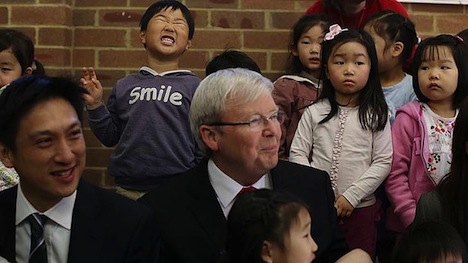
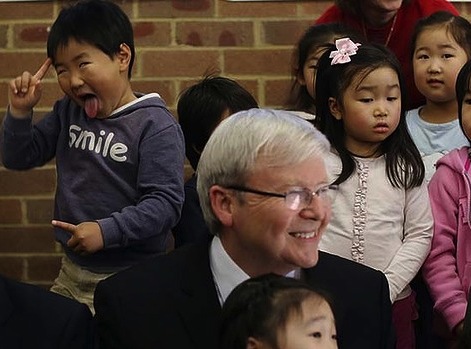
Another day on the campaign trail for Labor prime minister Kevin Rudd, though yesterday’s star was Joseph Kim, a five-year-old who delighted in making faces as the cameras rolled away at a Rudd campaign stop at a Korean church in Sydney on Wednesday.Australia Flag Icon

Australians vote in exactly one month on September 7 to determine whether to give Rudd a full term as prime minister, six weeks after his fellow Labor colleagues reinstated him as party leader when polls showed that former prime minister Julia Gillard had virtually no chance of winning this autumn’s election.  Gillard had replaced Rudd as prime minister in June 2010 after griping over Rudd’s management style.

All together, Labor is seeking a third consecutive term — Rudd led the party to a robust victory in November 2007, and Gillard led the party to the narrowest of victories in August 2010.

Rudd faces Tony Abbott, the leader of the National/Liberal Coalition, which governed the country under former prime minister John Howard in the early 2000s.

One more photo:

ruddbomb2

Photo credit: Andrew Meares, Sydney Morning Herald