Tag Archives: Hollande

Entinhaltlichung: the best thing you’ve read so far on German politics this year

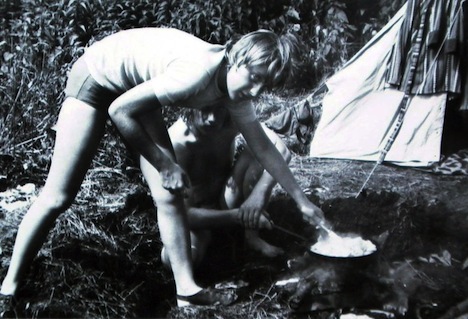
Angela Merkel gibt Einblicke in Privatleben

Neal Ascherson turns his gaze toward German chancellor Angela Merkel, her opponent Peer Steinbrück, the former East German ghosts that haunt Germany, and the Hartz IV labor reforms that also haunt it, in a superb essay for the London Review of Books that’s probably the best thing you’ve read so far this year on Germany, its politics, the importance of regional governance in an increasingly federal Europe and the north-south (and west-east) European divide.Germany Flag Icon

On Berlin, Ascherson captures in one paragraph the idiosyncratic nature of Berlin, which is really unlike any other city in Europe, which he argues ‘will never be a real capital again’:

When people talk about ‘Berlin’, they usually don’t mean the government of the most powerful nation in Europe. They mean Klaus Wowereit, the gay mayor, or the film festival, or a new café on the Oranienburgerstrasse, or the botched plan for yet another unnecessary airport. There is no centre. Even Bonn, in the years when the federal government was there, seemed more in command than Berlin is now.

Ascherson uses reunification as an analogical point — it’s the moment the West German social welfare model fell apart, for better and for worse:

And when the West Germans won that war and annexed East Germany (the best word for it), the aftermath was uncannily like Reconstruction after the American Civil War. Here was repeated the economic collapse, the inrush of greedy carpetbaggers from the victorious West, the purging of an entire elite from management, teaching and social leadership, the abolition of institutions and, of course, the liberation of the slaves – this time, into mass unemployment.

And as for Merkel herself, Ascherson nails it:

As for Merkel, sometimes she looks placid, sometimes she looks cross and disappointed, sometimes she smiles politely at foreigners over coffee and cakes. So she reminds people of Mum, and those who want to keep holding her hand think they know what she wants. Others, in despair, confess they have no idea what she wants. These days, she seems to have no policy of her own. Instead, after a suitable delay, she takes on opposition policies in a diluted form. Intellectual critics complain that she has no ‘idea’, no ‘concept’. And to describe what she does, or rather doesn’t, they have coined a frightful new German word: Entinhaltlichung. ‘It means what it says,’ a Berlin friend tells me: ‘Decontentification.’

Spiegel journalist Dirk Kurbjuweit summarized Merkel’s Entinhaltlichung earlier this month by comparing it to the Biedermeier era — the sleepy, happy period between 1815’s Congress of Vienna and the return of revolutionary spirit in 1848:

At the federal level, though, Merkel’s Germany is by and large somnolent, in part because of the government’s failure to present new ideas and plans. The chancellor gets by without them, and even the business-friendly Free Democratic Party (FDP), the junior partner in the ruling coalition, can’t seem to muster up much of an alternative, happy to avoid any danger of becoming a target of hostility…

By and large, things are calm in Merkel’s republic — and that really is something new…. as chancellor, she quickly became “mommy,” a nickname that seemed silly at first but has since proved apt, in the sense that a “mommy” is someone who takes care of the home, makes life pleasant and keeps worries at bay.

Ascherson’s essay strikes many parallel notes, even its title: ‘Hanging on to Mutti,’ a reference to an informal term for the German word for mother, Mutter, and both Kurbjuweit and Ascherson wrangle with the fundamental question of why Merkel herself remains so apparently popular despite leading a government that’s neither incredibly remarkable or popular.

What’s been clear for some time, at least since late last year when it became clear than the rather wooden Steinbrück would be the chancellor candidate of the center-left Sozialdemokratische Partei Deutschlands (SPD, Social Democratic Party), is that the September federal election is going to be all about Angela. Continue reading Entinhaltlichung: the best thing you’ve read so far on German politics this year
As Hollande marks one year in office, would Dominique Strauss-Kahn have been better for France?

DSK

Today is the one-year anniversary of François Hollande’s inauguration as the new president of France, having swept to the Elysée Palace with a mandate for a more subdued presidential administration and a leftward turn after the ‘bling bling’ administration of center-right president Nicolas Sarkozy.France Flag Icon

Hollande won’t face voters again for four more years, and by 2017, Hollande’s reputation may well have recovered, but at the one-year mark, he’s had a horrific presidency so far:

  • France slipped back, as a formal matter, into recession today, with a GDP growth rate of -0.2% for the first quarter of 2013 with an unemployment rate of over 10% and eclipsing the previous high in 1997. 
  • Barely a month into his administration, Monsieur Normal appeared to be unable to stop a fight between his current partner, Valerie Trierweiler, and his former partner, Segolène Royal, when Trierweiler tweeted her support for Royal’s opponent, thereby ending Royal’s chances to become the president of France’s parliament, the Assemblée nationale, and making Hollande look as if he couldn’t even control matters within his own relationship.
  • The traditional Franco-German axis that’s powered European integration for decades remains at a frigid impasse, despite the widespread belief that German chancellor Angela Merkel has outfoxed Hollande and is winning the policy war on how to address the ongoing eurozone economic crisis.
  • He worked to implement a 75% income tax rate on income above €1 million per year, though France’s constitutional court has ruled it unconstitutional on technical grounds, all the while keeping in place strict targets to reduce France’s budget deficit and retaining a rise in the retirement age from 60 to 62 implemented by the Sarkozy administration.
  • Budget minister Jérôme Cahuzac stepped down in April 2013 after it was revealed he had a Swiss bank account and had potentially committed tax fraud.
  • Altogether, Hollande’s approval ratings are the lowest of any president after one year in office, and fully 73% of French voters are dissatisfied with Hollande and 68% are dissatisfied with his prime minister, Jean-Marc Ayrault.

It’s been, from a political perspective — and even from a policy perspective — a bit of a disaster.  Hollande’s chief accomplishment, enactment of same-sex marriage in France, has been accompanied by vigorous opposition from Sarkozy’s party and from the far right, inspiring massive anti-marriage rallies and even an uptick anti-gay violence.

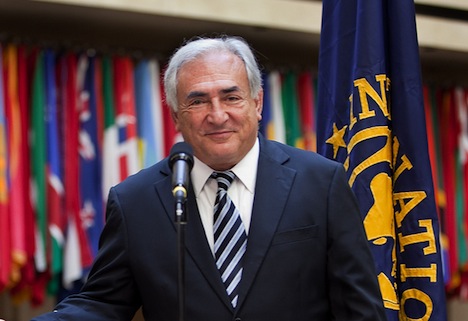
It’s enough to make you wonder — what would have happened if Dominique Strauss-Kahn had never been alleged to have sexually assaulted a maid in a New York hotel, had stepped down with his head held high as managing director of the International Monetary Fund to run for an almost certain nomination as the presidential candidate of France’s Parti socialiste (PS, Socialist Party) and proceeded to challenge Sarkozy?  Strauss-Kahn today, as a matter of coincidence, re-emerged to open a bank in South Sudan, one of his rare appearances since the debacle that led to his arrest in May 2011.  Although U.S. prosecutors dropped charges of attempted rape and other sexual abuse charges in August 2011, Strauss-Kahn’s political career was finished.

Though it’s subject to a ‘grass is always greener’ caveat, there’s good reason to believe that a Strauss-Kahn presidency would have been a smoother affair than the embattled Hollande administration.

Despite whether it would have been better or worse, a Strauss-Kahn presidency would have been an incredibly different beast from the outset.

It seems unlikely that Strauss-Kahn would have ever campaigned on a pledge to raise the top rate of tax to 75%, let alone attempted to enact it, when it’s such an outlier among peer tax regimes.  It seems more likely that Strauss-Kahn, as a relative moderate within the Socialist Party, would have been more receptive to implementing labor market reforms designed to make France more competitive — perhaps a gentler variant of the Hartz IV / Agenda 2010 reforms that Germany enacted under social democratic chancellor Gerhard Schröder in the early 2000s.

But as a former IMF chief and a former finance minister under the government of prime minister Lionel Jospin from 1997 to 1999 who worked to reduce the budget deficit to prepare for French entry into the eurozone, Strauss-Kahn would have come into office with an unrivaled economic credibility that would have allowed him to challenge Merkel on the direction of economic policy in the eurozone with vigor — and then some.  It’s not hard to imagine Strauss-Kahn pursuing a relatively ambitious reform program domestically while simultaneously calling for less punishing austerity measures in the more devastated southern European economies.

Certainly, Strauss-Kahn’s candidacy and his presidency would have been plagued with the same sort of scandalous affairs that brought his career to such a  screeching halt in 2011.  It’s difficult to imagine Strauss-Kahn being emasculated in his first month in office (fairly or not), unable to stop a very public spat between a current and former lover, one of whom happens to have been his party’s 2007 presidential candidate and a leading political figure in her own right.  Strauss-Kahn would have come to the French presidency after a career in the public eye, unlike Hollande, who had chiefly served a behind-the-scenes role — when he was half of France’s power couple, it was Royal, not Hollande, who was the public star.  Hollande, from 1997 to 2008, was the first secretary of the Socialist Party and, unlike Strauss-Kahn, he was never a minister in the Jospin government and he was certainly not among the presidential contenders in 2007.

Four years are a long time in politics, French or otherwise, and Hollande can at least point to a military intervention earlier this year in Mali that went relatively smoothly by accomplishing a narrowly defined goal, and the Mali operation represents the Hollande administration at its best.  Hollande could engineer his own comeback, especially if the economy improves this year or next — it’s hard to believe he can sink much lower in public opinion.  For now, Strauss-Kahn will still have some ways to go until he, if ever, reaches political redemption in France.  But he’s a formidable economic and political talent, and comebacks aren’t altogether unheard of in France.  Just look at the return of former prime minister Alain Juppé as foreign minister in the final 15 months of the Sarkozy administration, despite his 2004 conviction for mishandling public funds.

With such an uninspiring administration, Hollande could well turn to a cabinet shakeup in the future to replace Ayrault or other top minister, including finance minister Pierre Moscovici — and he might do well to bring Strauss-Kahn or Royal, whose political talents remain unutilized, back into the top tier of government.

What Iceland’s election tells us about post-crisis European politics

dusseldorf

Iceland was supposed to be different.Iceland Flag IconEuropean_Union

In allowing its banks to fail, neo-Keynesian economists have argued, Iceland avoided the fate of Ireland, which nationalized its banks and now faces a future with a very large public debt.  By devaluing its currency, the krónur, Iceland avoided the fate of countries like Estonia and others in southern Europe trapped in the eurozone and a one-size-fits all monetary policy, allowing for a rapid return to economic growth and rapidly falling unemployment.  Neoclassical economists counter that Iceland’s currency controls mean that it’s still essentially shut out from foreign investment, and the accompanying inflation has eroded many of the gains of Iceland’s return to GDP growth and, besides, Iceland’s households are still struggling under mortgage and other debt instruments that are linked to inflation or denominated in foreign currencies.

But Iceland’s weekend parliamentary election shows that both schools of economic thought are right.

Elections are rarely won on the slogan, ‘it could have been worse.’ Just ask U.S. president Barack Obama, whose efforts to implement $800 billion in stimulus programs in his first term in office went barely mentioned in his 2012 reelection campaign.

Iceland, as it turns out, is hardly so different at all — and it’s now virtually a case study in an electoral pattern that’s become increasingly pronounced in Europe that began when the 2008 global financial crisis took hold, through the 2010 sovereign debt crisis in the eurozone and through the current European-wide recession that’s seen unemployment rise to the sharpest levels in decades.

Call it the European three-step.

In the first step, a center-right government, like the one led by Sjálfstæðisflokkurinn (Independence Party) in Iceland in 2008, took the blame for the initial crisis.

In the second step, a center-left government, like the one led by Jóhanna Sigurðardóttir and the Samfylkingin (Social Democratic Alliance) in Iceland, replaced it, only to find that it would be forced to implement harsh austerity measures, including budget cuts, tax increases and, in Iceland’s case, even more extreme measures, such as currency controls and inflation-inducing devaluations.  That leads to further voter disenchantment, now with the center-left.

The third step is the return of the initial center-right party (or parties) to power, as the Independence Party and their traditional allies, the Framsóknarflokkurinn (Progressive Party) will do following Iceland’s latest election, at the expense of the more newly discredited center-left.  In addition, with both the mainstream center-left and center-right now associated with economic pain, there’s increasing support for new parties, some of them merely protest vehicles and others sometimes more radical, on both the left and the right.  In Iceland, that means that two new parties, Björt framtíð (Bright Future) and the Píratar (Pirate Party of Iceland) will now hold one-seventh of the seats in Iceland’s Alþingi.

This is essentially what happened last year in Greece, too.  Greece Flag IconIn the first step, Kostas Karamanlis and the center-right New Democracy (Νέα Δημοκρατία) initially took the blame for the initial financial crisis.  In the second step, George Papandreou and the center-left PASOK (Panhellenic Socialist Movement – Πανελλήνιο Σοσιαλιστικό Κίνημα) overwhelming won the October 2009 elections, only to find itself forced to accept a bailout deal with the European Commission, the European Central Bank and the International Monetary Fund.  In the third step, after two grueling rounds of election, Antonis Samaras and New Democracy returned to power in June 2012.
By that time, however, PASOK was so compromised that it was essentially forced into a minor subsidiary role supporting Samaras’s center-right, pro-bailout government.  A more radical leftist force, SYRIZA (the Coalition of the Radical Left — Συνασπισμός Ριζοσπαστικής Αριστεράς), led by the young, charismatic Alexis Tsipras, now vies for the lead routinely in polls, and on the far right, the noxious neo-nazi Golden Dawn (Χρυσή Αυγή) now attracts a small, but significant enough portion of the Greek electorate to put it in third place.

The process seems well under way in other countries, too.  In France, for examFrance Flag Iconple, center-right president Nicolas Sarkozy lost reelection in May 2012 amid great hopes for the incoming Parti socialiste (PS, Socialist Party) administration of François Hollande, but his popularity is sinking to ever lower levels as France trudges through its own austerity, and polls show Sarkozy would now lead Hollande if another presidential election were held today.

It’s not just right-left-right, though. The European three-step comes in a different flavor, too: left-right-left, and you can spot the trend in country after country across Europe — richer and poorer, western and eastern, northern and southern. Continue reading What Iceland’s election tells us about post-crisis European politics

Why is the opposition to same-sex marriage so strong in France?

franceopposition

To the rest of the world, France is a virtual billboard for sexual freedom and sophistication.France Flag Icon

Sex, of course, made an entire generation or two of French and European cinema — from Les enfants terribles to Jules et Jim to Last Tango in Paris.  Paris, for nearly a century, has been the world’s premier city of romance, and its popular mayor since 2001, Bertrand Delanoë, is openly gay.

As recently as a few years ago, the amorous French were rated, alongside the Spanish, the Italians and the Brazilians, as the world’s best lovers.  The international vocabulary of sex encompasses everything from French kissing to the ménage à trois.  French voters have long accepted a certain liberté among their leaders — French president François Hollande and Ségolène Royal shared lives and children together for decades without formally marrying, former president Nicolas Sarkozy famously divorced and courted singer Carla Bruni in the first months of his presidency and former François Mitterand had a daughter with his mistress.

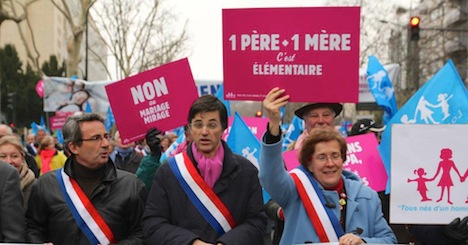
So it’s somewhat incongruent to see such strident opposition to same-sex marriage — on the day that France’s Assemblée nationale passed same-sex marriage into law, anti-marriage forces appear to have rioted in Paris, the city of love.

Since at least 1789, the French have never shied away from a riot — in recent years, France has seen civil unrest over everything from the plight of young Muslims in 2005 to the raising of the retirement age in 2010.  But that hardly explains why same-sex marriage has become such a heated issue.

More troubling is that the vote follows at least two incidents of anti-gay violence perpetrated in France in recent days.  Opponents vow to continue their fight — they’ve scheduled another large protest for May 26, notwithstanding the celebration of proponents of same-sex marriage, in France and beyond, and same-sex opponents have attacked Hollande’s government with increasing vitriol:

“They’re opening a Pandora’s box,” says Alain Escada, the head of the fundamentalist Christian group Civitas. “The next thing they will want three-way or four-way marriages,” blasted the archbishop of Lyon, Philippe Barbarin. “And then the ban on incest will be dropped.”

“Who would then, in the name of the sacrosanctness of love, still be able to convey that sex with animals or polyandry are wrongful,” asked the umbrella organization of Muslims in France. Finally, Frigide Barjot, the acid-tongued self-appointed icon of the anti-gay marriage movement, declared, “If Hollande wants blood, then he will get it.” The activist later retracted her statement.

Although the United Kingdom’s push for same-sex marriage hasn’t been without obstacles, it’s nonetheless moving forward and likely to be enacted by the end of the summer, largely without the passionate public opposition that we’ve seen in France.

Hollande has indicated he will sign the law, though the opposition has filed a challenge with France’s top constitutional court, so same-sex marriage, despite Tuesday’s vote, is not entirely a fait accompli.

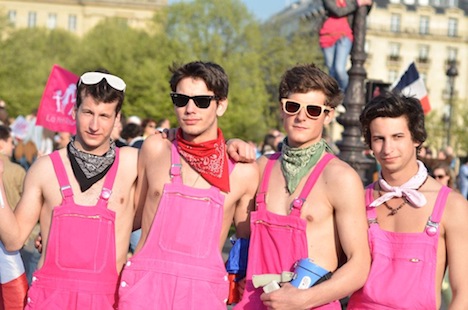
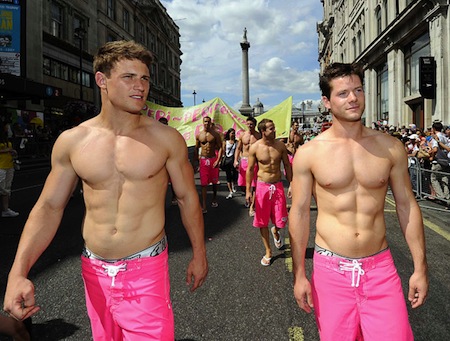
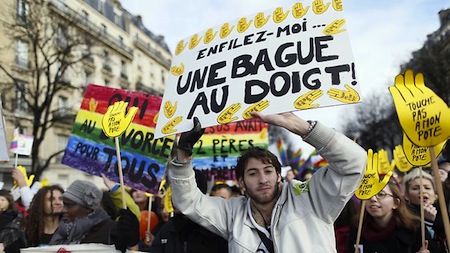
There’s no mistaking the anti-marriage movement for the anti-marriage protesters in the United States, which is steeped in a more evangelical Protestant tradition.  The name of most active anti-gay group ‘Manif pour tous‘ (‘Demonstration for all’) sounds at first like it could be a pro-gay group.  It’s also a bit weird that the anti-marriage movement has adopted pink as its color, which makes the anti-gay protests in France look like, well, pretty much a gay pride parade in any other country:

franceLGBT

So why, given the famously laid-back approach of the French to l’amour, are so many of the French so actively opposed to gay marriage?

The push for same-sex marriage remains a very partisan issue.  Unlike in the United Kingdom, where a Conservative prime minister has made its enactment a priority, largely with the support of the even more socially liberal Labour and Liberal Democratic parties, same-sex marriage remains an entirely leftist project in France, pushed by Hollande and his allies in the Parti socialiste (PS, Socialist Party) who control the French national assembly.

Yesterday’s vote was largely split on partisan lines, with 331 in support and 225 opposed — the opposition largely coming from Sarkozy’s Union pour un mouvement populaire (UMP, Union for a Popular Movement).  It’s odd to see the French right doubling down on opposition to gay marriage, even as conservatives in the United Kingdom and even in the United States are coming to embrace same-sex marriage.  But it largely has to do with internal politics — Jean-François Copé, the UMP president, and other top center-right leaders remain terrified of losing support to the more socially conservative Marine Le Pen, the leader of the far-right Front national (FN, National Front).  The same dynamic pulled Sarkozy increasingly to the right during his own presidential career on issues like immigration and crime.

Continue reading Why is the opposition to same-sex marriage so strong in France?

British, French governments poised to pass gay marriage into law

londongay

Amid a flurry of parliamentary action in the United Kingdom and France, two of the largest countries in Europe and, indeed, two of the five permanent members of the United Nations Security Council, are set to legalize gay marriage in the coming months.United Kingdom Flag IconFrance Flag Icon

The joint result gives an incredibly burst of global momentum for the idea of gay marriage and LGBT equality.

Even more striking, the gay marriage push has been pursued by two governments that couldn’t be much more different, ideologically — a right-wing, budget-cutting Conservative Party government in the United Kingdom and a leftist Parti socialiste (PS, Socialist Party) government in France.

Most immediately, in London yesterday, the British House of Commons voted overwhelmingly 400 to 175 to approve equal marriage rights for gay and lesbian partnerships in England and Wales.  Enacting same-sax marriage rights has been at the heart of UK prime minister David Cameron’s ‘modernising’ mission for the Conservative Party — i.e., pulling it to the forefront of supporting socially liberal causes, while the government continues pursuing a very conservative economic agenda.

Nonetheless, Cameron’s efforts, historic as they may be, have not been without a cost — despite the overwhelming support of his coalition partners, the socially progressive Liberal Democratic Party and of the opposition Labour Party, only 127 of Cameron’s 303 Tory MPs supported Tuesday’s bill.

That’s frankly somewhat of an embarrassment for the prime minister, who’s facing increasing pressure from backbenchers who are worried about the government’s unpopularity nearly halfway through its five-year term — young Tory MP Adam Afriyie is already reported to be considering an upstart leadership campaign against Cameron.  More worryingly than Afriyie, however, is the fact that Owen Paterson, the environmental secretary, led the Tory effort in the House of Commons against the gay marriage bill, and even Cameron’s attorney general, Dominic Grieve, abstained from the final vote.

For a party already perilously split on issues like the UK’s role in Europe, the vote has now opened a new rift over social progress as well, writes Polly Toynbee in The Guardian:

[Gay marriage], warn the old Tory chairmen of the shires, is “shaking the very foundations of the party”. If so, they really are done for. Cameron wrongly thought this a clause IV moment to parade a modernised party. Instead, he has revealed them as a nest of bigots. Disunity is electoral poison, and so is a leader losing control of his party. Rebel MPs, like runaway horses, lose their fear of whips. Gay marriage has become a proxy for other undisciplined craziness running through their veins, from hunting to Europe, privatising the NHS to breaking up the BBC, loathing windmills, loving fracking.

Notwithstanding the perils for Cameron, the bill will now proceed to the House of Lords, where it should pass relatively easily, and Cameron hopes to mark the law’s enactment later this summer.  Scotland, meanwhile, is considering its own gay marriage bill later this year — first minister Alex Salmond’s majority government, dominated by the Scottish National Party, is set to advance the issue after consultation on the bill ends in March 2013.

But France will be racing to beat Great Britain to the marriage chapel.

francegay

Over the weekend, the Assemblée nationale (National Assembly) of France approved a change in the definition of marriage from an agreement between a man and a woman to simply an agreement between two people, paving the way for the adoption of a comprehensive same-sex marriage and adoption bill later this year.

Gay marriage has also proven divisive in France, where a strong Catholic opposition to gay marriage has polarized political views on the issue.  Although France’s government won its most recent vote, it did so only with the support of the ruling Socialists — lawmakers from the conservative Union pour un mouvement populaire (UMP, Union for a Popular Movement) of former president Nicolas Sarkozy and the more far-right Front national (FN, National Front) of Marine Le Pen opposed the measure.

The conservative opposition has used amendment and other delaying tactics to stall the bill, despite a massive pro-LGBT rally in Paris late in January.

A recent poll shows that 63% of French voters support gay marriage.  A Guardian poll in December 2012 showed nearly the same level of support (62%) among British voters.

Europe has long been at the vanguard of extending marriage rights to same-sex couples. Continue reading British, French governments poised to pass gay marriage into law

François Hollande’s triumphant visit to Timbuktu — and next steps for Mali

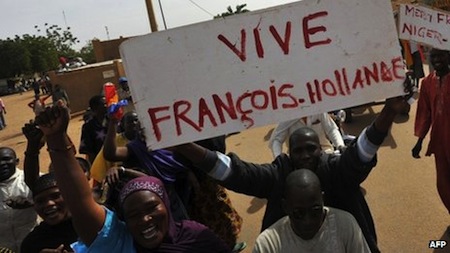
vivefrançois

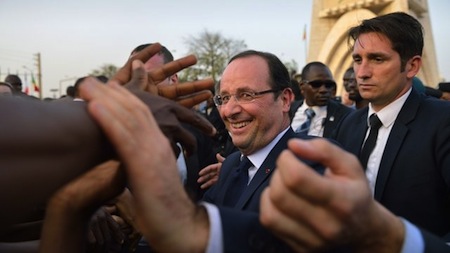
françoismali

Earlier this weekend, French president François Hollande flew to Timbuktu in Mali, where French forces have only in the last week cleared the historic city of Islamist control.France Flag IconMali Flag Icon

I was quick to argue that the intervention in Mali wasn’t some neocolonial retreat to Françafrique, and for a three-week military campaign, I’ll be the first to agree that Hollande’s intervention seems to have saved Bamako, Mali’s southern capital, from pending capture — or at least from pressure from Islamist rebels that were quickly closing in on Bamako after locking down control of the northern two-thirds of the country.

But given that the Timbuktu trip had a ‘mission accomplished’ feel to it, after just three weeks of French military effort, I’m not sure whether Hollande will ultimately come to regret such a high-profile event — as former U.S. president George W. Bush learned, prematurely spiking the ball is not smart politics.

For a country that’s often had a troubled post-colonial relationship with its former colonies, especially in north Africa, it’s perhaps an odd thing to see huge crowds of French-speaking Africans praising Hollande over the weekend:

As Mr. Hollande, ringed by security guards, plunged into the crowd to shake hands, some waved banners that said “Papa François, the mysterious city welcomes you.”

“Hollande is our savior,” said Arkia Baby, a 24-year-old college student, who wore a purple batik dress of a style banned by the Islamists. “He gave us back our freedom.”

You might think that Hollande’s success so far in Mali should be helping him at home politically, but budget woes, tax policy and continued economic weakness have nonetheless kept Hollande’s approval ratings incredibly low as he enters only his 10th month in office — only 35% of French voters continue to have confidence in Hollande, opposed to 61% who do not, pursuant to a TNS Sofres poll from January 30.

First and foremost, where does Mali go from here? If and when the French forces leaves, won’t the Islamist and Tuareg rebel forces simply re-emerge from their northern rural enclaves?

In contrast, if French forces really stay long enough to push the more radical Islamist elements out of Mali, won’t they just create a new problem in another country?

Mauritania doesn’t seem like an incredibly bad place for al-Qaeda in the Maghreb to target next.

Given that the French-backed effort to arm rebels in Libya against Muammar Gaddafi might have destabilized Mali by flooding north and west Africa with additional weapons, it’s not too early to wonder if the Mali effort will result in further unintended consequences, like so many falling dominoes.  It’s no secret, too, that U.S. aid to the mujahideen in the 1970s and 1980s in Afghanistan empowered the radical Islam that bloomed in the 1990s and turned against the United States by sponsoring al-Qaeda and other terrorist groups and, indirectly, resulted in the current U.S. quagmire in Afghanistan.

So there’s no way to know what follow-on effects the French offensive will have.

And that, of course, is probably a best-case scenario — there’s a risk that France could get stuck fighting an increasingly unpopular stalemate in Mali if it stays.  Continue reading François Hollande’s triumphant visit to Timbuktu — and next steps for Mali

M. Hollande’s little war — and what it means for French-African politics

malifabius Over the weekend, France found itself engaged in a new, if limited, war — and a new theater of Western intervention against radical Islam.Mali Flag IconFrance Flag Icon

French president François Hollande confirmed that French troops had assisted Mali’s army in liberating the city of Konna — in recent weeks, Islamist-backed rebels that control the northern two-thirds of the country had pushed forward toward the southern part of the country, threatening even Mali’s capital, Bamako.

On Tuesday, Hollande said the number of French troops would increase to 2,500, as he listed three key goals for the growing French forces:

“Our objectives are as follows,” Hollande said. “One, to stop terrorists seeking to control the country, including the capital Bamako. Two, we want to ensure that Bamako is secure, noting that several thousand French nationals live there. Three, enable Mali to retake its territory, a mission that has been entrusted to an African force that France will support.”

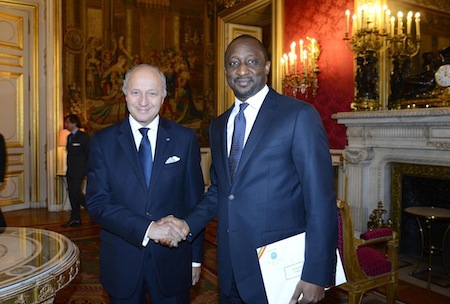
Hollande and his foreign minister, Laurent Fabius (pictured above with Malian foreign minister Tyeman Coulibaly), now face the first major foreign policy intervention of their administration, extending a trend that began under former president Nicolas Sarkozy, who spearheaded NATO intervention in support of rebels in Libya against longtime ruler Muammar Gaddafi and for the apprehension of strongman Laurent Gbagbo in Côte d’Ivoire in 2011.

Foreign Policy‘s Joshua Keating has already called the Malian operation the return of Françafrique. Françafrique refers to the post-colonial strategy pioneered largely by French African adviser Jacques Foccart in the 1960s whereby France’s Fifth Republic would look to building ties with its former African colonies to secure preferential deals with French companies and access to natural resources in sub-Saharan Africa, to secure continued French dominance in trade and banking in former colonies, to secure support in the United Nations for French priorities, to suppress the spread of communism throughout formerly French Africa and, all too often, source illegal funds for French national politics.  In exchange, French leaders would support often brutal and corrupt dictatorships that emerged in post-independence Africa.

But to slap the Françafrique label so blithely on the latest Malian action is, I believe, inaccurate — French policy on Africa has changed since the days of Charles de Gaulle and, really, even since the presidency of Jacques Chirac in the late 1990s.

After all, the British intervened just over a decade ago in Sierra Leone to end the decade-long civil war and restore peace for the purpose of stabilizing the entire West African region, and no one thought that then-prime minister Tony Blair was incredibly motivated by contracts for UK multinationals. Given the nature of the Malian effort, it’s quite logical that France — and Europe and the United States — has a keen security interest in ensuring that Bamako doesn’t fall and that Mali doesn’t become the world’s newest radical Islamic terrorist state in the heart of what used to be French West Africa.

Fabius, a longtime player in French politics, and currently a member of the leftist wing of the Parti socialiste (PS, Socialist Party), served as prime minister from 1984 to 1986 and as finance minister from 2000 to 2002, though his opposition — in contrast to most top PS leaders — to the European Union constitution in 2005 has left him with few friends in Europe.

Nonetheless, Fabius argued yesterday that it was not France’s intention for the action to remain unilateral — African forces from Nigeria and elsewhere are expected to join French and Malian troops shortly, UK foreign minister William Hague has backed France’s move, as has the administration of U.S. president Barack Obama — and today, the United Nations Security Council has also indicated its support for France’s efforts as well.

For now, Hollande has the support of over 75% of the French public as well as much of the political spectrum — and it’s hard not to see that the effort will help Hollande, who’s tumbled to lopsided disapproval ratings since his election in June 2012 amid France’s continued economic malaise, appear as a decisive leader. That doesn’t mean, however, that there won’t be trouble ahead for Hollande and Fabius. Continue reading M. Hollande’s little war — and what it means for French-African politics

Four reasons why Cope’s narrow Sunday win of France’s UMP leadership could be ruinous

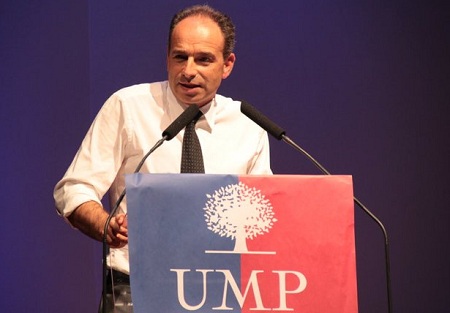
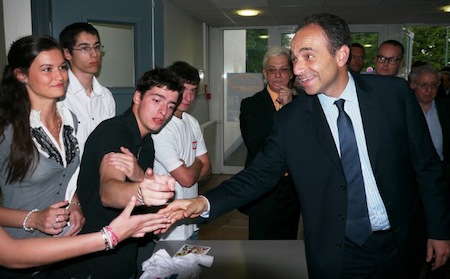
After a tense Monday during which both candidates declared victory and accused the other of fraud, it appears that Jean-François Copé (pictured above) has emerged as the presumptive leader of the French right.

With just a 98-vote margin, Copé won the election for general secretary of the center-right Union pour un mouvement populaire (UMP, Union for a popular movement) of former president Nicolas Sarkozy, after an election held among UMP members on November 18.  Copé defeated former prime minister François Fillon by about 50.03% to 49.97%.

Although Copé has served as general secretary since 2010, this election has taken on significant importance as a proxy fight not only for the upper hand to win the UMP’s 2017 presidential nomination, but as a proxy fight for the future of the French right.  Fillon, a cosmopolitan and relatively moderate figure, was viewed by the French public as more serious about government than Sarkozy, and it was Fillon who pushed through many of Sarkozy’s reforms as the head of his government.  Fillon, generally speaking, is more popular among the French electorate than Copé.

So there’s good cause for the French right to be worried about Copé’s victory.  Here are four reasons why. Continue reading Four reasons why Cope’s narrow Sunday win of France’s UMP leadership could be ruinous

The French right prepares to choose Sarkozy’s successor (maybe)

France’s center-right Union pour un mouvement populaire (UMP, Union for a popular movement) will vote on Sunday, November 18 to choose its next general secretary in what’s widely seen as a fight to get the upper hand on the UMP’s presidential nomination in 2017. 

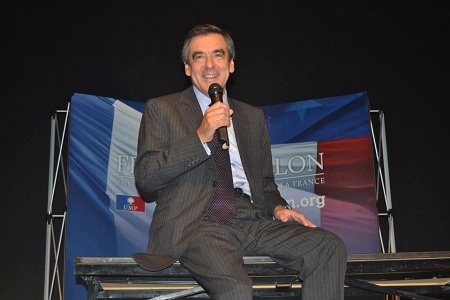
The UMP will choose between two key figures — former prime minister François Fillon (pictured above, top) and Jean-François Copé (pictured above, bottom), who has been general secretary since 2010.  As the contest approaches, both candidates have accused the other of fraud, marking an ugly end to what has been a dogfight within the French right.

Unlike most French prime ministers, Fillon actually remained in Matignon — the residence of the French prime minister — for all five years of the presidency of Nicolas Sarkozy.  Throughout the Sarkozy presidency, he maintained or even gained approval from French voters as a competent and moderate head of government who seemed at times more grounded and focused on Sarkozy’s reforms than even Sarkozy.  Indeed, there’s reason to believe that if Fillon had contested the presidential election against the Parti socialiste‘s François Hollande, he might have won.

Fillon, age 58, both urbane and technocratic, seems to hold a clear lead over Copé, age 48 — a recent Harris poll shows Fillon with a 67% to 22% lead among UMP voters, and a wide edge among French voters generally.

Copé, mayor of Meaux, a non-practicing Jew whose mother is Algerian, previously served as budget minister under prime minister Dominique du Villepin and president from 2005 to 2007, and he’s seen as belonging to the more strident right wing of the UMP.  In some ways, that makes him more like Sarkozy, who was no stranger to pulling hard to the right on issues like immigration or crime in order to win votes.  Copé is, in fact, styling himself as the same sort of hyperactive, gritty leader as Sarkozy.  During the campaign for the UMP leadership, Copé has spoken out against ‘anti-white’ racism in France, a naked bid for voters sympathetic to the hard right, and he mocked Muslims for taking away children’s pain au chocolat during Ramadan.

As such, Sunday’s vote is a bit of a proxy contest for the UMP’s direction in the years ahead — Fillon represents the moderate center-right and Copé represents a more full-throated hard-right approach.  But the next French election is over four years away — in April 2017.  In contrast, consider: five years before 2008, no one in the United States had even heard of Barack Obama.

After all, there’s nothing stopping Sarkozy himself for running for a second term in 2017 — many French voters still prefer Sarkozy to either Fillon or Copé for the time being, and Sarkozy has indicated he may be interested.

The winner of Sunday’s contest will have a delicate task in balancing an appeal to the broad center of French voters, while not allowing other political movements steal support on the UMP’s right.  Marine Le Pen, who won nearly 18% of the first-round vote of the presidential election in April 2012 will almost certainly try to make a bid to expand her appeal beyond the narrow confines of the far-right Front national and become the strongest candidate of the French right in 2017. Continue reading The French right prepares to choose Sarkozy’s successor (maybe)

Samaras ‘negotiations’ with Berlin not going so swell

It didn’t go so well for Greek prime minister Antonis Samaras on his visits with European Union leaders in Berlin.  His plea for more time to come up with cuts to the Greek budget is being met with stony nonchalance from both German chancellor Angela Merkel (pictured above right, with Samaras) and French president François Hollande, to say nothing of German civil society.

Samaras has requested an additional two years to come up with an additional €11.5 billion in cuts to the Greek budget.  While Merkel — and especially Hollande — were sympathetic to Samaras’s plea and reiterated their support for Greece to remain in the eurozone, Samaras will return to Athens having won no concessions from Berlin or Paris.

Business daily Handelsblatt writes:

“Greek Prime Minister Antonis Samaras does not tire of making new demands. Now he wants more time, for the health of his economy. Not more money, only more time — at least according to his requests to Berlin and Brussels. And, in Berlin and Brussels, there will be much discussion about whether Greece should be granted more time.”

“Our instinctive reaction regarding Samaras’ request is, well, that could be something. Given the near 40 degree Celsius (104 degrees Fahrenheit) temperatures that Germany experienced last weekend, we can empathize with Greek lethargy.”

“But is the Greek prime minister right? Is time instead of money really better? I say no.”

“We have known for a long time that time is money. Perhaps Angela Merkel will also say that to the Greeks. Despite the hot and sweaty 40-degree temperatures, there will be no more days off.”

Athens News reports that Merkel’s comments at a joint press conference with Samaras Friday were particularly tense:

“We expect Greece to deliver all that has been promised,” Merkel declared. In remarks that were unusually sharp for a joint news conference, she stressed that Berlin has heard words in the past but now expects deeds.

The tough talk contrasted sharply with the head of state honours and diplomatic smiles with which Samaras was received on his first official visit, complete with red carpet and band.

Merkel said that Samaras’ visit is a sign of the “very close ties” between the two countries, only to add later that each side had lost credibility in the eyes of the other and that trust must be regained.

And these are demands from someone who ‘Europe’ was desperate to win June’s Greek parliamentary elections.

Can you imagine how horrific the reaction would have been if the request had come from Alexis Tsipras, the leader of SYRIZA (the Coalition of the Radical Left — Συνασπισμός Ριζοσπαστικής Αριστεράς)?

Merkel spent Sunday trying to calm the waters against anti-Greek feeling in Germany, after German Bundesbank president Jens Weidmann attacked the European Central Bank’s buying of state debt, and Alexander Dobrindt, general secretary of the governing Christlich-Soziale Union (Christian Social Union), the Bavarian conservative party and sister party of Merkel’s own Christlich Demokratische Union (Christian Democratic Union), speculated that Greece would leave the single currency by next year.

Rutte and Roemer hope to consolidate support in Dutch election, as Europe watches nervously

As Dutch voters and the wider international world begin to pay attention to the Sept. 12 election, it’s becoming clear that ‘anti-austerity’ and ‘pro-austerity’ forces are coalescing behind the party of prime minister Mark Rutte (pictured above, top) and the Socialistische Partij (SP, the Socialist Party) of Emile Roemer (pictured above, below), leaving both newer and traditional parties of the Dutch political landscape floundering. 

The election, which is typically followed by months-long coalitions talks, will have a significant impact on the ongoing political and economic eurozone crisis: a Rutte victory would bolster German chancellor Angela Merkel in her cause for Europe-wide austerity, while a Roemer victory would embolden a growing ‘pro-growth’ cause that includes French president François Hollande and, to some degree, Italian premier Mario Monti.

After a relatively quiet election season, Rutte, leader of the Volkspartij voor Vrijheid en Democratie (VVD, the People’s Party for Freedom and Democracy), is back in the spotlight with a promise to increase an existing tax break for workers (arbeidskorting) by €300 in 2013 and by €1,000 in 2014.  The move is designed to sweeten the otherwise harsh effect of budget cuts that would lower the 2013 budget deficit to within 3% of GDP — last year’s budget was 4.7% of Dutch GDP, a shortfall that undermined Dutch credibility on the European stage.  Since Rutte came to power in a minority coalition government in 2010, he has made broad cuts across the entire spectrum of government spending, and the Dutch retirement age is set to rise from 65 to 67.

Rutte’s attempt to pass more budget cuts in the Netherlands in April led to the fall of his government, when Geert Wilders, the leader of the Partij voor de Vrijheid (PVV, the Party for Freedom) refused to support further cuts — although the PVV had not been a formal member of the coalition, it had provided crucial outside support to Rutte’s government.

Wilders, who rose to prominence and much electoral success in 2010 on his anti-Muslim, anti-immigration platform, is campaigning in 2012 on a full withdrawal from the euro and from the European Union altogether (even though the Netherlands was one of the original six members of the European Coal and Steel Community in 1951).  For whatever reason, however, voters are turning away from Wilders — much to Roemer’s benefit.

The subtext to Rutte’s drive to cut the Dutch budget is simple — he wants to retain the country’s pristine ‘AAA’ rating and keep the country out of any sovereign debt crisis and the ballooning yields that follow.  Above all, Rutte is determined to keep the Netherlands within the terms set by the Maastricht Treaty that establishes the 3% target.  The Netherlands is just one of four eurozone countries that has maintained its ‘AAA’ rating from each of the three major credit ratings agencies (joining Germany, Luxembourg and Finland).  Continue reading Rutte and Roemer hope to consolidate support in Dutch election, as Europe watches nervously

Final thoughts on French parliamentary runoff results

As noted in the immediate aftermath of Sunday’s parliament elections, the French left looked likely to take a narrow absolute majority of seats in the Assemblée nationale.

As it turns out, the Parti socialistof François Hollande did even better — it and its allies took 314 seats, not including the 17 seats that its electoral partner, France’s Green Party (Europe Écologie – Les Verts) won: significantly higher than the projection of between 270 and 300 and nearly equivalent to the parliamentary wave after Nicolas Sarkozy’s 2007 election.  In this sense, Hollande’s party actually outperformed Hollande in the presidential race.

But the left’s victory was expected — the pattern of French voters handing a solid presidential majority in June parliamentary elections (following the May presidential runoff) therefore continues.

It will mark the first time that the French left have won control of the government since the 1997 legislative elections; the left lost power in 2002, following Jospin’s surprise third-place finish in the presidential election of that year.

With the final results now counted, here’s a look at each party and its road ahead:

Continue reading Final thoughts on French parliamentary runoff results

Big weekend for France, Greece and Egypt

It’s another big weekend for elections!

Voters in Egypt go to the polls today and tomorrow to choose a president in the final runoff between the Muslim brotherhood’s Mohammed Morsi and Ahmed Shafiq, a former Air Force commander and the final prime minister of former president Hosni Mubarak, in what is seen as a Hobson’s choice between Islamism and the military. Since the Supreme Constitutional Court disbanded the parliament, and Egypt hasn’t even written a new constitution, though, we have no idea whether the new president has real power or will be a figurehead!

Read Suffragio’s coverage of the Egyptian election here.

Voters in France go to the polls for the second time in two weeks for the second round of parliamentary elections, which are expected to confirm a governing majority for newly elected Parti socialiste president François Hollande.  One open question is whether Hollande’s party (and their allies) will win the 289 seats necessary to govern without forming a coalition with the greens and/or communists.  Controversial individual contests also see Hollande’s former partner Ségolène Royal, far-right Front national leader Marine Le Pen and centrist François Bayrou fighting hard for seats in France’s national assembly.

Read Suffragio’s coverage of the French elections here.

Finally, voters return to the polls in Greece after no party emerged in May elections with enough support to form a governing coalition.  Far-left SYRIZA, led by the brash, youthful Alexis Tsipras, is expected to vie with center-right New Democracy for the lead in what will still likely be a fragmented result.  Most of the Hellenic parliament’s seats are awarded on the basis of proportional representation for all parties that receive over 3% of the vote, while the top party receives a ‘bonus’ of 50 seats.  The leading party seems likely to form a governing coalition.

Read Suffragio’s coverage of the Greek elections here.

Tweet sets off ‘battle Royal’ between first lady and Hollande’s former partner

At first, everyone thought her Twitter account must have been hacked.

But no: here was the new first lady of France, Valérie Trierweiler, the companion of President François Hollande, tweeting her apparent opposition to Hollande’s previous partner and mother of Hollande’s four children, Ségolène Royal, who was also the Parti socialiste‘s 2007 presidential candidate.  Royal is fighting for her political life in a tough second-round runoff where she faces an unexpectedly tough fight from renegade leftist Olivier Falorni.

While the entire Parti socialiste high guard from Hollande himself to party president Martine Aubry to prime minister Jean-Marc Ayrault have all called for Falorni to step down in favor of Royal, Trierweiler tweeted this yesterday:

Courage à Olivier Falorni qui n’a pas démérité, qui se bat aux côtés des rochelais depuis tant d’ années dans un engagement désintéressé. [Good luck to Olivier Falorni who is a worthy candidate. For years he has been fighting with selfless commitment for the people of La Rochelle.]

Needless to say, when there’s just a week between the two rounds of a parliamentary election, this has been an unwelcome headline for Hollande, crowding out other political news both yesterday and today.

In the first round in Charente-Maritime 17, Royal won just 32.03% to Falorni’s 28.91% — Sally Chadjaa, the UMP candidate, won just 19.47%, but did not qualify for this Sunday’s runoff.  The result caught the national media off guard and was one of the biggest surprises in Sunday’s mostly unsurprising first round.  Royal, who was running in the constituency for the first time, had been promised the presidency of the Assemblée nationale by Hollande, after graciously campaigning for Hollande at a large rally in Rennes earlier in the spring (shown together above).

Although a poll today, conducted before and during The Tweet, showed that Falorni leads Royal 58% to 42%, mostly on the strength of UMP votes, Ayrault has again called on Falorni to step aside.  It is customary, when two or more leftist candidates advance to the second round, for the second-place candidate to step aside for the first-round winner.  Falorni, who has been a longtime ally to Hollande and who actually lives in the constituency, has refused.

The tweet highlights at least four immediate problems for Hollande and the Parti socialiste, who hope to emerge from Sunday’s elections with an outright majority of at least 289 seats in the Assemblée nationale: Continue reading Tweet sets off ‘battle Royal’ between first lady and Hollande’s former partner

Final French parliamentary election results for first round

France has now had a full day since learning the results of Sunday’s first round of the French parliamentary elections (France votes again in the second round this coming Sunday), and there’s really not much surprise in the aggregate result.

Much as predicted: the Parti socialiste of newly inaugurated François Hollande narrowly led the first round with 29% to just 27% for the somewhat demoralized and rudderless Union pour un mouvement populaire.

It seems likely that Hollande and his allies will control a parliamentary majority following Sunday’s second round (although it’s not certain) — the Parti socialiste is projected to win 270 to 300 seats to just 210 to 240 seats for the UMP.  In the best case scenario, the Parti socialiste and its allies would like to win 289 seats outright this Sunday.  If they wins less than 289 seats, however, they will be able to rely first on France’s Green Party, Europe Écologie – Les Verts, with which the Parti socialiste has an electoral alliance (projected to win 8 to 14 seats, largely because of the alliance) and then, if necessary, with the support of the Front de gauche (projected to win 14 to 20 seats), a group of communists and other radical leftists under the leadership of Jean-Luc Mélenchon.  Hollande would prefer to avoid the latter, as many potential Front de guache deputies are members of France’s communist party who would attempt to pull Hollande’s agenda further leftward. Continue reading Final French parliamentary election results for first round