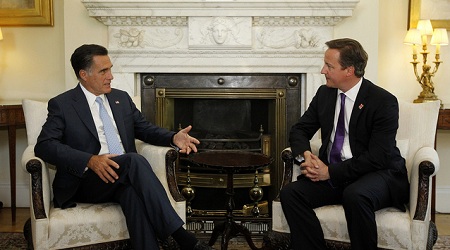
Romney/Cameron tiff showcases often odd relationship between US, UK leaders

Mitt Romney’s debut on the world stage is off to a bad start.

It’s become a bit of a campaign ritual in the United States for a presidential challenger to go on a mid-summer international trip to showcase the challenger’s ability for diplomacy in anticipation that the challenger may become the president of the United States — as executed ambitiously by Barack Obama’s July 2008 trip to Kuwait, Afghanistan, Iraq, Jordan, Israel, England, France and Germany.  (In Berlin, he even held a huge rally that drew thousands.)

Romney, the Republican nominee for president in the United States now challenging Obama, is currently on a tour to the United Kingdom, Poland and Israel.  The trip to the UK, in particular, as the 2012 Olympic Games open in London, was designed to highlight Romney’s role leading the Winter Olympics in 2002 in Salt Lake City.

He had already annoyed Obama supporters yesterday when his aides awkwardly asserted that Romney’s “Anglo-Saxon heritage” would somehow help him understand better the “special relationship” that both Americans and the British so fondly fete:

“We are part of an Anglo-Saxon heritage, and he feels that the special relationship is special,” the Telegraph quoted the adviser as saying, “The White House didn’t fully appreciate the shared history we have.”

Although the Romney camp likely meant to highlight that he would be a more “Atlanticist” president than Obama (whose foreign policy emphasis has been more on China and the Pacific than many of his predecessors), there were no mistaking the awkward racial overtones in the criticism of the United States’s first non-white president.

He then mistakenly referred to Ed Miliband, the leader of the UK’s Labour Party, as “Mr. Leader.”

But the real shocker has come today, when Romney not-so-subtly hinted that the Olympics aren’t assured of success and that some difficulties in preparations had been “disconcerting.”  British prime minister David Cameron, himself beleaguered by a sinking double-dip recession and a phone-hacking scandal that has enveloped some of his closest aides, snarked back:

“We are holding an Olympic Games in one of the busiest, most active, bustling cities anywhere in the world. Of course it’s easier if you hold an Olympic Games in the middle of nowhere,” an allusion to Salt Lake City, which hosted Games that Mr. Romney oversaw.

Ouch! Continue reading Romney/Cameron tiff showcases often odd relationship between US, UK leaders

Death of Ghana’s president John Atta Mills leaves December election unsettled

John Atta Mills, the president of Ghana, died yesterday somewhat unexpectedly, leaving Ghana’s future less clear in advance of December’s presidential election.

His vice president, John Dramani Mahama, has been sworn in as his replacement, and according to the Daily Graphic, will likely be the presidential candidate of Mills’s National Democratic Congress in December.

A longtime crusader for constitutional reform in the West African country of nearly 25 million people, and a symbol of a peaceful, democratic tradition still relatively rare throughout sub-Saharan Africa, Mills was elected in December 2008 in a very close election against Nana Akufo-Addo.

Mills, a quiet-mannered law professor, previously served from 1997 to 2001 as vice president to Jerry Rawlings.  Rawlings initially took power in a 1979 coup, but subsequently retired from the military and managed Ghana’s largely successful transition to democracy following a 1992 constitutional referendum.  He was elected president in his own right in 1992 and 1996.  That transition, two decades years ago, has held up relatively well — Rawlings transferred power peacefully to his political rival, John Kufuor, in 2001, who transferred power peacefully in 2009 to Mills.

The strength of Ghana’s institutions was on display yesterday, with no significant hitches in Mahama’s swearing-in:

Analysts took that smooth transition as reassurance of the robustness of Ghana’s institutions. “The constitutional process kicked into gear pretty well,” said Antony Goldman of the Africa-focused group PM Consulting. Razia Khan, head of Africa research at Standard Chartered bank, said: “The smooth inauguration of Mahama as President is an encouraging sign of strength of Ghana’s democratic institutions.”

Mills oversaw the first-ever oil production in Ghana in 2010 on the appropriately-named Jubilee oilfield, which has sparked maginificent double-digit growth rates — Ghana’s economy previously rested on gold mining, cocoa and other exports.  While its GDP per capita (even with newly discovered oil reserves) remains small in comparison to South Africa or Botswana  — or even Angola — Ghana has outpaced per capita GDP per capita of other West African countries like Sengal by 150% and countries like Mali and Burkina Faso by 200% to 300%.

In contrast to other countries in sub-Saharan Africa, including neighboring Côte d’Ivoire, Ghana has not been torn apart by ethnic or sectarian or tribal strife.  Unlike central and southern Africa, it does not have outrageously high HIV/AIDS rates and life expectancy lags not far behind that in Europe or the United States.

The spotlight now turns to Mahama, especially if, as expected, he becomes the standard-bearer of the NDC, the party that Rawlings founded and the more social democratic of two major parties in Ghana (the other main party in Ghana’s two-party system is the more center-right New Patriotic Party of Kufuor and of Akufo-Addo).

Presidential and legislative elections are scheduled for December 7 of this year, with runoffs to follow as necessary on December 28.  Like in the United States (and unlike, say, parliamentary systems in Germany or the United Kingdom), Ghana’s president is both head of government and head of state, so the presidential race will be a huge prize. Continue reading Death of Ghana’s president John Atta Mills leaves December election unsettled

Morsi announces surprise choice as new Egyptian prime minister

This is a little strange.

Egyptian president Mohammed Morsi has appointed little-known Hisham Qandil, the current transitional minister of water resources and irrigation, as Egypt’s new prime minister.

This upends several media reports over the past few weeks that Morsi was narrowing his search to more well-known economist types, such as former Central Bank of Egypt president Mahmoud Abul-Eyoun.  The announcement came nearly a month after Morsi was sworn in and after multiple delays.

Since inauguration, Morsi has struggled with the Supreme Council of the Armed Forces over everything from the appointment of the Constituent Assembly (which will write Egypt’s new constitution) to the disbanding of Egypt’s Islamist-dominated parliament.  One of the key problems in assessing Qandil’s appointment is that no one knows what Morsi’s powers will be as Egypt’s president (especially vis-a-vis SCAF), let alone what to expect from his prime minister.

We also know what Egypt’s investors think of the appointment: not much. Stock prices in the benchmark EGX 30 fell 1% today.

Qandil, relatively young at age 50, is not a particular specialist in economics and, prior to his appointment as water minister in July 2011, was a senior bureaucrat in the water ministry.  At a press conference later, he announced that he intends to appoint a technocratic cabinet shortly, and that he would focus on Morsi’s five top priorities — his ‘100 day plan’ to focus on security, traffic, bread, public cleanliness and fuel.

The announcement does not tell us with any further clarity what official role, if any, the Muslim Brotherhood’s Khairat al-Shater will play in the new government — al-Shater, a businessman and Islamic activist, was the Brotherhood’s original candidate for president prior to his disqualification earlier this spring, and is believed to wield signficant influence behind the scenes with the new Morsi administration.

I’ll note, however, that “water” is not among those five priorities, but water management and supply is a critical issue for a desert country whose main river, the Nile, is absolutely critical to its economy, transportation, agriculture, health and sustainability.

Like Morsi, he appears to have studied in the United States — he apparently has a doctorate in irrigation from the University of North Carolina in 1993.  He has also served as a senior manager for the African Development Bank.

It’s also strange that the announcement came initially via the Facebook page of the Muslim Brotherhood’s Freedom and Justice Party — Morsi has gone to lengths to sever official ties with the group since his election last month as Egypt’s new president, and he stressed in his press conference that Qandil has belonged to no official political party, but Egypt Independent has already noted one detail that could concern secularists:

The former irrigation minister’s beard has caused speculation of Islamist tendencies. He denied any affiliation with Islamist groups when he told Al Jazeera his beard was grown in keeping with religious obligations.

Photograph by Al-Masry Al-Youm of the Egypt Indpendent.

Up next in the spotlight during the EU’s summer of discontent: the Netherlands

It may seem hard to believe, especially as yet another bond crisis envelops Europe, but the Netherlands has less than two months to go before a new general election on September 12.

As with so many elections in Europe lately, this one will be fought and won primarily on the issue of austerity.

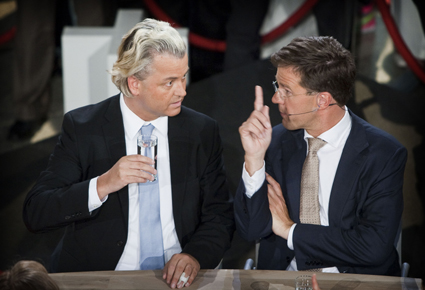
The early election was called at the end of April following the resignation of Mark Rutte (pictured above, right) over disagreements on the Dutch budget.  Rutte, whose fragile minority government was being supported by Geert Wilders’s Partij voor de Vrijheid (PVV, the Party for Freedom), had been in talks with Wilder and other government partners for weeks in an attempt to cut €16 billion from the Dutch budget, lowering the 2013 budget deficit from 4.7% of GDP to just 3% of GDP.

Wilders (pictured above, left), whose PVV vaunted to the heart of Dutch politics following the particularly fractured 2010 general election, refused to accept the cuts.

In no small part due to the populist, anti-Muslim Wilders, previous Dutch elections have focused on identity politics: protecting the particularly liberal social rights in the Netherlands (as to same-sex marriage, drug legalization and euthanasia, among others), immigration and the role of Muslims in Dutch society.

This campaign, however, is focused squarely on austerity, and while polls today show that voters are inclined to reward Rutte and his free-market, liberal Volkspartij voor Vrijheid en Democratie (VVD, the People’s Party for Freedom and Democracy), voters are also inclined to give Emile Roemer’s Socialistische Partij (SP, the Socialist Party) its best showing in Dutch political history — with projections of 30 to 32 seats.  This would only further fragment the Dutch Tweede Kamer, the 150-seat lower house parliament of the Netherlands.

After the 2010 elections, it took Rutte six months of long discussions to put together a minority government.  As it turned out, Rutte entered into a formal coalition with the center-right Christen-Democratisch Appèl (CDA, Christian Democratic Appeal), with outside support coming from Wilders’s populist, right-wing and anti-immigrant PVV.  The latest Ipsos Netherlands poll shows that both the CDA and the PVV will lose seats in September, which could complicate Rutte’s ability to form any government and which could also prevent the adoption of the 2013 budget.

Here’s the latest composition of the lower house of the Dutch parliament:

Continue reading Up next in the spotlight during the EU’s summer of discontent: the Netherlands

As snap election looms in Québec, what accounts for the charmless success of Jean Charest?

Almost every commentary on Canadian politics seems certain that Québec premier Jean Charest is set to launch a snap election in La belle province in the early autumn — with an announcement as soon as August 1.

Charest, whose Parti libéral du Québec (Liberal Party, or PLQ) has controlled the Québec provincial government since 2003, must call an election before December 2013.  But with Québec’s education minister, Michelle Courchesne and its international relations minister Monique Gagnon-Tremblay both announcing that they will step down at the end of the current term of the Assemblée nationale du Québec, and with a politically-charged Charbonneau Commission set to resume hearings on whether Charest’s government awarded government construction contracts in exchange for political financing, speculation is electric that Charest will call an election for early September.

The predominantly French-speaking Québec is Canada’s second-largest province with almost one-quarter of its population, so an election could well have national consequences.

An autumn election would follow a particularly polarizing spring, when student protesters rocked Montréal over a proposed hike in university tuition fees.  The tumultuous protests, which hit a crescendo back in May, have already resulted in the resignation of a previous education minister, Line Beauchamp.  Although Quebeckers seemed divided fairly equally in sympathy between the government and the student protestors, the battle has essentially cooled off as students depart for the summer.  Nonetheless, the government’s decision to enact Bill 78 — which provides that any gathering of over 50 people is illegal unless reported to police in advance — was less popular, leading many voters (not to mention national and international human rights advocates) to decry Charest.

For all of the stability he may have brought to Canadian federalism in the last decade, on the face of it, it would seem a rather difficult time for Charest to win a fourth consecutive mandate.  Charest’s Parti libéral recently lost a by-election in June in the riding of Argenteuil in southern Québec, a Liberal stronghold since 1966.

And yet — through all of this — Charest and his Parti libéral are, at worst, even odds to win a fourth term, an electoral achievement unprecedented since the era of Maurice Duplessis and his Union Nationale in the 1940s and 1950s.

Say what you will about Duplessis, his presence is unrivaled in 20th century Québec — he is synonymous with the province’s internal development, a staunch anti-Communist, French Catholic conservative whose rule over Québec was nearly unchallenged for two decades.

Which is to say: Jean Charest is no Maurice Duplessis.

Yet the always-impressive ThreeHundredEight blog’s latest forecast shows Charest’s PLQ with 60 seats to just 55 seats for the more leftist and separatist Parti québécois (PQ).  The newly-formed center-right, vaguely sovereigntist Coalition Avenir Québec, meanwhile, would win just 8 seats, and the radical leftist Québec solidaire would win 2 seats.

What can explain Charest’s staying power?

To understand Charest’s career is to understand that his political saga is an “only in Canada” story. Continue reading As snap election looms in Québec, what accounts for the charmless success of Jean Charest?

The GNC’s independents — not Mahmoud Jibril — will determine Libya’s path

Official results from Libya’s July 7 election have trickled in, and the result is being hailed as a victory for Mahmoud Jibril (محمود جبريل), pictured above.

His National Forces Alliance (تحالف القوى الوطنية) won 39 seats among the 80 seats that were available for political parties in the General National Congress, while the Muslim Brotherhood’s Justice and Construction Party (حزب العدالة والب) won just 17 seats.  The GNC will run Libya’s government until an elected Constituent Assembly can draft a new constitution for Libya — among its 200 members will be 120 “independents,” many of whom are unaligned with either Jibril’s coalition or the Brotherhood.

International and Libyan media immediately started to crown Jibril and the “secularists” as the winners as it became clear the NFA was leading against the Brotherhood’s candidates, but it remains unclear that Jibril’s group — which has distanced itself from the “secular” label — will necessarily control the GNC.  Jibril himself was not eligible to stand for election, so he will not actually be a member of the GNC.

Among the 120 independent candidates elected, and among the 21 members who were elected from other smaller parties, many members of the GNC will be sympathetic to a more Islamist view.  Others are already looking to strike a more nationalist third-way tone:

“We are trying to create a third way,” said Saleh Gawouda, a prominent political activist and writer who won a seat in Libya’s second largest city, Benghazi.  “The parties are trying to rally independents but until now they only met with nine or something, not big deal.”

“This new coalition will be a nationalist one,” he said.

Jibril served as the interim prime minister for a little over seven months as head of the National Transitional Council, which gained international recognition as the Libyan government from mid-2011 onward.  Jibril stepped down, as promised, upon the capture of Sirte and the killing of longtime Libyan leader Muammar Gaddafi.  His newly-formed National Forces Alliance is a union of liberals that have called for a civil democratic state and are proponents of moderate Islam.

But many Libyans are also wary of Jibril, who has very close ties to the United States and to Europe, and who served from 2007 until 2011 as the head of Libya’s National Economic Development Board, where he developed a close relationship with Saif al-Islam Gadaffi.  He was one of Libya’s leading proponents of privatization of state-run industries and liberalization of the Libyan marketplace to greater commercial ties with and development from the U.S. and Europe.

With militia leaders still active throughout Libya after a hard-fought civil war in 2011, Libya is not back to “normal” — and it’s not like there’s a “normal” to which Libya could return. Continue reading The GNC’s independents — not Mahmoud Jibril — will determine Libya’s path

Former Mubarak intelligence chief Omar Suleiman has died

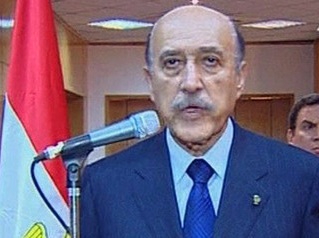
Omar Suleiman has died at 77, while undergoing medical tests in the United States.

He will not be missed among Egypt’s revolution-minded citizens, and he will be remembered both for the human rights violations that he is alleged to have committed as Egypt’s top intelligence chief for decades.  I think most of all, he’ll be remembered for his visible role as the vice president in the last, hectic days of Hosni Mubarak’s regime.  When the end came for the regime, it was Suleiman’s glassy face we remember, hours before the military brass issued its Communiqué No. 1, bringing the curtain down.

But recall that Suleiman was disqualified — along with several other top candidates — for the presidential race.  In the wake of that decision, former Mubarak prime minister Ahmed Shafiq effectively consolidated the pro-security, pro-military sector of the electorate to place second in the first round of the presidential election on May 23 and 24, and he only narrowly lost the runoff on June 16 and 17.

Had Suleiman not been disqualified, he may well have won the voters that ultimately supported Shafiq and perhaps had a real shot at winning the Egyptian presidency.

It’s hard to imagine how Egypt’s transfer could be any bumpier than it’s been, but it’s worth pausing to note that a Suleiman victory would have been an even greater disaster.  In addition to what would have been a controversial return of the felool — ‘remnants’ — of the old regime to power, Egypt would today be dealing with the fallout of that president’s death in office just three weeks after his inauguration.

Instead, we are awaiting the appointment of Mohammed Morsi’s prime minister, and Egypt’s Administrative Court has passed on the opportunity to disrupt the work of the Constituent Assembly, the group that is drafting Egypt’s new constitution.

Forget PIMCO’s Mohamed El-Erian — Egypt’s new PM is likely to be Mahmoud Abul-Eyoun

UPDATE, July 24: In a surprise move, Morsi has announced water minister Hisham Qandil as his new prime minister.

* * * *

Newly inaugurated Egyptian president Mohammed Morsi is set to announce his pick for prime minister on Wednesday, which will be perhaps the single most important signal yet from the Morsi administration as to how he will govern.

Western media are speculating that it will be none other than Mohamed El-Erian, chief executive officer of Pacific Investment Management Co.  The idea that El-Erian would leave PIMCO and return to Egypt after an entire adult life spent abroad to take on an undefined role for a Muslim Brotherhood-backed president whose role is equally undefined is, to say the least, farfetched.  Even El-Erian himself appears to have denied the reports.

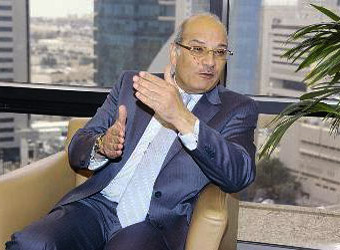
In contrast, several Egypt-based news sources seem almost certain that the new prime minister will be former Central Bank of Egypt president Mahmoud Abul-Eyoun (shown above), who served as the CBE president from 2001 to 2003 and served as CEO of the Kuwait International Bank until December 2011.

If not Abul-Eyoun, sources have indicated that the prime minister will come from among three additional possibilities, each of whom is an economist: Farouq al-Oqda, the current governor of the Central Bank of Egypt since 2003; Hazem al-Biblawy, a former finance minister; or Osama Saleh, head of the General Authority for Investment.

Those reports make a lot of sense to me:

  • Morsi is not an economist, but the biggest challenge for his administration will be to boost Egypt’s sclerotic economy — international reserves have plummeted by half and borrowing costs have risen 50% since Hosni Mubarak was toppled in Febraury 2011 after three decades in power.  Unemployment is high, especially among the young, and GDP growth is expected to slow from an already tepid 2.5% in 2011 to just 1.5% this year.
  • Morsi has stated  that he wants to appoint a cabinet gradually, so as to ensure the seamless nature of the transition.
  • If he appoints a Muslim Brotherhood member or an Islamist, it will be instantly divisive , drawing mistrust from Coptic Christians, secularists and liberals, to say nothing of SCAF, the military and the so-called ‘deep state’ elements that remain entrenched in the fabric of Egyptian political power.
  • As the former parliamentary leader of the Freedom and Justice Party, the Brotherhood’s political arm, however, Morsi will not want to appoint a prime minister deemed too unacceptable to the Brotherhood.
  • If he appoints someone too close to SCAF or Hosni Mubarak’s old regime, he’ll draw criticism from Islamists and secularists alike.
  • If he appoints someone too famous (like El-Erian or other well-known figures), he could also risk being overshadowed or outmaneuvered — after all, Morsi’s image in Egypt is of a “spare tire” who was only the Brotherhood’s last-minute choice for the presidency.

So among those four options, Abul-Eyoun seems the most likely.  The 75-year-old al-Biblawy served as finance minister recently under the transitional SCAF government, but tried to resign after clases between police and Coptic Christians in October 2011.  Morsi may also prefer to keep al-Oqda and Saleh in their current roles, so as not to disrupt Egypt’s economy any further.

That hasn’t stopped rumors like the El-Erian one, nor has it stopped speculation that Mohamed ElBaradei, former head of the International Atomic Energy Agency, might be appointed prime minister, or that the Muslim Brotherhood would prefer Khairat al-Shater, a businessman who was the Muslim Brotherhood’s first choice for the presidential race, until his disqualification in May. Continue reading Forget PIMCO’s Mohamed El-Erian — Egypt’s new PM is likely to be Mahmoud Abul-Eyoun

Despite likely fraud, AMLO, #YoSoy132 protests seem destined to fail

It’s been over half a month since Enrique Peña Nieto’s victory in the presidential election on July 1, but the protests against the electoral fraud alleged to have been committed by his party, the Partido Revolucionario Institucional (PRI), continue, however haltingly, especially in Mexico City.

Although the street protests are mostly at the impetus of a student protest movement called #YoSoy132 — it’s a long backstory, but think of it as sort of an ‘Occupy Zocalo’ movement, formed to call for greater electoral integrity and the elimination of corruption in Mexican government.  To be fair, the group has kept up a lot of pressure on the PRI both before and now after the election, especially in light of a scandal, revealed by The Guardian, suggesting a too-cozy relationship between Peña Nieto and Televisa, a top television news source in Mexico.

To be sure, it’s great that #YoSoy132 and other watchdogs will be watching the PRI like a hawk.  Notwithstanding its 12 years in the wilderness, it did control Mexico in a semi-authoritarian grip for seven decades (although I have argued that Mexico’s democratic and civil society institutions are sufficiently robust to withstand the PRI’s return to power, and the PRI may succeed where recent presidents Vicente Fox and Felipe Calderón have failed — in tax reform, on energy reform and on ending Mexico’s war on drug cartels).

Meanwhile, the runner-up in the July 1 presidential race, Andrés Manuel López Obrador (commonly, “AMLO” in the press), the candidate of the Partido de la Revolución Democrática (PRD), has cried foul play — he’s filed a complaint to invalidate the election with Mexico’s elections institute. He’s alleged that the PRI bought votes in the 2012 election and exceeded spending limits.  He’s probably right.

But unfortunately, he lost by between 6% and 7% of the vote.  A lot of folks in Mexico acknowledge that the PRI may have bought a lot of votes in the recent election and probably exceeded spending limits — even the Partido Acción Nacional (PAN), which currently controls the presidency, admits this. But there’s really no substantive legal recourse (just a post-facto fine). The relevant fact is that no one thinks Peña Nieto’s margin of victory is small enough for this to have actually mattered.  Continue reading Despite likely fraud, AMLO, #YoSoy132 protests seem destined to fail

Kadima leaves Israeli grand coalition over national service ‘Tal Law’ proposal

Well, that was short-lived.

After just 70 days in what was meant to be the broadest coalition in a generation of Israeli politics, Shaul Mofaz, the leader of the centrist Kadima party, announced that Kadima will leave Benjamin Netanyahu’s coalition over the terms of a controversial law designed to address the exemption of ultra-orthodox haredim Jews — yeshiva students of traditional religious texts — from mandatory service in the Israel Defense Force.

Netanyahu will continue as prime minster, albeit with his original 66-member coalition in the Knesset, Israel’s 120-seat parliament, with an August 1 deadline for enacting a new law.

Under the latest proposal, half of haredim between age 18 and 23 would be drafted into the IDF and another half would be drafted into national service between age 23 and 26.  It is only the latest attempt — the so-called “Tal Law” first emerged in 2002 and was extended in 2007, and has been controversial throughout its history.  Israel’s High Court of Justice, however, ruled that the Tal Law is unconstitutional and ordered the government to enact a replacement to the current law by August 1.

Mofaz, who had argued for a compulsory draft of everyone up to age 23, complained that the latest proposal did not go far enough:

Mofaz said that the proposal violates the ruling of the High Court on the issue, the principle of equal sharing of the burden of military service, is not proportional and does not meet the ultimate test of effectively resolving the issue.

Mofaz also noted that the proposal also did not include all draftable persons, and therefore, in reality, would merely maintain the unmanageable status quo.

The decision reinforces the difficult in crafting an alternative to the Tal Law in a manner that satisfies everyone in Netanyahu’s coalition. In addition to his own Likud Party and a small breakaway faction of Labor Party MKs loyal to defense minister and former prime minister Ehud Barak, the coalition contains several ultra-orthodox parties, including Shas, who are the most pro-exemption parties in the Knesset.  But it also contains the nationalist and secular Yisrael Beiteinu, which is introducing to the Knesset a bill that would require all 18-year-olds to serve (although Netanyahu has allowed Yisrael Beiteinu to introduce the bill, the remaining members of his coalition will defeat it).

Earlier this month, Netanyahu dissolved the Plesner Committee, which had been tasked with coming up with an alternative to the Tal Law, after committee members representing both Shas and Yisrael Beiteinu resigned from the committee in protest.

The question of whether to exempt haredimfrom IDF service — or whether to fashion some alternative form of civil service on the basis of equal burden-sharing — is an emotional issue in a country where security threats remain a top concern of all Israelis. Continue reading Kadima leaves Israeli grand coalition over national service ‘Tal Law’ proposal

What can we expect from Serbia’s new Dačić-led government?

Serbia’s new government is set to take office next Monday.

It will be led by Ivica Dačić, the leader of the Socialist Party of Serbia (Социјалистичка партија Србије / SPS), the nationalist, center-left party that finished a surprisingly strong third place in May’s parliamentary elections.

The SPS is perhaps most notorious for being the party that Serbian strongman Slobodan Milošević himself founded in the 1990s.  But Dačić, who has been a fixture in Serbian politics since the post-Milošević era, and has previously served as interior minister, has worked to pull his party back into the Serbian mainstream and has vowed that his government will not mark a return to the 1990s.

His government comes after a Hamlet-esque back-and-forth in choosing a coalition partner.  Dačić’s ultimate choice was to form a rather unexpected coalition with the nationalist center-right Serbian Progressive Party (Српска напредна странка / SNS).  In the May elections, the SNS emerged as a narrow winner — it won a plurality of seats in Serbia’s parliament and its presidential candidate Tomislav Nikolić defeated incumbent Boris Tadić.  Tadić had served as president since 2004 and leads the pro-western, center-left Democratic Party (Демократска странка / DS) that has essentially governed Serbia since the fall of Milošević. Continue reading What can we expect from Serbia’s new Dačić-led government?

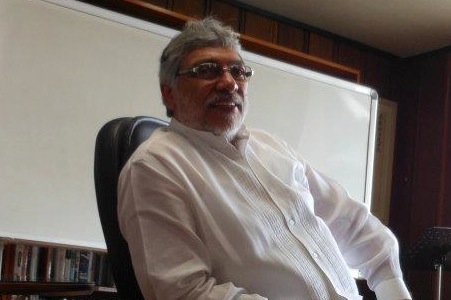
As Lugo fades, Paraguay enters diplomatic purgatory

It’s been almost three weeks since Paraguay’s congress voted to impeach and oust its president, Fernando Lugo.

The whole affair has been odd from the beginning, given that it came just 10 months before the next presidential election, and it has left regional trade blocs like Mercosur and the Organization of American States in an awkward position.

On the one hand, the impeachment was conducted in accordance with Paraguayan law — this wasn’t a military coup, but an overwhelming vote duly taken by its congress. And the vote wasn’t even close — it garnered support from not just the Partido Colorado, which Lugo defeated in 2008 to end 61 continuous years of Colorado rule, but also from the center-right Partido Liberal Radical Auténtico (the “Authentic Liberal Radical Party” or PLRA) to which Lugo’s vice president, one-time ally and, now, Paraguay’s new president, Federico Franco, belonged.

On the other hand, it’s easy to find a lot amiss with the affair — debate lasted for just two hours before the final vote, hardly the kind of constitutional due process you would expect from such a weighty matter as impeachment.  For that matter, the cause for impeachment wasn’t abuse of power, corruption, nothing more scandalous than “poor performance.” It’s an ominous sign for a country just establishing democratic norms, and it sets a dangerous precedent for the future.

From the outset, more conservative regimes saw the move as constitutionally permissible; more leftist regimes immediately saw a soft coup.

So Mercosur, bolstered by center-left Brazil and Argentina (each of which has a special distaste for extraconstitutional regime change) immediate moved to suspend Paraguay through at least next April’s presidential election.  In a further slap, Mercosur has fast-tracked the accession of Venezuela, whose president Hugo Chavez has been a particularly vocal supporter of Lugo, into the trading bloc.

Meanwhile, the OAS has taken a more tentative approach — its secretary-general José Miguel Insulza has said a suspension would only cause more difficulty for ParaguayContinue reading As Lugo fades, Paraguay enters diplomatic purgatory

First Past the Post: July 12

Mexico is poised to overtake Brazil as Latin America’s largest economy.

An early September election in Quebec seems very likely.

Don Braid comes to grips with what a Prime Minister Thomas Mulcair could mean for Alberta.

Silvio Berlusconi seems likely to run for Italian premier in the spring.

Spanish prime minister Mariano Rajoy will raise the country’s VAT from 18% to 21% and implement additional budget cuts, including limiting unemployment benefits to just six months.

Five reasons why Park’s frontrunning South Korean presidential race is defying gravity

In many ways, it is astounding that the politician with the most momentum in South Korea, the world’s 12th largest economy, is Park Geun-hye, who announced her candidacy for president earlier this week.

Her party’s been in power for the past four years — having won an election on a promise to boost South Koreans’ wealth, it has presided over a tepid economy that follows decades of nearly phenomenal, nation-transforming economic growth.  Even worse, her party’s incumbent, Lee Myung-bak, is massively unpopular and is so implicated in corruption scandals — 19 members of his administration, including his brother, are currently implicated in scandals — that he’s popularly known as “President Rat.”  He’s also taken hits for improperly spying on domestic rivals.

Park herself is the daughter of Park Chung-hee, essentially South Korea’s dictator from 1961 until his assassination in 1979, a figure about whom, it’s safe to say, 21st century South Koreans have mixed feelings. (More on that below).

So how is it that Park not only has a chance to win South Korea’s December 19 presidential election, but dominates polls in that election as well? Continue reading Five reasons why Park’s frontrunning South Korean presidential race is defying gravity

Apologies to my readers: dead laptop + vacation = light posting

I’ve been trapped in Alaska with a dead laptop for the past few days (luckily beyond the Mexican elections, but not soon enough for real-time commentary on the Libyan elections or Senegalese elections or East Timor elections — there will be more analysis, though, not to worry), so you’ll have had to settle for my post-mortem on the Mexican elections (all of them, not just the presidential race).

Technorati may have already punished me for my sins, but I will resume blogging on a consistent basis on July 10, when we’ll have a hot summer with relatively few elections, but a lot of fallout from spring elections — France to Mexico to Egypt to Greece to South Korea and beyond — with relatively few key world elections in the near term: Angola in August and the Netherlands in September and Venezuela’s presidential election in October before a more accelerated elections calendar in the last quarter of the year. (Although I would not be surprised by a fall Quebec provincial election).

After five months of near-daily blogging as a (very much) part-time venture, I have learned a lot — as much by accident as on purpose.  I will be taking much of July and August to look to ways to both sharpen and broaden the focus of this blog.  If you are a regular reader or just a visitor recently, I welcome all input on how to transform Suffragio into a more central hub for thoughtful analysis on comparative politics.

MAKING WORLD POLITICS LESS FOREIGN