What next for Liberal leader Jean Charest?

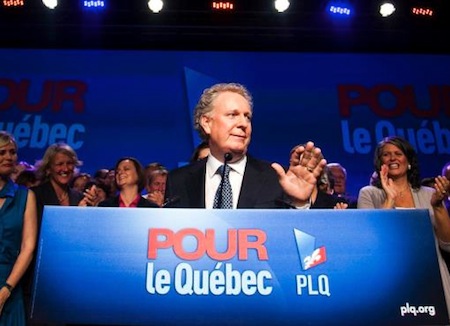
Jean Charest stepped down yesterday as the leader of Québec’s Parti libéral du Québec (Liberal Party, or PLQ), following his loss in Tuesday’s election for the 125-seat Assemblée nationale.

His party finished less than 0.75% behind the soveriegntist Parti québécois (PQ), and it won just 50 seats to the PQ’s 54.  But those four extra seats mean that the PQ will form a minority government under Pauline Marois, bringing Charest’s nine years as premier to an end.  Charest himself lost the seat that he has held since 1998 in his election district of Sherbrooke (where he also held a federal seat in the House of Commons from 1984 until leaving federal politics to take the helm of the PLQ).

The race is on to replace him, although outgoing justice minister Jean-Marc Fournier has already said he’s not running, and the remaining candidates are hardly well-known figures:

  • Raymond Bachand, Charest’s finance minister since 2009, has only been a MNA since 2005 and, at age 64, may be viewed as too old for the leadership.
  • Pierre Moreau, an MNA since 2003, was most recently Charest’s transportation minister.
  • Sam Hamad, also an MNA since 2003, the is Syrian-born, a former minister of labour, employment and transport, and most recently minister of economic development.
  • Pierre Paradis, an MNA since 1980, who clashed with Charest and never served in Charest’s cabinet, was previously a candidate in the 1983 leadership race that Robert Bourassa won.

In fact, the 1983 contest that Bourassa won was the last contested PLQ leadership race.  Bourassa, who was premier of Québec from 1970 to 1976, resigned after losing the 1976 election to the PQ, only to return in 1983 to provincial politics — he would thereupon return as premier from 1985 to 1994.

After nearly three decades at the pinnacle of Canadian and Québécois politics, surely Charest deserves a break — to be a grandfather and to reclaim a bit of his own life.

But was Charest’s decision the right one politically? Continue reading What next for Liberal leader Jean Charest?

An amazing 48 hours in Québec

Well, there’s not much I can add to what the Canadian — and indeed, the Québécois, media — have covered in the past 48 hours.

But let’s just recount:

  • In Tuesday’s election, the Parti québécois (PQ) finished first with 31.94% with 54 seats.
  • Premier Jean Charest’s Parti liberal du Québec (Liberal Party, or PLQ) came a very-much closer-than-expected 31.20% with 50 seats.
  • The newly-formed Coalition avenir Québec (CAQ) trailed narrowly with just 27.05%, but won just 19 seats.  That’s surely somewhat of a disappointment for its leader, François Legault, but the party did very well in the Québec City region and former Montréal police chief and anti-corruption figure Jacques Duchesneau won a seat.  Nonetheless, the CAQ was the significant gainer in the election and Legault has an excellent chance to build upon his success.
  • As such, the PQ leader, Pauline Marois, will form a minority government, and Marois will the first woman to become Québec’s premier, although it seems likely that we’ll see new elections long before the five-year government runs its course.
  • Marois’s victory speech was marred by a horrific assassination attempt, which left one man dead and another injured.
  • Léo Bureau-Blouin — the articulate 21-year-old and student spokesman — won his seat for the PQ in Laval-des-Rapides.
  • The leftist Québec solidaire won both seats for Amir Khadir and rising star Françoise David, but achieved a total vote of just 6.03%.  That, however, combined with the 1.90% that the breakaway sovereigntist Option nationale won likely hampered the PQ in its efforts to win a majority government — that’s nearly 8% of the electorate that would likely not have supported the PLQ or the CAQ.
  • Charest stepped down as leader yesterday after three decades in political life and after nine years as Québec’s premier.  Charest lost his own election district, Sherbrooke, which he has represented in either the federal House of Commons or Québec’s Assemblée nationale.
  • Marois has already started to move forward on ending Charest’s planned tuition hikes on students, the controversial Bill 78 limiting street protests and introducing changes to Bill 101, strengthening and enhancing the French-language requirements in the province.

Pauline Marois and the Parti québécois will form Québec’s new government

I’m in Mexico City’s airport about to board a flight to Washington, but La Presse and other outlets in Québec are calling it: The Parti québécois will win the election, form the next government (right now projected as a minority).  Premier Jean Charest’s Parti liberal du Québec will finish a strong second, and the Coalition avenir Québec follows far behind in seats, but close behind in total vote percentage.

It’s three-vote margin in Sherbrooke, Charest’s own election district.

Follow ThreeHundredEight and the Montreal Gazette‘s live-blog for additional up-to-the-moment coverage.

Is the European ‘Christian democracy’ party model dead?

When Dutch voters go to the polls on September 12, we don’t know whether they’ll favor prime minister Mark Rutte’s Volkspartij voor Vrijheid en Democratie (VVD, the People’s Party for Freedom and Democracy) or Emile Roemer’s Socialistische Partij (SP, the Socialist Party) or even Diederik Samsom’s Partij van de Arbeid (PvdA, the Labour Party) as their top choice.

What we do know is that the election could well be the worst post-war finish for the traditional Christian Democratic party in the Netherlands, the Christen-Democratisch Appèl (CDA, Christian Democratic Appeal).  It’s currently on track to finish in fifth place (or even sixth place) in a country that it had a hand in governing virtually without break in Dutch post-war politics until 2010.

In 2010, the CDA won just 21 seats in the lower house of the Dutch parliament, and it could win just 15 seats or less this time around.

So it goes all across Europe:

  • In Italy, the Democrazia Cristiana controlled the government (or participated in governing coalitions) for nearly 50 years of post-war Italian politics.  The Tangentopoli (‘Bribesville’) scandal led to its demise under the weight of massive corruption allegations in 1992, and the remaining core of that party, the Unione dei Democratici Cristiani e di Centro (UDC, the Union of Christian and Centre Democrats), led by Pier Ferdinando Casini, plays a significant, but minor role in Italian politics today.
  • Norway’s Christian Democratic Party, the Kristelig Folkeparti (KrF) once dominated Norwegian politics as well, but now holds just 10 out of 169 seats in the Norwegian parliament.
  • In Bavaria, the Christlich-Soziale Union (CSU, Christian Social Union) has controlled Bavaria’s state government since 1957.  It’s still the overwhelmingly largest party in Bavarian politics, but it lost 32 seats in the Landtag in 2008 and now holds just 92, and it looks likely to lose even more seats in the Bavarian state elections that must be held in 2013.
  • In Switzerland, the Christlichdemokratische Volkspartei der Schweiz (CVP, Christian Democratic People’s Party of Switzerland) has steadily declined since the 1970s.

Only in German federal politics does Christian democracy seem to be holding on — in the form of Angel Merkel’s Christlich Demokratische Union (CDU, Christian Democratic Union), which is allied at the federal level with Bavaria’s CSU.

So what’s happened to Christian democracy? And is it a concept whose time is up?

Christian democracy emerged as a political movement in the 19th century, as much as anything a reaction of the Catholic Church to the Industrial Revolution — and to the Marxist ideas that had so effectively challenged industrial capitalism in the mid-19th century, in the same way that the social democratic movement that gave voice to (and moderated) the growing labor movement.  (Some political scientists see a parallel in the “justice and development” strand of moderate Islamist parties that have emerged in Turkey and through vehicles like the Muslim Brotherhood in Egypt and Jordan).

It reached its heyday during the Cold War as a bulwark against the communist influences of Soviet Russia, but today seems increasingly an anachronism as the European right divides into, on the one hand, a free-market liberal ideology untroubled with cultural issues and, on the other hand, a nationalist ideology that is increasingly both anti-Europe and anti-immigrant.  That fragmentation provides yet another complication in navigating the European Union out of its current debt and currency crisis — the European Union was formed and the eurozone conceived in a world where Christian democracy largely controlled the initial EU member states. Continue reading Is the European ‘Christian democracy’ party model dead?

Québec votes today

Canada’s only French-speaking and second-largest province goes to the polls today to elect the 125-member Assemblée nationale — Quebec’s politics are a fascinating subset of Canadian politics (notwithstanding the fact that the election will likely have a minimal impact on federal Canadian politics).

Rather than try to provide my own rundown and projection, I’ll leave it to Éric Grenier of ThreeHundredEight: his ridiculously detailed (and amazing) projection calls for a majority government led by the leftist, sovereigntist Parti québécois (PQ), although just barely.

Polls show three top parties since premier Jean Charest announced snap elections and kicked off the campaign on August 1:

  • Charest’s own Parti libéral du Québec (Liberal Party, or PLQ) — Charest has governed the province since 2003, and the Liberals are seeking their fourth consecutive mandate in the face of charges of corruption (the Charbonneau Commission is looking into whether the government traded construction contracts in exchange for political financing) and a government that’s not done enough to boost the economy, despite a flashy plan to develop northern Québec.
  • The PQ, led by Pauline Marois, which is looking to return to provincial government after nearly a decade.
  • The Coalition avenir Québec (CAQ), led by François Legault, which was formed just last year and which lies vaguely to the right of the PLQ, although not in every way, and which lies somewhere between the sovereigntism of the PQ and the federalism of the PLQ (Legault, a former PQ minister, once supported the 1995 referendum on Québec’s independence, but has said any CAQ government will not pursue a new referendum).  The CAQ’s recruitment of quality candidates has been a boost, none of which more so than former Montréal police chief Jacques Duchesneau, whose presence in the election has been a constant reminder of potential PLQ corruption.

Grenier forecasts 63 seats for the PQ, just 33 seats for the Liberals and 27 for the CAQ.  If true, it would be a bloodbath for Charest’s Liberals, who would stand a chance of being pushed not only out of government, but into third place (while the CAQ becomes the Official Opposition) — it would likely also mean that Charest himself would lose his seat in Sherbrooke, a district where he’s been winning elections since 1984.

Roughly speaking, the PLQ is expected to hold its own in Montréal and its suburbs, where most of the province’s anglophones live (although they comprise 10% or so of the electorate, English-speakers tend to vote en masse for the Liberals, even though there are signs that some may be considering the CAQ).  The CAQ is expected to do well around Québec City further north, and the PQ is expected to do well everywhere else.

A key question will be whether two smaller more radically leftists and sovereigntist parties, Québec solidaire (whose spokeswoman Françoise David performed well in the party leaders debate) and Option nationale, succeed in taking away votes form the PQ — Marois has tread very lightly on the sovereignty issue, making it clear that she’s more interested in governing the province than arranging another referendum.

Increasingly less important over the course of the campaign has been the tuition fee issue — student protests over tuition hikes that shut down Montréal universities, and Charest’s police-heavy (some might say unconstitutionally repressive) response, brough international attention last spring.  Despite Marois’s opposition to tuition hikes and a high-profile PQ candidate in 20-year-old student leader Léo Bureau-Blouin, the issue has not had the salience you might have expected just a few months ago.

I am traveling most of Tuesday, but hopefully will have some brief thoughts much later tonight when we have an idea of which party — PLQ, PQ or CAQ — has won the most seats and whether they’ll command enough seats to have a majority government.

In the meanwhile, a little Céline Dion to help set the election day mood, and of course you can follow all of Suffragio‘s coverage of the election here.

À bientôt!

Plan Nord and the Québec election

Lurking behind the sexier issues at the forefront of tomorrow’s Québec provincial elections — sovereignty, federal-Québec relations, health care, corruption inquiries, tuition fees and student protests — lies an issue that will be quite strongly affected by who wins.

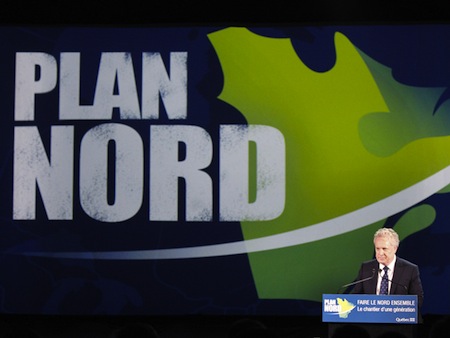
That issue is premier Jean Charest’s Plan nord — a plan announced in May 2011 to exploit the natural resources in the great expanse that comprises the northern two-thirds of Québec.  The idea is that over the next 25 years, the Plan will attract up to $80 billion in investments for mining, renewable and other forms of energy and forestry.  Charest, whose Parti libéral du Québec (Liberal Party, or PLQ) is struggling to win a fourth consecutive mandate, has made it one of his government’s top priorities, although it’s been met with some resistance from environmentalists as well as from the native Innu people, around 15,000 of whom inhabit Québec’s far north, to say nothing of Charest’s political opponents.

His government claims that northern Québec contains deposits of nickel, cobalt, platinum group metals, zinc, iron ore, diamonds, ilmenite, gold, lithium, vanadium and rare-earth metals, and that, with a warming climate and melting polar ice, extracting the mineral wealth will be easier than in past generations.  The region, although fairly undeveloped and remote, already produces 75% of hydroelectric power in Québec.

Pauline Marois, who leads the sovereigntist — and more leftist — Parti québécois (PQ), which leads polls for tomorrow’s election, has said that she will not scrap the plan if elected, but will instead raise royalties on mining companies from 16% to 30% for mining companies that achieve a certain level of profits, with a minimum royalty of 5% on all mining companies.  Charest’s government has already raised royalties from 12% to 16%.

François Legault, the leader of the newly-formed Coalition avenir Québec (CAQ), has argued that Charest’s government is “putting all its eggs in one basket” with Plan nord, but he hasn’t said he wants to scrap it — he’s criticized Marois as well for trying to extract more royalties from mining companies.  Legault has proposed using $5 billion from the province’s $160 billion Caisse de depot et placement (its public pension fund) to capitalize a new natural resources fund.

In announcing Plan nord, Charest stressed the developmental elements of the plan, which would include a $2.1 billion investment from the province in northern infrastructure and which would also aim to build roads to link communities — in many cases, for the first time.

He also stressed the conservation elements of the plan — the government has claimed it will set aside 50% of the region for natural protection and unavailable for industrial development.

Late last week, however, Charest’s PLQ was ranked the worst of the three parties for the environment in a survey among environmental groups — a fourth party, the leftist and sovereigntist Québec solidaire,  scored the highest with 83% under the survey, while the Liberals scored just 33%.  The report followed another news story in Le Devoir late last week that claimed the Plan nord would wipe out wild caribou herds in the region.

Meanwhile, it is not clear that Charest has ever had the native population, which owns much of the land and mineral rights, quite on board.  Also last week, Ghislain Picard, Grand Chief of the Assembly of First Nations of Quebec and Labrador, criticized the Charest government in a criticized the manner in which the Charest government has approached northern development: Continue reading Plan Nord and the Québec election

As expected, Dos Santos and the MPLA are leading the vote count in Angola

It wasn’t a surprise — Angola’s president José Eduardo dos Santos has won reelection, following the parliamentary victory of his Movimento Popular de Libertação de Angola – Partido do Trabalho (MPLA or the People’s Movement for the Liberation of Angola – Labour Party) after elections on Friday, September 1 with nearly 74% of the vote.

Read about the run-up to the election here — no one predicted that the elections would be free or fair.

From Reuters:

The provisional results gave the MPLA’s closest challenger, former rebel group UNITA, nearly 18 percent, while the third-placed CASA-CE party was approaching five percent in its first election test after being formed by UNITA dissident Abel Chivukuvuku four months ago.

Chivukuvuku told reporters his party, which along with UNITA had complained repeatedly of serious irregularities in the vote preparations and the electoral process, was analysing the results before deciding whether to accept or reject them.

But another prominent CASA-CE member, candidate for Luanda William Tonet, dismissed the provisional results as “cheating taken to its maximum level”.

“This is like a declaration of war by the MPLA … it indicates to citizens that there can be no alternative through the electoral route,” he told Reuters.

Impressions of Oaxaca in México’s Peña Nieto era

I have been in Oaxaca this weekend (and will be so until Tuesday of the following week — when Québec votes!) and I wanted to share just a little about what I’ve seen here, and how it colors my perception of Mexican politics.

Oaxaca is the capital of Oaxaca state, which is by and large a student-heavy city (so lots of supporters of the #YoSoy132 movement in opposition to president-elect Enrique Peña Nieto of the Partido Revolucionario Institucional (PRI) ) in a state that already traditionally supports the Partido de la Revolución Democrática (PRD), and its candidate for president in the July 1 election, Andrés Manuel López Obrador.  It is also the capital of state that is the most indigenous in all of México– with Zapotec, Mixtec, Mazatec, Chinantec and myriad other groups calling the region their home.  It is the home of México’s sole indigenous president, Benito Juárez, a central figure of 19th century Mexican history.

The backstory is that Oaxaca was the site of a fierce — and deadly — fight between police forces and the Asamblea Popular de los Pueblos de Oaxaca (APPO, or the Popular Assembly of the Peoples of Oaxaca), which emerged after the tense showdown between authorities and a teachers’ union during a strike in Oaxaca in May 2006.  Brutal force by the police during that strike escalated the incident into a full-fledged battle that left Oaxaca, essentially, with a reputation as the Chiapas of the 2000s.  Although the governor at the time, Ulises Ruiz, a PRI governor, left office in 2010, his successor is the PRD-backed Gabino Cué, the first non-PRI governor of Oaxaca in over 80 years, and peace has, more or less, returned to the beautiful city 5,000 meters above sea level.

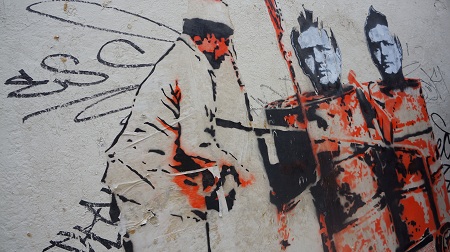
Nonetheless, and despite the ruling of México’s highest election court that Peña Nieto, has indeed won the election, despite accusations of unfair play from the PRD, I have been struck by the expressions of anti-Peña Nieto grafitti everywhere (see above, and see below, with Carlos Salinas, former PRI president from 1988-1994, ummm, popping out of Peña Nieto’s brain:

And here is Mexico’s president-elect being portrayed as garbage:

It’s understandable that there’s a certain segment of Oaxaca’s population that is significantly opposed to Peña Nieto, given the authoritarian background of the PRI when it was in power for seven decades from 1929 to 2000, but it’s striking that there’s been so little, just two months after the election, in the way of support of López Obrador or of opposition to the current, outgoing Mexican president, Felipe Calderón, whose Partido Acción Nacional (PAN) has held the presidency for the past 12 years.

None of this is to rule out the potential of a Peña Nieto presidency, but it’s a clear signal that he has yet to convince many segments of México’s vast population that he has their interests at heart.

Photo credit to Kevin Lees — Oaxaca, Mexico, September 2012.

Angola votes today

Although it’s incredibly, overwhelmingly likely that, José Eduardo dos Santos, Angola’s president since 1979, will be reelected, and his party, the Movimento Popular de Libertação de Angola – Partido do Trabalho (MPLA or the People’s Movement for the Liberation of Angola – Labour Party) will likely retain control of Angola’s Assembleia Nacional, Angola will go through the motions of an election today — its second since the end of a 30-year civil war in 2002.

Notwithstanding the fact that the election is not seen as being free and fair — even yesterday, opposition campaigners were arrested at the at the national election commission in Luanda, Angola’s capital, for trying to obtain credentials to observe voting — one key question is whether the MPLA will retain the 191 seats (out of 220) it currently holds, or whether the opposition União Nacional para a Independência Total de Angola (UNITA or the National Union for the Total Independence of Angola) will be allowed to win more seats.  The MPLA and UNITA today are remnants of the two major groups that contested Angola’s civil war.  A third group, the Convergência Ampla de Salvação de Angola (the Casa-CE, or the Broad Convergence for Angola’s Salvation-Electoral Coalition), is trying to bring a new, postwar identity to Angolan politics.

Overwhelmingly, the main issue in the election campaign has been poverty — despite Angola’s oil wealth, over 40% of the country’s 18.5 million citizens remains impoverished.

Until we have the results, I’ve linked to Bonga (José Adelino Barceló de Carvalho), one of the most popular musicians in Angola’s samba musical tradition.

Follow Suffragio‘s coverage of the Angolan election here.

First Past the Post: August 30

Is it the end of Dutch election poster wars?

South Koreans are running out of patience with the will-he-won’t-he candidacy of Ahn Cheol-soo.

Liberal Democratic leader and U.K. prime minister Nick Clegg hits back at his internal critics.

In Colombia, president Juan Carlos Santos will hold peace talks in Norway in October with armed revolutionary group Fuerzas Armadas Revolucionarias de Colombia (FARC, or  Revolutionary Armed Forces of Colombia). The Economist‘s take here.

Americas Quarterly reviews the platform of Venezuelan president Hugo Chávez.

Global Post looks at Germany and the country’s attitudes on the eurozone in a series of pieces.

Opposition members in Angola are arrested on the eve of elections.

Who is Diederik Samsom? A look at the newest party leader in the Netherlands

When Dutch voters tune into tonight’s debate — the second in advance of the September 12 parliamentary election — they will be watching closely the man who was deemed to be the winner of last week’s debate.

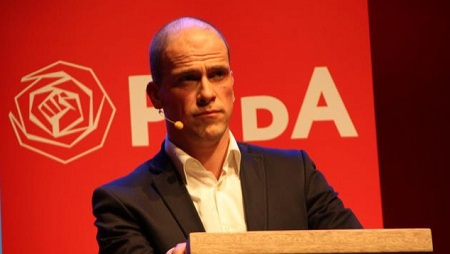
That’s Diederik Samsom, the leader of the social democratic Partij van de Arbeid (PvdA, the Labour Party), is riding a wave of popularity, with Labour rising very narrowly in the polls and with indications that Dutch voters may be giving Samsom his first real look as they contemplate doubts about Emile Roemer, the popular leader of the Socialistische Partij (SP, the Socialist Party).

A former Greenpeace activist who once studied nuclear energy and physics, Samsom has been a Labour member of the Tweede Kamer, the lower house of the Dutch parliament, since 2003, and has served as the party’s spokesperson for environmental issues.  Hailing from the left branch of the Labour Party, Samsom opposed extending the Dutch military presence in Iraq in 2004 in defiance of much of his own party.

The Labour Party currently holds the second-largest number of seats in the Tweede Kamer — 30 seats to 31 for the party of prime minister Mark Rutte, the the Volkspartij voor Vrijheid en Democratie (VVD, the People’s Party for Freedom and Democracy).

Many Dutch voters appear ready to reject Rutte’s brand of austerity, which would normally leave Labour well-placed for the elections.  Instead, Labour has watched as Roemer and the Socialists bounded to the top of the polls, tied or even leading Rutte’s VVD. Continue reading Who is Diederik Samsom? A look at the newest party leader in the Netherlands

Could this man defeat Québec premier Jean Charest in his own district?

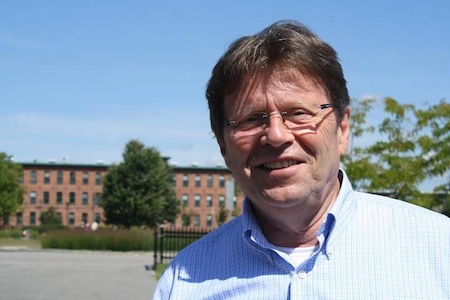
Serge Cardin (pictured above) leads the premier of Québec in his own election district by 12 points in the latest Segma poll — by a daunting margin of 45% to 33%. 

It’s not a fluke — Jean Charest’s seat is one of the most vital election districts to watch among the 125 seats up for grabs in next Tuesday’s election for control of Québec’s Assemblée nationale, and it’s far from certain that Charest himself will even be reelected.  Cardin’s 12-point lead is actually narrower than a poll earlier in the month that showed him with a 15-point lead.

Just yesterday, protesters in Sherbrooke proved so disruptive that Charest cancelled a campaign appearance in his own district.  Moreover, Charest has spent a significant amount of time in Sherbrooke since announcing snap elections in early August, indicating that the premier is increasingly worried about his own constituency.

Although Charest has been the premier of Québec for nearly a decade, and he’s won elections in eight federal and provincial elections since 1984 in Sherbrooke, he faces an increasingly tough fight — the latest province-wide CROP poll shows his party, the Parti libéral du Québec (Liberal Party, or PLQ) in third place with just 26% to 33% for Pauline Marois’s sovereigntist Parti québécois (PQ) and 28% for François Legault’s newly-formed Coalition avenir Québec (CAQ).

Charest, who is seeking a fourth consecutive mandate from Québec voters, finds his government under attack from both the PQ and the CAQ on the economy, on his response to student protesters over the tuition increase and, above all, charges of corruption, including a high-profile commission investigating whether his government traded construction contracts in exchange for political financing. Continue reading Could this man defeat Québec premier Jean Charest in his own district?

Galicia regional elections will be the first test of Rajoy’s austerity measures

Galicia’s premier Alberto Núñez Feijóo on Monday announced that his province, too, would join the Basque Country in holding early regional elections on October 21, rather than waiting for his term to run out in March 2013.

In so doing, Feijóo (pictured above, right) who hails from the center-right Partido Popular de Galicia (PPdeG, the People’s Party of Galicia), the local version of Spanish prime minister Mariano Rajoy’s Partido Popular (PP, People’s Party), has launched the first electoral test for Rajoy’s government, after just eight months in office.

Given Rajoy’s ties to Galicia and its status as a traditional PPdeG stronghold, it’s very much more fraught for Rajoy (pictured above, left) than the simultaneous Basque election, where two nationalist parties lead polls and where unique local and autonomy issues will figure nearly as much as national issues.

Rajoy’s party won the Spanish general election in November 2011, but his government is already facing mounting unpopularity as it’s made increasing cuts to the Spanish budget, notwithstanding an economy that’s back in recession — the economy has contracted by 0.7% so far this year and grew just 0.4% in 2011 — and an unemployment rate of 24.8%, as of June.

So far, Rajoy has pushed through at least four different austerity packages, designed to bring the Spanish deficit to just 6.3% of Spanish GDP, down from an 8.9% deficit in 2011.  Rajoy has raised the Spanish income tax rate, raised the Spanish value-added tax by 3% to 21%, eliminated tax breaks for home owners and reduced spending on education and health care — and that comes after two years of cuts implemented by the government of Rajoy’s predecessor, José Luis Rodríguez Zapatero.

For all its efforts, Spain is still straining under yields on its sovereign debt that rose from 5% (on 10-year bonds) when Rajoy entered office to 6.5% now, down from a crisis-level high of around 7.5% in mid-July.  So notwithstanding the harsh austerity, it seems more likely than not that Spain will seek a bailout from the European Union, possibly later this year — earlier in June, the European Central Bank intervened to provide funds for ailing Spanish banks.  That, too, has caused Rajoy to lose credibility after promising that he would never seek a bailout during his campaign.

The austerity push has affected the regions, which are responsible for cutting their own budgets to a combined 1.5% of GDP, and Galicia has not been unaffected by cuts at the regional level.

Since the end of the Franco era, the PPdeG has been out of power for just four years.  As such, it will be somewhat of an embarrassment if Feijóo and the PPdeG cannot win reelection in a region that’s historically been a bastion of Spanish conservatism — Rajoy himself is from Galicia and who once himself served in the Parlamento de Galicia Continue reading Galicia regional elections will be the first test of Rajoy’s austerity measures

What effect will the Québec election have on Canadian federal politics?

With all eyes on Québec’s election next Tuesday, federal Canadian politics has somewhat been on the backburner for the past month.

But what are the consequences of the election in Canada’s second most-populous province for federal Canadian politics?

By and large, federal politics is highly segregated from provincial politics.  While there’s some overlap, provincial parties do not necessarily line up with national parties (for example, in Alberta, both the Progressive Conservative Party and the Wildrose Party are considered ‘conservative’ by federal standards and both parties attracted support from the federal Conservative Party in Alberta’s provincial election in April 2012).  That’s especially true in francophone Québec — the province has greater autonomy than most provinces, historically leans more leftist than the rest of Canada, and features its own separate federalist / sovereigntist political axis that is unique to Québec.

Nonetheless, a possible win by either of the three major parties — a fourth-consecutive term for premier Jean Charest and his Parti libéral du Québec (Liberal Party, or PLQ), Pauline Marois and the sovereigntist Parti québécois (PQ) or former PQ minister François Legault’s newly-formed Coalition avenir Québec (CAQ). — could affect federal Canadian politics in subtle ways.

Prime Minister Stephen Harper and the Conservative Party

There’s little downside for the federal Conservatives in any case, especially considering that Harper hasn’t devoted time or effort to backing anyone in the Québec race.

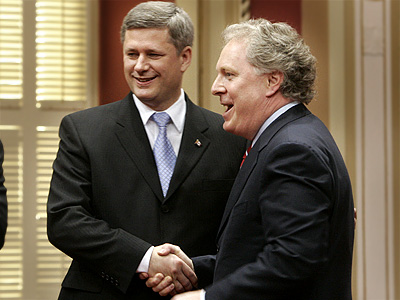
Charest, of course, once served as the leader of the federal Progressive Conservative Party in the 1990s before moving to provincial politics — the Progressive Conservatives ultimately merged with Harper’s Western-based Canadian Alliance in 2003 to become the Conservative Party.  Although Charest has been a staunch federalist in nearly a decade of leading Québec’s government, he hasn’t always had the best relationship with Harper (pictured above, left, with Charest).  That’s partly due to the tension between a provincial premier and a federal prime minister, but Harper, in particular, is still thought to feel somewhat burned after intervening on behalf of Charest in the final days of the 2007 Québec election.

Harper provided $2 million in additional federal transfers to Québec that may well have helped premier Jean Charest narrowly win that election — Charest proceeded to use the funds to pass $700 million in tax cuts instead of for extra services, causing Harper problems with his allies in other provinces.   Continue reading What effect will the Québec election have on Canadian federal politics?

Who is Luis Fortuño? A primer on Puerto Rico and the Republican Party’s favorite boricua.

Tonight, at the U.S. Republican National Convention in Tampa, Florida, the list of primetime speakers will feature the governor of the Commonwealth of Puerto Rico, Luis Fortuño.

Although Suffragio doesn’t normally wade into U.S. politics, Puerto Rican politics lies fairly far afield from mainstream American politics, notwithstanding the plum role that Fortuño will fill tonight at the convention in his support for U.S. presidential candidate Mitt Romney.

Fortuño was elected governor of Puerto Rico in 2009, winning 52.8% of the vote to just 41.3% for the incumbent, Aníbal Acevedo Vilá, who had been implicated in a corruption scandal.  As governor, Fortuño immediately embarked upon a relatively unpopular program of cutting $2 billion from Puerto Rico’s budget, resulting in over 12,000 layoffs of state employees.  Fortuño also passed and implemented Law 154, which imposed a temporary excise tax on certain overseas sales, while also cutting taxes 50% for individuals and 30% for businesses.  Ultimately, Fortuño brought the budget deficit from $2 billion in 2009-10 to just $333 million in 2012-13 — his zeal for cutting budgets and for lowering taxes has attracted a significant amount of regard from Republicans on the U.S. mainland, and he was even mentioned as a potential vice presidential candidate for Romney.

Political parties in Puerto Rico, however, aren’t organized along the same ideological lines as on the U.S. mainland — Fortuño belongs to the Partido Nuevo Progresista de Puerto Rico (the PNP, New Progressive Party of Puerto Rico), which is first and foremost a proponent of full statehood for Puerto Rico.  In contrast, the Partido Popular Democrático de Puerto Rico (the PPD, Popular Democratic Party of Puerto Rico) favors Puerto Rico’s current status as a commonwealth.  A smaller third party, Partido Independentista Puertorriqueño (Puerto Rico Independence Party) favors Puerto Rico’s full independence — it looks and feels much like a traditional Latin American populist/leftist party, and it has attracted the support of the likes of high-profile Latin American figures, including author Gabriel García Márquez.

Continue reading Who is Luis Fortuño? A primer on Puerto Rico and the Republican Party’s favorite boricua.

MAKING WORLD POLITICS LESS FOREIGN