2014 US midterms showcase rise of Asian Americans

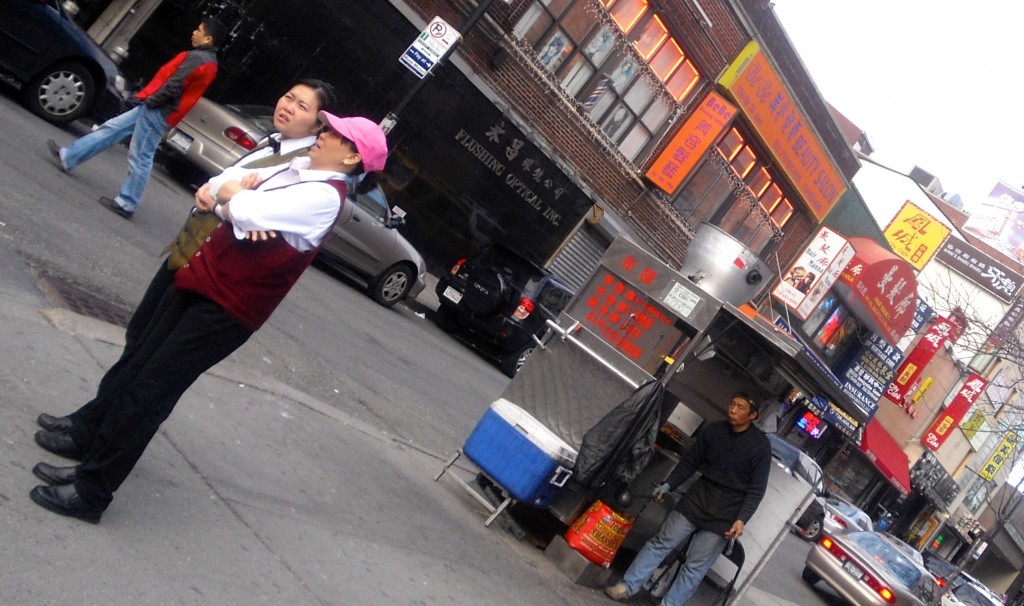
CIMG9933Flushing, in Queens, is one of the most Asian neighborhoods in the United States.

Apparently, the swing among Asian Americans between the 2012 general election in the United States and the 2014 midterm elections was a staggering 46%:asia iconUSflag

Note the big swing in the Asian voting bloc, too. In 2012, strong support for the president among Asian-American voters was a surprise. Asian voters preferred the president by 47 points. In 2014, the (low turnout) group split about evenly. It was a 46-point swing.

That still translates to a fairly robust tilt among Asian Americans toward Democrats — just not the overwhelming trend that we saw in 2012 and 2008 and, even to some degree, 2010. Other exit polling shows that Asian Americans still strongly supported Democrats — in Virginia, they favored incumbent Democratic senator Mark Warner over Republican challenger Ed Gillespie by a margin of 68% to 29%, for example.

But why should Asian Americans necessarily lean to the left? The Asian American experience in the United States is extremely varied, and it’s a growing bloc of disparate cultures and experiences. In that regard, Asian Americans are just like Latin Americans, who come from an equally broad range of national and ethnic background. Mexican Americans in California may have different political views that Mexican Americans in Texas, to say nothing of Salvadorans in Maryland, Cubans in New Jersey or Dominicans in Florida.

The same goes for Asian Americans.

So what are we talking about when we say, ‘Asian Americans?’ Continue reading 2014 US midterms showcase rise of Asian Americans →

Juncker’s first ‘scandal’ shouldn’t merit resignation calls

10690262_10152500553938129_6918856406027085946_n
I spoke with RIA Novosti earlier today about the revelations that Luxembourg’s government has been much more intimately involved in granting tax concessions to international companies.European_UnionluxembourgThose revelations come less than a week after former Luxembourgish prime minister Jean-Claude Juncker officially took office as president of the European Commission.Marine Le Pen, the leader of the far-right, eurosceptic Front national (National Front) has already called on him to resign.
My full remarks follow below:

It’s a very embarrassing position for Juncker, because he only took office as the president of the European Commission a few days ago, and he’ll take some perhaps well-deserved political heat for the matter, and it probably reduces his credibility on tax reform matters.

Everyone has, in the back of their minds, the example of the Santer Commission, which resigned en masse in 1999 over corruption. For now, the revelations do not appear to implicate Juncker in anything more than the kind of aggressive steps that state leaders sometimes take to attract foreign development and investment. If, for example, Juncker was found to have taken personal kickbacks in exchange for favorable treatment, it would be a much more serious allegation for himself, for the Commission, and for confidence in Luxembourg’s institutions. But there’s no evidence of that.

Meanwhile, the Commission is a professional regulatory body, and any investigations into Amazon or other companies that received state aid in potential violation of European law will be conducted by Denmark’s Margrethe Vestager, the EU commissioner for competition, who is a former minister of economic affairs and deputy prime minister. It’s helpful, from an ideological perspective, that Vestager comes from the Danish Social Liberal Party, which should give some comfort to the European Parliament’s leftists. Ultimately, this is less a ‘scandal’ than a valid policy issue, insofar as Luxembourg and other countries have long pushed the envelope in making their jurisdictions extremely favorable to international companies. Note the Irish government’s decision last month to revise the ‘double Irish’ structure so common in the taxation of intellectual property assets. So as the Commission and other EU (and even international) institutions look into these decisions, it will help clarify the line between permissible and impermissible in the future.

Marine Le Pen is hardly the best critic on the matter, because her party has long been in favor of lowering taxes and promoting the kind of economic nationalist steps that Luxembourg’s officials may have taken with many international companies. Her call for Juncker’s resignation isn’t credible, but it’s very important for her to maximize support among the eurosceptic French right if she’s going to have any credible shot at winning the French presidency in 2017, a task made much more difficult by the return of former president Nicolas Sarkozy.

Latin America should stop worrying (about term limits) and start to love incumbency

dilma

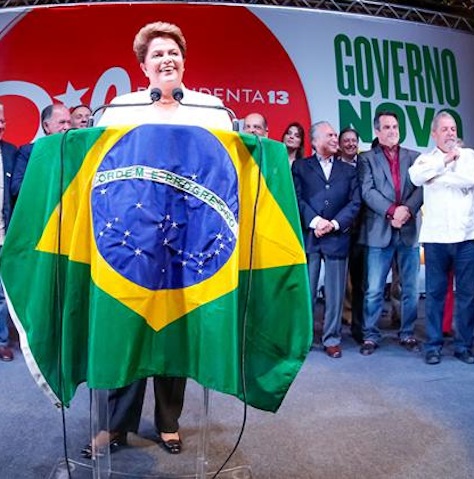
My latest for Americas Quarterly argues that the hand-wringing over the advantages of incumbency in Latin America is overwrought, and that term limits may actually hinder the development of sustained policy gains.brazil

In particular, Colombia’s Juan Manuel Santos, Bolivia’s Evo Morales and Brazil’s Dilma Rousseff each won their respective presidential contests since June. But two of those three elections were incredibly competitive:

Incumbent victories in Brazil and Colombia, the two largest economies of South America today, are also much more fragile than they appear. Rousseff only narrowly defeated challenger Aécio Neves, and her margin of victory was the smallest of any presidential election since the end of Brazil’s military dictatorship in 1985.

Santos actually lost Colombia’s first-round vote in May to the more conservative Óscar Iván Zuluaga, who had threatened to shut down talks between the Santos government and the leftist Fuerzas Armadas Revolucionarias de Colombia (Revolutionary Armed Forces of Colombia—FARC) that have destabilized the country for a half-century. More notably, the country’s March parliamentary elections transformed the Colombian Congress from a rubber-stamp chamber into a much stronger check on presidential power.

In both countries, democratic competition is on the rise. Even in countries lacking truly fair elections, such as in Venezuela, Henrique Capriles nearly defeated President Nicolás Maduro in April 2013, despite the widespread institutional advantages from which Maduro benefitted after over a decade of chavismo.


Read it all here.

Putin tops world power rankings

putinpower

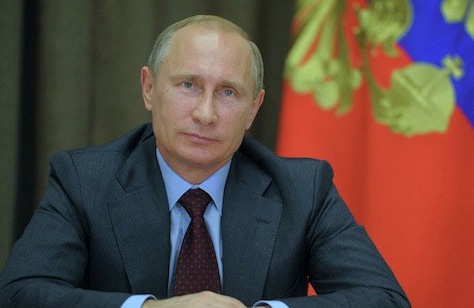
It’s far from scientific, but less than 24 hours after Republicans appeared to defeat US president Barack Obama in midterm congressional and gubernatorial elections, Russian president Vladimir Putin defeated him to the top spot on Forbes‘s 72 Most Powerful People in the World.USflagRussia Flag Icon

The rankings don’t really mean that much in the grand scheme of things, of course.

The Forbes rationale?

We took some heat last year when we named the Russian President as the most powerful man in the world, but after a year when Putin annexed Crimea, staged a proxy war in the Ukraine and inked a deal to build a more than $70 billion gas pipeline with China (the planet’s largest construction project) our choice simply seems prescient. Russia looks more and more like an energy-rich, nuclear-tipped rogue state with an undisputed, unpredictable and unaccountable head unconstrained by world opinion in pursuit of its goals.

Hard to argue with that, I guess.

But the rankings represent a nice snapshot of what the US (and even international) media mainstream believe to be the hierarchy of global power. Though I’m not sure why Mitch McConnell, soon to become the U.S. senate majority leader, isn’t on the list.

So who else placed in the sphere of world politics this year?

  • Obama ranked at No. 2 (From the Forbes mystics: ‘One word sums up his second place finish: caution. He has the power but has been too cautious to fully exercise it.’).
  • Chinese president Xi Jinping, who took office in late 2012 and early 2013, ranked at No. 3. (Tough break for the leader of the world’s most populous country!)
  • Pope Francis, ranked at No. 4, even though Argentina lost this year’s World Cup finals to Germany.
  • Angela Merkel, ranked at No. 5, third-term chancellor of Germany and the queen of the European Union.
  • Janet Yellen, ranked at No. 6, the chair of the US Federal Reserve.
  • Mario Draghi, ranked at No. 8, the president of the European Central Bank.
  • David Cameron, ranked (appropriately enough) at No. 10, the Conservative prime minister of the United Kingdom, who faces a tough reelection battle in May 2015.
  • Abdullah bin Abdul Aziz Al Saud, No. 11, the king of Saudi Arabia.
  • Narendra Modi, No. 15, India’s wildly popular new prime minister.
  • François Hollande, No. 17, France’s wildly unpopular president.
  • Ali Khamenei, No. 19, Iran’s supreme leader, especially as Iranian nuclear talks come to a crucial deadline this month.

Continue reading Putin tops world power rankings →

What the world can teach the United States about DC voting rights

DSC00905

A view of DC from the top of Anacostia in East Washington.

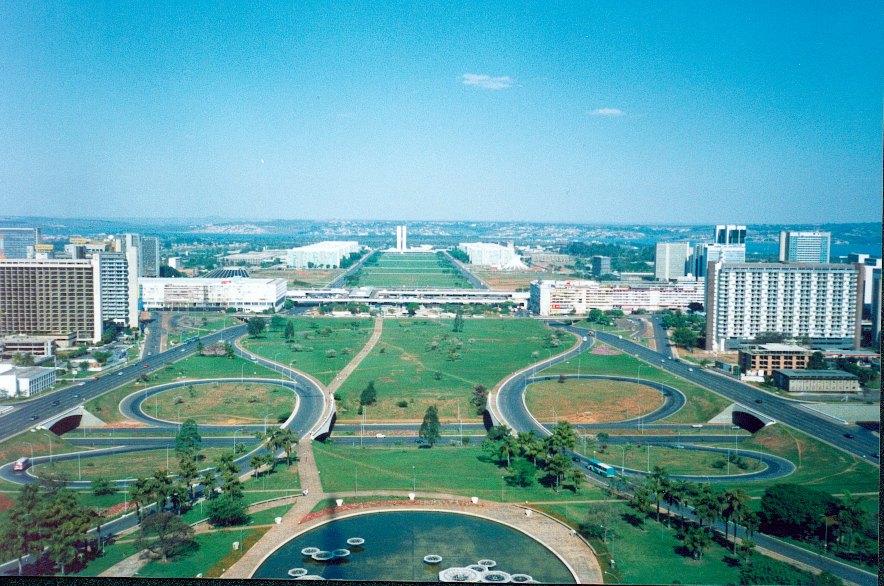
If you walk through parts of Brasília, it’s hard to believe that it wasn’t modeled, at least architecturally, upon Washington, D.C. when it was built in the late 1950. But when it comes to the voting rights of its capital’s citizens, Brazil has looked beyond the American example.Washington_DC_IconUSflag

Last month, when Brazil held a general election, some 2.5 million voters in the Brazilian Distrito Federal voted for a new governor, eight members to the Chamber of Deputies, the lower house of Brazil’s National Congress, and one of its three members to the Senate, its upper house. In that regard, Brazil’s DF is not unlike any other state in the country. Remarkably, with one deputy per 310,000 residents, that’s a better ratio of representation than the residents of Brazil’s largest state, the far more populous São Paulo.

It’s a typical and unremarkable arrangement around the world, and it’s not unlike Mexico’s Federal District (Mexico City), India’s Delhi Capital Territory and even places with a much more limited history of democracy, including Nigeria’s Federal Capital Territory (Abuja) and Malaysia’s Federal Territory of Kuala Lumpur.

But not in the District of Columbia.

The United States of America, otherwise a beacon of democratic rule for over two centuries, is essentially the North Korea of federal district voting rights, a clear outlier for democratic best practices across the world. As voters across the country elect members of the House of Representatives, District voters have nothing. Continue reading What the world can teach the United States about DC voting rights →

What a Republican Senate means for world politics

potomacview

On Tuesday, when tens of millions of US voters go to the polls, they are very likely to deliver a US Senate majority to the Republican Party.USflag

Six years into the administration of Democratic president Barack Obama and four years after the midterm elections that delivered control of the US House of Representatives to the Republicans and conservative speaker John Boehner, most polls and poll aggregate forecasts give the Republicans anywhere from a strong (70%) to moderate (74%) to an overwhelming (96%) chance to retake the Senate.

It’s not uncommon for the ‘six-year itch’ to reward the non-presidential party with gains in midterm elections. Throughout the post-war era, in every midterm election during the second term of a reelection president, the opposition party has made gains each time — with the exception of 1998, when the Democrats benefited from a strong economy and Republican overreach in pursuing  what would eventually become impeachment hearings against US president Bill Clinton over alleged perjury in the Monica Lewinsky affair.

It’s also not unheard of that foreign policy can drive larger narratives about presidencies.

Most recently, in 2006, Democrats recaptured both houses in midterm elections, forcing then-president George W. Bush to accept the resignation of his defense secretary Donald Rumsfeld, in light of the war in Iraq’s unpopularity and the unfolding sectarian civil war taking place there despite US military occupation. As it turns out, the 2006 midterms paved the way for a much more moderate tone to the final two years of the Bush administration and a change in strategy under Robert Gates, Rumsfeld’s successor, who ultimately stayed on as defense secretary until 2011, lending a sense of continuity to the Obama administration’s approach to defense policy.

So what exactly would a Republican Senate mean for US foreign policy in the final two years of the Obama administration? Continue reading What a Republican Senate means for world politics →