Tag Archives: socialist party

De Wever gets first shot at forming Belgium’s next government

dewever copy

In Belgium, where national and regional elections were largely overshadowed by the simultaneous European parliamentary and Ukrainian presidential elections, Flemish nationalist Bart De Wever is working to assemble a broad center-right government from parties of both of Belgium’s linguistic regions.Belgium Flag

Realistically, however, though Belgium’s king Philippe, has given De Wever through tomorrow, June 10, to report back on possible coalitions, there’s a chance that Belgium’s coalition-building process could take months, if not the 541-day ordeal that followed the previous May 2010 national elections.

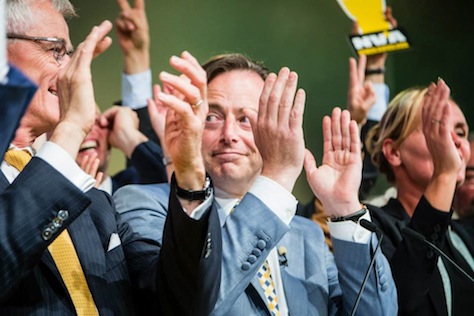
De Wever’s Flemish nationalist Nieuw-Vlaamse Alliantie (N-VA, New Flemish Alliance) emerged as the clear winner of the May 25 Belgian federal elections. It won, by far, the largest share of the vote — 20.26% of the national vote, even though nearly all of it came from Flanders, where it outpolled the center-right CD&V by a margin of 32.22% to 18.47%. De Wever (pictured above), having lost an astonishing amount of weight through diet and exercise since the last election, has given the N-VA a new look, too. While it remains officially in favor of Flemish independence, it’s toned down its support for separation and increased its calls for greater regional autonomy. The N-VA has also enhanced its calls for tax cuts and a trimmer federal and regional budget.

That was enough to put the N-VA in the driver’s seat for the first round of post-election negotiations. Belgium’s king Philippe appointed De Wever as informateur, whose role is to report back to the Belgian king as to potential coalition possibilities. If De Wever can point to a credible governing majority, it’s possible Philippe will appoint him as formateur, officially charging him to form a government.
belgium14

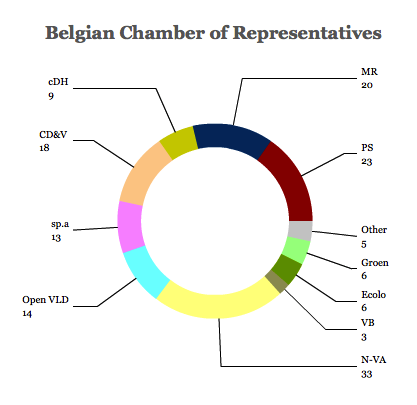
Outgoing prime minister Elio Di Rupo, the head of the French-speaking, Wallonia-based Parti Socialiste (PS, Socialist Party), is not expected to lead a second government, even though his party emerged as the second-largest in the 150-member Chamber of Representatives (Kamer van Volksvertegenwoordigers/Chambre des Représentants), and the largest vote-winner in French-speaking Wallonia.

Therein lies the awkwardness of the federal negotiations. The largest share of Flemish voters overwhelmingly supported an autonomist, center-right party, while the largest share of Walloon voters supported a federalist, center-left party.

De Wever is working to form a government of both Flemish and Walloon center-right, Christian democratic and liberal parties. But that would require a historic effort, given that Francophone parties have refused to work at the federal level alongside the N-VA in the past. Moreover, any Walloon parties willing to join forces with De Wever could face the wrath of Walloon voters at the next election.

Since the May 25 elections, the shape of Belgium’s regional governments have come increasingly into view, which will in turn influence the national government formation process.

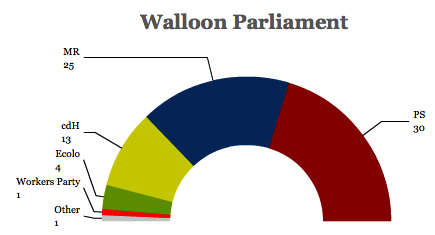
Last week, Di Rupo’s Socialists announced that they would open coalition negotiations with the centrist, Christian democratic Centre démocrate humaniste (cdH, the Humanist Democratic Centre) to form a government in the 75-member regional parliament of Wallonia: 
walloon14

The Walloon deal comes at the expense of the center-right, liberal Mouvement Réformateur (MR, Reform Movement), which made the greatest gains at the regional level, picking up six additional seats and which nearly outpolled the Socialists. The MR’s leaders are already decrying the deal between the Socialists and the cdH, arguing that they instead have the momentum to form a new Walloon government. 

The MR’s disappointment is amplified by the apparent coalition deal to lead the Brussels regional government, where the Socialists and the cdH intend to form a government with the Fédéralistes Démocrates Francophones (FDF, Francophone Democratic Federalists), until 2011 part of the MR coalition.

For now, the N-VA will likely become the senior partner in the Flemish government, continuing a partnership with the center-right Christen-Democratisch en Vlaams (CD&V, Christian Democratic and Flemish).

flemish14

But because of the N-VA’s gains, largely at the expense of the CD&V, it’s unlikely that the CD&V’s Kris Peeters will remain as the minister-president of the Flanders region. Peeters and the N-VA’s Geert Bourgeois, who has served as vice-minister-president under Peeters since 2009, are leading the current negotiations for the Flemish government.

So what does all of this mean for the federal negotiations? Continue reading De Wever gets first shot at forming Belgium’s next government
Sapin, Royal, Montebourg headline new French cabinet

Michel Sapin

Though French president François Hollande on Monday promised a gouvernement de combat in his cabinet reshuffle, it looks like the government he’s chosen might wind up spending more time combatting one another that the myriad economic challenges that France faces.
France Flag Icon

Just 48 hours after naming interior minister Manuel Valls, the hard-charging, Roma-busting strongman of the Parti socialiste (PS, Socialist Party) as France’s new prime minister, Hollande announced the rest of his cabinet reshuffle today.

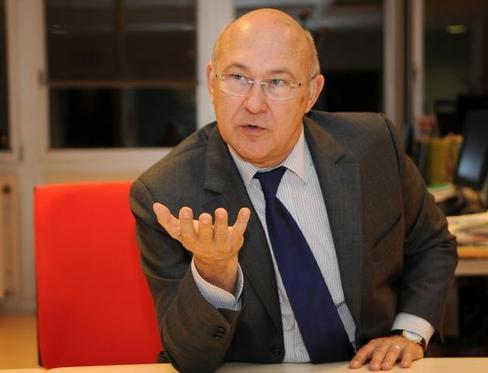
Though the return of Ségolène Royal, Hollande’s partner of three decades and the 2007 Socialist Party’s presidential candidate, is sure to top most headlines, the heart of the cabinet reshuffle are Hollande’s schizophrenic choices for finance minister, Michel Sapin (pictured above), and economy minister, Arnaud Montebourg.

At first glance, Hollande’s new slimmed-down cabinet (16 ministers instead of 20) seems like a kind of ‘team of rivals,’ given that Valls, Montebourg and Royal all campaigned for the Socialist Party’s 2012 presidential nomination — the only major rival not to hold a post in the new government is Martine Aubry, a longtime champion of the party’s left wing and the former minister who introduced France’s 35-hour workweek (a policy that Valls stridently opposes).

But it’s hardly Lincolnesque.

Sapin and Royal are assuming roles they first held 22 years ago, while Montebourg is a leftist whose views are at extreme odds with the economic policy that Hollande and Valls are expected to pursue over the next three years.  Continue reading Sapin, Royal, Montebourg headline new French cabinet

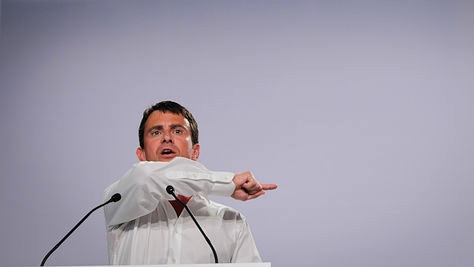
Who is Manuel Valls? Meet France’s new prime minister

valls

In choosing Manuel Valls, the popular interior minister, as France’s new prime minister, French president François Hollande is taking a risk that elevating the most popular minister in his government will attract support from among the wider French electorate without alienating the leftist core of the Parti socialiste (PS, Socialist Party).France Flag Icon

Pivoting off the poor Socialist showing in last weekend’s nationwide municipal elections, Hollande’s cabinet reshuffle is a sign that he understands he has largely lost the trust of the French electorate in less than two years. Other ministers, including finance minister Pierre Moscovici, could also lose their jobs in a reshuffle to be announced later this week.

Prime minister Jean-Marc Ayrault resigned today after just 22 months on the job. LIke Hollande, Ayrault has become increasingly unpopular as the government has pursued aggressive measures to stabilize France’s budget, including tax increases and adjustments and cuts to France’s pension system — all in the face of a sluggish economy, a 10.8% unemployment rate and a greater crisis in confidence over France’s role within the European Union and the world. 

In a short statement announcing Valls, Hollande pledged to continue pursing a payroll tax cut and additional pension and labor law reforms as part of a recent attempt to win support from the French business community, a series of reforms that Valls has enthusiastically promoted throughout his career. He also promised that Valls would lead a ‘combative government,’ which sounds like somewhat of an understatement in translation from a gouvernement de combat.

In light of Ayrault’s highly collaborative style, and Valls’s much more aggressive style, even the original French seems like an understatement.

But while the latest IFOP poll from mid-March gave Hollande a 23% approval rating (his highest, in fact, since last October) and Ayrault a 26% approval rating, Valls has an approval rating of 63%. That goes a long way in explaining why Hollande is replacing Ayrault with Valls today.

It’s not a choice without risks. Valls, a centrist with controversial views about the Roma and immigration, could divide the French left. If Hollande’s unpopularity continues, he could taint one of the few remaining popular figures within the Socialist Party. If Valls succeeds, he could supplant Hollande as the more attractive presidential candidate in 2017.

Continue reading Who is Manuel Valls? Meet France’s new prime minister

Final Paris mayoral election results

hidalgo

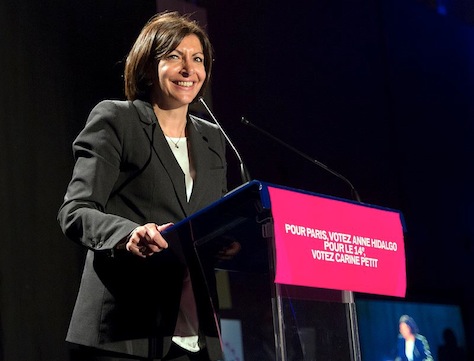
Anne Hidalgo won a strong victory to become Paris’s first female mayor, extending the electoral hold of the Parti socialiste (PS, Socialist Party) in the French capital.France Flag Iconparis

Hidalgo, who has served as France’s first deputy mayor under the administration of Bertrand Delanoë since 2001, won the election by  a larger-than-expected margin, besting   Nathalie Kosciusko-Morizet, a moderate former environmental minister and a rising star of the French right, by a margin of around 54.5% to 45.5%. Kosciusko-Morizet narrowly won the first round of the election on March 23, but polls showed that Hidalgo always had a clearer path to victory in the runoff, thanks to a large reservoir of green and other leftist voters.

Despite the margin, Kosciusko-Morizet ran a strong race in a city that has veered further to the left over the past 15 years — a wild swing from the two decades that Jacques Chirac served as mayor (before winning the French presidency in 2005). Though Kosciusko-Morizet lost Sunday’s election, the center-right Union pour un mouvement populaire (UMP, Union for a popular movement) made marginal gains on the Paris city council, and Kosciusko-Morizet  strengthened her profile by taking on the challenge of a campaign that was always going to be a stretch for the UMP.

If it was a sweet victory for the Socialists, it was one of the only bright spots of a very brutal round of municipal elections nationwide for the party and for its unpopular president François Hollande. The Socialists lost Toulouse, Angers, Quimper, Reims and Saint-Étienne — and the left lost power in Limoges for the first time since 1912.  Continue reading Final Paris mayoral election results

Runoff looms to select Paris’s first female mayor

smogparis

The success of the far-right Front national (FN, National Front) dominated headlines from Sunday’s municipal elections in France.
paris
France Flag Icon

In Paris, though, the mayoral race has shaped into a predictably traditional runoff between the French left and the French right, a personality-driven campaign to determine whether Anne Hidalgo or Nathalie Kosciusko-Morizet will become the first woman to serve as the city of France’s capital.

Though president François Hollande and the Parti socialiste (PS, Socialist Party) may be faltering throughout the rest of France, and though Marine Le Pen’s Front national may be cutting into the traditional strongholds of both the Parti socialiste and the center-right Union pour un mouvement populaire (UMP, Union for a popular movement), Paris remains a stronghold for the Socialists. Outgoing mayor Bertrand Delanoë, one of the few members of Hollande’s party with robust approval ratings, is leaving office after 13 years as the city’s third directly elected mayor — former president Jacques Chirac held the office from 1977 to 1995.

hidalgo

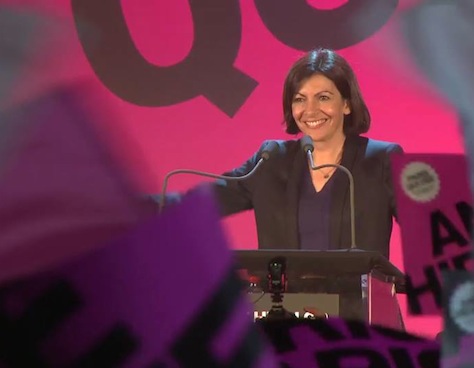
Polls show that Parisians will likely replace him with Hidalgo (pictured above), an Andalusia-born official who’s served as Delanoë’s first deputy mayor since he took office in 2001. In a city where residents seem largely happy with the status quo and with Delanoë, Hidalgo is the narrow frontrunner to win in Sunday’s second-round runoff. Delanoë’s rise has coincided with the capital city’s leftward shift, as longtime working-class Socialist voters join educated professionals to give the Socialists an increasingly strong electoral coalition over the past decade.

As mayor, Delanoë has increased housing and social welfare spending, though he might be most well-known for two things.

First, he was one of the world’s first openly gay high-ranking officials — Delanoë’s longtime honesty about his sexuality helped paved the way for greater LGBT acceptance throughout Europe. Secondly, Delanoë’s Paris has been at the vanguard of the urban livability trend. He created the Paris-Plages project in 2002, which every summer recreates a beach, complete with sand and palm trees, on the banks of the Seine. In 2007, Paris became one of the first major global cities to institute a bike-sharing programs, Vélib’, which today is the largest program of its kind outside of China.

nkm

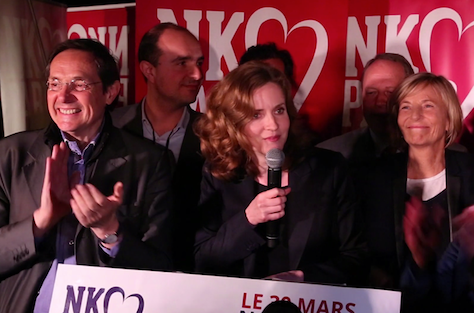
Gaffes from both women have dominated the campaign’s coverage. Kosciusko-Morizet (pictured above), who comes from a wealthy background, has had a difficult time shedding her often awkward aristocratic mien. Her comments romanticizing the Paris metro as a ‘charming place’ overshadowed an otherwise welcome plan to keep it open until 2 a.m. on weekdays. But her background as a rising star from the UMP’s moderate wing, her experience as France’s environmental minister, and her high-profile role as campaign spokesperson for Nicolas Sarkozy’s 2012 presidential campaign makes Kosciusko-Morizet a better fit for Paris than other prominent UMP figures. She’s given the French center-right a chance of becoming Paris’s next mayor — even if she loses in the second round to Hidalgo, she has raised her profile considerably.

Hidalgo, in the meanwhile, is campaigning largely on consolidating and extending the gains of the Delanoë administration — more green space, 10,000 new homes a year (65% of which would be public housing), and extending not only the Paris metro, but the Vélib’ system to scooters (Scooterlib’) and electric cars (Autolib’).

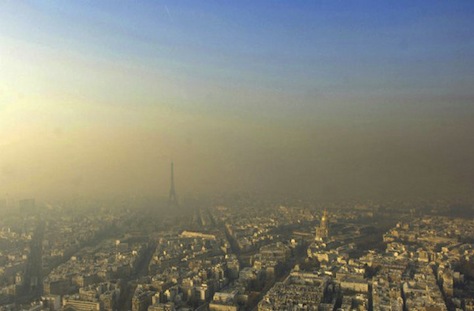
But the literal cloud hanging over the municipal elections is the recent smog that enveloped Paris. Continue reading Runoff looms to select Paris’s first female mayor

Le Pen v. Wilders: a tale of two far-right European movements

wilderslepen

The big story from Sunday’s municipal elections in France is the success of Marine Le Pen’s far-right Front national (FN, National Front), overshadowing the marquee Paris mayoral election.France Flag IconNetherlands Flag IconEuropean_Union

The far-right won the mayoral race in Hénin-Beaumont, a former mining town in the north, in a rare first-round victory, the FN came in second in Marseille, France’s second-largest city, and it led in at least six other locations as France prepares for second-round runoffs on March 30.

The result should certainly boost Le Pen in her efforts to win  support in European parliamentary elections in May — and to unite the populist hard right across the continent.

According to preliminary results, the Front national won just 4.65% of the national vote. That’s a big deal because the party was running in just 597 of around 37,000 jurisdictions — it’s a massive increase from the 2008 municipal results, when the FN won around 1% and ran in just 119 constituencies. 

The other narrative from Sunday’s vote is the collapse of France’s center-left — president François Hollande’s Parti socialiste (PS, Socialist Party) won 37.74% nationally, while the center-right Union pour un mouvement populaire (UMP, Union for a popular movement) of former president Nicolas Sarkozy won 46.54% nationally. The bright spot for the Socialists remains Paris, where first deputy mayor Anne Hidalgo is the slight favorite to win a runoff against former Sarkozy campaign spokesperson and ecology minister Nathalie Kosciusko-Morizet — but don’t rule out an upset next Sunday there, either.

The success in the 2014 municipal elections is just the latest chapter for Le Pen’s rebranding of the Front national in France as a slightly more moderate alternative than the party her father, Jean-Marie Le Pen, led for decades. It’s harder today to target the Front national as a xenophobic, anti-Semitic fringe, because Le Pen has focused on an agenda much heavier on euroskepticism and economic nationalism. While the Front national isn’t exactly immigrant-friendly, its position has largely converged with the UMP’s position since the Sarkozy presidency, which embraced hard-right positions on immigration and law-and-order issues. By shifting rightward, Sarkozy may have sidelined Le Pen during his presidency and co-opted her supporters, but today, Sarkozy is almost as responsible as Le Pen for bringing the Front national within the political mainstream.

With the line blurring between the UMP and the Front national, Le Pen could become the chief voice of the French right in 2017, especially if the UMP succumbs to more infighting between its right-wing leader Jean-François Copé and the more moderate former prime minister François Fillon. The next presidential election is still a long way off, but if Sarkozy doesn’t run for the presidency in 2017, Le Pen stands just as much chance as Copé, Fillon or any other UMP figure of representing the French right in the second round.

More immediately troubling for France’s political elite are the European parliamentary elections in May. Despite its breakthrough performance on Sunday, the Front national isn’t about to overrun the city halls of France. Its victory is more symbolic than substantive. But if it’s one thing to turn over your local government to Marine Le Pen, it’s a far different thing to support the Front national as a protest vote with respect to European Union policy.

Polls show that the Front national and the UMP are competing for first place in the European elections within France — the most recent Opinion Way poll from early March shows the UMP winning  22%, the FN winning 21% and the Socialists just 17%. It wouldn’t be surprising to see a wave of undecided voters support the Front national at the last moment, nor would it be a surprise to learn that polling surveys currently underestimate FN support.

Extremists on both the far left and the far right are gaining strength throughout the entire European Union. That’s perhaps understandable, given the harsh economic conditions that have plagued Europe since the last EU-wide elections in 2009. But the euroskeptic right, in particular, seems poised for a breakthrough. Nigel Farage hopes to lead the anti-EU United Kingdom Independence Party to a breakthrough performance in May, and the Freiheitliche Partei Österreichs (FPÖ, the Freedom Party of Austria) is tied for first place in polls in Austria.

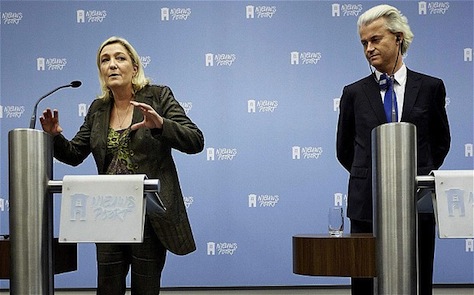
But just as Le Pen hits her stride, another standard-bearer of the hard right, Geert Wilders, found himself in free fall last week after pledging to allow fewer Moroccans into the Netherlands, remarks that have launched a cascade of criticism and a handful of defections from his party: Continue reading Le Pen v. Wilders: a tale of two far-right European movements

Weekend municipal elections from Japan to France

hashimoto

It’s another busy weekend for world politics — especially with regard to municipal elections in two G-8 countries.

Here’s a quick weekend update of the three world elections taking place today and tomorrow.

Maldivian parliamentary electionsmaldives

First, the Maldives on Saturday elected all 77 members of the Majlis, the unicameral Maldivian parliament. The parliamentary elections follow the highly botched presidential election last autumn — the initial September vote was annulled and Maldivian election officials postponed the vote to the point of constitutional crisis. By the time the country held a new vote in November, it pushed through a runoff just five days later. Former president Mohammed Nasheed, who won the first round, lost the runoff to Abdulla Yameen, the half-brother of Maumoon Abdul Gayoom, who previously governed the Maldives between 1978 and 2008. 

The polls are already closed there, and the voting has gone smoothly, according to initial reports. Results are expected on Sunday, and the contest pits Nasheed’s Maldivian Democratic Party against Gayoom’s Progressive Party of Maldives. 

Osaka municipal electionosakacity osakaprefectureJapan

In Japan, Osaka’s controversial mayor Tōru Hashimoto (橋下徹) is forcing a mayoral election after resigning in February in what amounts to a power play over his plan to unite the city of Osaka and Osaka prefecture into a larger ‘Osaka-to’ region.

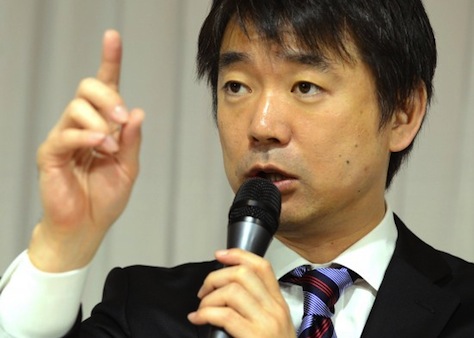
Though no major party is running a candidate against Hashimoto (pictured above), the popularity of the former television personality has fallen rapidly both at the national and local level.

His bid to join forces with former Tokyo mayor Shintaro Ishihara to form the right-wing Japan Restoration Party (日本維新の会, Nippon Ishin no Kai) made waves in December 2012 when it nearly became the second-largest force in the lower house of the Japanese Diet, but Hashimoto’s rising star has faded over the past 15 months, not least of all because of his insensitive comments that attempted to justify the use of ‘comfort women’ — Korean sexual slaves — by Japanese soldiers during World War II.

Though Hashimoto will likely win reelection in the Osaka vote on Sunday, his critics have attacked the election as an unnecessary waste of taxpayer money.

Hashimoto, who served as the governor of Osaka prefecture between 2008 and 2011, has served as the city of Osaka’s mayor since 2011. In 2010, he founded the Osaka Restoration Association (大阪維新の会, Ōsaka Ishin no Kai) under the banner of ‘One Osaka,’ his longtime campaign to unite the prefecture and the city as one larger metropolis, like the structure of Tokyo’s combined metropolitan government. Osaka is Japan’s second-most populous metropolitan area, and Osaka prefecture, which encompasses the city of Osaka, is home to 8.9 million residents.

The plan faces opposition by the Osaka city council, where Hashimoto’s Osaka Restoration Association doesn’t hold a majority. Though there might be gains in merging the prefecture and city governments, critics fear that Hashimoto is more motivated by the possibility of creating a regional political empire. The central government also opposes the plan, because it might mean ceding power from the federal to the prefectural level.

Paris (and other French) municipal electionsFrance Flag Iconparis

French municipal elections are also taking place this weekend — the first round will take place Sunday, with second rounds to follow next Sunday, March 30.

The indisputable highlight of the French elections is the Paris mayoral race, with Bertrand Delanoë stepping down after 13 years in the office. The race will almost certainly result in a runoff next week between first deputy mayor Anne Hidalgo, the Andalusia-born candidate of the Parti socialiste (PS, Socialist Party), and Nathalie Kosciusko-Morizet, a moderate who served as a former minister of ecology, sustainable development, transport and housing and as campaign spokesperson for Nicolas Sarkozy in 2012.

The vote takes place amid one of the worst bouts of air pollution that Paris has seen in recent years, which caused the city government to impose emergency restrictions on automobiles last week.

Though polls forecast a tight race, Hidalgo has held a consistent, if narrow, lead over Kosciusko-Morizet for nearly a year — the most recent BVA poll from mid-March predicted that Hidalgo would win the second round by a margin of 53% to 47%.

Outside Paris, however, the elections are a test for the struggling administration of France’s socialist president François Hollande, and an opportnity for France’s far-right Front national (FN, National Front), with its leader Marine Le Pen hoping to win at least some mid-sized towns and villages in the FN’s traditional stronghold in the Mediterranean south and in the economically depressed post-industrial north.

Who is Aleksandar Vučić? Serbia’s next prime minister.

Aleksandar-Vucic-Serbian-leader

While most of the world fixes on Crimea’s sham referendum and the growing standoff between Russia and the United States, an arguably far more important vote took place in another country on Sunday  with strong ties to both the European Union and Russia — Serbia.Serbia_Flag_Icon

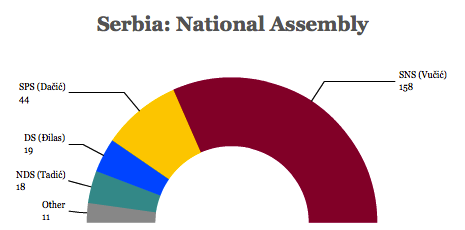
It’s difficult to imagine that the center-right Serbian Progressive Party (SNS, Српска напредна странка) could have done much better.  Following Sunday’s vote, the Progressives will control 158 of the 250 seats in the National Assembly (Народна скупштина).

It also means that Aleksandar Vučić who served as minister of defense and first deputy prime minister in the previous government, will almost certainly become Serbia’s next prime minister.

What’s more, he will also become Serbia’s most powerful leader since the fall of Yugoslav strongman Slobodan Milošević in 2000 — and potentially, the most powerful leader in the Balkans since Milošević.

*****

RELATED:  The most important EU success story you’ve never heard? Serbia.

*****

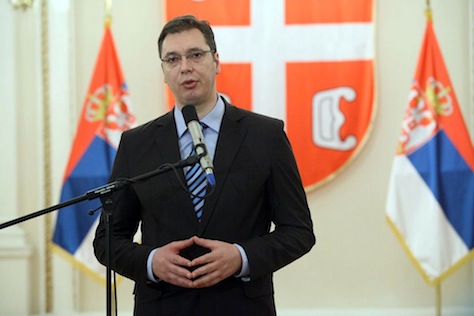
Not only does Vučić (pictured above) have the luxury of an absolute majority in the National Assembly, it will be the first time since 2000 that the Serbian right simultaneously controls both the government and the presidency.   Vučić comes to power with an ambitious agenda and if he succeeds, he could restore the high-growth economy of the early 2000s and nudge Serbia on a firm path into the European Union. Continue reading Who is Aleksandar Vučić? Serbia’s next prime minister.

Serbian Progressives win huge victory, majority in National Council

serbia2014

Although everyone expected the governing Serbian Progressive Party (SNS, Српска напредна странка) to win Serbia’s parliamentary elections on Sunday, no one quite expected the Progressives to win such a stunning mandate — the first time in the post-Milošević era that a single party won an outright majority in the Serbian parliament.Serbia_Flag_Icon

Although the Progressives went into Sunday’s election with the largest bloc of seats in the 250-member National Assembly (Народна скупштина), the fluke of the previous elections in May 2012 left the Progressives stuck in coalition with the center-left, nationalist Socialist Party of Serbia (Социјалистичка партија Србије / SPS), and the Socialist leader Ivica Dačić as prime minister instead of a Progressive prime minister.

*****

RELATED: Who is Aleksandar Vučić?  Meet Serbia’s next prime minister.

*****

Back in 2012, the Progressives were unwilling to enter into coalition with the center-left Democratic Party (Демократска странка / DS), and Progressive leader Tomislav Nikolić had just defeated Serbian president Boris Tadić, ending eight years of Tadić-led, Democratic government.  That gave Dačić, whose Socialists finished a surprisingly high third-place in the 2012 elections, the power to decide whether he would enter government with Progressives or with the Democrats.

After weeks of negotiations, Dačić chose the Progressives.  The price for the Progressives was to allow Dačić to become prime minister.

Dačić’s record isn’t incredibly poor — he presided over the official opening of accession talks for Serbia’s ultimate entry into the European Union, his corresponding efforts to integrate Serbia into mainstream Europe have brought Serbia and Kosovo closer to a long-term settlement over Kosovo’s status (and Kosovo’s own future European integration), and the Serbian economy is doing better than it was two years ago, despite a broader push of austerity measures over the 21-month government.

But with polls showing the Progressives with such a wide lead, and with the Serbian left divided between supporters of Tadić and supporters of former Belgrade mayor Dragan Đilas, the tail-wags-the-dog world of a Socialist-led government made increasingly little sense to top SNS leaders, most especially Aleksandar Vučić, the first deputy prime minister who is now set to become Serbia’s prime minister for the next four years.  Even before the Progressives essentially demanded snap elections in January, Vučić and his young, Yale-educated finance minister Lazar Krstic were setting more government policy than Dačić.

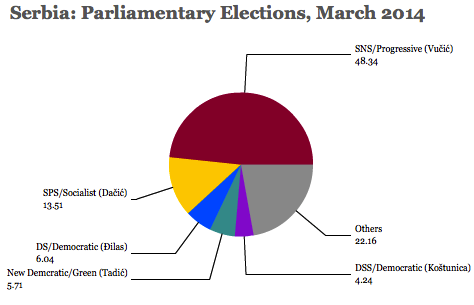
Sunday’s election was a landslide for Vučić and the SNS, which outpolled its nearest competitor, Dačić’s SPS, by more than a 3-to-1 margin.  Đilas’s Democrats won  just 6% of the vote, and Tadić, leading the alternative center-left bloc, the New Democratic Party/Greens (NDS, Нова демократска странка — Зелени), won just 5.7% and 18 seats.

serbia NA 2014

Vučić now seems free to push through an ambitious agenda of economic liberalization, including a new bankruptcy law, a looser labor law, an anti-corruption push and accelerated privatization of state industries — with the goal of unleashing a stronger Serbian economy as well as bringing Serbia’s laws and economic policy closer in line with mainstream EU policy.  Although the Progressives will control an absolute majority in the Serbian parliament, Vučić may yet try to bring one or more of the decimated opposition parties into a wider, reform-minded coalition. Continue reading Serbian Progressives win huge victory, majority in National Council

The most important EU success story you’ve never heard? Serbia.

ashtonserbia

The global media’s attention this weekend will be fixed on Crimea, where a status referendum is almost certainly likely to result in its  annexation into the Russian Federation.European_UnionSerbia_Flag_Icon

But the world’s attention should be on Serbia, which is holding snap elections on March 16 — the same day as the Crimean referendum.  Serbia’s parliamentary elections come just two months after formally opening negotiations to join the European Union, a landmark step in what’s been a decade-long push for greater Serbian-EU integration.

When political commentators tell you that Ukraine is the frontier of the European Union, they’re right that European policymakers have both an economic and security interest in Ukraine’s stability.

But the true frontier of the European Union is the Balkans, and no country is more vital to the future political and economic stability of the region than Serbia, home to over 7 million residents, the most populous of the Balkan states.

Polls show that the outcome of Sunday’s election is almost certain — a wider majority for the center-right Serbian Progressive Party (SNS, Српска напредна странка), which as a member of the current coalition government, is working to tackle corruption, liberalize and privatize sectors of the Serbian economy and bring Serbian budget closer to balance — all while the country faces unsteady economic growth and an unemployment rate of 20%.

Notwithstanding the real economic pain today in Serbia, none of that matters as much as the fact of Serbian continuity with respect to European integration.  Though Serbia’s formal accession may take up to a decade, Serbia seems certain to become either the 29th member (or the 30th member, following Montenegro) of the European Union.  What’s more, the most significant fact of Serbian political life in the past two years has been the durability of the national commitment, across all major political parties and ideologies, to Serbia’s eventual EU membership.

Think back to the breakup of Yugoslavia in 1991.  Or to the ‘ethnic cleansing’ that marked the civil war among Croats, Bosnian Muslims and Serbs between 1992 and 1995 in Bosnia and Herzegovina.  Or to the Serbian aggression over Kosovo that led to  NATO military action against Belgrade in 1998-99 and the emergence of the semi-independent Kosovo today.  Or to the dictatorship of Serbian strongman Slobodan Milošević from 1987 until 2000, with full-throated support from Moscow.

Though it’s something that we take for granted in the year 2014, it wasn’t always a foregone conclusion that Serbia today would be so united in its push to turn economically and socially toward Europe.

It wasn’t even so clear in 2012.

Nikolić and Dačić: an unlikely pair of EU champions

In the last parliamentary elections in May 2012, the SNS won the greatest number of seats (73) in Serbia’s 250-member National Assembly (Народна скупштина), and the SNS’s Tomislav Nikolić, running for the fifth time, narrowly won the Serbian presidency over incumbent Boris Tadić, whose center-left Democratic Party (Демократска странка / DS) had governed Serbia since 2004.  Tadić, throughout the 2000s, laid the groundwork for greater cooperation with the European Union.

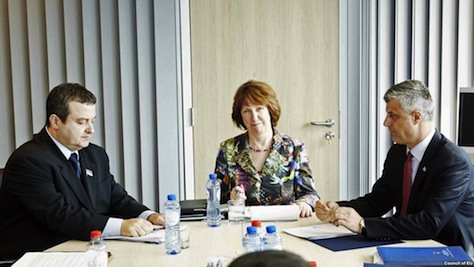
When Tadić lost power in July 2012, no one knew whether Nikolić and the Serbian Progressives would pursue EU cooperation with the same zeal as the Democrats had.  Nikolić (pictured above, right, with EU foreign affairs high representative Catherine Ashton, middle, and prime minister Ivica Dačić, left) long favored Russia over the European Union, and his first trip abroad as president was to Moscow, where he declared in September 2012, ‘The only thing I love more than Russia is Serbia.’   Continue reading The most important EU success story you’ve never heard? Serbia.

Can the Obama administration save François Hollande?

2ckb1152No one could miss the undertones of yesterday’s op-ed, co-written by US president Barack Obama and French president François Hollande, in The Washington Post and Le Monde:France Flag Icon

A decade ago, few would have imagined our two countries working so closely together in so many ways. But in recent years our alliance has transformed. Since France’s return to NATO’s military command four years ago and consistent with our continuing commitment to strengthen the NATO- European Union partnership, we have expanded our cooperation across the board. We are sovereign and independent nations that make our decisions based on our respective national interests. Yet we have been able to take our alliance to a new level because our interests and values are so closely aligned.

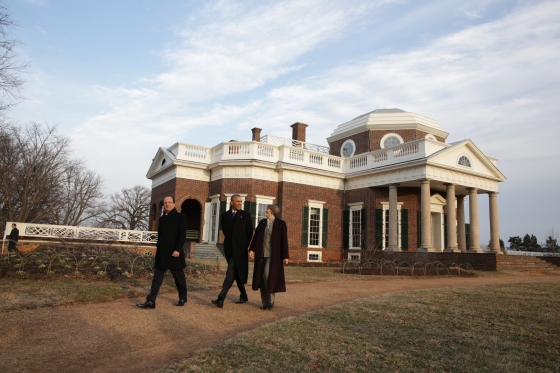
It was one of the biggest, wettest, sloppiest kisses that the Obama administration has given a foreign leader — and it’s not something that this administration does often.  It’s part of the red-carpet treatment that Obama is rolling out for Hollande, who visited Monticello, the home of Thomas Jefferson, in Virginia on Monday, and will be the host of a state dinner tonight at the White House.

It’s clearly an opportunity for the newly single Hollande to move on after a dismal January, when sensational headlines over his trysts with a French actress overshadowed his his attempts to introduce a new economic reform package.  It became a nearly monthlong saga that sent Hollande’s partner, Valerie Trierweiler, to a Paris hospital for over a week, and that ended with their breakup.

Time magazine, which a wide-ranging interview, asks this week on its cover whether Hollande can fix France.  It’s worth asking whether, first, the White House is trying to help fix Hollande.  Polls routinely show Hollande with an approval rating in the low 20s (or even high teens), making him the least popular president in the history of the Fifth Republic, not even two years into his five-year term.

The White House treatment, including Monday’s joint editorial, undoubtedly hopes to share of Obama’s star power with the widely derided president.  Obama needs Hollande’s help to finalize the US-EU free trade pact, the Transatlantic Trade and Investment Partnership, even though it could harm French farmers and wine producers by opening the European Union to cheaper US exports.  Obama will also need Hollande’s help to win a long-term nuclear energy deal with Iran while the temporary six-month deal remains in effect.

It’s true that France has been, surprisingly, almost as reliable a partner on US foreign policy as the United Kingdom in recent years.  Hollande has deepened France’s 21st century internationalism, of course, most notably through his decision to mount a largely successful intervention to keep northern Mali from falling to foreign Islamic jihadists, thereby giving Bamako the space to hold new elections and build a stronger national government.  French peacemakers in the Central African Republic may have also helped limit violence between Christians and Muslims in December and January and smoothed the way for Michel Djotodia’s resignation.  Hollande was willing to back a US military attack on Syrian president  Bashar al-Assad last August when the United Kingdom and the US Congress were not.


But credit for the hard work of repairing US-French relations, insofar as it relates to the newly muscular tone of French foreign policy, more appropriately rests with former president Nicolas Sarkozy, whose administration marked the true pivot on foreign policy.   Continue reading Can the Obama administration save François Hollande?

Serbian government pushes forward with early elections

nikolic-dacic

As Serbia takes another step closer to joining the European Union, its government is headed to snap elections on March 16, with the Serbian Progressive Party (SNS, Српска напредна странка) of president Tomislav Nikolić hoping to replace prime minister Ivica Dačić with its own leader, Aleksandar Vučić, after just 18 months since Dačić took office. Serbia_Flag_Icon

Dačić and his Socialist Party of Serbia (SPS, Социјалистичка партија Србије) emerged in the May 2012 parliamentary elections as the surprisingly strong third-place winners.  That gave Dačić and the SPS the power to determine whether the new government would comprise an alliance with Nikolić’s center-right Progressives or the center-left Democratic Party (DS, Демократска странка) of former president Boris Tadić.  Nikolić, on his fifth attempt to win the presidency, edged out Tadić in the May 2012 presidential runoff, bringing Tadić’s eight-year tenure to an end.

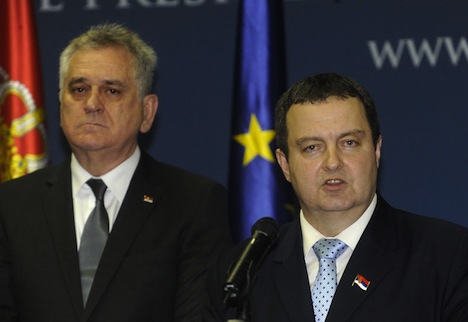
As the kingmaker for Serbia’s next government, Dačić (pictured above, right, with Nikolić, left) decided to crown himself king — and Dačić became prime minister, though his Socialists, with 44 seats in Serbia’s 250-member National Assembly (Народна скупштина), were technically the junior partner in coalition with the Progressives, which hold 73 seats. (The Democrats currently hold 67, and three more minor parties each hold between 16 and 21 seats).

The Dačić-led government oversaw an economic recovery — a 1.7% contraction in 2012 transformed into an estimated 2.4% expansion in 2013.  In any event, there’s no doubt that the Serbian economy has marked a definite improvement.  Though unemployment remains high at around 20%, it’s fallen from a high of around 25.5% in early 2012.

Moreover, Serbia achieved significant progress on EU membership, with negotiations opening earlier this month and ongoing EU-brokered negotiations on the fragile relationship over the future status of Kosovo, despite concerns in 2012 that Nikolić and the Progressives have historically been closer to Russia than to western Europe and wary of EU accession.  The EU talks will rank among the top issues in the election campaign, including the reform program that Brussels requires as a prelude to membership, which could significantly boost the Serbian economy.

But a year and a half into government, Nikolić and the Progressives believe the time has come for Vučić to assume the premiership — and polls show that Serbians agree.  With a fresh mandate, Vučić will push forward with the EU negotiations, and there’s a chance that a new Progressive-led administration work with the IMF for a package of guarantees to reduce lending costs.

A Faktor poll last week showed that 42.1% of Serbia’s electorate support the Progressives, while just 13.9% support the Democrats and 10.5% support Dačić’s Socialists.  Two other parties achieve significant support: the eurosceptic, conservative Democratic Party of Serbia (DSS, Демократска странка Србије), led by Vojislav Koštunica, Serbia’s president from 2000 to 2003 and prime minister from 2004 and 2008, would win 6.8%; and the free-market liberal, centrist Liberal Democratic Party (LDP, Либерално-демократска партија), led by Čedomir Jovanović and several former Democratic Party members, would win 5%.

Vučić, who became the leader of the Progressive Party in May 2012, serves as the first deputy prime minister, and from July 2012 to August 2013, he also served as Serbia’s defense minister.  As the head of the largest party in government, however, he holds more de facto power that Dačić.  As the Progressive Party leader, he’s taken a strong stance against corruption, and he has played a central role in negotiations with respect to Serbia’s accession to the European Union.  As a member of the once-dominant Serbian Radical Party, Vučić served as minister of information in the late 1990s, when at the young age of age 28, he was responsible for assessing fines against journalists who criticised the government and Serbian president Slobodan Milošević — a stance he has recanted today. Continue reading Serbian government pushes forward with early elections

Hollande’s economic restart falls flat amid domestic drama

scooter

Nothing screams ‘sexy’ more than… a payroll tax cut.France Flag Icon

With the French press salivating over French president François Hollande’s surprisingly sordid love life, Hollande tried to refocus his administration’s agenda last week at a press conference to announce a planned cut in France’s payroll taxes and other measures to boost France’s competitiveness.  It’s a bid to win back some control over his unravelling public image.  Hollande suffers from massively low approval ratings —  just 22% of French voters support Hollande (somewhat of an improvement over polls in November that gave him just 15% approval).  There’s even talk that his administration could augur the collapse of France’s Fifth Republic.

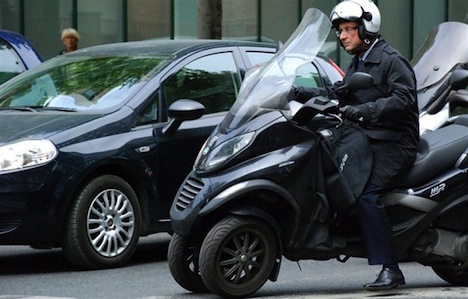
But Hollande’s policy revamp has been lost in the furor over Hollande’s alleged dalliance with actress Julie Gayet.  Tabloids showed photos of the French president sneaking off to meet Gayet on his scooter (pictured above), and the news seems to have sent his current partner, Valérie Trierweiler, to a Paris hospital for over a week.  Elected on the premise that he would bring decorum and normalité to the Élysée after the ‘bling-bling’ presidency of Nicolas Sarkozy, Hollande’s love life began overshadowing his presidency within days of his inauguration.

Trierweiler tweeted in support of Olivier Falroni, a dissident parliamentary candidate in June 2012, who was running against Ségolène Royal, Hollande’s former partner and the 2007 presidential candidate of the Parti socialiste (PS, Socialist Party).  Royal lost that race, despite Hollande’s support.  A reporter for Paris Match, Trierweiler fulfills the role of France’s first lady, complete with budget and staff, notwithstanding that she and Hollande never married.  Hollande and Royal also never officially married during their nearly 30-year relationship, which produced four children.

Trierweiler left the hospital after more than a week on Saturday afternoon, but the discord between France’s first couple continues to dominate headlines, with Le Journal de Dimanche reporting that presidential advisers are calling the relationship ‘finished.’  So much for Mr. Normality.  Though Sarkozy and his two predecessors, Jacques Chirac and François Mitterand, were both known for active love lives, the nature of media has changed since the French press kept Mitterand’s longtime mistress a secret from the public in the 1980s.

At a policy level, none of Hollande’s domestic troubles should matter.  But they come at exactly the wrong time, overshadowing Hollande’s push to make France’s economy more competitive.  At the center of Hollande’s proposal is a €30 billion payroll tax cut for French businesses, continue pushing forward with plans for €15 billion in budget cuts this year, with €50 billion more to follow over the next three years.  Though Hollande hopes that will make France’s businesses more willing to hire French workers, it seems unlikely to erase the mistrust Hollande has engendered by pushing a top income tax rate of 75% on incomes over €1 million, a troubled policy that seems set to take effect after facing legal problems in France’s top constitutional court.  Hollande and his leftist parliamentary majority pushed through a labor market reform in January 2013, but it was a relatively minor first step that merely streamlined the process for conducting layoffs.

Hollande would have engendered much more goodwill if he’d announced a retreat from the iconic 75% rate or announced a much bolder labor market legislation.  But that carries with it the risk of a full-scale revolt on the French left.  Continue reading Hollande’s economic restart falls flat amid domestic drama

14 in 2014: Belgium parliamentary elections

dirupoin14

8. Belgium parliamentary election, May 25.Belgium Flag

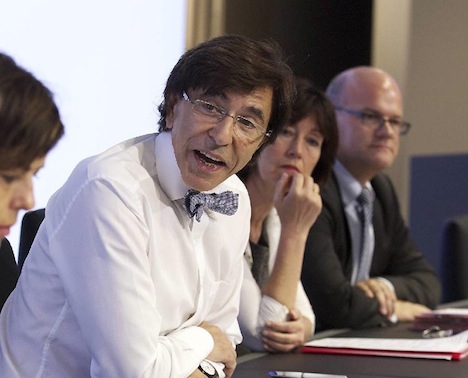
Pity Belgian prime minister Elio Di Rupo — despite the fact that Belgians last voted in June 2010, the ensuing coalition talks meant that Di Rupo (pictured above) only became prime minister in December 2011.  Just two years later, Belgium is already looking ahead to elections in May, and coalition talks could once again stretch in terms of years, not days or months.

While the agreement that installed the Di Rupo government enacted to a set of political reforms that ended direct elections for the upper house of the Belgian parliament, Belgians will determine all 150 members of the Chamber of Deputies (Kamer van Volksvertegenwoordigers in Flemish, Chambre des Représentants in French).  With 88 seats up for grabs in the Dutch/Flemish-speaking northern region of Flanders and 62 seats in the French-speaking southern region of Wallonia, the linguistic and regional divide virtually guarantees that no single party can come close to winning an outright majority.

Polls show that the parties have roughly the same amount of support as in 2010.

That means that Di Rupo’s leftist Parti Socialiste (PS, Socialist Party) is likely to emerge as the largest Francophone party.  But it’s followed closely by the liberal Mouvement Réformateur (RF, Reformist Movement).  The Christian democratic Centre démocrate humaniste (cdH, Christian Humanist Center) and Ecolo, Belgium’s Francophone green party, should also win a significant number of seats.

But on the Flemish side, Antwerp mayor Bart de Wever’s Nieuw-Vlaamse Alliantie (N-VA, New Flemish Alliance), which has called for the gradual secession of Flanders from Belgium, seems set to improve on its 2010 total.  The N-VA emerged as the party with the largest number of seats after 2010 (with 27 to 26 for Di Rupo’s Socialists), and it could emerge as the largest party by an even wider margin in 2014.  Its chief competition is the more conventional Christen-Democratisch en Vlaams (CD&V Christian Democratic and Flemish), which leads the regional Flanders government.  Other parties include the social democratic Socialistische Partij Anders (sp.a, Socialist Party Different), the liberal Open Vlaamse Liberalen en Democraten (Open VLD, Open Flemish Liberals and Democrats), the far-right, pro-independence Vlaams Belang (VB, Flemish Interest, VB) and the Groen, the Flemish Greens.

The current government brings together the top three Francophone parties (socialist, liberal and Christian democratic), the Flemish Christian Democrats and the Open VLD, leaving the most pro-independence Flemish parties and the two green parties in opposition.  With the federal election scheduled for the same day as elections to the European Parliament, it could maximize turnout among the euroskeptic and the Flemish secessionist electorate, which could leave de Wever and the N-VA in a much stronger position over the next five years.

Next: European Parliament

Bachelet’s most tenacious second-term foe? Lofty expectations.

michellewins

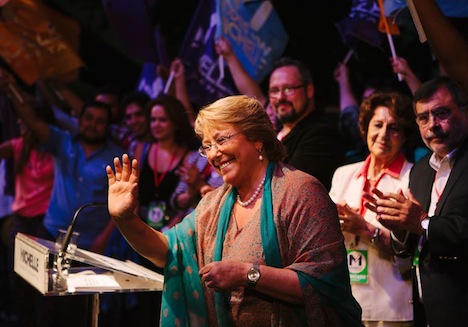
Michelle Bachelet, Chile’s president between 2006 and 2010, pulled off Sunday what no other Chilean president has done since the return of democracy in the post-Pinochet era — win a second, non-consecutive term.chile

To draw a contrast to the United States, only one president managed to return to the White House after leaving it — Grover Cleveland, who served two non-consecutive terms in the 1880s and the 1890s, though he’s routinely ranked among the more forgettable and inconsequential of US presidents.  Although it’s an inexact analogy (US presidents have never been barred from holding two consecutive terms the way that Chilean presidents are), Bachelet now faces the challenge of becoming one of Chile’s transformational 21st century leaders — in short, her challenge is not to become Chile’s Grover Cleveland.

Her return as president follows a four-year interregnum of government by Chile’s center-right — and in Sebastián Piñera, a president who represented the most moderate tendencies of the Chilean right, largely unsullied by association with the 17-year military regime of Augusto Pinochet.  Piñera’s term has been marked by relatively robust economic growth and sound government, even if Piñera himself hasn’t always been the most effective advocate for his own administration.  That became especially clear as Piñera seemed to lose control of the tussle between his government and student protesters throughout his term in office.

Moreover, the center-right did itself no favors in the process of nominating a candidate to succeed Piñera — the initial resignation of frontrunner Laurence Golborne last spring over private-sector scandal, the subsequent primary fight within the Chilean right between the more moderate Renovación Nacional (RN, National Renewal) and the more conservative Unión Demócrata Independiente (UDI, Independent Democratic Union), the sudden withdrawal of the primary winner Pablo Longueira, and his hasty replacement with former labor minister Evelyn Matthei as the standard-bearer of the fractured center-right Coalición por el Cambio (Coalition for Change) — widely referred to as the Alianza por Chile (Alliance for Chile).

But even in a parallel universe where a united Alianza backed a scandal-free Golborne, Bachelet was always deemed the favorite to win the Chilean presidency.  Furthermore, though Bachelet nearly routed Matthei in the first round (46.70% to 25.03%), she won a nearly two-to-win landslide against Matthei in Sunday’s runoff (62.16% to 37.83%).  But as Bachelet prepares to return to La Moneda, she should fear that the same forces that rendered the Piñera administration so unpopular could also render her second term even more  unpopular, especially after raising such high expectations in her successful second-term presidential campaign.

Part of the problem is that her constituency today covers a wider portion of Chile’s political spectrum than it did in her first victory eight years ago.   Continue reading Bachelet’s most tenacious second-term foe? Lofty expectations.