The Greek far right gets the NYTimes treatment

In advance of the May 6 legislative elections in Greece, The New York Times takes a look at Golden Dawn (Χρυσή Αυγή), the neo-fascist — even neo-Nazi (just take a look at the party’s flags and think about which infamous 20th century group they appear to emulate) — party that is polling up to 5% in polls, which would entitle it to representation for the first time in the Hellenic Parliament.

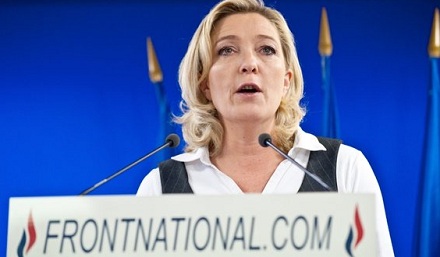
Make no mistake, this gang makes Marine Le Pen look warm and cuddly and downright pro-immigration.

The piece notes that the entire terrain of Greek politics has moved far to the right on immigration issues, in no small part because of the traction of Golden Dawn:

Experts say the group is thriving where the Greek state seems absent, the most virulent sign of how the economic collapse has empowered fringe groups while eroding the political mainstream, a situation that some Greek news outlets have begun comparing to Weimar Germany. Continue reading The Greek far right gets the NYTimes treatment

Park Geun-hye: ready for the Blue House?

With South Korean elections for the National Assembly now complete, and with the Saenuri Party (새누리당) holding on to its majority in the National Assembly, it is in many ways now the first day of South Korea’s presidential campaign.

No one emerges from the election with more of a boost than the Saenuri Party’s leader, who shepherded the Saenuri Party from the control of its unpopular and scandal-ridden old guard and rechristened it from the Grand National Party: Park Geun-hye, who also happens to be the daughter of former South Korean leader Park Chung-hee.

It seems clear that Park is ready to launch a campaign — she visited a national cemetery in Seoul Thursday morning and wrote in the visitors book at the front gate that she would create a new Republic of Korea.

Indeed, the Korea Times has a piece today setting the stage for Park’s emergence as presidential frontrunner:

Before the elections, few campaign watchers expected the Saenuri Party would receive such wide support from the general public after a series of scandals and corruption cases involving President Lee Myung-bak’s aides and relatives tarnished its image.

Park was called upon to assume the interim leadership last December when party support hit rock bottom.

The Korea Herald also hails her triumph, noting that Saeunri is rallying around Park in the aftermath of their win. Continue reading Park Geun-hye: ready for the Blue House?

Marine Le Pen and the youth vote

With 10 days to go until the French election, and with presumably more pressing topics to discuss, the campaign’s narrative has turned once again to Front national candidate Marine Le Pen — and her surprisingly strong support among the youngest voters.

According to a poll published in Le Monde earlier this week, Le Pen wins 26% of the 18-to-24 vote, to just 25% for Parti socialiste candidate François Hollande, 17% for incumbent Nicolas Sarkozy and 16% for Front de gauche candidate, Jean-Luc Mélenchon.  An IFOP poll earlier this week showed her polling second among the 18-to-22 vote.

This should not be a surprise – with unemployment running high in France amid near-recession levels of GDP stagnation and in the middle of a Europe-wide sovereign debt crisis (and currency crisis), it is perhaps understandable that job anxiety among the young, for whom unemployment runs highest, is fueling her support. 

Her anti-immigration rhetoric has been sanitized to the point where her argument is essentially economic and employment protectionism, less the nastier xenophobia of her father’s Front national.  She has no particular problem with LGBT rights and she has not emphasized religion in the same way as her father.  As an outsider, she is not tied to the difficulties and compromises that come with being a player in the European arena, which also undoubtedly plays a role in her success.

These polls somewhat remind me of the exit polls in the United States that showed U.S. representative and avowed libertarian Ron Paul leading among 18-to-29 voters in the Republican primaries of 2012 — as in the United States, it is hard to know whether to strike the anomaly to youthful rebellion or some deeper ideological turn among the right’s youngest generation.

But by all means: give Marine credit for her success.

She’s managed to take what was once a shamefully anti-Semitic, anti-immigrant and otherwise parochial party, headed by a grumpy old toad, and bring it within the mainstream of French politics.  Marine has clearly mastered the art of 21st century political imagery in ways her father could have never fathomed.  Indeed, at this point, the Front national probably has a stronger brand in France than Sarkozy’s own party — can you even name it?*  Even in a country like France where party identification is relatively weak, the party of center-right has been rechristened about once every decade in the Fifth Republic.  Continue reading Marine Le Pen and the youth vote

South Korean national assembly elections — final results

In concert with earlier reports from Seoul, the Saenuri Party has won yesterday’s elections to fill the seats of the National Assembly.

According to the Republic of Korea’s National Election Commission, Saenuri will take 152 seats to just 127 seats for the Democratic United Party and 13 seats for the DUP’s ally, the Unified Progressive Party.  The conservative Liberal Forward Party has won five seats.

UPDATE (April 13): See after the jump an election map showing the regional results in the legislative elections.  As is the key to much of Korean politics — six of the country’s eight presidents have come from North Gyeongsang province in the southeast of the country; the two most recent, Roh Moo-hyun and Lee Myung-bak, hail from South Gyeongsang province.  During Park Chung-hee’s regime from 1961 to 1979, Gyeongsang — which was historically the strongest of South Korea’s historical kingdoms — reaped beneficial treatment from the national government, which only furthered social stigma against Koreans from Jeolla province, which today remains a DUP strongold.  The DUP also performed well in Seoul, another traditional DUP stronghold.

Continue reading South Korean national assembly elections — final results

Mexican race still Peña Nieto’s to lose


Despite decisively winning the presidential nomination of the PAN (Partido Acción Nacional) in February and emerging in the Mexican presidential race with a flash,  Josefina Vázquez Mota has spent the last week attempt to rejuvenate her campaign and unite the PAN in her cause, even as the latest polls show that Enrique Peña Nieto, the candidate of the PRI (Partido Revolucionario Institucional), remains the strong favorite to win the Mexican presidency on July 1.

The latest polls indicate Peña Nieto leads with 38% of the vote to just 25% for Vázquez Mota and 19% for Andrés Manuel López Obrador, the candidate of the PRD (Partido de la Revolución Democrática), who came within a fraction of a percentage of winning the presidency in 2006.

In the 12 days since the campaign formally started, Vázquez Mota has been plagued by missteps— the former education minister’s campaign was ridiculed when her team misspelled the Mexican state of Tlaxcala as ‘Tlazcala’ on Twitter, for example. 

She has tried to draw a line around her campaign this week, starting with a show of PAN unity.  Her rival for the PAN nomination, former finance minister Ernesto Cordero, appeared at a press conference with Vázquez Mota on Monday, and Luisa María Calderón, the sister of outgoing, term-limited president Felipe Calderón, has been put in charge of the get-out-the-vote effort in Calderón’s home state of Michoacán.  Cordero was viewed as Calderón’s favorite and the favorite of many of the PAN elite during the nomination race.

Nonetheless, even today, former president Vicente Fox opined that it would take a miracle for Vázquez Mota to defeat the PRI and win the presidency:

Lo racional me dice que ahora lo que tenemos que hacer es de esa opción (el PRI) que puede llegar a la Presidencia, obligarla a ser buena, obligarla a que deje de sere nostálgico de aquel pasado, de aquellos niveles de corrupción y autoritarismo que vivimos antes, que sea una nueva generación de priístas.

[Translated into English: My rationality tells me that, we have the real option of (the PRI) winning the president, it will be obligated to be good, obligated to stop being nostalgic for the past, those levels of corruption and authoritarianism through which we lived before, that it will be a new generation of PRIístas.]

In the meanwhile, Peña Nieto has been off to an energetic start, avoiding some of the gaffes he endured over the winter — indeed, he has been able to outflank the traditionally business-friendly PAN by suggesting more private-sector involvement in — and potentially a public stock listing for — Mexico’s state-owned oil monopoly, Pemex.  On the campaign trail, he has praised the reforms of the Brazilian government in the 1990s to open its similar oil monopoly, Petrobras, to private investment.  Mexico is the world’s seventh-largest oil exporter, producing upwards of 2.5 million barrels per day. Continue reading Mexican race still Peña Nieto’s to lose

Greek election date set for May 6

We (finally) have a date for the Greek parliamentary elections: May 6.

Under the Greek election system, which will be conducted under a new 2007 electoral law, 250 of the 300 seats in the Hellenic Parliament will be awarded on the basis of proportional representation (only if the national tally exceeds 3% of the total vote, however).  The additional 50 seats will be awarded to the party that wins the leading number of votes.

Currently, the top two vote-winners in polls are Greece’s two longtime parties: New Democracy (Νέα Δημοκρατία), which has led most polls going into the vote with just over 20% of likely voters, and PASOK (the Panhellenic Socialist Movement, or Πανελλήνιο Σοσιαλιστικό Κίνημα), which polls anywhere from 12% to 16% under its new leader, former finance minister Evangelos Venizelos

Both PASOK and New Democracy support the current round of bailouts from the ‘troika’ of the European Central Bank, the European Commission and the International Monetary Fund, including regulatory reforms and controversial austerity measures that have led to widespread cuts in public spending, strong disapproval from the Greek electorate and have helped stall Greek GDP growth.  Together, PASOK and New Democracy approved the appointment of current prime minister Lucas Papademos, who succeeded former PASOK prime minister George Papandreou (who will nonetheless be standing for election on May 6 in Achaia). 

Accordingly, both PASOK and New Democracy are at near-record levels of unpopularity heading into the May 6 election.

The latest poll from Public Issue, however, shows New Democracy with just 19% support and PASOK with 14.5%, which is too little to form a coalition — any party (or parties) need to win between 36% and 39% of the total vote to command enough seats to govern.  Taken together, the 33.5% represents the lowest total of the two of any poll to date.

Nonetheless, at least four anti-bailout parties have also emerged with anywhere between 8% and 12% of the vote, making it likely that both ND and PASOK will receive traditionally lower support than ever.  The KKE, Greece’s longtime Communist Party, wins 11%, SYRIZA, a coalition of the Radical Left no longer associated with the KKE, wins 13%, DIMAR — the “Democratic Left,” a splinter group from SYRIZA, wins 12%.  Meanwhile, the Independent Greeks, an anti-austerity group that splintered from New Democracy, also wins 11%.  The neo-fascist Golden Dawn polled 5% and each of the Ecologist Greens and the right-wing Popular Orthodox Rally polled 3%.

Of Ahn and Angry Birds: the political culture that is South Korea

This video comes to us from Ahn Chul-soo, who is emerging as a potential independent presidential candidate in the South Korean election in December of this year.

Ahn comes to politics from the business world — he founded AhnLab, Inc., an antivirus software company, and he now serves as the dean of the Graduate School of Convergence Science and Technology at Seoul National University.

In the clip above, Ahn uses Angry Birds to make a point to South Korean voters to turn out to today’s (now completed) legislative election:

“Bad pigs are hiding behind the castle, the solid establishment. These good birds are throwing themselves to break the castle,” Mr. Ahn said.

Then a voice asks him what he would do if the election turnout is over 70%, and he answers he would sing. “Since I can’t sing, it is a big sacrifice,” he said.

But the voice insists he dance as well. He laughs and reluctantly agrees. The voice then wraps up the interview by declaring “Mr. Ahn will sing and dance in mini-skirt!” Mr. Ahn looks clearly embarrassed and throws the Angry Bird stuffed animal he was holding towards the camera. Then a message appears on screen, “Angry?? Just Vote!”

Ahn rose to political prominence last year with a series of appearances and commentaries on South Korean politics.  He currently garners significant support in pre-election polls as a credible, if not leading, presidential candidate.  Ahn met with Microsoft founder Bill Gates in Seattle earlier this year, furthering speculation that the one-time IT entrepreneur will make a run at the Blue House (the ROK’s presidential home).

Upset win for Saenuri Party in South Korea

With just over half of the ballots counted, Korean news sources are projecting that the governing Saenuri Party (새누리당 or the ‘Saenuri-dang’) will win, however slightly, more seats than the opposition in South Korea’s April 11 parliamentary elections.

The Saenuri Party is forecast to win about 144 seats in the South Korea national assembly — it currently holds 165 under current leader and likely future presidential candidate Park Geun-hye, daughter of the former ROK leader.

The victory is also good news — or at least a reprieve — for embattled president Lee Myung-bak, whose one-time popularity has plummeted due to the stagnant economy, high unemployment and scandals over illegal internal surveillance.  Analysts, however, cautioned a rough road ahead for Lee, who will be a convenient punching bag ahead of December’s presidential election.

Prior to today’s election, the Democratic United Party (민주통합당, or the ‘Minju Tonghap-dang’) faced skepticism over the troubles it had in formalizing an alliance with the Unified Progressive Party, but looked to have an odds-on even chance at worst of winning the election.

Although the DUP will add seats to the 80 seats it held prior to the election, its inability to win outright will be seen as somewhat of a disappointment on expectations, given the current president’s unpopularity — so much so that the Saenuri Party only earlier this year, under Park’s leadership, rebranded itself from is previous “Grand National Party” moniker.

As of 11:30 pm South Korean time, the Saenuri Party had won or was leading in 127 out of a total of 246 constituencies with the DUP carrying 107, according to the National Election Commission. The United Progress Party (UPP), the DUP’s ally, had won or was leading in six.

Park will now almost certainly be the Saenuri presidential candidate in the December election (although Gyeonggi Province Governor Kim Moon-soo remains a potential alternative).  Although the DUP’s potential candidate is less clear following the result, the leading contender remains former Roh administration chief of staff Moon Jae-in, who won election today in a district in Busan.  In addition, IT entrepreneur and Seoul National University professor Ahn Chul-soo has also been seen as a popular potential independent candidate.

The Korea Times highlights some of the winners and losers in individual races — the losers include a former Saenuri Party leader, Hong Joon-pyo.  Among the highlights are more representation among the so-called ‘486 generation’ — those who were born in the 1960s and were student activists in the fight for democracy in the 1980s (the ‘4’ notes that they are in their 40s — the original term was ‘386’ generation when coined in the 1980s).

Also among the new National Assembly members will be Cho Myung-chul, the first North Korean defector to be elected in South Korea (Cho was listed fourth on Saenuri’s list of proportional representation candidates).

Orbán feisty in first U.S. interview

Hungarian prime minister Viktor Orbán is taking a feisty tone in his first interview with a U.S. journalist.

In a remarkably sassy back-and-forth with Lally Weymouth, Orbán makes no apologies for his party Fidesz or his conduct since Fidesz has taken power in Hungary.  Fidesz holds 263 of the 286 seats in the Hungarian parliament after a landslide win in the 2010 parliamentary elections.

For example, here’s Orbán on revising the Hungarian constitution last year:

Since your party, Fidesz, won a two-thirds majority, you have basically obliterated all checks and balances. Do you agree?
No. The constitution is based on checks and balances. That is a very unfair domestic opinion.

Your critics say you rushed the constitution through without consulting the opposition.
That is factually false. There was a commission created by the parliament. It invited all the parties represented in the parliament——even the opposition—to be part of that process.

Isn’t it fair to say the outcome of the legislation has been to concentrate all power in your hands?
The constitution by itself does not make it possible to concentrate any kind of power.

Here he is on freedom of the press:

Why did you decide there should be a board to control the media? You appoint the head of the media board, and parliament appoints every member of the board. And members stay in power for nine years and cannot be replaced unless there is a two-thirds vote in the parliament.
Everybody agreed that the previous media regulation system collapsed. It was the responsibility for the new parliament to create a system that works. Until the last election, international observers like you admired the Hungarian system because two-thirds majority means consensus. Now that we have a two-thirds majority, it is an accusation….

But is the government acting in an even-handed fashion toward those in the print media that oppose the government? The government gives out advertising to the print media.
The government owns some companies—like an electric company or an oil company—and they run advertising. Try to imagine Hungary as at least as democratic a country as the United States.

More, on the Jacksonian attempts to circumvent the central bank:

You have given [central bank] Gov. Andras Simor a really hard time. He seems like a distinguished civil servant. What’s wrong with him?
“Distinguished” depends on your taste, but he is a good servant. He stays. Nobody would like to push him out. It’s impossible.It sends quite a signal when you cut someone’s salary by 75 percent.
Hungary is a poor country. We decided that regardless what kind of office you have if you are a public servant, you have a salary cap for everybody of 2 million forints, which is 6,000 euro [about $7,800] per month.

There’s much, much more — about gay rights, about abortion, about the perceived crackdown on religion, about other examples of executive overreach, none of which will provide much comfort to onlookers among Hungary’s peers in the European Union and in the United States, already troubled at Hungary’s backsliding from liberal democracy.

Addio to the Lega Nord


 Umberto Bossi resigned last week as the leader of the populist and xenophobic Lega Nord (the Northern League), Italy’s largest separatist party, based chiefly in the northeastern and north-central regions of Italy, especially in the Veneto and Lombardy.

Since before Silvio Berlusconi ascended to the top levels of Italian public life, first in 1994 with the Forza Italia party, later with the Casa della Libertà coalition of right-wing groups and finally the more formal Popolo della Libertà party, Bossi and the Lega Nord have been inexorable toads on the Italian right’s lilypad.  

Berlusconi often needed Bossi in order to form a coalition to govern, but the anti-immigrant tenor of the Lega Nord — in 2008, it tried to prevent the building of any Islamic mosques in Italy — was always a bit of a distraction for the Berlusconi government.  Indeed, in 1995, Bossi and the Lega Bord caused the first Berlusconi government to fall after losing a vote of confidence.  In the late 1990s, the Lega called for the independence of northern Italy under the name of “Padania.”  While Berlusconi’s forces have largely supported the austerity measures of new, technocratic prime minister Mario Monti, Bossi and the Lega have been remained in somewhat bitter opposition.

The party vacillated between a high of 10.1% in the 1996 election to a low of 3.9% in 2001, only to re-emerge with 8.3% and 60 seats in the most recent 2008 election that restored Berlusconi to power.  It’s an even bet, though, that we’ll be saying “addio,” and not the more we’ll-meet-again breezy “arrivederci” to the Lega Nord, which may crumble with the fall of Bossi, whose resignation stems from the kind of sleazy corruption reminiscent of the Bettino Craxi era of Italian politics — abuse of the party’s coffers for improvements to his own property and kickbacks to family members.

Despite his protestations, it is difficult to understate just how intertwined Bossi and the Lega Nord have become: Bossi is the Lega Nord and has been for two decades. Continue reading Addio to the Lega Nord

Good golly, Miss Mali

Perhaps this was inevitable, given that the coup leaders who deposed President Amadou Toumani Touré have wavered with indecisiveness in the face of international and regional backlash since taking power on March 21.

But the National Movement for the Liberation of Azawad declared the north’s independence Friday, making an already tense situation worse.

It is ironic to note that Captain Amadou Haya Sanogo led the original Mali coup out of frustration that the current administration was not doing enough to retard the progress of the Tuareg rebels, but it seems as if the latest move has somewhat stymied the coup’s newly installed government, Comité national pour le redressement de la démocratie et la restauration de la démocratie et la restauration de l’état (“CNRDRE”).

The Mali dynamic has featured some of the same north-south tensions as Sudan — but in reverse: in Mali, the northern, nomadic Tuaregs have long complained of mistreatment and a lack of support from Bamako and the south, where the majority of Malians live.  While the overwhelming majority of Mali is Muslim, the Tuaregs have more in common with Algeria and Libya than with southern Mali, which has correspondingly more cultural ties to other west African Francophone countries like Senegal.

With plenty of access to arms from the recent campaign in Libya to Mali’s north and the example of South Sudan to Mali’s east, it is not exactly surprising that this could have happened.  Unlike with South Sudan, however, the fear among the United States and Europe that al-Qaeda and other Islamic fundamentalist groups could turn the north into a terrorist haven, don’t expect the international community to leap at the opportunity to recognize the new nation of Azawad anytime soon.

So it’s looking like Mali is even further removed from holding a new presidential election anytime soon, which was originally scheduled for April 29.

A shift in tone about Chávez’s health

It sounds like Hugo Chávez’s cancer may be taking a turn for the worst, if his teary-eyed moment at a pre-Easter service is any indication. 

From the always superb Caracas Chronicles:

As he customarily does, Chávez turned a religious service into a revival session-cum-political rally-cum-touchingly televised cinematic cliffhanger. He wept, prayed for his life to be spared, and movingly thanked his family for their support.

I don’t want to be too cynical about this, and I am willing to forgive the uncomfortable use of a religious service for … something else. To me, the most noteworthy aspect of this is the shift in tone.

I’ve noted in the past that chavismo without Chávez does not have a promising future — but that may not be the best news for presidential candidate Henrique Capriles.

Capriles has been tied with Chávez in polls in advance of October’s presidential election, although the latest poll from Caracas-based Datanalysis, released on March 29, shows Chávez with a 44.7% to 31.4% lead over Capriles.

Nonetheless, there remains a chance that Chávez’s death or incapacity could trigger any number of events that could supersede the election, including a coup by Chávez’s ruling Partido Socialista Unido de Venezuela or a coup by Chávez opponents.

North Korea’s vote is anti-Lee, anti-Park

There are few world relationships trickier than the politics between North Korea and South Korea.

But two flavors of news from North Korea have shaped the upcoming South Korean legislative elections:

  • North Korea has announced its intention to launch a satellite and long-range rocket into orbit between April 12 and 16 in honor of Kim Il-Sung.
  • North Korea is not being shy about its hope that President Lee Myung-bak’s Saenuri Party (새누리당 or the ‘Saenuri-dang’) loses next Wednesday’s legislative elections.

It is difficult to know just what impact the North Korean issue will have on the election, the main focus of which has been the South Korean economy.  Lee has reversed the “sunshine policy” of his predecessors that marked the 2000s, where South Korea pushed comparatively more aid to North Korea — instead, he has taken a harder-line stance against Pyongyang.  At the same time, Cho Myung-chul, who defected from the North in 1994, is running on the Saenuri Party ticket to become the first defector to stand in the South Korean parliament.

At the same time, Pyongyang is increasing that rhetoric in none too subtle ways against Lee and the current leader of the Saenuri Party, Park Geun-hye.  Pyongyang’s Korean Council for Reconciliation today called Park a “dictator’s daughter” (Park is the daughter of former South Korean president Park Chung-hee, who was South Korea’s leader from 1961 to 1979 whose commitment to economic progress was somewhat greater than his commitment to political liberalization):

“A dictator’s bloodline cannot change away from its viciousness…all walks of life in the South must not be deceived by Park and her clique, and must judge the conservative traitors through the elections,” it said.

“We, along with all the Korean people, will never allow the ghosts of the dictatorship to make a comeback,” it said in a statement carried by the official news agency.

The North Korean government newspaper christened Park as a “Judas” with an “unlimited greed for power”.

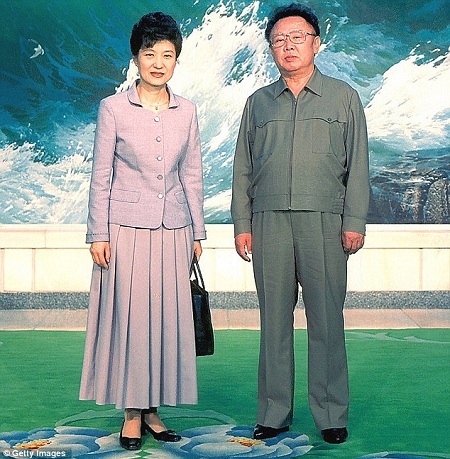
Park met North Korea’s leader, the late Kim Jong-il, in Pyongyang in 2002 — they are pictured above in, um, happier times.  Kim died in December 2011 and his son, Kim Jong-un, has succeeded him, although the extent of Kim Jong-un’s power and the direction he’ll try to take North Korea remains murky.

I’m not sure how that is going to play with South Korean voters — most likely, they will probably just ignore the North’s clumsy attempts at political interference, just as they seem to ignore South Korean politicians who try to gain political advantage from any perceived threat from the North:

“Voters see any North Korean action more as Pyongyang strengthening its rhetoric to escalate tensions rather than a real national security threat or an actual move to attack the South,” said Lee Taek Soo, president of Seoul-based polling service Realmeter. “Parties have also abused the threat of North Korea in past elections, so voters have learned their lesson.”

The latest poll from Realmeter, conducted from March 27 to 30, shows the Saenuri Party with a slight uptick in support at 39.8%.  The chief opposition party, the Democratic United Party (민주통합당, or the ‘Minju Tonghap-dang’) garners 30.5% and its coalition partner, the Unified Progressive Party wins 8.1%.

‘Hollande will destroy the French economy in two days’

That blunt messaging is one of the reasons why Nicolas Sarkozy still has a shot to win reelection.

He also claimed that, if elected, Parti socialiste candidate François Hollande would turn France into another Greece.

All of this would be fabulously amazing positioning for a president whose record on balancing the budget is not stellar — public debt has gone up under his watch.  It’s more amazing when you consider that only in December, Sarkozy presided over France losing its ‘AAA’ credit rating from a major ratings agency.

Last week, Sarkozy pounced on the news that the French deficit for 2011, projected to be 5.7%, was, in fact, only 5.2% — never letting horrible be the enemy of terrible.

Even as unemployment hovers around 10%, last week’s GDP report also showed that France grew at a near-recessionary 0.2% pace in the final quarter of 2011.  Nonetheless, Sarkozy managed to turn even that into an opportunity to attack his opponent:

“The Socialists said France was in recession, as if they actually enjoyed it every time there was bad news for France,” Sarkozy told Europe 1 radio, announcing the 2011 deficit figure.

You cannot imagine Dominique Strauss-Kahn, for example, letting Sarkozy push him around like this.

Continue reading ‘Hollande will destroy the French economy in two days’

La revanche de Ségolène

The revenge of Ségolène indeed.

Ségolène Royal, the 2007 presidential candidate of the Parti socialiste, joined François Hollande, the 2012 presidential candidate of the Parti socialiste at a campaign event in Nannes Wednesday night to rally left-leaning voters in France at a time when apathy — and a fierce radical left presidential challenge from Jean-Luc Mélenchon — threatens to erode Hollande’s first-round lead in the presidential race. 

Normally, it’s not incredibly advisable for a candidate, skirting along the cusp of victory, to invite last cycle’s loser to headline one of the largest pivotal rallies of the campaign — it’s sort of like Jimmy Carter inviting George McGovern to campaign for him in the 1976 U.S. general election.

But there, of course, is something fascinating and perhaps a little cathartic in watching the two — intraparty rivals, partners for over three decades and parents of four children — unite in such a public manner.  Although their political differences aren’t nearly so wide as some in the PS, no other moment could symbolize the party’s unity in the 2012 election.

It is rumored that, should Hollande win in May and should the PS win legislative elections in June, Hollande will appoint Royal as President of the National Assembly.

Among especially those with the weakest political voices in the suburbs, Royal retains an aura of excitement that the more plodding Hollande can never match — she has been campaigning for Hollande especially hard in Marseille, for example.  While the glamour has faded from Royal, who once looked to become France’s first female president — she finished embarrassingly low in the 2011 primary for the PS presidential nomination — there’s a glint yet of the magic and excitement that her 2007 candidacy once promised.

As Le Monde notes:

Et même s’il sort gagnant, il devra lutter contre cette suspicion de ne l’avoir été que par la virulence de l’anti-sarkozysme. Pour toutes ces raisons, il a besoin de retrouver un peu de la ferveur de 2007. [And even if Hollande wins, he will struggle against the suspicion of not really having won, but rather than the result of the virulence of anti-Sarkozyism. For all these reasons, he needs to regain some of the fervor of 2007.]

On the other hand, Hollande had better hope that the appearance with Royal — who lost the second round of the 2007 race to Nicolas Sarkozy by six points — does not make French voters see him as just the next in a long line of sacrificial lambs on the left in the past two decades to have watched nearly “certain” presidential campaigns end in disaster.

MAKING WORLD POLITICS LESS FOREIGN