South Korean national assembly elections — final results

In concert with earlier reports from Seoul, the Saenuri Party has won yesterday’s elections to fill the seats of the National Assembly.

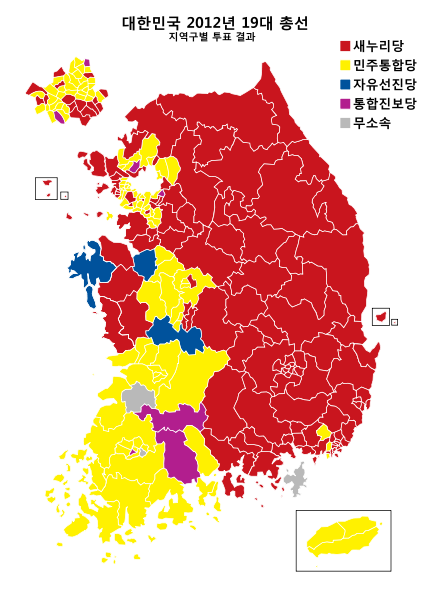
According to the Republic of Korea’s National Election Commission, Saenuri will take 152 seats to just 127 seats for the Democratic United Party and 13 seats for the DUP’s ally, the Unified Progressive Party.  The conservative Liberal Forward Party has won five seats.

UPDATE (April 13): See after the jump an election map showing the regional results in the legislative elections.  As is the key to much of Korean politics — six of the country’s eight presidents have come from North Gyeongsang province in the southeast of the country; the two most recent, Roh Moo-hyun and Lee Myung-bak, hail from South Gyeongsang province.  During Park Chung-hee’s regime from 1961 to 1979, Gyeongsang — which was historically the strongest of South Korea’s historical kingdoms — reaped beneficial treatment from the national government, which only furthered social stigma against Koreans from Jeolla province, which today remains a DUP strongold.  The DUP also performed well in Seoul, another traditional DUP stronghold.


6 Responses

  1. [...] South Korean elections for the National Assembly now complete, and with the Saenuri Party (새누리당) holding on to its majority in the National Assembly, it [...]

  2. [...] one step on the way to flexing her real political muscle — by winning South Korea’s parliamentary elections in April earlier this year – the Saenuri Party holds 152 seats out of 300 in South Korea’s National Assembly, to [...]

  3. [...] the Saenuri Party late last year, she led her party from a bit behind to win South Korea’s parliamentary elections in April, notwithstanding the incredible unpopularity of the incumbent, Lee Myung-bak (who Park challenged [...]

  4. [...] earlier this year to rebrand the Saenuri Party (once the ‘Grand National’ Party) and managed to win legislative elections against the DUP in April 2012.  Since those elections, Park has been seen as a narrow favorite for [...]

  5. [...] notwithstanding Lee’s unpopularity, Park’s Saenuri party won the April 2012 elections, taking a small majority in the South Korean national assembly by netting 25 more seats than the DUP.  Her bravura [...]

  6. [...] then led the Saenuri Party to victory in elections for the National Assembly in April despite the unpopularity of her party’s incumbent president Lee [...]

Leave a Reply

Your email address will not be published. Required fields are marked *

You may use these HTML tags and attributes: <a href="" title=""> <abbr title=""> <acronym title=""> <b> <blockquote cite=""> <cite> <code> <del datetime=""> <em> <i> <q cite=""> <strike> <strong>