Tag Archives: justin trudeau

Liberals dominate New Brunswick vote

gallant

The cardinal rule of political prognostication in Canada is that provincial results can provide no guarantee of future performance.newbrunswickCanada Flag Icon

Nevertheless, Justin Trudeau must be feeling pretty good this week about the Liberal brand throughout Canada, after a strong Liberal victory in New Brunswick, the fourth consecutive Liberal triumph in provincial elections since Trudeau won the federal leadership in April 2013.

The New Brunswick victory follows a rout in Québec, where the Parti libéral du Québec (Liberal Party, or PLQ) won April elections under the leadership of former health minister Philippe Couillard, after just 18 months in opposition. It also follows elections in Ontario, where the provincial Liberal Party won a fourth consecutive term and a majority government under premier Kathleen Wynne in June.

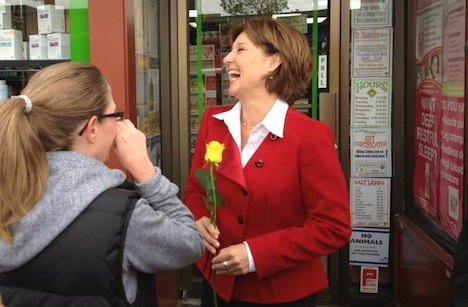
Those follow a landslide victory last October in Nova Scotia and a come-from-behind win by the incumbent Liberals under premier Christy Clark in British Columbia last  May.

The Liberal Party last came to power in New Brunswick in 2006 when voters narrowly ousted two-term premier Bernard Lord, oft-mentioned in the early 2000s as a potential Conservative prime minister. But in 2010, voters turned against the Liberals and premier Shawn Graham after an ambitious four-year program designed to improve energy, education and health care.

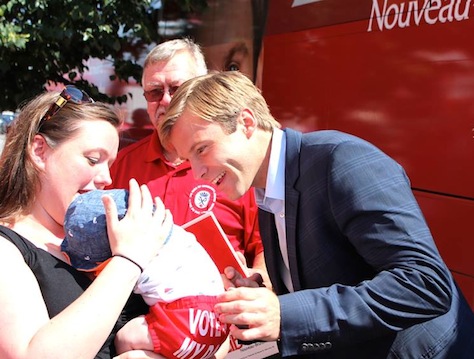
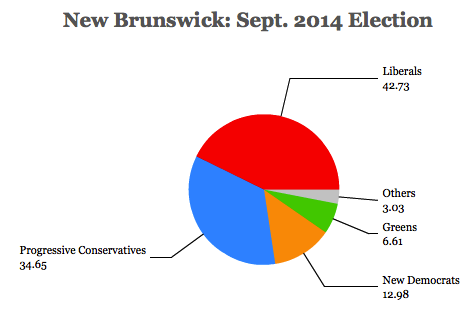
On Monday, however, New Brunswick’s voters rejected the Progressive Conservatives and premier David Alward. Under the leadership of the 32-year-old Brian Gallant (pictured above), who was just two years old when Trudeau’s father, Liberal premier Pierre Trudeau, left office in 1984, the Liberals have now returned to power. Liberals gained 14 seats to hold a total of 27 in the province’s legislative assembly, to just 21 for the center-right Progressive Conservatives and one for the Green Party’s leader David Coon, a historic breakthrough for a party whose two members of the Canadian House of Commons come from British Columbia.

newbrunswick2014

Gallant, who was predicted to win the September 22 election, despite polls showing a narrowing race in the days leading to the vote, promised to deliver more jobs and better roads and other provincial infrastructure.

All major parties, including the Liberals, supported the Energy East oil pipeline, which would link Albertan and Saskatchewan oil fields to Saint John, New Brunswick’s largest city on the southern coast along the Bay of Fundy. But while Alward vocally championed the development of shale gas exploration and ‘fracking’ within New Brunswick during the campaign, Gallant opposed fracking and, along with the Greens, supports a moratorium on fracking — for now.  Continue reading Liberals dominate New Brunswick vote

Wynne lifts Ontario Liberals to majority government, 4th term

wynnewins

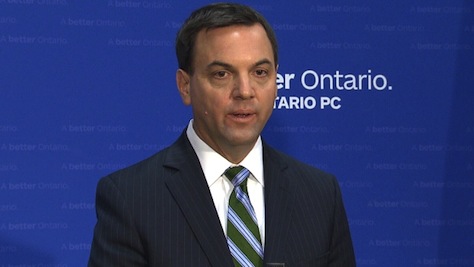
Heading into Thursday’s provincial elections, polls showed that both the center-left Liberal Party of Ontario and the center-right Progressive Conservative Party of Ontario (PC) both had a chance of winning at least a minority government.Canada Flag Iconontario

Late-breaking polls on Tuesday and Wednesday, however, showed the Liberal vote creeping up, matched by a decline in support for the progressive alternative, the New Democratic Party of Ontario (NDP).

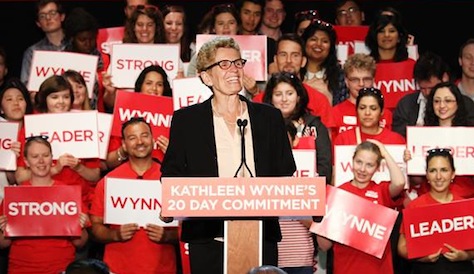
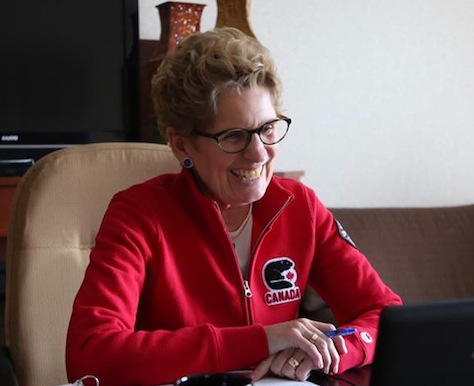
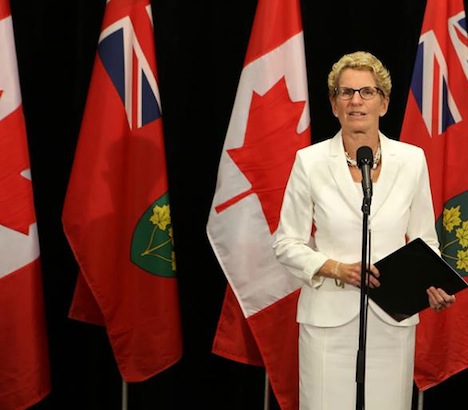
As it turns out, those late polls were spot on, and Ontario’s new premier Kathleen Wynne, who inherited a minority government from her predecessor Dalton McGuinty just 16 months ago, reinvigorated Ontario’s Liberals and won a majority government in her first campaign leading the party.

* * * * *

RELATED: Meet Kathleen Wynne, Ontario’s premier and the 180-degree opposite of Rob Ford

* * * * *

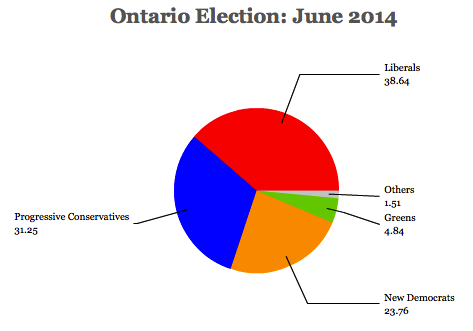
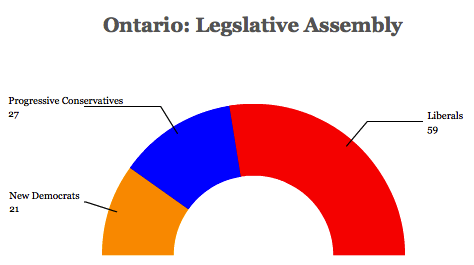
The Ontario Liberals won 59 seats in the 107-member Legislative Assembly with nearly 39% of the vote, while the Ontario PC won just 27 seats with just over 31% of the vote, a nearly disastrous result that found the Tories losing ground in what was shaping up as a PC landslide a year ago:

ontario14 ontarioLA

It’s an unexpected trajectory for a party to go from two terms of majority government to one term of minority government and, then, back to a majority government. Part of the reason is that Ontario’s voters simply never warmed to PC leader Tim Hudak.   Continue reading Wynne lifts Ontario Liberals to majority government, 4th term

Ontario election too close to call with 48 hours left to go

hudak

wynne

Just two months after Québec’s extraordinary election, which devastated the sovereigntist Parti québécois (PQ) and replaced the minority government of Pauline Marois with a federalist majority government under Philippe Couillard, Ontario voters will choose their own provincial government on Thursday in what has become a tight two-way race.Canada Flag Iconontario

Politics in Anglophone-majority Ontario, however, looks nothing like politics in Francophone-majority Québec.

As in most provinces, Ontario’s political parties have only informal ties to federal political parties. But Ontario’s political framework  largely maps to the federal political scene. Accordingly, the center-left Liberal Party of Ontario is locked in a too-close-to-call fight with the center-right Progressive Conservative Party of Ontario (PC), with the progressive New Democratic Party of Ontario (NDP) trailing behind in third place.

All three parties have led provincial government the past 25 years. The Liberals are hoping to win their fourth consecutive election, after Dalton McGuinty won majority governments in 2003 and 2007 and a minority government in 2011. Under the leadership of popular former premier Mike Harris, the Progressive Conservatives won elections in 1995 and 1999. Bob Rae, formerly the interim leader of the Liberal Party of Canada, led an NDP government between 1990 and 1995.

ThreeHundredEight‘s current projection, a model based on recent polling data, gives the Liberals an edge over the Ontario PCs of just 37.3% to 36.5%, well within the margin of error. The Ontario NDP is wining 19.8% (though individual polls show that the Ontario NDP could win anywhere from 18% to 27% of the vote) and the Green Party of Ontario is winning 5.2%.

Voters elect all 107 members of Ontario’s unicameral Legislative Assembly in single-member ridings on a first-past-the-post basis. That, according to ThreeHundredEight, could result in anything from a Liberal majority government to, more likely, a hung parliament with either a Liberal or PC minority government.  Continue reading Ontario election too close to call with 48 hours left to go

Meet Kathleen Wynne — Ontario’s premier and the 180-degree opposite of Rob Ford

wynneantiford

Though it’s been five months since the first reports emerged that Toronto mayor Rob Ford smoked crack cocaine, it’s only been within the last week that the controversy surrounding Ford has reached truly staggering attention.toronto ontarioCanada Flag Icon

When the embattled mayor earlier this month admitted that he used crack cocaine in a drunken stupor, he only opened the floodgates to more questions — and more allegations, which have certainly followed in short order.  It’s been a truly catastrophic week for Ford, who made his problems even worse with some misogynist comments about a former female aide, his refusal to step down as mayor, further admissions that he’d purchased illegal drugs in the last two years, and that he’s operated a vehicle while drunk.

But this week also marks the first time that anyone’s suggested that the province of Ontario should step in — and that’s putting Ontario premier Kathleen Wynne in the spotlight, who is the absolute opposite of everything Ford represents.  Wynne is not only the first female premier of Ontario and the highest-ranking openly gay official in Canadian politics, Wynne exemplifies the polite, dignified consensus-driven leadership for which Canada has become so well-known.

Wynne gently waded into Toronto’s growing crisis earlier this week, urging Ford to take heed of the Toronto city council’s call to step down:

“The concern for me is that city council can function and it seems today that that’s exactly what’s happening,” she said, referring to two overwhelming council votes to politically emasculate the mayor by stripping him of some powers.  “I see that city council is making decisions and they are determined . . . to find a way to make that work,” the premier said at a Council of the Federation meeting in Toronto.

There’s not much that the Ontario premier can actually do to remove Ford, though Wynne opened the door to legislative action earlier this week — but only at the request of the Toronto city council and only with the support of the leaders of both the Progressive Conservative Party of Ontario, Tim Hudak, and the Ontario New Democratic Party, Andrea Horwath.

Ironically, it’s the ‘amalgamation’ plan that former Progressive Conservative prime minister Mike Harris pushed through the Ontario legislative assembly in 1998, over the protest of many Toronto residents, that made Rob Ford’s 2010 election possible.  Under amalgamation, the city of Toronto merged with the surrounding communities of East York, Etobicoke, North York, Scarborough, and York — Ford himself comes from Etobicoke, a suburb to the west of Toronto’s urban core.

Meanwhile, the Toronto city council is likewise limited in its ability to remove Ford from office, though it voted to strip Ford of many of his powers on Friday — on a vote of 39-3, councillors removed Ford’s ability to hire or to fire the city’s standing committee chairs and the deputy mayor, and on a vote of 41-2, councillors voted that Ford’s powers should be delegated to the deputy mayor in the event of an emergency situation.  Despite the council’s limitations, it’s important to keep in mind that the office of mayor in Toronto is relatively circumscribed — in many ways, Ford is more like the council chief than a true chief executive with the broad executive powers of, say, the New York City mayor.

Ford has become an international punchline, to the horror of many Toronto residents, who are proud of a city long known as Canada’s financial capital, a magnet for immigration, and a quiet showcase of North American prosperity and safety.

Far less well-known is Wynne, who is the anti-Ford of Ontario politics.  In her remarks on the Toronto mayoral situation earlier this week, she stressed that Ford’s antics do not characterize Ontario and do not characterize Toronto — Wynne herself represents Toronto in Ontario’s legislative assembly:

“I believe Toronto is not defined by one person, by one politician. We have to be very careful that we not allow ourselves to be defined by this,” she said.

Still, the premier expressed sympathy for Ford and his family, given the mayor’s drinking and admitted illegal drug use.  “I’m very concerned about the human element of this. A person who is struggling in his life, as far as I can tell, and so I hope that he will look after himself.”

Wynne became the province’s first female premier in February.  But that’s not exactly a surprising feat in Canada, where Kim Campbell served as the first female prime minister (however briefly) for just over four months in 1993, and where the premiers of Québec, Alberta and British Columbia are all women.  What makes Wynne more remarkable is that she’s the first openly gay premier of any Canadian province. Continue reading Meet Kathleen Wynne — Ontario’s premier and the 180-degree opposite of Rob Ford

Despite CETA signing, Harper’s 2014 agenda remains unambitious

barrosoharper

Canadian prime minister Stephen Harper today celebrated the signing of a landmark free-trade deal between Canada and the European Union, bringing to fruition one of the top accomplishments that Harper can claim since taking office with a minority government in 2006 and a majority government in 2011. Canada Flag Icon

Although the pact won’t be ratified until 2015, the Comprehensive Economic and Trade Agreement (CETA) removes tariffs between Canada’s economy and the $17 trillion economy of the European Union, which comprises 28 countries and over 500 million people.  Together with the North American Free Trade Agreement (NAFTA), it will give Canada exclusive access to more than half of the global economy.  CETA will allow Canadian automakers to export 12 times as many automobiles to Europe, and it will fully open the EU market to Canadian fruits, vegetables, wheat, grains and dairy, while removing tariffs on European wine and spirits, all seafood, metals and minerals (including steel and iron) and up to 29,000 tonnes of European cheese.  Furthermore, Harper is considering granting compensation to Canada’s dairy producers, especially in Québec, if they lose revenue in the wake of the agreement.

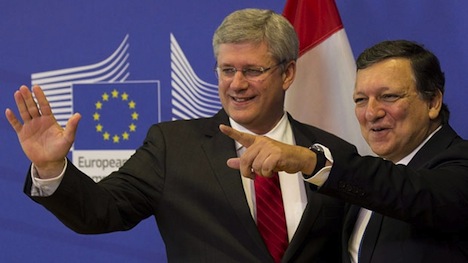
What’s more, Harper (pictured above with European Commission president José Manuel Barroso) will be able to brag that his vision for a Canadian-European free trade agreement served as a precedent for the Transatlantic Trade and Investment Partnership (TTIP) still being negotiated between the United States and the European Union.

At a time when the Liberal Party has emerged from the brink of political oblivion with the selection of its popular, telegenic leader Justin Trudeau, to lead polls in advance of the 2015 election — an iPolitics/EKOS poll earlier this week gave the Liberals 36% support to just 26% support for Harper’s Conservative Party and 25% for the social progressive New Democratic Party — the completion of CETA and its ratification gives Harper three domestic policy wins.

First, it’s perhaps his most significant policy accomplishment in seven years.  Second, not only does it give him a substantive accomplishment, it gives him one that bolsters the case that he’s dedicated to creating jobs and strengthening Canada’s economy, and it provides a contrast to Trudeau’s often wishy-washy blather.  Third, it hoists a difficult choice on the NDP — support the CETA and anger labor unions, especially within its new Québécois stronghold; or oppose to CETA to draw a stronger contrast to Trudeau’s newly invigorated Liberals.

But don’t expect much more in the way of ambition from Harper’s government this year.

The agreement comes after the reading of Harper’s 2013 Throne Speech, much of which constituted a victory lap detailing Canada’s superior employment and economic record compared to its developed-world peers, such as the United States and the European Union, where political instability, stagnant GDP growth and joblessness have been more acute.  While Harper hopes to pass a law requiring balanced budgets in the future, it’s unclear whether he can actually pass a bill through Canada’s parliament or that future governments would keep it in place.

The rest of Harper’s agenda amounted to an odd mix of populist consumer protection schemes:

The government promised to “take steps to reduce roaming costs” for cellphone users. It says it will take action so that cable and satellite customers can “choose the combination of television channels they want” by “unbundling” channel packages. And it promised to move on “hidden fees,” including making it so that “customers won’t pay extra to receive paper bills.” If this part of the agenda reads like it was pilfered from the NDP, that’s because to some extent it was.

It’s puzzling for a market-oriented party like the Tories to prioritize these kind of measures — services like Netflix and Hulu are already, in part, helped to unbundle television packages through market forces.  Roaming costs for Canadian users are already coming down due to market pressures.  So many of the consumer goals Harper listed are likely to come about through the market without the need for government interference.

It’s equally baffling to know how Harper will reduce ‘geographic price discrimination,’ his term for the price differential between consumer goods sold in Canada and the United States. Presumably, if the price difference is enough, Canadians (90% of whom live within 100 miles of the US border) will make a trip down south to buy them at cheaper prices, or enterprising entrepreneurs will find a way to undercut them — especially in the world of e-commerce.

But even more, it’s small ball.  It’s the Canadian equivalent of former US president Bill Clinton’s much-derided 1995 agenda of school uniforms and ‘v-chips.’  Though consumer protection initiatives aren’t nothing, it’s hardly the kind of bold, conservative agenda that you might have expected Harper to champion upon coming to power seven years ago, and surely not what you’d expect from a government just two years after finally capturing a majority government.

John Ivison, writing in The National Post, likened the Throne Speech to ‘a botox treatment gone bad’:

The Throne Speech is littered with examples of the government wading into sectors of the economy to “fix” problems that should be left to either the market or the existing regulators — all to the detriment of millions of Canadian shareholders.  It’s all so transparent and light as tinsel.

But it’s not just this year’s Throne Speech.

Aside from CETA, it’s hard to point to any truly groundbreaking, signature legislative acts in the Harper era.  Sure, the government reduced the rate of the Goods and Services Tax from 7% to 5% by January 2008, and it will likely balance Canada’s budget by 2015.  But those accomplishments, significant as they are, won’t be remembered in 50 or 100 years in the same way that CETA could be remembered.  Continue reading Despite CETA signing, Harper’s 2014 agenda remains unambitious

The problem with Pauline Marois’s sovereignist minority government in Québec

ridiculous

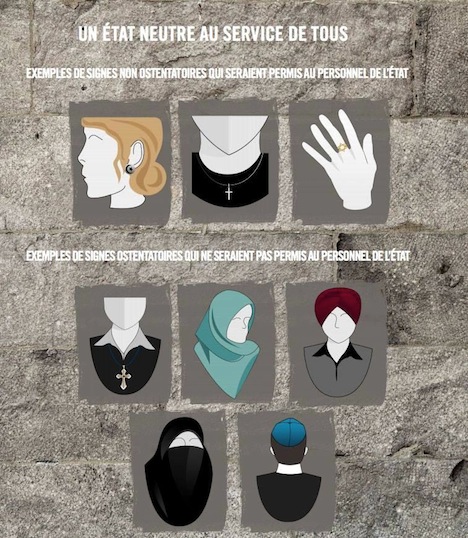
One year into the minority government of Québec premier Pauline Marois, the province is again at the center of controversy with a new attempt to legislate a ‘charter of Québec values’ that’s drawing ire from the rest of Canada. Quebec Flag IconpngCanada Flag Icon

That chart above isn’t a joke — it was released yesterday by Québec’s government, and it purports to demonstrate examples of ‘non-ostentatious’ signs that state employees are permitted to wear.

You’ll note that two-thirds of ‘approved’ examples are Judeo-Christian religions and three-fifths of the ‘banned’ examples are not.  The ‘secular charter’ (la charte de la laïcité) would ban public sector workers from wearing kippas, turbans, burkas, hijabs or ‘large’ crucifixes.  Remember that in Québec, the public sector is quite expansive, so the charter would capture not only folks like teachers, police and civil servants, but employees in Québec’s universities and health care sector as well.

For good measure, the proposed charter would also tweak Québec’s Charter of Human Rights and Freedoms to limit religious exemptions, though it wouldn’t eliminate subsidies to religious private schools in Québec that are largely Catholic and largely funded by the state and it wouldn’t eliminate property tax exemptions for churches and other religious buildings.

In short, the charter looks less like a secular bill of rights than a sop to French Canadians to perpetuate preferred legal and cultural benefits at the expense of other ethnic and religious groups — tellingly, the crucifix hanging in Québec’s provincial assembly would be exempt from the law.  A charter that, at face value, purports to secularize Québec’s society, would actually enshrine the dominant Catholic French Canadian culture and exclude Canada’s growing global immigrant population from many of the religious freedoms typically associated with a liberal democracy.  If passed into law, it would conflict with the religious freedom guaranteed in Canada’s Charter of Rights and Freedoms (essentially, Canada’s bill of rights) — Québec did not sign the federal Charter, nor did it approve of the 1982 constitutional settlement, but remains subject to the federal Charter.  That means the ‘secular charter’ could once again put Québec on a collision course with the rest of Canada.

It’s also the latest salvo in a series of only-in-Québec culture-war misfires that have plagued the Marois government since it took power last year, and it goes a long way to explaining why Marois and the sovereignist Parti québécois (PQ) are in danger of losing the next election.

Over the past year, it would have been enough for Marois to declare victory on the issue of student fees and largely pacifying student protests, to declare that her government would largely continue Charest’s Plan Nord, a push to develop Québec’s far north in pursuit of resources over the coming decades, and to focus on bringing investment and jobs to Québec.  Marois’s government has also pushed to end support for Québec’s notorious asbestos industry, winning plaudits from environmentalists.

But if you want to know why Marois’s minority government isn’t in a more commanding position, it’s because it has pursued language and culture legislation as a time when Québec, which wasn’t exactly Canada’s most growth-oriented province to begin with (its per-capita GDP of around CAD$43,400 is CAD$5,500 less than neighboring Ontario’s and a staggering CAD$35,000 less than resource-rich Alberta), is falling behind the rest of Canada.

Between August 2012 and August 2013, Canada’s unemployment rate has dropped from 7.8% to 7.6%, but in Québec, the unemployment rate rose from 7.8% to 8.1%.

Instead, her government has plunged Québec back into the language wars, drawing ridiculous global headlines — a great example is the crackdown of the Office québécois de la langue française against a Montréal Italian restaurant’s use of the word ‘pasta’ and other Italian words on its menu and demanding the restaurant print their French equivalents more prominently. (Though we all know that apéritif or hors-d’œuvre is not the same thing as antipasto are not the same thing).

It comes after the Marois government has largely given up its year-long fight to pass Bill 14, which would amend Québec’s La charte de la langue française (Charter of the French Language, also known as ‘Bill 101’) by allowing the government to revoke a provincial municipality’s bilingual status if the anglophone population falls below 50%, requiring small businesses (of between 26 and 49 people) to use French as their everyday workplace language, and mandating that all businesses that serve the public use French with customers.

Marois switched gears from the language charter to a new religious charter when it became clear that her minority government would have a hard time pushing Bill 14 through, but also because a ban on religious symbols is relatively popular among the Québécois electorate.  Continue reading The problem with Pauline Marois’s sovereignist minority government in Québec

How the British Columbia Liberals managed to pull off such a stunning upset victory over the NDP

christyclark

The incumbent British Columbia Liberal Party, under the leadership of premier Christy Clark in her first provincial-wide election, has held on to power for a fourth consecutive government, despite the fact that the British Columbia New Democratic Party was heavily favored throughout the campaign to win the election.BC flagCanada Flag Icon

This was definitely a surprise, given that the BC NDP was leading by nearly 20 points two months ago, and even though polls showed a narrowing race in Canada’s third-largest province, forecasters still believed the BC NDP a heavy favorite just a day ago that showed a narrowing race in Canada’s third-largest province.  No poll showed the BC Liberals leading this race, though polls showed Clark narrowing the gap against BC NDP opposition leader Adrian Dix.

As of around 1:15 am EST on Wednesday morning, the BC Liberals have been elected to 45 seats and were leading in 51 seats, while the BC NDP had been elected to 27 seats and leading in just 32.  Andrew Weaver was set to become the province’s first Green Party legislator, with one independent rounding out the membership of the 85-seat provincial assembly.  Given that the BC Liberals held 45 seats going into the election and the BC NDP held 36 seats, the BC NDP may well have lost seats on Tuesday.

In particular, former Vancouver mayor from 2005 to 2008, Sam Sullivan, was handily elected to a seat in the Vancouver-False Creek riding for the BC Liberals.  Clark was leading, just slightly, in her own constituency in Vancouver Point Grey against a strong challenge from the BC NDP’s David Eby (NB: if Clark doesn’t win, it’s expected that a colleague will step down to allow Clark to win a speedy by-election).

It’s, of course, really bad news for Dix, whose leadership should almost certainly come to an end with Tuesday’s disastrous result.  It’s really bad news for Thomas Mulcair, the opposition leader of Canada and federal NDP leader, who had embraced Dix and the provincial NDP in a way that federal Liberals had not embraced Clark and the BC Liberals.

It’s the second upset in as many years in western Canada — in Alberta in April 2012, nearly every pollster showed that another longtime incumbent party was set to lose power.  But Alison Redford, the beleaguered incumbent premier, led her Progressive Conservative Party to victory against a challenge from Wildrose, a new party that had run both to the social and fiscal right of Redford.

So how did the BC Liberals do it?  Here are four reasons that explain what happened Tuesday in British Columbia. Continue reading How the British Columbia Liberals managed to pull off such a stunning upset victory over the NDP

Despite Trudeaumania, Joyce Murray personifies the future of Canada’s center-left

joycemurray

It’s a safe prediction that Joyce Murray will not be the next leader of the Liberal Party.Canada Flag Icon

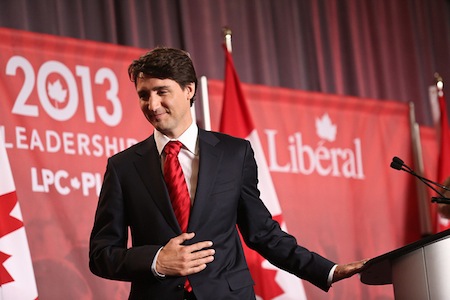
When the Liberal Party’s membership finishes voting and the winner is announced this Sunday, the winner is certainly going to be Justin Trudeau — and likely by a landslide margin.  His anticipated election is already pushing the Grits ahead in polls, and not only against the official opposition, the New Democratic Party under Thomas Mulcair, but into contention for first place against the Conservatives under Stephen Harper.

It seems equally likely that the Liberals will get an even larger boost in the polls in the ‘Trudeau honeymoon,’ as the presumptive Liberal leader ascends to lead a party that governed Canada during 69 years of the 20th century — and which has seen its share of the vote fall in each of the past five elections.

Murray, who served as minister of water, land and air protection in the Liberal government of British Columbia premier Gordon Campbell in the early 2000s, lost her provincial seat in 2005 and reemerged as a Liberal MP from Vancouver in the House of Commons in the 2008 election.  Since the withdrawal of MP Marc Garneau from the leadership race, however, Murray has been locked in a battle for second place with former Ontario MP Martha Hall Findlay.

The late momentum, however, lies with Murray, whose main campaign strategy has been a unite-the-left platform aimed at pulling together the Liberals, the New Democrats and the Greens together in an alliance for the next general election.  Murray certainly has raised more money than any of the non-Trudeau hopefuls.

The fundamental fact of Canadian politics is that the broad left — from the most moderate business-friendly Liberals to the most ardently progressive New Democrats — remains split between two credible alternatives to the Conservatives.  In many ways, it parallels the split between the old-guard Progressive Conservative Party and the upstart Reform Party / Canadian Alliance in the 1990s and early 2000s, which allowed Liberal prime ministers Jean Chrétien and Paul Martin to govern without much of an opposition from 1993 to 2004.

In the same way, the logic that propelled the conservative merger in 2003 augurs for a similar center-left alliance in 2013.

And the logic is tantalizing — in a country where MPs are determined in 308 first-past-the-post single member ridings, the Tories won a majority government in 2011 with less than 40% of the vote.  A recent Léger poll shows the Conservatives with 31%, the Liberals ascending to 30%, the NDP with 24% and the Greens with 7%.  Taken together, Murray’s dream coalition would trounce the Tories on a vote of 61% to 31%.

The problem is that unlike the PCs, which never won more than 15 seats in the House of Commons after their decimation following the 1980s governments of Brian Mulroney, and unlike Reform/Alliance, which never managed to extend its reach beyond western Canada, both the NDP and the Trudeau-era Liberals are national parties with long, proud histories in Canada that stretch back far into the prior century.

Trudeau himself has argued to the incompatibility of the Liberal and NDP traditions:

But this debate is less about electoral calculations than about Trudeau’s assessment of congenital incompatibilities on the left of the Canadian political spectrum. In an interview last year with Maclean’s, he contrasted the unification of the right, as accomplished by Harper in 2003, and the notion of symmetrical coming together of Canadian progressives.

“The right didn’t unite so much as reunite,” Trudeau said. “I mean, Reform was very much a western movement breaking away from Brian Mulroney. But they broke away, then they came back together. The NDP and the Liberals come from very, very, very different traditions.”

But that overstates the case — keep in mind that the most successful leader the Liberals have had in the past decade, the current interim leader Bob Rae, is the former NDP premier of Ontario.  Mulcair, the current NDP leader, was a member of the Québec Liberal Party during his career in provincial politics.  Though it’s important to keep in mind that provincial parties aren’t affiliated with national parties, it’s fair to say that there’s a significant amount of cross-pollination between the two traditions.

Even beyond her controversial support for a broad center-left alliance, however, the center of gravity in Canada is moving in two directions — both westward in the geographic sense and toward a more globalized, diverse, immigrant-rich Canada in a demographic sense — and British Columbia (and Vancouver) is obviously at the heart of both of those trends.  Continue reading Despite Trudeaumania, Joyce Murray personifies the future of Canada’s center-left

Trudeau now all but certain to become Liberal leader in Canada

trudeaudebate

While everyone was watching to the Vatican City on Wednesday, another potential world leader took a step toward his own elevation — Justin Trudeau, whose chief rival for the Liberal Party leadership in Canada dropped out and endorsed him in advance of what’s now likely to be a mere formality on April 14. Canada Flag Icon

Like the new Pope Francis, Trudeau will assume control of a once-powerful organization that has had difficulty finding its purpose in a vastly changing world — the world of 21st century Canadian governance.  He’ll do so having risen to the leadership as the son of a beloved former prime minister on a campaign that’s little more substantive than rewarmed platitudes of what’s been orthodox Liberal policy of the past two decades and his airy good looks.

Right now, Canadians love him, though — they say that they would overwhelmingly support the Trudeau-led Liberals in the next election.  Today, however, with his election as leader all but certain, the Liberals remain mired in third place behind the Conservative Party and the New Democratic Party.  So it’s worth taking caution in reading polls that seem to show a Trudeau landslide in the next election — those polls suggest to me the upper limit of what Trudeau might achieve in a best-case scenario in 2015, when the next federal election is likely to be held.

As the leadership race approaches, though, the central question of Canadian politics has now become whether, on the one hand, Trudeau’s rock-star quality and popularity will wear thin after his coronation (dooming the Liberals to what must certainly be oblivion) or, on the other hand, Trudeau will rise to the occasion by navigating the top echelons of federal politics sufficient to bring the Liberals back into power by following in the footsteps of his father.

The future of Canadian politics — and Canadian policy in the next decade — rests on the answer to that question.

His chief rival Marc Garneau exited the race on Wednesday after releasing a survey that showed he would win just 15% of Liberal voter support to 72% for Trudeau, who he also endorsed.

As the first Canadian in outer space, Garneau is somewhat the John Glenn of Canada — he served as the president of the Canadian Space Agency from 2001 to 2006, and then moved into electoral politics, winning a seat in the 2008 election in the Québécois riding of Westmount in the Montréal area.  He’s thoughtful, articulate, and he hasn’t been unwilling to take on Trudeau — taking advantage of several debates to challenge Trudeau directly for running a campaign of ’empty words’ as an untested rookie.

Garneau, ironically, would have been a better candidate than any of the past three Liberal Party leaders — former prime minister Paul Martin, who lost the 2006 federal election to Stephen Harper’s ascendant Conservative Party; former environment minister Stéphane Dion, who won just 26% in the 2008 federal election; and former author and academic Michael Ignatieff, who won just 19% and 34 seats in the 2011 federal election, well behind the more progressive NDP that’s now Canada’s official opposition. He may well have even been a better Liberal leader than Bob Rae, who ruled out a run himself last year, despite receiving high marks for his performance as interim leader.

If Trudeau becomes prime minister in 2015, Garneau will obviously be at the top of the list to fill an important ministry.

But Trudeau fils has always been the frontrunner in the race, and it was never likely that anyone would be able to dislodge what the Liberals believe is their last shot at returning to electoral viability.  Sure, six additional candidate remain in the race — including former justice minister Martin Cauchon, former leadership contender Martha Hall Findlay and British Columbia MP Joyce Murray, who has called for center-left unity with both the NDP and Canada’s Green Party.

Nonetheless, it seems ever more likely that Trudeau will now overwhelmingly win the Liberal leadership and, sure, he probably seems like the best chance that Liberals have to retake power, even if they would need to quintuple their current 35 seats in the House of Ridings in order to win a majority.  We still don’t know if Trudeau’s breezy success in politics to date will continue after he wins the Liberal leadership, though even former prime minister Jean Chrétien, the last Liberal to have widespread electoral success, agrees that the race — and, implicitly, Trudeau’s energetic campaign — has boosted Liberal fortunes.

Either way, the Liberal Party in 2013 is a far cry from the Liberal Party that governed Canada for 69 years in the 20th century — a party dominated by elites from Montréal, Toronto and Ottawa — and personified by Trudeau’s father, Pierre Trudeau, prime minister in the 1970s and 1980s.  Continue reading Trudeau now all but certain to become Liberal leader in Canada

13 in ’13: Thirteen up-and-coming world politicians to watch in 2013

2013red

Earlier today, Suffragio kicked off its 2013 coverage of world politics with a look at 13 key elections to watch in 2013.

While we’ll watch as new leaders, from Egyptian president Mohammed Morsi to French president François Hollande to South Korean president Park Geun-hye begin their first full years of power, we’ll also watch for comebacks by former presidents — former Brazilian president Luiz Inácio Lula da Silva will make a decision about running for a third term in the 2014 Brazilian presidential election and former Chilean president Michelle Bachelet is the odds-on frontrunner to win a new term in Chile’s December 2013 election.

In addition, however, here are 13 up-and-coming politicians and other public figures who will figure prominently in the next 12 months — either because they are likely to come to power themselves in 2013 or because this year will will likely be a make-or-break year for them to achieve power beyond 2013. Continue reading 13 in ’13: Thirteen up-and-coming world politicians to watch in 2013

Trudeau will seek leadership of Canada’s Liberal Party

For better or worse, Justin Trudeau is expected to announce next Tuesday that he will seek the leadership of the beleaguered Liberal Party in Canada.

Trudeau, the son of beloved former prime minister Pierre Trudeau, is the last, perhaps best, hope of an endangered party.  As John Ibbitson noted in The Globe and Mail yesterday, Trudeau’s assets make him an almost prohibitive favorite.

At age 40, however, the Montréal-area MP has been a member of the House of Commons since just 2008, and he will face doubts that he’s seasoned enough to become prime minister.

If he wins the leadership, he’ll first face the task of winning back supporters from the New Democratic Party, who made such incredible inroads in the 2011 election under the late Jack Layton that they far eclipsed the Liberals to become the Official Opposition and the main alternative to prime minister Stephen Harper’s Conservative Party.

Currently, polls show the NDP, under new leader Thomas Mulcair, within striking distance of the Tories and Liberals trailing in distant third place.  But a National Post poll today shows that the Trudeau-led Liberals would win 39% to just 32% for Harper and 20% for the NDP.  Those numbers, I believe, represent a best-case scenario for Trudeau — when he really represents nothing more than nostalgia for his father and before he’s had to contend through a long leadership fight and go head-to-head against not only Harper, but Mulcair as well.  Trudeau will have to sideline the NDP (or otherwise engineer a merger or alliance with the NDP) and then win not only a sizeable number of ridings in Quebéc, but also in Ontario and elsewhere in Canada.

There will be much more to say in the months leading up to the leadership race — it doesn’t start until November 14 and it won’t end until April 14, 2013.  Since the 2011 election that saw the Liberals reduced to just 34 seats, former (NDP) Ontario premier Bob Rae has served as interim leader.

There will a lot of rebuilding for whomever wins the leadership — and since Rae himself ruled out running for the leadership in a permanent capacity earlier in June, it’s seemed like the leadership is Trudeau’s for the taking, despite a number of candidates also expected to run — the most serious potential challengers to Trudeau include Dominic LeBlanc, a New Brunswick MP since 2000 and currently the party’s foreign affairs critic and, perhaps more intriguingly, Marc Garneau, a retired astronaut and former president of the Canadian Space Agency from 2001 to 2006, who has served as an MP since 2008, also from Montréal, and is the current Liberal House Leader.  Each candidate will pay a $75,000 entry fee — it’s thought the steep price will limit the number of contenders to just serious challengers, and campaign spending will be capped at $950,000.

It’s difficult to fathom just how far the Liberals have fallen in just little over a decade.

Continue reading Trudeau will seek leadership of Canada’s Liberal Party