Tag Archives: crimea

Ukraine (Crimea and Sevastopol) fact of the day

Ukraine's new PM Tymoshenko greets opposition leader and former PM Yanukovich before meeting in Kiev

If you re-run the results of the 2010 presidential election without Crimea and Sevastopol, you reduce the margin of the winning candidate, Viktor Yanukovych, against his opponent, Yulia Tymoshenko (pictured above with Yanukovych), by about half.Ukraine Flag Icon

The final result of the runoff election?

Yanukovych: 48.95%
Tymoshenko: 45.47%
Against all: 4.36%

Now look what happens when you simply remove the votes from Crimea and Sevastopol, where Yanukovych racked up some of his largest margins against Tymoshenko:

Yanukovych: 47.03%
Tymoshenko: 45.11%
Against all / Crimea / Sevastopol: 7.86%

It doesn’t mean that, without his support in Crimea and Sevastopol, Yanukovych would have lost the 2010 presidential race, which everyone at the time considered a relatively free and fair vote.  But it would have made a clear win much messier, perhaps giving Tymoshenko a case to rally against potential election fraud.

That’s something to keep in mind for the future of Ukrainian politics if, as expected, Crimeans vote on March 16 in favor of annexation by Russia (in what will almost certainly not be a free and fair vote).

It probably will have little effect on the scheduled May 25 presidential election, which will almost certainly be won by either Petro Poroshenko, a businessman who supported the anti-Yanukovych protests, or by Vitaliy Klychko, the heavyweight boxing champion and opposition political leader.  But as the old east-west tensions that have become the hallmark of Ukrainian politics reemerge (as they invariably will) for, say, the 2019 presidential election, it will be that much more difficult in a Crimea-less Ukraine for an eastern leader, sympathetic to Russia, to win the Ukrainian presidency in the future.

It’s also worth noting that in the 2012 parliamentary elections, Yanukovych’s eastern, pro-Russian Party of Regions (Партія регіонів) won 11 of 12 single-member districts within Crimea and Sevastopol. (The 12th went to Union, a local pro-Russian party).  In the 2012 elections, Yanukovych changed electoral law to provide that 225 of the 450 seats in Ukraine’s parliament, the Verkhovna Rada, would be determined on a first-past-the-post basis in single-member districts — the idea being that the Party of Regions would win more seats by splitting the opposition, a strategy that largely succeeded for Yanukovych in 2012.  Under the previous 2004 constitution, which has now been reinstated by Ukraine’s parliament in the wake of Yanukovych’s ouster, all 450 seats are determined on the basis of proportional representation through national party vote.
Brussels trumps Washington and Moscow over Ukrainian crisis

eastboundanddown

Not with a whimper, not with a bang, but with $15 billion in financing. European_UnionUkraine Flag Icon

This is how the acute phase of Ukraine’s political crisis ends — it’s all about bringing the struggling country back on its feet in economic terms, not a  geopolitical fantasy in the minds of Cold Warriors in Washington and Moscow.

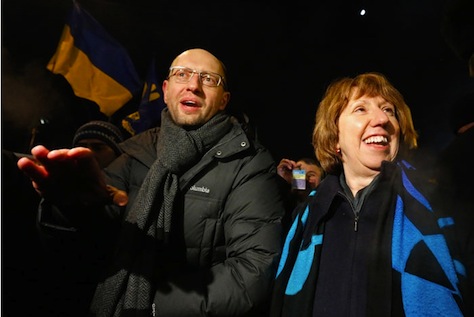
With the European Union’s decision earlier today to deploy €11 billion ($15 billion) in aid, Ukraine’s treasury will now pull back from the brink of sovereign default — a catastrophe that would, ironically, have harmed Russian banks far greater than European banks (Russian investors have a cumulative exposure of nearly $30 billion to Ukrainian debt).  That assistance was almost guaranteed from the moment former Ukrainian president Viktor Yanukovych fled from office after his government unleashed lethal fire on anti-government protesters that had gathered for four months at Maidan Square in central Kiev.  Interim president Olexandr Turchinov and interim prime minister Arseniy Yatsenyuk (pictured above with Catherine Ashton, the EU high representative for foreign affairs) are firmly committed to economic reform and Ukraine’s turn toward Europe.

Accordingly, it’s the European Union — and not the United States and not Russia — that looks both most sensible and most productive in the aftermath of last week’s showdown. 

Throughout the entire Ukrainian crisis, American and Russian policymakers have routinely disregard the role of the European Union, including some very undiplomatic language from a top State Department official a month ago.

But stabilizing Europe’s expanding periphery is what the European Union does best — and why it won the Nobel Peace Prize in 2012.  The earliest iteration of the European Union sutured the wounds among Italy, France and Germany in the 1950s, midwifing the economic expansion of the 1960s.  It brought the United Kingdom more closely into  Europe in the 1970s, and catalyzed economic reform that transformed Ireland into a high-income country.  It smoothed the transitions of Spain, Portugal and Greece from dictatorship to democracy in the 1980s, and its embrace of the former Warsaw Pact states in 2004 anchors economic and political growth from Prague to Tallinn to Warsaw.  EU policymakers today are effectively dangling the carrot of EU membership to Serbia in order to bring enduring peace to the Balkans.

Jean Monnet would be overjoyed today to see the European role in ending Ukraine’s crisis, and the promise of extending peace and prosperity more widely beyond the boundaries of Europe’s core. Continue reading Brussels trumps Washington and Moscow over Ukrainian crisis

Let Russia take Crimea — the focus should be on Ukraine’s economy

ukrainetank

Why is US president Barack Obama using so much bluster to warn Russian president Vladimir Putin against what appears to be a likely military action in Crimea?Russia Flag IconcrimeaUkraine Flag Icon

If your answer to the question involves broad references to ‘appeasement,’ the 1930s, American exceptionalism or to NATO, you should probably re-examine the premises of that answer.  In the debate over Ukraine — and now, Crimea — empty talk by US commentators about the vital US interests in Ukraine could do more harm than good.  If you’re using ‘national interest’ according to the standard, IR theory definition, it draws from the realist concept that a country acts in international affairs in accordance with its self-interest.

But what is the US interest in whether Crimea is administered from Russian or Ukrainian authority?  Ukraine itself lies an ocean and a continent away from the United States.  It’s on the periphery of the European Union, and though it may one day be an EU member-state, Russian interference in Ukraine barely ranks among European security threats, though EU leaders should for obvious reasons be much more engaged on developments in Ukraine than US policymakers.  European policymakers have a strong stake in Ukraine’s future success.

To argue that the United States has a vital interest in Crimea is to argue that Russia has a vital interest in Puerto Rico.

While there’s a role for the United States to respond to Russian aggression, it’s certainly no reason to start calling for a new Cold War or to start arguing that Obama is somehow powerless to rein in Putin.  It’s not a matter of whether US warships, for example, could halt Russian advances in Crimea, it’s a matter of whether it’s worth spending US dollars and risking US lives to do so.

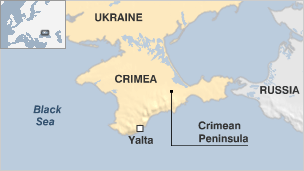
Crimea isn’t your everyday oblast.  It has always been a ‘special’ region straddling Russia and Ukraine with a unique history tied to both countries.  When Ukraine became an independent country in 1991, Crimea decided to proclaim itself an independent republic in 1992.  It ultimately chose to remain part of Ukraine as an ‘autonomous republic,’ with its own constitution and regional parliament, and it’s the only region of Ukraine where ethnic Russians constitute a majority of the local population, around 58% of Crimea’s total 2 million residents.  Last week’s anti-Kiev, pro-Moscow demonstrations weren’t the first time Crimeans have clashed with Ukraine’s central government, though. Continue reading Let Russia take Crimea — the focus should be on Ukraine’s economy

What comes next for Ukraine following Yanukovych’s ouster?

maidan

There’s apparently a limit on what Ukraine’s president can get away with.Ukraine Flag Icon

He could preside over massive amounts of corruption, he could jail his chief political opponent on ridiculously politicized charges, he could swerve disastrously between a pro-Russian worldview and a pro-European worldview, and he could even brazenly change Ukraine’s election law to win more seats.

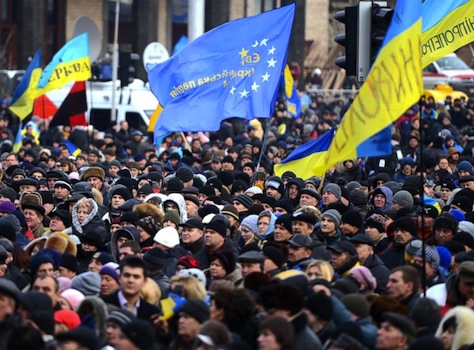
But when the government of Ukrainian president Viktor Yanukovych became responsible for the deaths of 88 protesters last week, even members within his own Party of Regions (Партія регіонів) were defecting from Yanukovych.  Arguably, until his police force unleashed lethal fire on hundreds of civilians, Yanukovych could point to a relatively legitimate electoral mandate in the previous 2010 presidential election (and, though it was flawed, the 2012 parliamentary elections).

interim

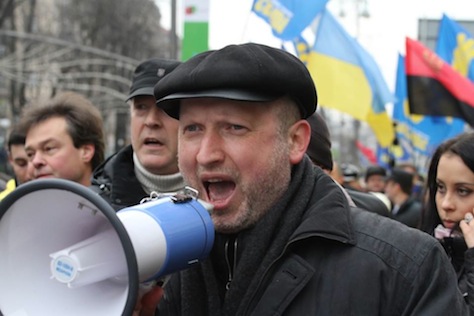
Since Friday, when the European Union seemed to broker a deal between Yanukovych and Ukraine’s opposition leaders, events galloped at a dramatically rapid rate (though apparently not too fast for Ukraine’s leading oligarchs, Rinat Akhmetov and Dmitry Firtash), leaving Yanukovych in hiding in eastern Ukraine, under charges of mass murder.  The country’s parliament, the Verkhovna Rada, voted in quick succession to elect speaker Oleksander Turchinov (pictured above), an opposition, pro-European politician, as interim president.

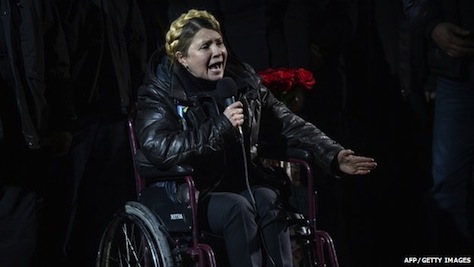
It also elected to restore the 2004 constitution, which restores more power to Ukraine’s parliament and away from its president, and set a tentative May 25 date for new presidential elections.  The parliament also cleared the path to free Yulia Tymoshenko, a former prime minister and a leader of the center-right ‘All Ukrainian Union — Fatherland’ party (Всеукраїнське об’єднання “Батьківщина), who narrowly lost the 2010 presidential vote to Yanukovych.  Tymoshenko (pictured below) was jailed in late 2011 by Yanukovych’s government on charges related to her handling of the natural gas crisis in 2009 during her premiership.  That precedent, ironically, may be one of the reasons that Yanukovych remained so keen on holding onto power in Kiev — having established that he was willing to throw Tymoshenko in prison on politically motivated grounds, it’s Yanukovych who now faces imprisonment on the basis of far more serious charges.  Tymoshenko, who has ruled out leading Ukraine’s soon-to-be-announced interim government, will nonetheless be a leading candidate in the upcoming presidential ballot.  Though she’s been imprisoned throughout the current crisis, she’s also unsullied by having negotiated with Yanukovych, a group that includes another opposition favorite, heavyweight boxing champion Vitaliy Klychko.

tymoshenko

Russia, who had delivered $3 billion of a promised $15 billion bailout, is obviously dismayed.  Though Yanukovych was never quite the Russian puppet that some Western leaders believed him to be, it’s clear that his sympathies lied to the east more than to the west.

So what comes next for Ukraine?  Past experience demonstrates that the story won’t end with ‘happily ever after’ upon the appointment of this week’s new interim government.  As I wrote last December, the Maidan protests — even if they succeed — won’t by themselves end Ukraine’s political crisis.  Just a year after the ‘Orange Revolution’ of December 2004 and January 2005 that brought Viktor Yushchenko power, the pro-European government crumbled into infighting that lasted until Yushchenko left power, massively unpopular, in 2010.  Yanukovych took advantage of the ongoing disunity of the Ukrainian opposition in October 2012’s parliamentary elections, winning largely by dividing the supporters of Tymoshenko’s Fatherland and Klychko’s newly formed Ukrainian Democratic Alliance for Reform (Український демократичний альянс за реформи).

crimea

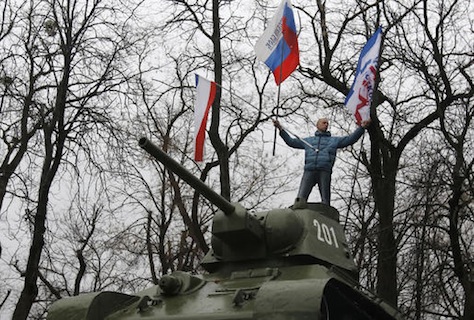
Almost on schedule, this morning brings news of serious counter-protests in Crimea, the peninsula that lies in the Black Sea on the southeastern coast, one of the 24 oblasts that comprise Ukraine.   Continue reading What comes next for Ukraine following Yanukovych’s ouster?