Category Archives: France

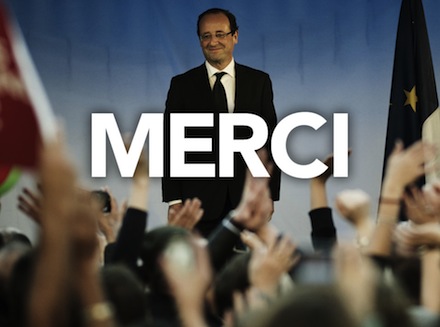
Monsieur President: Hollande era begins in France

France24 this morning has a concise biography — complete with photos — of the man of the hour, France’s newly elected president François Hollande:

[Hollande’s] political rise to the country’s top post has been slow and steady, with the French media portraying him as “Monsieur Normal” – an easygoing, everyday man. Contrast that with the glamour-struck Nicolas Sarkozy, who earned the nickname “hyper-president” during his five years in office.

If Hollande’s victory has a fabled quality, it surely mirrors Aesop’s “The Hare and The Tortoise”, with the steady, shelled creature finally outpacing the hyperactive hare.

International audiences are probably more familiar with his former partner, Ségolène Royal, who unsuccessfully ran against Sarkozy in the 2007 presidential poll. For those who knew him during the 2012 campaign trail – and that includes his comrades on the left – Hollande was the butt of snide, if good-natured, monikers, including “Flanby” (a wobbly custard) and “capitaine du pedalo,’ or the captain of a pedal boat.

But in the course of his bid for presidency, Hollande emerged as a statesman-like figure, a change that included an image makeover, complete with a 10 kilo weight loss and designer glasses. Continue reading Monsieur President: Hollande era begins in France

Could François Fillon have won Sunday’s French presidential election?

When I look at the final tally of votes in Sunday’s French presidential election — François Hollande took nearly 52% of the vote against incumbent Nicolas Sarkozy’s 48% — I cannot help but note that the margin is actually lower than in 2007, when Sarkozy beat Ségolène Royal with 53% of the vote.

It’s quite stunning — an election that was supposed to be a landslide for Hollande, in which every poll showed him beating Sarkozy by anywhere from five points to double digits, turned out to be closer than the Sarkozy-Royal race.

So when I look at that — and when you look at exit poll data showing that many Hollande voters were motivated not by Hollande, but rather by the desire to give Sarkozy the boot, I really wonder what would have happened if Sarkozy had stepped down from the presidency in favor of his longtime prime minister François Fillon. Continue reading Could François Fillon have won Sunday’s French presidential election?

Three elections — and three defeats — for EU-wide austerity

The concept of a ‘democratic deficit’ has long plagued the European Union — the EU’s history is littered with grand, transformative schemes planned by EU leaders that voters have ultimately rejected as too sweeping.  As recently as 2005, French and Dutch voters rejected the proposed EU constitution, smacking the EU elite for getting out too far in front of an electorate that clearly did not approve.

Sure enough, the story of the last three days — in the UK, in France and in Greece — will go down in EU history as a similar pivot point against German chancellor Angela Merkel’s attempt to impose strict fiscal discipline across the continent, even as additional electoral hiccups await in the North-Rhine Westphalia state elections later this week, the Irish referendum on the fiscal compact later this month and French and Dutch parliamentary elections due later this summer.

French president-elect François Hollande will now immediately become the face of the EU-wide opposition to austerity and is expected to challenge Merkel with a view that advocates more aggressive spending in a bid to balance fiscal responsibility with the promotion of economic growth — a distinct change in Franco-German relations after the ‘Merkozy’ years.  In his victory speech, Hollande called for a ‘fresh start for Europe’ and laid down his gauntlet: ‘austerity need not be Europe’s fate.’

It is an incredible turnaround from December, when Merkel and deposed French president Nicolas Sarkozy single-handedly pushed through the fiscal compact adopted by each of the EU member states (minus the UK and the Czech Republic), which would bind each member state to a budget deficit of no more than just 0.5% of GDP.  The treaty followed in the wake of the latest eurozone financial crisis last November, during which both the governments of Silvio Berlusconi in Italy and Georgios Papandreou in Greece fell, to be replaced by Berlin-approved technocratic governments, each tasked with the express purpose of making reforms to cut their governments’ respective budgets.

Continue reading Three elections — and three defeats — for EU-wide austerity

Hollande wins French presidential election

François Hollande has been elected the president of France — the first such victory for a Parti socialiste candidate — or any center-left candidate in France — since François Mitterand’s reelection in 1988. 

Exit polls show that Hollande has defeated incumbent Nicolas Sarkozy with a vote of 52% to Sarkozy’s 48%.  If true, it would indicate that the race was quite tighter than nearly all prior polls had shown in the preceding months, which had shown a steady second-round lead of between five and 10 points for Hollande.  Indeed, it would be a tighter margin than Sarkozy’s own five-point victory over Parti socialiste candidate Ségolène Royal in 2007.

Of course, with parliamentary elections due in June, and with the future of the eurozone still in some doubt, Hollande’s victory was never the key question — those will be just be starting to be asked and the answers will only begin to clarify over the months ahead.

Follow Suffragio’s prior coverage of the French presidential election here.

Hollande and Sarkozy move beyond debate: motion without movement

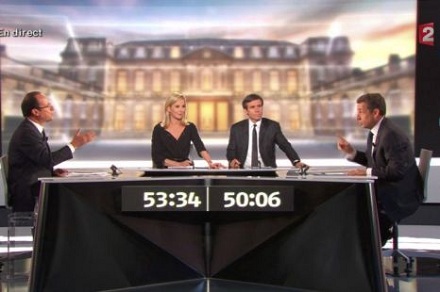
French presidential finalists — incumbent Nicolas Sarkozy and Parti socialiste candidate François Hollande — faced off Wednesday night in what commentators are calling the most animated debate in the history of French presidential debates.

In short, Sarkozy jumped into the arena as attack dog on any number of issues — defending his record on the economy in France and in the eurozone, and going on the offensive on any number of cultural issues, such as immigration.  Hollande, in turn, gave as good as he took from Sarkozy, showing that he could rebut the president’s jabs persuasively, forcefully and calmly.

For me, the debate is crystallized by a snarky exchange over Dominique Strauss-Kahn, the former IMF managing director and Party socialiste heavyweight who, until he was charged with raping a housekeeper in New York last year, was the favorite to win the Socialist nomination and the French presidency:

“I won’t accept lessons from a political party that was enthusiastically uniting behind Dominique Strauss-Kahn,”Sarkozy said in a hard-fought debate four days before France’s election.

“I was sure you were going to bring that up,” Hollande retorted. “You put him at the head of the IMF.”

In any event, the result is a presidential race with a dynamic fairly unchanged from the pre-debate dynamic, with Hollande leading by anywhere from six to nine points in advance of Sunday’s second-round vote.  If anything, Hollande gained a little ground — by pushing back at Sarkozy, he showed he is not quite the squish everyone assumes him to be.

Ultimately, I can’t help thinking that the debate is a metaphor for the second round so far: a lot of motion, but not a lot of movement. Continue reading Hollande and Sarkozy move beyond debate: motion without movement

French first-round presidential election results


The first round of France’s presidential election is now over, and the two leaders, incumbent Nicolas Sarkozy and Parti socialiste candidate François Hollande are both running hard for the runoff election on May 6 — just nine days away.

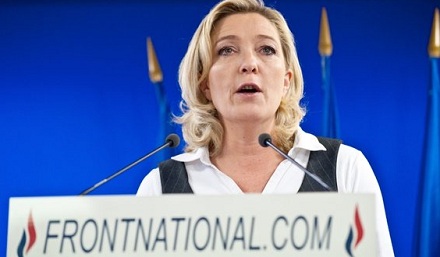
The big story out of Sunday’s vote — the strong third-place finish of Front national candidate Marine Le Pen — has  shaped coverage of the race, even as Le Pen has fallen out of the race: both Sarkozy and Hollande are pursuing Front national voters.

Hollande won the first round with 28.63% of the vote to just 27.18% for Sarkozy.  Le Pen won a higher-than-expected 17.90% and Front de gauche candidate Jean-Luc Mélenchon won a lower-than-expected 11.10%.  Centrist Mouvement démocrate candidate François Bayrou finished in 5th place with 9.13%.

So where is this race headed for the second round?

In the history of the Fifth Republic, no incumbent president has lost the first round of a presidential race (although there have been three occasions when the first-round winner ultimately lost in the second round — the last time was 1995, when Jacques Chirac defeated first-round winner Lionel Jospin).

Whereas Mélenchon has already given his full support to Hollande, Le Pen has not given her support to Sarkozy — and FN voters are split among Sarkozy, Hollande and abstaining altogether.

Sarkozy and Hollande will face off in a May 2 debate.

France presidential first-round campaign comes to an end

French voters go to the polls on Sunday for the first round of the presidential election.

While the French media has been fixated on rules that would prohibit the early publishing of exit poll data on Sunday, and each candidate has been making a final push for votes, there’s not so much to analyze in advance of the vote:

We already know the top two candidates to emerge will most certainly be incumbent Nicolas Sarkozy and Parti socialiste candidate François Hollande.

Despite polls that showed Sarkozy tied with or even pulling ahead of Hollande, the trend has now moved back to a slight Hollande lead.  Either way, it seems a safe bet that each will win just under one-third of the votes.  Ultimately, every poll has shown Hollande with a significant second-round lead, so the winner of the first round will take away bragging rights and perhaps a little momentum, but if Sarkozy edges Hollande out in the first round by a small amount, don’t expect that alone to significantly scramble the dynamic.

Indeed, the first-round winner is by no means a lock to win the second round — Lionel Jospin, for example, won the first round of the 1995 election but Jacques Chirac emerged in the second round with a majority; similarly, François Mitterand lost the first round of the 1981 election (to Chirac) before winning the second round, and Valéry Giscard d’Estaing won the second round in 1974 after losing the first round.

The battle for third place looks a bit more interesting — although none of Front national candidate Marine Le Pen, Front de gauche candidate Jean-Luc Mélenchon or centrist François Bayrou will place out of the first round on Sunday, a strong showing for any of them could increase their political leverage with Sarkozy and/or Hollande in the event of a second-round endorsement (Le Pen is unlikely to support Sarkozy, although her supporters will likely support him overwhelmingly; Mélenchon has already said he will support Hollande in the second round; it is unclear who Bayrou might endorse).  Each will also be looking to June parliamentary elections as well — a strong showing in April is not dispositive of a similarly strong showing in parliamentary elections, but it’s a good indicator.  Mélenchon, too, may well be able to exchange a full-throated and enthusiastic endorsement of Hollande for soft support in the legislative election and/or potential ministry posts for his fellow communist/leftist coalition partners.

Chirac endorses Hollande?

 Reports that Jacques Chirac will support Francois Hollande in the April 22 presidential election are not compeletly surprising, given the acrimony between the former president and his successor, Nicolas Sarkozy:

Visiting the Correze administrative region where Hollande is president of the general council in June last year, Chirac himself – perhaps jokingly – that he would support the Socialist candidate.

“But he wasn’t joking,” Chirac biographer Jean-Luc Barré told BFM-TV on Tuesday referring to the former president’s comments. “I saw him ten days ago and he told me he was going to vote for Francois Hollande.”

Barré told Le Parisien that Chirac admired Hollande’s “radical socialism” and was attracted to the “social Gaulism” that he felt was strong in Hollande’s political agenda.

Chirac was always a man of survival than a man of ideology, but the concept that he would admire a Parti socialiste presidential candidate strikes for his “radical socialism” strikes me as a little suspect, given that word of his support comes third-hand.  It will be interesting to see if any other sources close to Chirac confirm the support in the next week.

But Chirac has long been less than enthusiastic about Sarkozy, who served as Chirac’s interior minister from 2005 to 2007, but who earned Chirac’s enmity — he had once been a rising star under Chirac’s patronage — when he endorsed Édouard Balladur in 1995 over Chirac in the presidential election.

Chirac, who remains a popular ex-president of France and who served as prime minister in the 1970s and 1980s before ascending to the presidency in 1995, was just last December convicted of corruption while he served as mayor of Paris in the 1980s. The conviction, which did not see Chirac serve any jail time, have not significantly harmed the ex-president’s popularity.

Marine Le Pen and the youth vote

With 10 days to go until the French election, and with presumably more pressing topics to discuss, the campaign’s narrative has turned once again to Front national candidate Marine Le Pen — and her surprisingly strong support among the youngest voters.

According to a poll published in Le Monde earlier this week, Le Pen wins 26% of the 18-to-24 vote, to just 25% for Parti socialiste candidate François Hollande, 17% for incumbent Nicolas Sarkozy and 16% for Front de gauche candidate, Jean-Luc Mélenchon.  An IFOP poll earlier this week showed her polling second among the 18-to-22 vote.

This should not be a surprise – with unemployment running high in France amid near-recession levels of GDP stagnation and in the middle of a Europe-wide sovereign debt crisis (and currency crisis), it is perhaps understandable that job anxiety among the young, for whom unemployment runs highest, is fueling her support. 

Her anti-immigration rhetoric has been sanitized to the point where her argument is essentially economic and employment protectionism, less the nastier xenophobia of her father’s Front national.  She has no particular problem with LGBT rights and she has not emphasized religion in the same way as her father.  As an outsider, she is not tied to the difficulties and compromises that come with being a player in the European arena, which also undoubtedly plays a role in her success.

These polls somewhat remind me of the exit polls in the United States that showed U.S. representative and avowed libertarian Ron Paul leading among 18-to-29 voters in the Republican primaries of 2012 — as in the United States, it is hard to know whether to strike the anomaly to youthful rebellion or some deeper ideological turn among the right’s youngest generation.

But by all means: give Marine credit for her success.

She’s managed to take what was once a shamefully anti-Semitic, anti-immigrant and otherwise parochial party, headed by a grumpy old toad, and bring it within the mainstream of French politics.  Marine has clearly mastered the art of 21st century political imagery in ways her father could have never fathomed.  Indeed, at this point, the Front national probably has a stronger brand in France than Sarkozy’s own party — can you even name it?*  Even in a country like France where party identification is relatively weak, the party of center-right has been rechristened about once every decade in the Fifth Republic.  Continue reading Marine Le Pen and the youth vote

‘Hollande will destroy the French economy in two days’

That blunt messaging is one of the reasons why Nicolas Sarkozy still has a shot to win reelection.

He also claimed that, if elected, Parti socialiste candidate François Hollande would turn France into another Greece.

All of this would be fabulously amazing positioning for a president whose record on balancing the budget is not stellar — public debt has gone up under his watch.  It’s more amazing when you consider that only in December, Sarkozy presided over France losing its ‘AAA’ credit rating from a major ratings agency.

Last week, Sarkozy pounced on the news that the French deficit for 2011, projected to be 5.7%, was, in fact, only 5.2% — never letting horrible be the enemy of terrible.

Even as unemployment hovers around 10%, last week’s GDP report also showed that France grew at a near-recessionary 0.2% pace in the final quarter of 2011.  Nonetheless, Sarkozy managed to turn even that into an opportunity to attack his opponent:

“The Socialists said France was in recession, as if they actually enjoyed it every time there was bad news for France,” Sarkozy told Europe 1 radio, announcing the 2011 deficit figure.

You cannot imagine Dominique Strauss-Kahn, for example, letting Sarkozy push him around like this.

Continue reading ‘Hollande will destroy the French economy in two days’

La revanche de Ségolène

The revenge of Ségolène indeed.

Ségolène Royal, the 2007 presidential candidate of the Parti socialiste, joined François Hollande, the 2012 presidential candidate of the Parti socialiste at a campaign event in Nannes Wednesday night to rally left-leaning voters in France at a time when apathy — and a fierce radical left presidential challenge from Jean-Luc Mélenchon — threatens to erode Hollande’s first-round lead in the presidential race. 

Normally, it’s not incredibly advisable for a candidate, skirting along the cusp of victory, to invite last cycle’s loser to headline one of the largest pivotal rallies of the campaign — it’s sort of like Jimmy Carter inviting George McGovern to campaign for him in the 1976 U.S. general election.

But there, of course, is something fascinating and perhaps a little cathartic in watching the two — intraparty rivals, partners for over three decades and parents of four children — unite in such a public manner.  Although their political differences aren’t nearly so wide as some in the PS, no other moment could symbolize the party’s unity in the 2012 election.

It is rumored that, should Hollande win in May and should the PS win legislative elections in June, Hollande will appoint Royal as President of the National Assembly.

Among especially those with the weakest political voices in the suburbs, Royal retains an aura of excitement that the more plodding Hollande can never match — she has been campaigning for Hollande especially hard in Marseille, for example.  While the glamour has faded from Royal, who once looked to become France’s first female president — she finished embarrassingly low in the 2011 primary for the PS presidential nomination — there’s a glint yet of the magic and excitement that her 2007 candidacy once promised.

As Le Monde notes:

Et même s’il sort gagnant, il devra lutter contre cette suspicion de ne l’avoir été que par la virulence de l’anti-sarkozysme. Pour toutes ces raisons, il a besoin de retrouver un peu de la ferveur de 2007. [And even if Hollande wins, he will struggle against the suspicion of not really having won, but rather than the result of the virulence of anti-Sarkozyism. For all these reasons, he needs to regain some of the fervor of 2007.]

On the other hand, Hollande had better hope that the appearance with Royal — who lost the second round of the 2007 race to Nicolas Sarkozy by six points — does not make French voters see him as just the next in a long line of sacrificial lambs on the left in the past two decades to have watched nearly “certain” presidential campaigns end in disaster.
Just say non

With 20 days to go, Charlotte says “non” to each of the 2012 presidential contenders.  A bit lighter, as we emerge from the Toulouse aftermath and its impact on the campaign.  H/t to The Guardian

France’s election — three weeks to go

It’s been a while since I’ve posted much about France’s upcoming presidential election, and in large part that’s because the past week has been somewhat subdued in the wake of the Toulouse shooting.

But there are three weeks left until the first round and almost five weeks left until the runoff, with a parliamentary election to follow a month thereafter.

So where is the race headed?

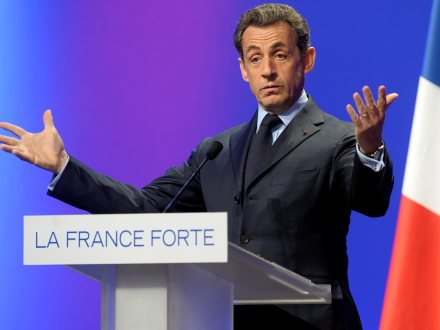
Nicolas Sarkozy has shown he is leagues ahead of his competitors in terms of raw political talent.  He can move from European statesman to right-wing demagogue and back to statesman with dexterity.  One moment, he’s the sober-minded man of the hour to stabilize Europe, the next he’s arguing to halve immigration, the next he’s assuming the mantle of counter-terroist-in-chief (never mind that he presided over an administration that knew about, and failed to apprehend, the Toulouse killer prior to his deadly shooting sprees).

The past month of the campaign has not been flawless for Sarkozy, but there’s a sense that the momentum has switched from frontrunner François Hollande to Sarkozy — if not necessarily in support, then certainly in setting the campaign’s narrative.

Hollande’s strategy — to show up as the most credible ‘non-Sarkozy’ and riding his polling lead into the Elysée — is looking ever more precarious.  His cautious approach has left a space for Jean-Luc Mélenchon, whose fiery rhetoric has galvanized France’s left.

As such, a once formidable first-round lead has been reduced to a dead heat (at best).  Certainly, Hollande still leads polls for the second round, but if you add together the share of the vote currently going to Sarkozy, François Bayrou and Marine Le Pen, it’s not difficult to foresee Hollande losing his second-round lead as well. Continue reading France’s election — three weeks to go

‘It is difficult to imagine François Hollande acting like him. That is probably unfair but that’s the way it is’

In my post last night, I argued that the Toulouse shootings could harm French president Nicolas Sarkozy because it could (i) focus attention on the inability of French security services to apprehend Mohammed Merah after numerous warnings and after he committed two shooting rampages and (ii) force Sarkozy to mute his rhetoric on immigration, leaving the stage to more extreme voices like Front national candidate Marine Le Pen to capitalize on voter anger about the shootings.

I still believe that’s true — and we’ll know in two or three weeks when the politics of the tragic shooting have more fully played out.

And yet… this sentence from a superb summary in The Financial Times rings very, very true:

“This will definitely reinforce his strengths but it will also reinforce the weakness of his counterparty,” said one close associate of the president. “It is difficult to imagine François Hollande acting like him. That is probably unfair  but that’s the way it is.”

It’s been quite clear that Sarkozy has a much wider range of political skills than Hollande, and there’s a certain advantage to being able to project a message of unity and calm as the sitting head of state.

Who ‘wins’ in the fight about the Toulouse shootings?

To say that French president Nicolas Sarkozy will try to use the Toulouse shootings to his advantage in the presidential race is fairly coals-to-Newcastle (or, if you will, coals-to-Nantes).

Although his campaign is already trying to fake the high road by accusing rivals of taking advantage of the incident for political gain, Sarkozy himself has managed to sound a message of national unity and calm, on the whole, which should be the first job of any head of state in the aftermath of a tragic event. That’s to be applauded.  

But politically, it’s a fluid situation, and while it’s already impacting the presidential race (and it was impossible for such a large event not to impact the race), it’s not clear to me that it’s a win for Sarkozy, even if the gunman does turn out to have ties — real or aspirational — to al-Qaeda.

In a world where Front national candidate Marine Le Pen will continue to deploy over-the-top rhetoric in arguing that the way to stop future shootings like those that occurred Monday is to ban French immigrants and treat Muslims with suspicion, and where Sarkozy wants to be seen to rise above petty politics by playing the statesman, Sarkozy may well have to lay off the immigration rhetoric that he’s used to such great effect in the past few weeks — thereby giving up (for now) the one tool that’s helped him claw his way back into contention for the first-round lead.

While Sarkozy may try to use the incident to paint himself as a stronger candidate on terrorism — I have no doubt that Sarkozy’s tough talk will be more convincing than Hollande’s — I’m still not so sure that will be such a clear win.

If it is true that French security forces have known about the gunman for “a long time,” and if Parti socialiste candidate François Hollande has any fiery pluck as a candidate, he should soon be asking why Sarkozy’s government let the suspect shoot three Muslim soldiers and then, days later, three Jewish schoolchildren and one parent, before going after him — and then taking the better part of a day to apprehend the gunman.