Wildrose continues to stoke prairie wildfire

A new poll out in Alberta shows Wildrose taking a 43% lead to the Progressive Conservative’s 30%, with less than three weeks to go until the provincial assembly election — a stronger result even than polls earlier this week that showed Wildrose taking a narrow lead over the PCs, who have governed Alberta since 1971. 

The poll shows Wildrose nearly even with the PCs in the capital city of Edmonton, but with nearly a 20-point lead in Calgary and nearly a 20-point lead everywhere else.  The New Democratic Party and the Liberal Party continue to battle for third place in the low teens (NDP at 12%, Grits at 11%).

Don Baird at the Calgary Herald frames the campaign in stark dynamics, contrasting the tightly controlled Wildrose campaign to the more freewheeling PC campaign, but also in their ideological roots:

Ideologically, the two parties are now so widely separated they can’t possible reunite for many years.

[Premier] Alison Redford has whittled her PCs down to their origins as traditional Peter Lougheed progressives, firm believers in the state’s power to shape  economics and behaviour.

Danielle Smith’s Wildrosers are latter-day Preston Manning Reformers, suspicious even of the governments they run themselves, but trusting of individuals.

That characterization is definitely not a good sign for the long-governing PCs in what constitutes the most conservative province in Canada — the tea-party-like Wildrose has been able to claim a mantle of the “true” conservative party with its emphasis on budget-cutting and smaller government.

The PCs are starting to respond with vigour, emphasizing Wednesday that Wildrose would endanger ‘conscience rights’ by allowing officials to refuse health care or other governmental services on the basis of personal opposition to same-sex marriages, contraception or abortion.

Baird — if you are reading just one person on Albertan politics, by the way, it should be him — agrees that the PC campaign has no choice but to launch a “bogeywoman” attack on Wildrose and on the prospect of Smith as Alberta’s premier:

The stakes aren’t just power. They’re history, too. Redford is on the brink  of becoming the last Alberta PC premier, forever filed with Kim Campbell as a female leader who suffered for the sins of men before her.

Anybody who thinks the PCs will just accept this fate is deluded. Their real campaign begins now. It will bring 20 days of bogeywoman politics aimed at [Smith].

A commie in wolf’s clothing?

It has not been the best week for newly elected Hong Kong chief executive Leung Chun-ying, who’s already garnered loud criticism for appearing too close to Beijing — and he was the “popular” candidate!

Protesters gathered earlier this week in Hong Kong after Leung visited — on just the day after his election as chief executive — Beijing’s liaison office in Hong Kong:

“Beijing blatantly interfered in our election,” said retiree Lam Sum-shing, 69, who was wearing a green army uniform and a mask with Leung’s photo. “I’m wearing this to show he will be a yes man for Beijing. He was not chosen by the seven million Hong Kong people, he was chosen by 689 pro-Beijing elitists.”

Given that Hong Kong residents fiercely guard their autonomy under the “one China, two systems” rubric whereby prior freedoms under British colonial rule — press freedom, economic liberalization, rights to assembly — are meant to continue for at least 50 years in the special administrative region, this was perhaps not Leung’s smartest move — especially given the rumors during the election campaign that Leung was a secret member of the Chinese Communist Party.

China’s leadership has promised full elections among the Hong Kong populace in the next election in 2017. Continue reading A commie in wolf’s clothing?

N’Dour, Kane headline new Senegalese cabinet

Newly elected Senegalese president Macky Sall has named his cabinet.

The headline appointment is popular singer Youssou N’Dour, who was one of the most vocal opponents of former president Abdoulaye Wade — when Sall emerged as the sole challenger to Wade in the second round of the presidential election, N’Dour and the entire spectrum of Wade opposition enthusiastically supported Sall.  N’Dour had attempted to run for president in the March vote, but was disqualified prior to the election. He will serve as minister of culture and tourism.

The cabinet contains just 25 appointees, down from the 40 in Wade’s prior cabinet.

Abdoul Mbaye — a former banker and technocrat with no party affiliation — will serve as Sall’s first prime minister.

Amadou Kane, a former banker with Senegal’s branch of BNP Paribas, previously head of the International Bank for Trade and Industry of Senegal and a former official with the West African Development Bank, will serve as finance minister.

Sall ally Alioune Badara Cissé will be the new foreign minister.

London mayoral race heats up

The Guardian has a thoughtful piece on whether London mayor Boris Johnson and former London mayor Ken Livingstone hate each other, two days after Johnson called Livingstone a “fucking liar” on a radio program.

Both candidates, however, are perhaps most well known for their tense relationships with their own party comrades.

The Tory Johnson (above, left), delightfully off-message for most of his political career, has had a bit of a rough relationship with his old classmate David Cameron.

Livingstone (above, right) was such a rebel when he was mayor of London that Tony Blair actually kicked him out of the Labour Party.

The two squared off in a television debate Tuesday in advance of the May 3 vote.

London’s mayoral election will be just its fourth ever — Livingstone won the first two in 2000 and 2004, and Boris won the 2008 election against Livingstone.


One week until South Korean elections

It is difficult to believe, but South Korea came to democracy only in 1988 with the election of Roh Tae-woo as president — its democratic institutions are really newer there than in places like post-Franco Spain or post-Pinochet Chile, and akin to the gradual opening of democracies in which were effectively one-party states, such as post-war Italy under the Christian Democrats and post-war Japan under the Liberal Democratic Party.

With that in mind, South Korea goes to the polls a week from today to elect its legislature — a competitive election that will serve as a precursor to next year’s presidential race.

The two main parties are the Saenuri Party (새누리당 or the ‘Saenuri-dang’), the conservative party, renamed from the Grand National Party only in February, and the Democratic United Party (민주통합당, or the ‘Minju Tonghap-dang’), the chief liberal party.  Two smaller parties include the Liberty Forward Party, a second conservative party, and the Unified Progressive Party, a leftish party. Continue reading One week until South Korean elections

PASOK gets post-Venizelos polling bounce

In the wake of anointing former Greek finance minister Evangelos Venizelos as its new leader, the Panhellenic Socialist Movement (Πανελλήνιο Σοσιαλιστικό Κίνημα), or “PASOK” (ΠΑΣΟΚ in Greek) has received a small, but noticeable, bounce in the latest polls in advance of this spring’s legislative elections.

PASOK receives 15.5% to 22.5% for the traditionally center-right New Democracy party (Νέα Δημοκρατία).

Meanwhile, the KKE (Greece’s Communist party) would win 12%, SYRIZA (the Coalition of the Radical Left) would win another 12.5%, and the new DIMAR (Democratic Left) would also win 12%.  A new anti-austerity right-wing party, the Independent Greeks, would win 8.5%.

LAOS (the right-wing Popular Orthodox Rally) would take just 2%, the neo-fascist Golden Dawn takes 5% and the Ecologist Green party takes 3%.

Both of Venizelos and ND leader Antonis Samaras had nearly identical 30% favorability and 30% unfavorability ratings.  Fotis Kouvelis, the leader of the Democratic Left, remained the most popular of the leaders with just over 50% favorability.

It’s shaping up as an odd election in that the traditional parties of the right (ND) and the left (PASOK) have converged in their positions — ND presided over the initial 2008 global financial crisis and PASOK presided over the onset of the 2010 sovereign debt crisis and subsequent waves of budget cuts, notwithstanding its traditional character as a socialist party.

As such, and especially following the appointment of Lucas Papademos as interim prime minister in November 2011 with the support of both ND and PASOK, both parties are pregnant with supporting the harsh austerity terms that have conditioned Greece’s recent bailouts:

[Translated from the original Greek]: In other words, the two (former) major parties in power have come so close by ideological (neoliberal) view and policy (co-ruling) practice, they now appear as “one flesh.”

Most commentators assume that the ND will win the elections with a minority or in a more formal ‘grand’ coalition with PASOK, thereby making permanent the informal coalition cobbled together to appoint Papademos.  Together, PASOK and the ND — the “bailout” parties — win just 38% of the vote. Continue reading PASOK gets post-Venizelos polling bounce

Burmese election a turning point

It wasn’t exactly the opening of the floodgates, but Burma’s Sunday elections marked a significant step toward greater political liberty from a regime that is moving rapidly from authoritarian to something much more liberal. 

Longtime pro-democracy leader Aung San Suu Kyi emerged as the clear winner, with her National League for Democracy (NLD) winning 40 of the 45 seats being contested.  Kyi herself will join her NLD colleagues to become a member of the Burmese parliament.

Nonetheless, the military still essentially controls the majority of the 664 seats in the parliament, which itself has very weak powers in respect of governing the country.

Still, Burma is shaping up to be one of the more surprisingly positive stories of the year, as its once-tight junta loosens political controls over a country long known for its repression.  General Ne Win took power in post-independence Burma in 1962, and the military has held power essentially ever since.  The so-called “8888 Uprising” in August 1988, saw Ne Win resign from power and Aung San Suu Kyi emerge for the first time as a player in Burmese politics.  Even though the military used lethal force to put down the 8888 Uprising, just as it had during protests in 1975 on the occasion of the death of Burmese politician and United Nations Secretary-General U Thant, new hope — in the form of the 1990 elections — indicated perhaps a new opening in Burma for political freedom.

Kyi won those elections handily — the NLD took 58.7% of the vote and 392 of the 492 available seats in the constitutional committee to be formed.  The military junta, however, annulled those results, established what would become the State Peace and Development Council under General Than Shwe, who ruled until 2011.  Kyi, who was awarded the Nobel Peace Prize in 1991 for her efforts, remained under house arrest for most of those 20 years.  Even recently, in the so-called “Saffron Revolution,” a revolt led by Burma’s highly respected Buddhist monks in 2007, was put down with brutal force, and the 2010 elections were not in any way fair or free.

Shwe stepped down in March 2011 and his successor, Thein Sein, has been making moves toward moderate reform ever since — Sunday’s election result was perhaps less striking than the amnesty provided to many political prisoners, the program of economic reform that Thein Sein has initiated and the diplomatic front that his government has opened to warm relations with the west — UK Foreign Minister William Hague and US Secretary of State Hillary Clinton have both visited in the past year.  Indeed, the announcement yesterday of a “managed” floating exchange rate is perhaps even more significant for Burma’s reemergence on the world stage.

As Simon Tidsall writes in The Guardian, it is too early to tell whether the gains are irreversible — Burma’s leaders are not all nearly as reforming as Burma’s new president.  Indeed, Kyi herself made the same point — with just a handful of seats in a parliament that remains submissive to the military, the NLD will be hard-pressed to achieve its three goals: rule of law, a revised constitution and national reconciliation.

But after two chilly decades of repression, all signs indicate cause for cautious optimism that such a thaw is well under way, even if it remains to be seen if Burmese military leaders will oversee a transition to full democratic freedoms and economic liberalization.

In its four decades of military, near-autarchic rule, Burma has watched Japan and South Korea leapfrog into the league of fully developed nations.  It has watched China and India assume their role as the 21st century’s massive economic giants in manufacturing and data services.  It has watched income growth in countries like Cambodia, Laos and Vietnam — once well far behind Burma’s development — double and even triple that of Burma/Myanmar.

After four decades that have seen Burma degenerate from one of Southeast Asia’s economic powerhouses into one of its poorest nations, Thein Sein’s gestures are a clear sign that Burma’s leadership wants to pivot to a freer society and a freer economy — and attract the international aid that can facilitate that transition.

Just say non

With 20 days to go, Charlotte says “non” to each of the 2012 presidential contenders.  A bit lighter, as we emerge from the Toulouse aftermath and its impact on the campaign.  H/t to The Guardian

Sall sworn in as new Senegalese president

Just eight days after a second-round runoff in which Macky Sall (above, right) defeated incumbent Abdoulaye Wade by nearly a two-to-one margin, Sall was sworn in hours ago as Senegal’s new president.

The inauguration is the culmination of a sometimes tumultuous campaign that threatened to explode into a constitutional crisis — Wade had opted to run for a controversial third term, notwithstanding a constitutional ban (passed earlier by Wade himself) limiting the president to two terms.  Notwithstanding the fact that popular candidates were refused an opportunity to run and Senegalese police used force in putting down protests in advance of the first round of the vote (leading to up to six deaths), the peaceful transfer of power marks the second such transfer in 12 years and further strengthens Senegal’s democratic tradition — even as its neighboring Mali descends into post-coup confusion.

Notwithstanding the fact that Senegal’s opposition put all of its support behind Sall in the second round, Sall remains a creature of the Senegalese establishment and was Wade’s one-time right-hand man.  With a stagnant economy, high food and electricity prices and moderate corruption, Sall’s inauguration alone — however much a victory for democratic legitimacy — will not be enough to meet the opposition’s fairly high expectations.

Politically, Sall’s first challenge will be to secure victory in Senegal’s June 17 parliamentary elections — Wade’s Parti Démocratique Sénégalais won the 2007 legislative elections, taking 131 of 150 seats, after opposition candidates boycotted Wade’s efforts to undermine free and fair elections.

One question is whether the popular singer Youssou N’Dour (above, left) — who attempted to run for president, but was not permitted by Wade’s government — will serve in Sall’s administration, as minister of culture or otherwise.

Sall’s first interview with the international media is here.

AllAfrica coverage of Senegal’s future here.


Wildrose takes clear polling lead in Alberta

From ThreeHundredEight, which now projects Wildrose in majority territory in advance of Alberta’s April 23 provincial assembly elections.

If Wildrose — think of it as an Albertan answer to the U.S. tea party movement — holds on, it could knock the Progressive Conservative Party out of power for the first time in four decades.

France’s election — three weeks to go

It’s been a while since I’ve posted much about France’s upcoming presidential election, and in large part that’s because the past week has been somewhat subdued in the wake of the Toulouse shooting.

But there are three weeks left until the first round and almost five weeks left until the runoff, with a parliamentary election to follow a month thereafter.

So where is the race headed?

Nicolas Sarkozy has shown he is leagues ahead of his competitors in terms of raw political talent.  He can move from European statesman to right-wing demagogue and back to statesman with dexterity.  One moment, he’s the sober-minded man of the hour to stabilize Europe, the next he’s arguing to halve immigration, the next he’s assuming the mantle of counter-terroist-in-chief (never mind that he presided over an administration that knew about, and failed to apprehend, the Toulouse killer prior to his deadly shooting sprees).

The past month of the campaign has not been flawless for Sarkozy, but there’s a sense that the momentum has switched from frontrunner François Hollande to Sarkozy — if not necessarily in support, then certainly in setting the campaign’s narrative.

Hollande’s strategy — to show up as the most credible ‘non-Sarkozy’ and riding his polling lead into the Elysée — is looking ever more precarious.  His cautious approach has left a space for Jean-Luc Mélenchon, whose fiery rhetoric has galvanized France’s left.

As such, a once formidable first-round lead has been reduced to a dead heat (at best).  Certainly, Hollande still leads polls for the second round, but if you add together the share of the vote currently going to Sarkozy, François Bayrou and Marine Le Pen, it’s not difficult to foresee Hollande losing his second-round lead as well. Continue reading France’s election — three weeks to go

Friday eye candy, Canada version


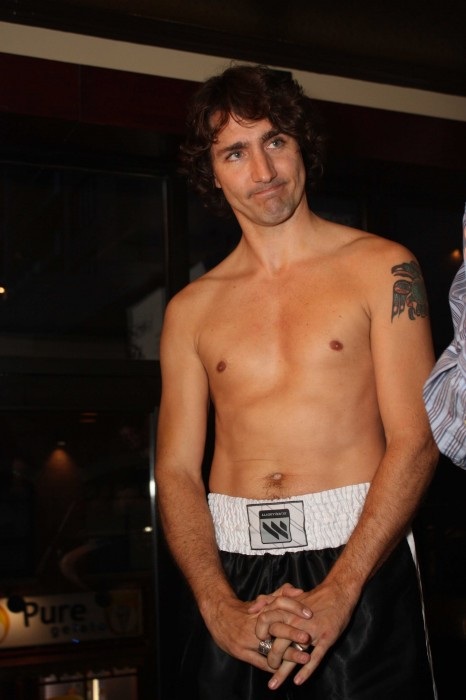
So here’s the oft-hailed future savior of Canada’s Liberal Party Justin Trudeau (son of that Pierre Trudeau, the 1970s and 1980s Canadian prime minister).

He’s shown here at a charity boxing match with Conservative Senator Patrick Brazeau from Thursday.  Apparently, Defence Minister Peter MacKay (the leader of the Progressive Conservative party at the time of its merger with Stephen Harper’s western Canada-based Canadian Alliance) totally wimped out of Trudeau’s challenge.

Stats: 40 years old, 6’2″ and 175 pounds.  Not bad for someone who places top among voters in the 2013 Liberal leadership race, even though he ruled out a run six months ago.

Certainly a better bod than Bob Rae, Stephen Harper or Thomas Mulcair (but let’s see what André Boisclair is up to these days).


Alberta’s Tea Party makes a run at power


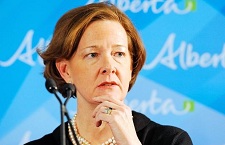
As the federal Canadian political scene solidified with the New Democratic Party’s selection of a leader last Saturday, attention this week has turned west to Alberta, where Premier Alison Redford (above, top) has called a long-awaited general election for April 23.

Alberta, Canada’s fourth-largest by population and its richest by GDP per capital, is an odd province politically — it has been governed by a conservative party for over a century, going back to 1917, when the United Farmers of Alberta entered electoral politics and swept the Liberal Party out of office.  In 1935, the more radical Social Credit took power — and stayed there until 1971, largely under the premiership of Ernest Manning, who served from 1943 to 1968, governing Alberta with a strongly Christian and prairie populist political power base that had little do with the “social credit” theories from which the party’s name originated.  Thereafter, the Progressive Conservatives took power, where they’ve remained ever since; under the premiership of Ralph Klein from 1992 to 2006, Alberta generally prospered with a strong economy buoyed by oil wealth as well.

Klein’s successor, Ed Stelmach, continued the streak in the 2008 elections, in which the Progressive Conservatives won 72 of the 83 seats in Alberta’s legislative assembly (the Liberals took 9 and the NDP the other 2).

But times being rough with a financial crisis, and with 41 consecutive years in power tricky for any party to navigate (let alone in a society with open elections), Stelmach’s popularity waned and Redford succeeded him last October.

With the Liberals and NDP terminally unpopular in Canada’s most reliably conservative — culturally and economically — province, it seems unbelievable that it took so long for a new conservative alternative to emerge.

That alternative — the Wildrose Party, so named for the wild roses that grow in the prairie province, burst onto the scene in 2008 and started to lead polls for the first time in 2010 (at the same time a little certain conservative movement in the United States was making trouble on the far right as well).  Its popularity waned as the economy seemed to improve and as Redford emerged, but it has now gradually clawed back into an essential tie for first place under leader Danielle Smith (above, bottom). Continue reading Alberta’s Tea Party makes a run at power

Malian presidential candidates adjust to new reality

After last week’s coup in Mali, it has been assumed that the president election scheduled for April 29 has been, uh, indefinitely postponed.

Indeed, in less than a week, France has suspended its “cooperation” with Mali and the United States, the European Union, the African Development Bank and the World Bank have all cut off their aid to Mali, but the coup’s leaders have declared a new constitution and promised fair elections in due course, in which none of the coup actors would participate.  Current president, Amadou Toumani Touré, who has been president for a decade (and who is known simply as “ATT”) and was set to step down after April’s election after a decade in office, and who had not been heard from or seen since the coup, stated yesterday he was unharmed, and he called for a quick solution to the standoff:

“I am free in my country,” he said in his first public comments since his removal last week.

“The most important thing is not about my well-being. I am two months to the end of my mandate. I think the most important thing today… is to find a way out of the crisis.”

The coup, led by Capt. Amadou Haya Sanogo under the banner of the Comité national pour le redressement de la démocratie et la restauration de la démocratie et la restauration de l’état (“CNRDRE”) ousted ATT on the basis that the current government was not doing enough to stop Tuareg rebels who have since January been agitating in the sparse desert north of the country, which is culturally closer to the Libyan desert tribes than to the majority of the Malian population in the south.

Yeah Samaké, a candidate in that election who has received significant press in the United States as a BYU-trained Mormon candidate in a heavily Muslim country and who may or may not have been a frontrunner in advance of the scheduled election, weighed in on last week’s coup in an interview with Public Radio International.

Samaké stressed that he opposed the action and recounted his firsthand account of last Wednesday’s coup:

I was right in front of the radio station when they attacked the ORTM, the national televisions. We found ourselves surprised by militaries with gunfires, so there’s a light that clicked in my head, ‘This is likely to be a coup d’etat.’

Samaké added that the presidential candidates have formed a united front against the coup and meet daily to discuss strategy.

The coup leaders had apparently arrested and imprisoned another former prime minister and presidential candidate, Modibo Sidibé, but have since released him, although not without noting that Sidibé seemed to be predestined as ATT’s favorite to succeed him: Continue reading Malian presidential candidates adjust to new reality

Oh dear. Enrique Peña Nieto has discovered Instagram.

Presented without comment — as the formal Mexican presidential campaign is about to begin with official campaigning permitted to start on Friday, though, it looks like the PRI has learned how to be hip. 

Fasten your cinturón de seguridad.

MAKING WORLD POLITICS LESS FOREIGN